Category: Host Page 53 of 85

Week Five: Inport Dutch Harbor

10/13/18 – 10/22/18

Week Five: Inport Dutch Harbor

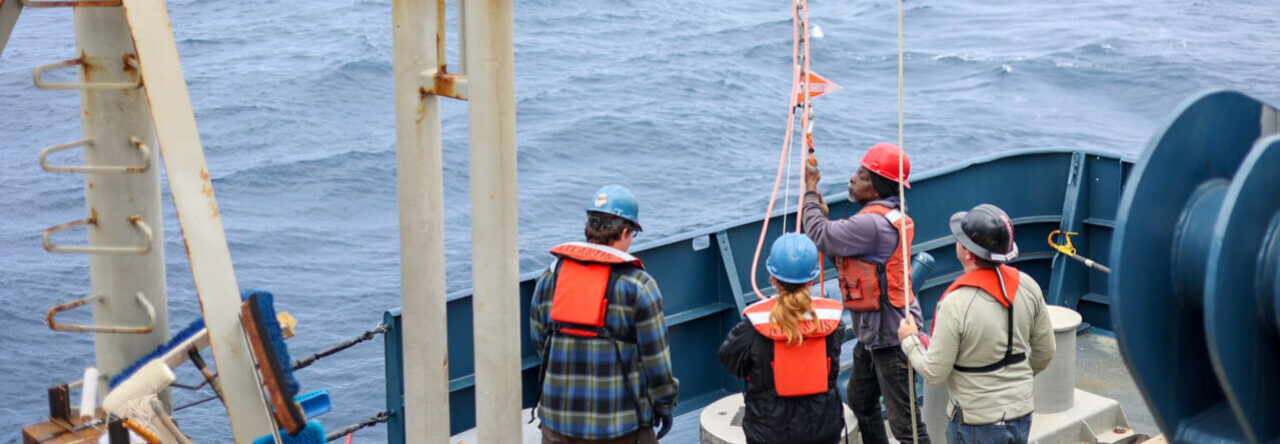
This week we spent the majority of our time steaming back through the Bering Strait and Bering Sea. We saw the Diomede islands in daylight this time, which was amazing. The Big Diomede is Russia and the Little Diomede is the United States. We could also see mainland Alaska as we passed through the strait. Weather had been predicted to be a little sporty as we went through the Bering, but ended not being all that bad. We still had a couple loose ends to take care of for NOAA in two mooring recoveries south of St. Lawrence Island. The first mooring had conditions outside parameters to deploy a small boat, so the captain and chiefs decided they would release the mooring and pick it with a grapple and the aft a-frame. This proved to be really challenging as it was the first time in a very long time the Healy had done something like this. While this is standard on some UNOLS ships, the Healy is far larger and doesn’t have the manuverability that those ships have. It was an exciting recovery and you could really feel the whole crew getting into it. The conditions were challenging and the recovering was challenging and thus made the success all that much better. We ended passing the second mooring due to conditions not being favorable and that would conclude our full science operations. We were now on our way to pull into port in Dutch Harbor. 

I spent my time on the bridge while we made our way into Dutch Harbor and to the pier. It was a cool site to see everyone up there anxious to finally pull in after 37 days underway. We pulled in around 1400 on October 18th. 

The rest of the time spent in Dutch Harbor before I departed was spent doing some routine mantainence on our systems and improving some science seawater capabilities. 

My time has come to an end on the Healy and with the crew of STARC. I enjoyed every minute of my internship aboard and had some unreal experiences and opportunities that do not come very often. Thank you for taking the time to read my blog and I hope you enjoyed hearing about our adventures in the realm of the Arctic Circle. 

-Nick

Week Four: Finishing Science Ops and Steaming Towards Dutch

10/06 – 10/13

Week Four: Steaming Towards Dutch

We have just one more SODA mooring to put in the water and we also have to deploy one last WIMBO and a AMOS float at a secondary ice floe location along the way. We were stuck in an ice floe for approximately 6 hours, which was definitely the longest we had been stuck throughout the duration of the ice cluster stations.

We started science ops for the WIMBO and AMOS floats on October 7tharound 1000. They each went extremely fast. Usually I had been out on the ice the majority of the time to help with the ITP, but for these deployments I just went out during the end to help finalize each deployment. In total, they took about three hours to deploy. After deployments were completed we took a group science photo in front of the bow.

After the deployments commenced we transited south to find a SODA C location. While we transited, Tony, Brett and I were working on the pumps, valves, and piping of the science seawater system down in the motor room. This was a project they had been working on for quite some time and we finally got it done. There are two forms of naming for each valve and the engineering department only had some best guesses as to matching the forms of naming. I sorted everything out and then relabeled every valve with both forms. I also taped each pipe line with orange, purple, or green electrical tape to signify which line was used for what (primary deicing, secondary deicing, uncontaminated science seawater). We ended up deploying SODA C successfully and then having to recover a navigational mooring and redeploy that. Overall we took a few more days to complete this all, but were still on track to pull into Dutch Harbor early on the 18thof October.

The science party had some glider problems and we spent an extra day or two recovering and then redeploying and then recovering some more in order to get them to communicate correctly with the navigational moorings.

More awesome nature news, we saw three polar bears swimming about 50 miles from ice edge and another 300 miles from solid land. It was absolutely amazing and you could hear them all barking as they got closer to the ship. Definitely the coolest experience I saw during the trip. 

-Nick

5. Back in Bermuda

The R/V Atlantic Explorer has made its way home to the Bermuda Institude of Ocean Sciences (BIOS), thursday morning. I was up for the CTD cast at 2230 and then went to bed so that I could wake up in time for the ship to arrive at the dock. Once we arrived we waited for customs to clear us. As the ship was making its way back, Jillon showed me the various tasks that marine techs are responsible for at the end of a crusie. We also had to prepare for the ship to be dockside for the next five days. After being cleared by customs, the scientists and crew on shore were able to come on to the ship and retrieve the samples they had collected during the trip and bring them to the lab. The crew on the boat began the various tasks that had to be done during the demob of the ship. There was a bunch of activity as we hadn’t seen these people for the past two weeks. This is when I met the other marine techs, Rory and Mason, that I would be sailing with during the last three weeks of my internship. 

I helped out the other marine techs take apart the CTD so that we could switch the sensors out. First we had to dump all of the water that was collected in the Niskin bottles, then we had to take the Niskin bottles off so that we could get to the sensors. I had never seen a CTD without all of the bottles on. Then began the task of unplugging all of the wires, labeling each one and protecting each of the plugs. During this process we made sure that everything was labeled clearly so that when we had to put it all back together, it would be much easier. It took us the rest of thursday to get all of the sensors off.

Maya working on the CTD. 

Photo Credit: Jillon McGreal

On friday, the task was to get the new sensors back on. We took our time in putting the sensors back on, making sure that they were in the right places and were accurately put together. Electrical tape and zip ties were used to secure the tubes and rings holding the sensors into place. One of the tasks that I had was to write down which sensor was used and if it was attached to the primary or secondary set or sensors. This is beacuse each sensor as its own calibration and when we set it up on the computer we have to let it know which sensor is being used. Once all the sensors were in place it was time to plug everything back in and check to see if it was working. With the labeling done correctly yesterday it was easy to see where each of the connections went. Then it was time for a deck test. This is where we go up to the CTD computer, and turn it on to see if the CTD will communicate with the program. it was all good. During this test we checked to see if the sensors were reading numbers that made sense. According to the marine techs I was working with, it looked good. This brought us to the end of the day so we cleaned up and on Monday we will finish putting the CTD back together. There are a few more tasks that have to be done before we head out mid-week for the next cruise.

Preparing for an High Arctic Expedition

10 days before I depart up to Alaska to meet the USCGC Healy! 

It is funny talking about Alaska to people in general conversation. I use to be stationed there with the US Coast Guard aboard the USCGC Hickory in Homer for a year, back in 2006-2007. When I lived there, I would always get the craziest questions like “Do you live in an igloo?, Do you have a pet penguin? and even Do people ride moose to work?”,  so when I mention that I am meeting the ship in Dutch Harbor, everyone always tells “stories” of what they “know” (mostly from the Deadliest Catch), not realizing that I have actually been there before. I am more than ecstatic to go back. This will be my 4th time heading above the Arctic Circle, while participating on this cruise, but I have never been there this late in the season, so I am excited to see the differences from 12 years ago, and compare to my recent time in the High Arctic in Canada, Greenland, and Russia.

With the day light hours dwindling, temperatures dropping, and the Northern Lights beginning their dance high above, I am looking forward to working with the STARC program. Polar and deep-sea exploration has always been my passion, since there is so much we can learn from our oceans, a database can be created of information needed to better understand global change, filling gaps in the unknown to convey reliable and honest science that is foundational to providing prescience about the future. From rapidly receding glaciers and ice caps, to plastics being found everywhere, to oceans chemistry changing, there is a lot we need to still learn, to better help us prepare for the future.

With participation with the internship, I am also fortunate it enough to get to attend the RVTECH and INMARTECH conferences next week in Woods Hole. Luckily it is a short 45-minute drive from my residence! Looking forward to meeting everyone. I am so grateful for the opportunities this internship has already provided for continuing my education, training, and support, and I haven’t even left yet!

Time to start packing!

Week Three:80 degrees north

09/29 – 10/06

This week was filled with ice station deployments and more polar bears. There were three main ice stations in which the ITP, WIMBO and AOFB were all being deployed and then there were two secondary stations in which one more WIMBO was being deployed. The first ice station started off slowly as everyone was getting used to their roles on their teams and figuring out how to do everything. I was personally working with Peter Koski of Woods Hole to deploy the ITP. We first had to use a two-foot diameter auger to drill holes in the ice for the AOFB and then the ITP itself. At the first location the ice was over nine feet thick. This took quite a while to do and ultimately made the day long. The ITP itself is fairly straightforward to deploy. We connected four 70 pound weights to cable and then lowered the weights about 690 meters deep. Then the ITP was connected towards the top of the hole. We ran some tests on the Iridium communications and tested the ITP again. The ITP is set to profile the ice and will move itself up and down the cable to get certain data measurements at specific programmed depths. The scientists back at Woods Hole have decided the best method for surveying, so we were in charge of making sure it was deployed correctly. The cable also holds two Seabird Microcats (small CTD’s) which rest about one meter and two meters below the surface of the ice. Once the ITP was connected we transferred the cable load and then strung the rest of it through the buoy and then slowly lowered everything down. Our first time doing this whole process took about 8 or 9 hours. The second two times we were able to pre-drill the holes the day before and we had a better understanding of what we were doing, this cut down on our deployment time drastically. The image to the left is the finished ITP buoy and Iridium sensor deployed through ice. 

While setting up for the ice stations we had a couple of small setbacks. During the second station, we picked a lot of the equipment to the ice with the crane and then someone from the bridge noticed a crack in the ice. This ended ice operations for that day and all the equipment had to be returned. During the second station we drifted about 50 yards aft of where we wanted to be and the bridge had to take the ship around a full circle in order to better position us to be connected to the floe. Both were small setbacks thankfully and did not eat up too much time. 

We saw a mother and yearling polar bear about 300 yards off the port side of the ship during the morning of the third ice station. It was an amazing sight to see as the sun was rising and the polar bears were just crossing over our path we cut in the ice. Pretty amazing to see these animals above 80 degrees north in the Arctic. 

The science party seems a little pressed for time, and as I was saying earlier, there were setbacks during the mooring deployments that ate up some of our spare days. After cranking out these ice stations though, I think we are in good shape to get done on time or even early. We are unable to pull into Dutch Harbor for port early, but there will not be as much of a rush to get science ops done. 

-Nick


4. Arrival in Puerto Rico

We have arrived in Puerto Rico! The first leg of this cruise has come to an end. During this past 8 days I have held the night shift (1500-0300) with my mentor, Nick. This was an adjustment since I am normally more of a morning person, but I made it through. Sleeping most of the day until my shift began later in the day. 

During this cruise the main piece of equipment deployed was the CTD, where it would be deployed down to the bottom of the ocean. As we got closer to Puerto Rico the depths we were sending the CTD down were in the 5000 meters range. Our last station where we deployed the CTD was in the Puerto Rico Trench, which is located on the boundary between the Caribbean Sea and the Atlantic Ocean and has maximum depth of 8,648 meters. Although when we got here, there we only sent the CTD down to 6000 meters, since that was the maximum depth for some of the senors we had it. Other deployments that were done during this leg were zooplankton tows and saito-pumps.


CTD being deployed

During the times that were transiting to the next station or while we wer wating for a CTD to come back to the surface, I worked on raspberry pi. This is a small single-board computer that is used to help learn about programming though various projects. I was able to make a light turn on and off along with various other projects, using linux and python, two computer coding languages. I am still just beginning to understand them, but through the practice of the different prrojects I am understanding a lot more than I started out knowing (which was none). 


                 Maya working on Raspberry Pi                         Raspberry Pi breadboard set up

                 Image taken by Nick Mathews 

We are have the rest of today and the morning of tomorrow off. Then it is time to head back to Bermuda. 

Week Two: The Start of the SODA Moorings.

First on the list of science operations for this week was to initiate the deployment of the main SODA and navigational moorings. There have been some setbacks regarding the SODA moorings and battery packs are being built to complete the sensor array in the stablemoors. Once these are done, we will then be able to continue with SODA deployments, but for the time being we are going to be deploying the navigational moorings first. These moorings are not equipped with the same amount of sensory equipment as the SODA moorings and also do not require as precise of a depth measurement. The SODA moorings need to be in an exact spot in order for the multi-beam data to be as they expect and to ensure the data is at the resolution they want. Thus, the navigational moorings should overall be trial runs for the SODA moorings, but also very important in terms of the big picture. These moorings are going to be integral parts of the glider/mooring data streaming back to University of Washington. Usually I watch the mooring process from aft conn with some of the crew and pay attention to how everything is working out and the safety the boatswain is taking into account. Once they get to the main line (about 3700m) there’s really nothing more to see until the anchor goes in. 

As for personal projects this week, Tony taught me about CTD cable terminations and tests you should do to make sure the cable is in good shape for a next cast. We also did a full termination and re-termination so that I could get some good practice if I ever have to cut some off myself. The process begins with stripping down and peeling back the outer layers of the cable, which prove to be quite difficult, and then getting down to the wire in order to solder it to another connection cable. This was a great experience to learn because it involved a lot of techniques for underwater cable splicing and making sure that everything is water proof. We wrapped the soldering job in multiple layers or protection including shrink wrap, scotchkote electrical splicing paste, and rubber splicing tape. We did about three layers of each and then the main waterproofing was complete. We just were using an old piece of wire to get some practice in, the actual CTD wire onboard Healy is in great shape and didn’t need anything to be fixed. I also removed an extra dissolved oxygen sensor from the CTD and re-plumbed the main pump back to the temperature and conductivity sensors. Quick and easy job, but I enjoyed it. We also launched many expendable bathymetric thermographs (XBT) in order to assure the multi-beam has the best possible sound speed profile for accuracy in the data. We had a lot of trouble getting the XBT’s to perform the way they are supposed to; which it seems the environment is partly to blame. Sometimes the wire can get hung up on ice or blown far to the side and affect the outcome of the data or completely terminate the XBT producing no data. Basically an XBT is dropped over the fantail and then falls at a calculated rate until 1000m where it has then collected enough data in the water column to produce a sound speed profile of that area. 

Couple of cool nature events occurred this week as well! We got the chance to see a polar bear as we were heading out of the ice and there was a small falcon that somehow found its way to the ship.

There’s a lot of new software to be learned aboard the Healy so I try to test things out everyday and see what I can do. I have been playing around with ice imagery on QINSy which gets relayed to the bridge and I have been cleaning and exporting multi-beam data from mooring locations in Qimera. If this group of scientists were interested in the multi-beam data other than a secondary measure of depth, I could do some great things for them and be able to get them good clean data very efficiently. Not a skill I will be using on this cruise too much, but definitely good to get used to these programs for future cruises or science parties that may want to use multi-beam data for other purposes. 

As we get closer to deploying the ice stations, more meetings are taking place about the logistics of the sites and specific coast guard procedures that need to take place before we can do anything. We have been looking for a site to deploy a Weather, wave, ice mass balance and ocean drifter (WIMBO). We will be deploying four more of these in the future as well. I am going to be helping out with the ice tethered profiler (ITP) team and drilling holes for lower the gear down. We had a couple small side meetings about those procedures and things to watch out for while deploying the instrument. I volunteered so that I could secure a spot in getting out on the ice. It’s pretty amazing to be able to stand on the Arctic Ocean around 80 degrees north latitude. Not many people can say they had that opportunity. 

I have been reading Skinny Dip by Carl Hiaasen, watching a lot of movies and playing some cribbage with my roommates in my free time. I am on call from 0600 to 1800 and have about 4-5 hours after dinner to relax and get ready for the next day before heading to sleep. 

I will be back in another week with more ice cluster updates and how we are doing heading into the last stretch of being in the Arctic Ocean. 

-Nick
3. En Route to Puerto Rico

Hello again! 

I have now spent a week on the R/V Atlantic Explorer and one research cruise complete. Prior to the BATS-Val cruise, which I am currently on, heading to Puerto Rico, there was a 24 hour curise with a group of students from Oxford University. Once we leave the Bermuda Institute for Ocean Science (BIOS), the home of the R/V Atlantic Explorer, we run through some of the saftey drills. We practiced putting on the immersion suits, which would be used if we had to abandon ship. The immersion suit is a special type of waterproof dry suit that protects the body from hypothermia. The suit a bit big on me.

Maya in Immersion Suit

On this cruise we headed out to Hyrdostation “S”, a bi-weekly cruise to supplement for the Bermuda Atlantic Time-Series Study (BATS). While at this station we deploy the Conductivity, Temperature and Depth (CTD) to monitor the physical and chemical properties of the water column. As the CTD makes its way down to the bottom (or another depth decided on by the scientists) a profile collecting the temperature, salinity, oxygen and fluorescence is created. On the way back to the surface water samples at certain depths are collected in bottles, which will then be sampled. 

This was the first cruise I went out on with the R/V Atlantic Explorer and the first time I have been back out on the ocean in three years. I had to get used to the motion of the boat and deal with sea sickness for the first day. Luckily it only lasted one day and since then I have been fine. 

It has a been a day in since we left Bermuda for Puerto Rico and we had already stopped at a station north of Bermuda to do CTD’s, zooplankton tows and put pumps in the water. During each of these deployments I was able to observe Nick and Jillon, watching the steps for each of the casts so that I would be able to do them soon. This week has been full learning and I am excited to become more involved as the internship continues.                                                                                    

Week Twenty-Two: Part of Something Big

1930 Local time

Hiya!

We are one week in on the Ocean Observatories Initiative (OOI) Endurance Array cruise on the Sally Ride. If you have not looked up OOI yet, then let me encourage you to do so by giving you some handy links. The Endurance Array is just 1 of 6 uncabled arrays spanning the Pacific and Atlantic ocean basins and provide a wealth of data on climate variability, ocean circulation, ecosystem impacts from climate change, sub-seafloor and ocean-atmosphere interactions, plate dynamics and more! The great thing is that there is a lot of outreach to the science community and public alike, and all of the observation data is available 24/7 through the OOI data portal.

Thankfully, while we were out at sea, NSF awarded $220 million to Woods Hole, University of Washington, and Oregon State University (the team I am with) to continue to operate and maintain the OOI system for the next 5 years. Woo hoo!

This past Tuesday saw us off the coast of Washington deploying and recovering shelf and offshore moorings. The offshore moorings are over 500 meters in length, so we can only average 2 per day with these. At each site, we also do a CTD cast to collect water samples at the depths of the sensor packages as well as a good water column plot. This helps the OOI team to calibrate their various instruments as a reference.

This pattern repeated through Friday, at which point we transited down to Newport, Oregon and docked on the OSU pier in order to offload the recovered moorings and pick up more to deploy. Needless to say, there is an incredible amount of dynamic shuffling on the back deck to make way for hundreds of meters of line, EM cables, and stretch hoses not to mention massive flotation devices, anchors, vertical profilers, and sensor frames/anchors that weigh upwards of 11,000 pounds.

We always meet as a team before each deployment or recovery to assign positions and talk through the progressions of where things need to be and what block we will be pulling through to which winch and how many tag lines are needed to stabilize the various components. Communication and situational awareness are key! The rest of this week will see us finishing up the Washington inshore and offshore moorings and then we will be back in Newport one more time to do another offload and onload of gear. In total, it’s 3 legs of deployment/recoveries in just 16 days. I am confident that we can do it. 🙂

More soon!

– Emily

Week One: Underway from Dutch Harbor and into the realm of the Arctic Circle

This week shaped up to be filled with a lot of new experiences!  USCGC Healy departed Dutch Harbor at 1300 local time on the 15thand began the steam to Nome to pick up more gear on our way to the first mooring locations of the science cruise. The cruise is centered around Stratified Ocean Dynamics of the Arctic (SODA) and involves deploying a series of four moorings used for navigation as well as three more instrument heavy moorings equipped with upward facing multi-beams and CTDs to survey ice floe throughout the duration of the next year. There are also going to be 3 ice stations later on in the cruise where we will deploy multiple buoys and floats to survey ice floes over the next year. Our original plan was to steam to the first SODA mooring location and get going with those as soon as possible, but there were some slight delays, which eventually turned out to be longer than originally intended, that caused us to change plans. Instead we stopped off at a secondary mooring location for University of Delaware and the deployment was successful. This was my first time seeing a mooring go into the water and the process of getting everything together was really valuable to watch. The US Coast Guard does not allow much deck time, if any at all, so I will be mostly standing by to survey exactly what the boatswain and crew on deck are doing to safely deploy all these moorings over the course of the next 4 weeks and try to learn as much as I can from that perspective. 

On our way to the Badiey (UDel) mooring location, my first project was to design and build a mooring release transducer conversion j-box so that Healy would be able to account for multiple types of deck boxes for the science party to use. The deck boxes are used to range and communicate with the moorings they are placing and also to release depth sensors and even the whole mooring if need be. I did not fully understand what my conversion box was going to be responsible for until I watched it be put to use. It felt good to know that I helped a main part of the science and shipboard technology improve and be capable of improving more in the future. Below are some good images of what the finished product and wiring look like inside the j-box. While transiting north to the first mooring location we crossed the line of the Arctic Circle which, if you complete a ceremony through the coast guard, registers you as a “bluenose” for having crossed the line on a ship. I do not think we will be able to do any such ceremony on this cruise, but still a great experience to have done. 

Science operations are changing in what seems like by the hour so we are just ready for anything. We have been working 12 hour shifts in the lab to make sure everything is covered science tech wise, even though most of the ops are going to be happening in the daylight. We were now going to put in one of the navigational moorings and delay the SODA moorings even further. All the moorings from here on out will be over 3700 meters deep. Part of our job as STARC and science technology aid is to run multi-beam surveys over the potential mooring sites so that they are able to better gage the actual profile of the seafloor. Our EM122 multi-beam has been having a fair amount of trouble that we actively troubleshoot and relay to the bridge what needs to be changed to get better data. Brett and I found some great ways to clean the data and then give the scientists various data output formats for them and us to use later. 

A day later, my conversion box was used to release a depth sensor off one of the navigation moorings, and then we proceeded to steam halfway to the next one to deploy gliders on the way. The gliders are going to collect data from the SODA moorings and be able to send it back to the University of Washington via Iridium satellites, that way they will be able to know just how well the moorings are functioning when we arrive back in port and further on into the year. 

 I forgot to mention! We hit ice around 0700 on 09/19. It is really amazing to see for your first time and it reminded me of watching a fire in that you could really get lost in the ice breaking for as long as you want, only it’s below freezing temperatures and extremely windy outside, not exactly as comforting as the fire. 

Overall first week has been full of great experiences and the big SODA moorings are coming up soon a long with ice clusters. I will report back soon with how everything is going with the main part of the SODA mission and how we are travelling in the ice. 


 – Nick


Page 53 of 85

Powered by WordPress & Theme by Anders Norén