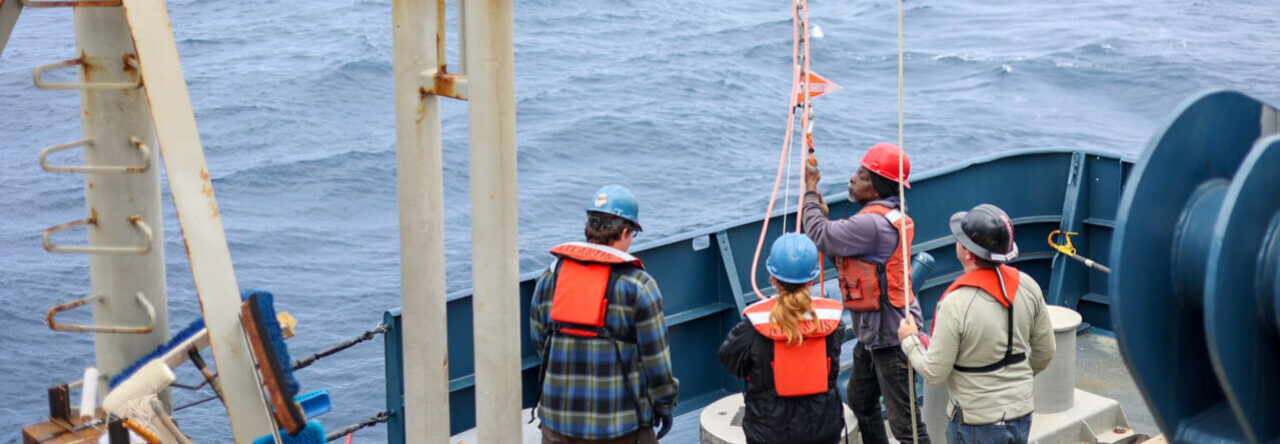
The R/V Atlantic Explorer has made its way home to the Bermuda Institude of Ocean Sciences (BIOS), thursday morning. I was up for the CTD cast at 2230 and then went to bed so that I could wake up in time for the ship to arrive at the dock. Once we arrived we waited for customs to clear us. As the ship was making its way back, Jillon showed me the various tasks that marine techs are responsible for at the end of a crusie. We also had to prepare for the ship to be dockside for the next five days. After being cleared by customs, the scientists and crew on shore were able to come on to the ship and retrieve the samples they had collected during the trip and bring them to the lab. The crew on the boat began the various tasks that had to be done during the demob of the ship. There was a bunch of activity as we hadn’t seen these people for the past two weeks. This is when I met the other marine techs, Rory and Mason, that I would be sailing with during the last three weeks of my internship.
I helped out the other marine techs take apart the CTD so that we could switch the sensors out. First we had to dump all of the water that was collected in the Niskin bottles, then we had to take the Niskin bottles off so that we could get to the sensors. I had never seen a CTD without all of the bottles on. Then began the task of unplugging all of the wires, labeling each one and protecting each of the plugs. During this process we made sure that everything was labeled clearly so that when we had to put it all back together, it would be much easier. It took us the rest of thursday to get all of the sensors off.

Maya working on the CTD.
Photo Credit: Jillon McGreal
On friday, the task was to get the new sensors back on. We took our time in putting the sensors back on, making sure that they were in the right places and were accurately put together. Electrical tape and zip ties were used to secure the tubes and rings holding the sensors into place. One of the tasks that I had was to write down which sensor was used and if it was attached to the primary or secondary set or sensors. This is beacuse each sensor as its own calibration and when we set it up on the computer we have to let it know which sensor is being used. Once all the sensors were in place it was time to plug everything back in and check to see if it was working. With the labeling done correctly yesterday it was easy to see where each of the connections went. Then it was time for a deck test. This is where we go up to the CTD computer, and turn it on to see if the CTD will communicate with the program. it was all good. During this test we checked to see if the sensors were reading numbers that made sense. According to the marine techs I was working with, it looked good. This brought us to the end of the day so we cleaned up and on Monday we will finish putting the CTD back together. There are a few more tasks that have to be done before we head out mid-week for the next cruise.