Hello again!
I have now spent a week on the R/V Atlantic Explorer and one research cruise complete. Prior to the BATS-Val cruise, which I am currently on, heading to Puerto Rico, there was a 24 hour curise with a group of students from Oxford University. Once we leave the Bermuda Institute for Ocean Science (BIOS), the home of the R/V Atlantic Explorer, we run through some of the saftey drills. We practiced putting on the immersion suits, which would be used if we had to abandon ship. The immersion suit is a special type of waterproof dry suit that protects the body from hypothermia. The suit a bit big on me.

Maya in Immersion Suit
On this cruise we headed out to Hyrdostation “S”, a bi-weekly cruise to supplement for the Bermuda Atlantic Time-Series Study (BATS). While at this station we deploy the Conductivity, Temperature and Depth (CTD) to monitor the physical and chemical properties of the water column. As the CTD makes its way down to the bottom (or another depth decided on by the scientists) a profile collecting the temperature, salinity, oxygen and fluorescence is created. On the way back to the surface water samples at certain depths are collected in bottles, which will then be sampled.
This was the first cruise I went out on with the R/V Atlantic Explorer and the first time I have been back out on the ocean in three years. I had to get used to the motion of the boat and deal with sea sickness for the first day. Luckily it only lasted one day and since then I have been fine.
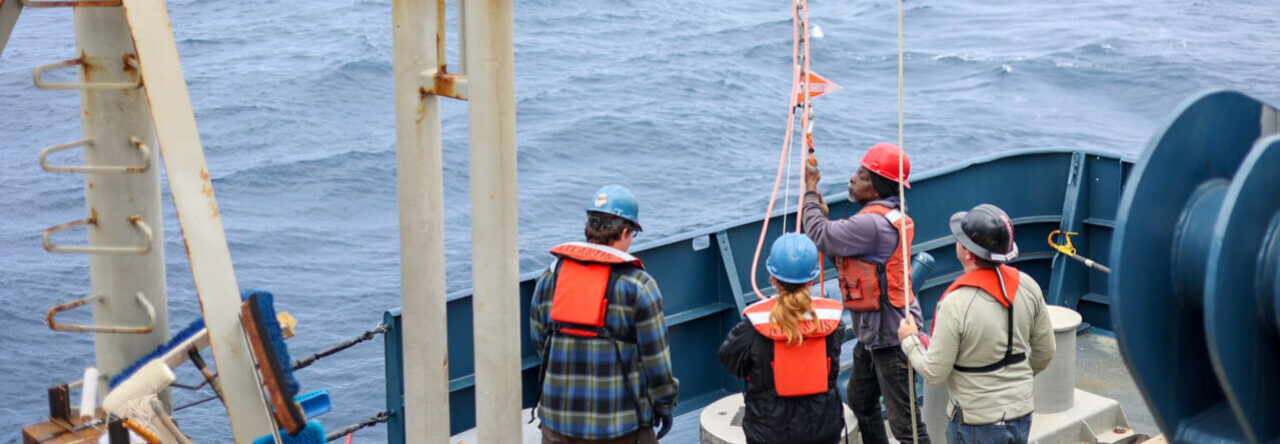
It has a been a day in since we left Bermuda for Puerto Rico and we had already stopped at a station north of Bermuda to do CTD’s, zooplankton tows and put pumps in the water. During each of these deployments I was able to observe Nick and Jillon, watching the steps for each of the casts so that I would be able to do them soon. This week has been full learning and I am excited to become more involved as the internship continues.