Week three of our cruise has passed and the time has seemingly flown by and trickled at a glacial rate. We began the week in the midst of being on our third station and it has become the problem child. During the 5 days we were at station we continually faced equipment, weather and sediment difficulties though luckily to no detriment to morale. For several of the days the weather kept us from deploying off deck part of the time. That coupled with difficult ocean conditions limiting the amount of usable cores meant we had our work cut out for us. It was certainly rewarding for all when we recovered the last core onto deck and made our heading for our next station. The next several days of transit were a welcomed change of pace with several projects to take on, both small and large. We arrived on station Tuesday morning refreshed and ready to get that mud. Unfortunately this sediment was far too dry for the science party’s liking and thinking quickly they decided to move overnight attempting to find more favorable conditions. Hopefully our new location holds mud worthy of our efforts.
Category: Columbia University, Lamont-Doherty Earth Observatory Page 3 of 10
Week Three: 6/23-6/29
Week three was spent collecting sediment from our station in the Newfoundland Basin. We arrived on station Sunday evening, and spent our first full day coring on Monday. We were also met with some challenges: a few cases of COVID, low success rates on core casts, a blip of foul weather, and a repair on a crucial turning block.
COVID cases springing up was a bit out of left-field, given we had been at sea for two weeks. Testing, isolation, and masking were parts of the (very calm and collected) response initiated by the captain, and by the end of the week things were mostly back to normal.
We kept up a steady pace of 3-4 casts per day, but each cast only produced one or two usable cores. Progress was slow. This was an interesting chance to experiment with the multicore, and adding wooden blocks on the bottom of the “spider” helped to produce better cores by keeping the multicore a little shallower in the sediment when it touched down.
One stroke of good luck was the weather we had been tracking mellowed out by the time it reached us, and we only missed a half day of work rather than the 2 days we initially expected. On either side of the poor weather, we enjoyed some warm, sunny days.
On Friday, Ayse noticed the main turning block (mounted on the A-frame, which the winch wire runs through), was starting to make an odd squawking sound, a lot like the sound of a mallard duck. After we finished that cast, the deck crew assembled some scaffolding to take a look at it. They quickly determined that source of the squawk was the inner sheave, which was starting to separate due to improper hardware. With the proper bolts in place, the duck was silenced, the block was fixed, and coring was resumed.
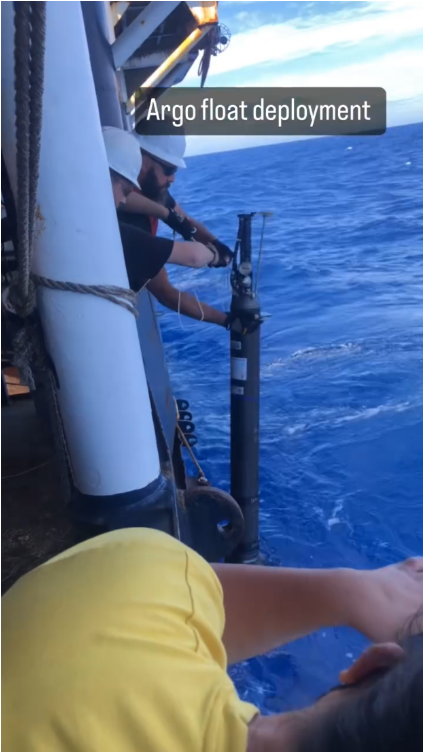
On Saturday morning, the morning shift completed the final cast at station 2 to send the CTD and Niskin carousel! Once the CTD was secure, they turned their attention to one of three wooden crates on deck. In each of these crates, there is an Argo float. These are robotic instruments that meander around the ocean, measuring CTD profiles as they descend and ascend, and send these data back to scientists. This is an international project that started in 2000. Today, there are 3908 active Argo floats taking these measurements. The Argo float was deployed off the stern, and we were on our way to station 3!
Week Two on the Langseth has come and gone!
We finished up our first transit, and then spent a few days on station coring. We experienced a little kerfuffle with the new winch, and lost a few hours of work until we were able to devise a solution.
It took us 8 casts with the multicore to collect sufficient “mud”. It’s not actually the mud that the science team is after though; it is the water trapped between the fine grains of the sediment. This water is called pore water. To extract the water from the sediment, the science team does lots of careful scooping, centrifuging, filtering, and bottling.
The multicore has eight tubes that are lowered into the sediment and then pulled back up (hopefully) full of a beautiful core of deep-sea sediment. So far, it is very rare to have a cast in which all eight cores are usable. A good cast for us has resulted in 5 or 6 “keepers” and subpar casts bring up 1 to 3 keeper cores.
The number of casts needed depends on many factors, including how “watery” the sample is (i.e. what the sediment is like) and the conditions of the ocean. It is easier to get a nice core in calm water.
After we wrapped up station 01 (not to be confused with station 00, which was our first stop), we transited about 800 nautical miles northeast. Transit allowed time for extra resting and project catch-up.
Now we’re at work getting samples here at station 02, where conditions have been more difficult; we have about 2 knots worth of current and we are retrieving only a couple usable cores from each cast. At this site’s depth of about 4830 meters, it takes about 2 hours to send the multicore down and 2 hours to retrieve it..it is a long way to go at a pace of about 45 meters per minute.
One night we enjoyed the sunset over very calm waters with the company of dozens and dozens of dolphins. Several pods over the course of a few hours swam towards the ship, under the bow, and along the wake. Very special!


06/18/2024:
- New rules for winch booth: one person at a time, max 1-hour stay.
- Minor issues adjusting winch during deployment rotation.
06/19/2024:
- Deployed corer at 6 am after prep with Joe at 5 am.
- Assisted with taglines and bottle replacement, each deployment takes 4 hours.
- Noticed winch operator error during shift change.
- Experienced sudden vision changes; eyesight issues noted.
06/20/2024:
- general deployment day.
06/21/2024:
- transit to next station
06/22/2024:
- Day spent seasick, rested in theater room and cabin.
- Tested negative for COVID after some of the crews positive results.
06/23/2024:
- Reapplied patch, feeling better.
- Five onboard tested positive for COVID.
- Anticipated arrival at station tomorrow morning.
06/24/2024:
- Winch line on first cast was angled significantly, had to call all stop and work with the captain to get the boat to drift with the current
- last cast yielded only one usable sample.
06/25/2024:
- First cast nearing completion by 9:30 am.
- Helped Arron on the fly bridge with setting up some stuff for an O2 sensor.
- Switched from hour long shift rotations to half hour.
06/26/2024:
- Took off weight from the corer and crew added wood blocks on the bottom so that the tubes wouldn’t sink so low into the mud.
IN CONCLUSION:
A bit more downtime this week, but I am beginning to feel settled down with living and working on a boat. Im honestly shocked that it’s only been a little over two weeks. The most notable event this week is that we were able to get 5 (out of 8) good samples on one of the casts. Which is way better then usual! We also changed our shift rotations to 30mins instead of an hour. That was no one has to hold the winch joystick for a whole hour.


My second week aboard the Langseth has officially ended and the time has seemingly flown by. At the beginning of this week we were just starting our transit to the next station. From the Bermuda area we headed North East up the Atlantic for several days. These transit periods are a good time to rest as well as perform some of the necessary tasks that we wouldn’t have time to while we’re at a station, busy collecting core and water samples. During this transit we did some house cleaning of the marine tech shop, prepared equipment for future projects and remounted the remote controls for the winch. All our work was well rewarded though when we were accompanied by a huge pod of dolphins at sunset on our last day of transit.
Fearing foul weather oncoming, we began coring with haste on Monday succeeding in deploying three times in the day and three times again today. It seems we are getting a rhythm to the task and even with depths reaching near 5000m we are having no issues keeping that pace. The difficulty I’ve come to understand with coring is until you have the samples back aboard, you never truly know what quality you’re going to get. The coring specialists do everything in their ability to optimize each deployment but in the end we are at the whim of currents, sediment and benthic characteristics. Unfortunately the science party has only been able to utilize a few individual cores from each deployment on this station though we are trying several fixes to bump those numbers up. As they say, necessity is the mother of invention. Hopefully this week comes with better mud and even more adventure.


Our first week of the trip has already come and gone in a flash. I boarded the Langseth in Brooklyn Harbor late on the 9th. That was followed by a full day of preparations and getting the lay of the ship. Its quite a maze of hallwyays and decks that I easily became lost in the first several days. I would say I know it well now though I think I find a new room everyday. The ship left port in the early hours of the 11th in order to refuel and then were on our way out.
The ship’s engineers were faced with a potential delay, waiting for a part, and not wanting to waste any precious time the crew and science party decided on a new first deployment station whilst we wait. The instrumentation we are primarily using on this cruise are multi-cores, taking cylinders of mud from the sea floor, thousands of meters below the surface. The first station was a bit of a crash course for me in the operation of multi-cores as we deployed them several times over the next couple days. Some good news came at the end of this station when the engineers were able to fix the ship without going back to port.
After finishing up at our initial station it was time to make haste towards the next and official first station. Transit took several days and was a good time for all to rest and reset before the real work began. We only arrived on station yesterday and have already had our share of success and tribulations. During an inital CTD deployment the Langseth’s new winch malfunctioned leaving the CTD stuck close to the bottom for several hours. With the valiant efforts of the ship’s engineers and electricians the winch was repaired and CTD recovered in one piece. Today we’ve deployed two more cores and seem to be smoothing out all the little problems as they come. We hope for fair winds and following seas as our journey begins.


June 9, 2024:
-
Flew from SF to NY, arriving at 3pm (about 5:30 hours)
-
Journeyed to the boatyard near 168 Flushing Ave, NY.
-
Settled into a boat, toured, and met crew members.
-
Went to Walgreens for last minute purchases and slept very well.
Flew from SF to NY, arriving at 3pm (about 5:30 hours)
Journeyed to the boatyard near 168 Flushing Ave, NY.
Settled into a boat, toured, and met crew members.
Went to Walgreens for last minute purchases and slept very well.
June 10, 2024:
-
Met in the supervisor’s office at 7am.
-
Assisted in stress testing a new winch cable wire.
-
Had downtime and enjoyed really good food.
-
Spent evening onboard, contacting family.
Met in the supervisor’s office at 7am.
Assisted in stress testing a new winch cable wire.
Had downtime and enjoyed really good food.
Spent evening onboard, contacting family.
June 11, 2024:
-
Departed dock at 1am for anchorage and fueling.
-
Attended 7am meeting;
-
Volunteered to take the night shift (12am-12pm).
-
Worked with roommate Eddie (other mate intern) on securing crates and boxes.
-
Met with the science crew and learned about their work and what exactly they are trying to prove with the data they are collecting.
-
Prepared ship for departure from fueling barge;
-
Was concerned about seasickness.
Departed dock at 1am for anchorage and fueling.
Attended 7am meeting;
Volunteered to take the night shift (12am-12pm).
Worked with roommate Eddie (other mate intern) on securing crates and boxes.
Met with the science crew and learned about their work and what exactly they are trying to prove with the data they are collecting.
Prepared ship for departure from fueling barge;
Was concerned about seasickness.
June 12, 2024:
-
Worked from 7am to 12pm on pCO2 monitor.
-
Participated in ship-wide drills for fire and abandon ship procedures.
-
Only worked about 6 hours since I was switching to night shift.
-
Rested in the cabin after; prepared for night shift.
Worked from 7am to 12pm on pCO2 monitor.
Participated in ship-wide drills for fire and abandon ship procedures.
Only worked about 6 hours since I was switching to night shift.
Rested in the cabin after; prepared for night shift.
June 13, 2024:
-
Started night shift at 12am.
-
Assisted with CTD trigger test and monitored computer screens.
-
Assisted senior technicians with adding more weight to the multicorer and primed it for deployment.
-
Controlled winch operations and assisted with retrieval.
-
Worked on drafting protocols for working on the new winch with Joseph (another tech).
Started night shift at 12am.
Assisted with CTD trigger test and monitored computer screens.
Assisted senior technicians with adding more weight to the multicorer and primed it for deployment.
Controlled winch operations and assisted with retrieval.
Worked on drafting protocols for working on the new winch with Joseph (another tech).
June 14, 2024:
-
Night shift activities included rounds on the vessel and ensuring equipment security.
-
Spotted basking sharks near the boat in the early morning!!
-
Participated in deploying multi corners; experienced a minor incident with equipment.
-
Successfully retrieved samples, including a brittle star.
Night shift activities included rounds on the vessel and ensuring equipment security.
Spotted basking sharks near the boat in the early morning!!
Participated in deploying multi corners; experienced a minor incident with equipment.
Successfully retrieved samples, including a brittle star.
June 15, 2024 – June 16, 2024:
-
Lots of downtime working a night shift and while heading to the new station.
-
Spent most of time monitoring computer screens.
-
Spent a couple hours with the the 2 and 3 mate in the bridge while they stood night watch
Lots of downtime working a night shift and while heading to the new station.
Spent most of time monitoring computer screens.
Spent a couple hours with the the 2 and 3 mate in the bridge while they stood night watch
June 17, 2024:
-
The night was not very eventful but in the morning we noticed the sea floor had a lot of seamounts so it was decided to pause the transit and start a back and forth grid search for flatter ground.
-
Technical difficulties popped up so a lot of time was spent on that.
The night was not very eventful but in the morning we noticed the sea floor had a lot of seamounts so it was decided to pause the transit and start a back and forth grid search for flatter ground.
Technical difficulties popped up so a lot of time was spent on that.
IN CONCLUSION:
I am having a wonderful time.! The food is delicious and the beds are really comfortable. Everyone is super nice and the work is very enjoyable and fulfilling. I’m excited to get to the next station to do more work!


Week One on the Langseth!
We had a busy start to the week as we prepared to depart from the Brooklyn Navy Yard. We faced some potential delays (engine parts, science gear), but ultimately decided to make our first, near-shore station (which was initially intended as a test site for our gear) a full research station. After completing work there, it was decided to proceed to the next station (rather than returning to NY to pick-up parts). So, the next land we see will be Iceland!
The new Okeanus winch passed its stress test, and we made a valiant effort at calibrating the Rugged Controls winch sensor as best we could. We finished rigging up the multi-corer and CTD/Niskin Rosette, then proceeded to make our first cast for cores! This site was relatively shallow at 2240m, and it takes about 45 minutes for the corer to reach the ocean floor at this depth.
The collection of the cores is controlled by the winch operator; once the corer’s feet land on the seabed, more cable is paid out to release the plastic core tubes into the sediment and gather the sample. We spent several days coring, with the science crew also working long hours to get all the samples processed appropriately. All of their work needs to be done in oxygen-free environments (nitrogen-filled glove boxes) so as not to alter the chemistry of the sediment.
After the science crew was happy with the amount mud/pore water we collected, we switched the winch cable to the CTD/Rosette and sent that over. It was cool to watch the CTD take a profile on the descent and then to fire the Niskin bottles to close at various depths on the way back up.
Driving the winch to land the multicorer on the seabed and assembling the CTD and using its software program (SeaSave) were some of my favorite tasks this week.
Since being in transit, I have also spent some time in the bridge standing watches. I learned a lot about the systems on board and the maritime field in general by talking with the deck crew and officers.
Today (Monday 6/17) we set our clocks forward by an hour to -3 UTC…the cities of Halifax and Buenos Aires both work as a correct time zones.
I am feeling very grateful that the ship has an awesome kitchen and steward team. We have been eating well, thanks to John and Insuk. In addition to the science party, the marine techs, and the kitchen and steward crew, the engine room and deck crews have also been working hard. It has been exciting to see how all these teams come together to make for a successful day.
Also, basking sharks and dolphins!
Thanks,
Eddy


Hey Y’all! My name is Ayse (“I-Sha”). Right now I am gearing up for my upcoming internship on the R/V Marcus Langseth, and I couldn’t be more excited! A little information about myself, I studied Oceanography and Scientific Diving at Cal Poly Humboldt. I have been very fortunate to experience many different jobs and I like to keep busy. I have worked on the R/V Coral Sea since 2019 and have loved every minute of it. I have had many different positions on the vessel but my main ones would be, the Student Research Assistant for Zooplankton Ecology Lab, NOAA Cruise Assistant, Class Teaching Assistant, and Deckhand.
In my free time, I enjoy being outside and reading.


Hello Everyone,
My name is Chaii Layne-Neubauer and I am one of the interns about to sail with the R/V Marcus G. Langseth on its next voyage from New York to Iceland! To introduce myself, I grew up on the beaches of California and in the deserts of Arizona. I got my Bachelor’s in Mechanical Engineering from the University of Arizona and then worked as a test engineer for Caterpillar for a time. Recently, I’ve been pursuing working in the marine research world so this opportunity has been a dream for me. This will be my second research cruise, the first being aboard the R/V Sally Ride working with a water sampling team for Scripps where I learned the ropes of CTD deployment and fluorometer readings. In my freetime I enjoy cooking, fishing, taking apart (and sometimes putting back together) cars and a good horror flick. I cant wait to begin this new adventure so keep an eye out for updates from me on the weekly!