Week 1 — Preparing in Port — Theo

Hello! All is well on the Langseth; I’ve really enjoyed working with Cody (the Chief Science Officer), the other interns, and the rest of the crew so far. Quick update—we are no longer headed to Costa Rica. Things have been a little crazy around here, and because of some uncertainties about funding we’ve made a rare last minute change in plans. We are now headed to Cape Verde to pick up some OBS equipment that was deposited last year, which means we’re sailing across the Atlantic!

This first week has been super eventful and I’ve learned a lot. The Langseth is a very impressive boat and it’s been really great getting my bearings around the ship. It’s a global-class marine seismological vessel—the only of its kind in the UNOLS fleet—and the equipment they have on board is incredible. We’ll start working more closely with some of those systems next week—most of what we’ve done so far has involved a lot of maintenance and upkeep across the ship’s different labs and stations. We’ve packaged and shipped some outdated equipment back to Columbia and WHOI, and have also unpacked and stored new shipments of PPE, tools, and stores. Some daily and weekly responsibilities we have include cleaning the labs and making sure all loose items are tightly secured for the transit. It’s been quite busy but I’ve enjoyed getting my hands dirty, especially on a few key projects!
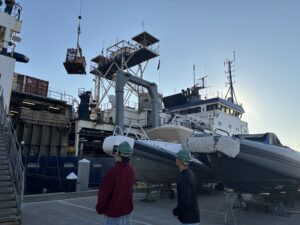
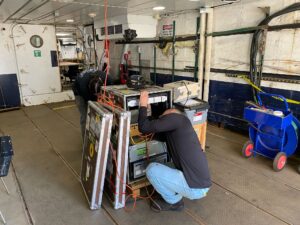
One of our first projects involved prepping the Lamont-Doherty Earth Observatory’s gravimeter for transport back to Columbia. This instrument is incredible—it’s a gray box built in the 60s that measures localized gravitational pull. It’s fragile and a little finicky, so we learned how to run daily checks on the instrumentation, run a gravity-tie test for calibration, and how to prepare it for transport without ruining everyone’s day (it would be a very costly break). We had to constantly keep it hooked up to a power supply and had to be very careful while moving it so as not to upset any of its internal workings. I’m very grateful I got the chance to work with it and to pick Cody’s brain about what makes it tick.
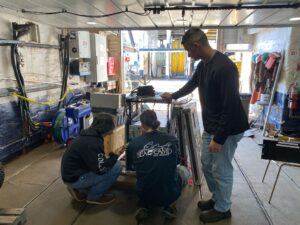
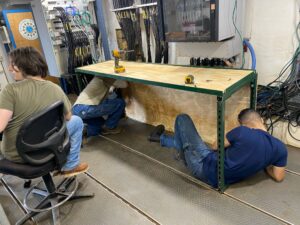
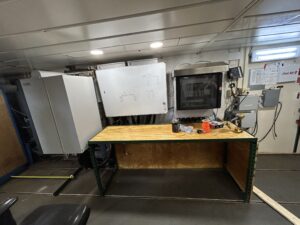
Another one of our projects was creating two shelfs/desks in the Dry Lab to create more workable surface area. I’ve never worked seriously with power tools before, and it was a blast getting to test things out with all the equipment and materials around the ship. This was definitely the project that took us the longest: we had to plan out the dimensions, clear the location, figure out our materials, cut out our metal frame, cut out our wooden surfaces, bolt pieces together, smooth out rough patches, and stain the wood. I’m very proud of our end product and it’ll definitely inspire me to work on more construction projects once I get home.

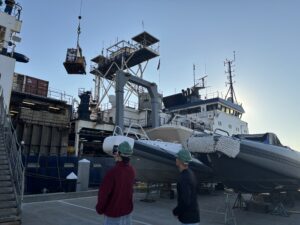
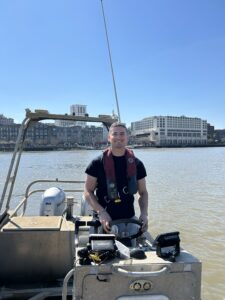
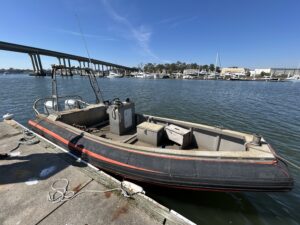
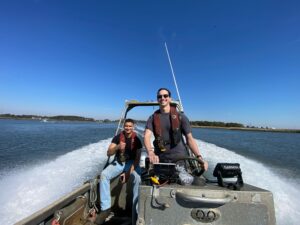
Finally, we spent some time on the workboat when we went to go get it fueled. This boat is kept on the ship in the event technicians need to perform maintenance on deployed equipment or lines. We were only supposed to be gone for an hour and a half, with the fuel dock being about 5 miles away, but our little vacation turned into a 4 hour maintenance trip. We initially had some problems with our electronics and port motor, which snowballed into an oil leak we had to patch and refill at the dock. It was a great time! We saw some dolphins, enjoyed the weather, and got very, very familiar with the inner workings of outboard motors.
Really looking forward to starting the transit tomorrow! I’m excited to get the ball rolling with a bit more technical projects, including working on our digibirds, getting familiar with our sonar systems, and testing out the streamers. Fingers crossed that I don’t get seasick!
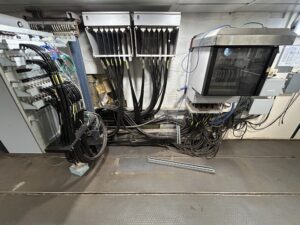
Week 1 – Preparing the R/V Langseth – Will

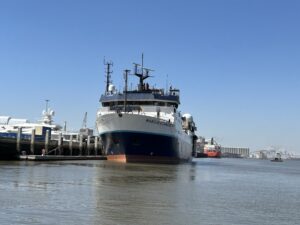
Greetings from aboard the R/V Marcus G. Langseth! We have had a very busy, productive first week aboard the Langseth, assisting LDEO’s technical team in preparing to get underway. In regards to getting underway, the Langseth will now be setting sail for Cape Verde, off the coast of Africa, to retrieve OBS equipment as opposed to our initial plans of traveling to Costa Rica to deploy OBS equipment. This change comes in light of concerns with next year’s NSF funding, with fears that there may not be enough funding to retrieve the equipment that was to be deployed off the coast of Costa Rica.

The Langseth is a remarkable ship, and the only one in the UNOLS fleet equipped to carry out multi-channelled seismological research, making it a world-class floating Earth observatory! One of the very first things we did was a vessel famaliarization tour with our supervisor and Cheif Science Officer, Cody Bahlau, allowing us to familiarize ourselves with all of the impressive lab spaces that we would be frequently working in.

One of the first major projects we had aboard the Langseth was the construction of a set of shelves that would be fitted into the ship’s Dry Lab in order to replace the old filing cabinet and fencing, create more workable area, and improve the overall quality of the lab.

The shelves were contructed in about 3 days, leaving us very proud and fulfilled with our final products! This was the first time I had every built something from scratch using power tools, so I was thrilled to put some hard work and new skills under my belt so shortly into my internship! The three of us even signed our names underneath, which I thought was really cool!

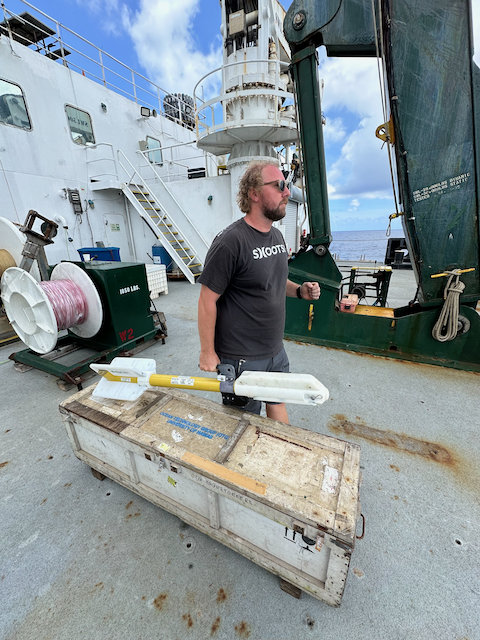
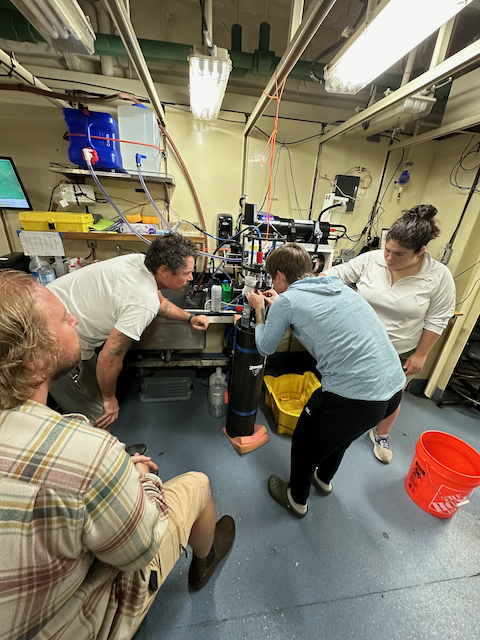
We also began to learn about the instrumentation aboard the Langseth that is used to conduct research, such as the multibeam sonar system, Digibirds, weather station and gravimeter. While still waiting till we are underway to really begin using and maintaining the sonar and Digibirds, this first week exposed us to running the sonar’s instrument testing, ensuring the weather station was transmitting data properly, and performing a Gravity Tie and weekly checks in preparation for transporting the gravimeter off the ship.

Moving and preparing the gravimeter for transportation was a very precise task, as we had to ensure it recieved uninterupted power at all times, otherwise, we could be risking thousands of dollars in damage and repairs! While our time with the gravimeter was short, we learnt a lot about how it functions and were involved in every step of its offloading.

We also had the opportunity to join Cody for a venture along the Savannah River in the Langseth’s science workboat, which provided us a nice break from the ship out on a beautiful day, but wasn’t free of complications! While issues with the port motor were not ideal, it gave us the opportunity to perform some maintenance and troubleshooting, all valuable experience!

Besides these larger activities, we have been hard at work preparing the Langseth to set sail for Cape Verde, which includes less glamarous but essential tasks such as securing items to the ship, cleaning and organizing work spaces & labs, installing computers & monitors, offloading non-essential equipment for transport back to WHOI and Columbia University, labeling equipment, loading provisions, inventorying PPE, and continuing to familarize ourselves with the vessel, daily operations, and emergency procedures. Cody has been a great supervisor, forthcoming with his experience and wealth of knowledge, and always present to assist us as needed but allowing us the autonomy to work and troubleshoot tasks independantly. Unfortunately, we did lose Ethan a few days ago, as he could not do the couple extra days added to the trip by Cape Verde due to other commitments he had.

I am super excited to get underway to Cape Verde soon, and I look forward to continuing to share my experience during this internhship! See you at sea!

– Will

Theo Lafontant Kagan — Introduction

Hello! My name is Theo and I am one of three interns aboard the R/V Langseth this February.

I recently graduated from Bowdoin College, where I majored in Biology (concentrating in Ecology, Evolution, and Marine Biology) and minored in Environmental Studies. I have a strong background in marine science, having previously studied shark populations in South Africa, modeled upwelling dynamics along the Skeleton Coast, and analyzed marine food webs using eDNA.

Down the road, I’m interested in pursuing graduate-level studies in ecology and marine systems, but before applying I wanted to become more familiar with the technology and instrumentation used in field expeditions. I’m looking forward to developing my technical skills with the Langseth’s state-of-the-art scientific equipment and to collaborating with the marine technical team at sea. This will be my first time working aboard a UNOLS vessel, so I am excited to learn from everyone on board.

Check back in next week for an update!

Ethan Wadsworth – Introduction

Hello! My name is Ethan Wadsworth and I will be one of the Interns aboard the R/V Marcus G. Langseth transiting from Savanna, Georgia to Puntarenas, Costa Rica.

I am a recent graduate from Cal Poly Humboldt in northern California. I graduated with a Bachelor of Science in Oceanography and a minor in Geology. At Cal Poly Humboldt, I had the opportunity to go on day cruises aboard the R/V Coral Sea introducing me to marine technology and research cruises. I am super excited to spend time at sea aboard the R/V Marcus G. Langseth developing my technical skills and gaining and growing experience with different instruments and equipment. I am particularly interested in the sea floor so I’m looking forward to getting hands-on experience with sonar.

I can’t wait to meet everyone and sharing more once I’m on board.

William Eltringham – Introduction

Greetings! My name is William Eltringham; I will be interning aboard the R/V Marcus G. Langseth from February 20th to March 9th, starting in Savannah, Georgia, and ending in Puntarenas, Costa Rica!

I am currently a Junior at the Massachusetts Maritime Academy, where I am pursuing a degree in Marine Science, Safety, and Environmental Protection with a minor in Marine Biology! As an undergrad, my goal is to build my work experience to make myself a great candidate moving into my professional career! Having had plenty of previous outstanding internships, I am particularly excited for this unique and remarkable opportunity to join the LDEO team aboard the R/V Langseth as a MATE-Marine Technical Intern! Working aboard the ship during its transit to Puntarenas will provide a great opportunity to develop my technical skills and knowledge as I work and familiarize myself with the onboard equipment and operations.

I look forward to sharing more of my experience and will be sure to touch back soon!

Journey’s End, Career’s Beginning

Howdy all,

What a journey it’s been since my last post! We safely reached Tahiti, completed a mapping cruise while managing a suite of underway instrumentation, and concluded my long-term MATE internship. As this is my final blog post, there’s plenty to share.

Arriving in Tahiti marked the end of one of the most significant research cruises I’ve ever participated in. After so long at sea, it was a welcome change of pace. Our team of scientists and crew celebrated our successful cruise by unwinding in beautiful Papeete. I had the chance to relax with friends, go freediving in Moorea, and explore the islands. However, after just two days of recovery, it was back to work for our next cruise.

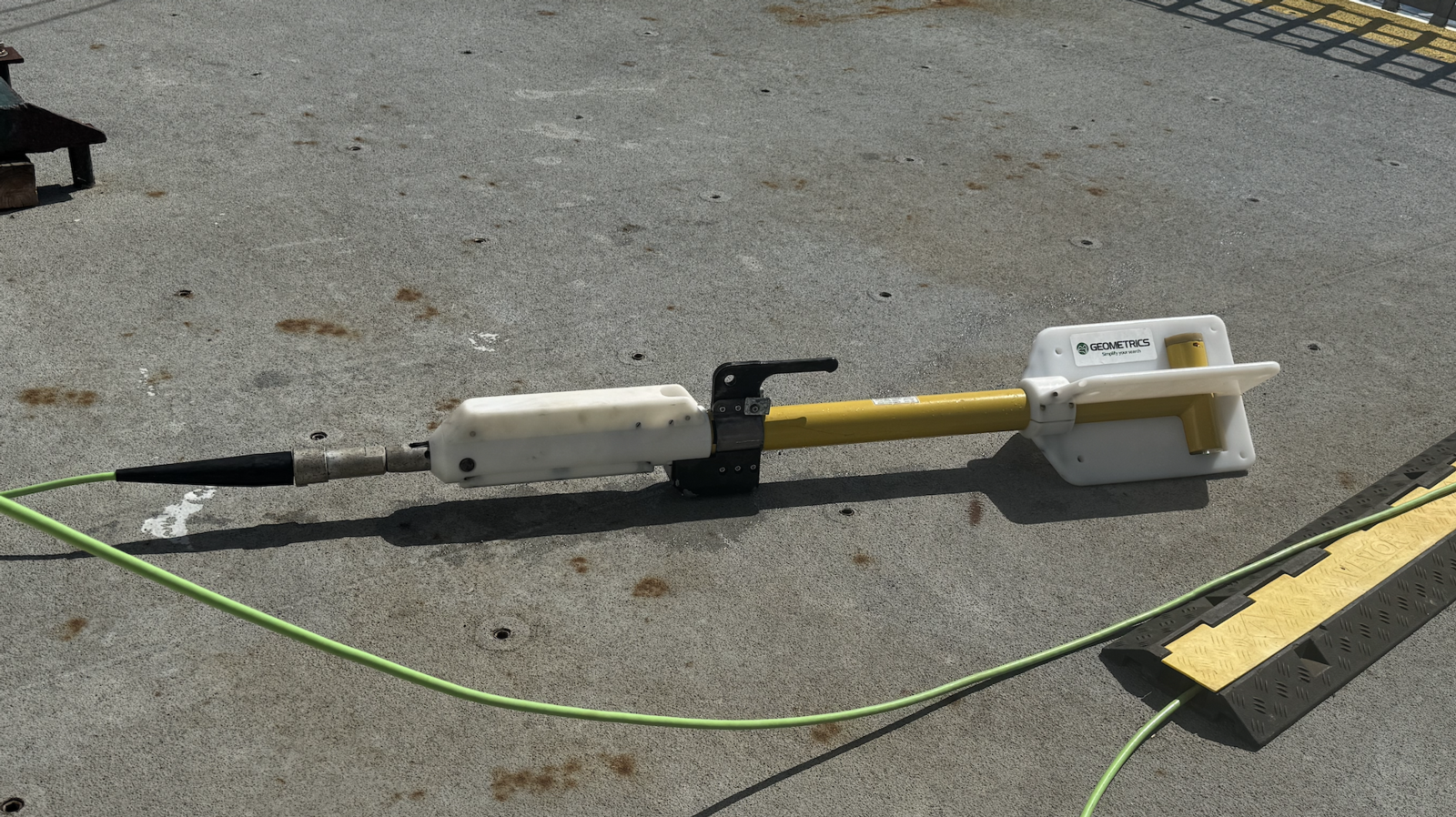
On our return journey to Honolulu, the Kilo Moana embarked on a cruise to map understudied seafloor regions. This survey utilized ship systems such as a multibeam echosounder, subbottom profiler, and magnetometer. For OTG, this suite of instruments operated fairly autonomously, requiring only light deck work for the magnetometer, consistent monitoring of mapping software, communication with the bridge about ship heading, and ensuring data upload to our remote researchers. In addition to mapping, this was also a cruise of opportunity for optical seawater measurements. Working alongside Dr. Ali Chase, Briana and I helped maintain and troubleshoot unique instrumentation measuring different spectral properties of surface seawater and the atmosphere. The primary goal of this data was to validate satellite-derived data. By the end of the cruise, Dr. Chase had collected valuable data, while Briana and I gained more troubleshooting and hands-on experience with high-sensitivity optical instrumentation.

The beauty of this cruise’s operational schedule was that it didn’t require 12-hour shifts. This allowed me time to work with Ben and James, learning about the ship’s network architecture and how OTG members leverage VOID Linux and the MQTT publish-subscribe communication protocol to manage the ship’s network and connected instruments. Over a few sessions, they taught me to operate a Void Linux machine, configure a network switch, interact with the ship’s network, and connect a sound velocity probe for data acquisition and storage. As IT and networking skills become increasingly important for marine technicians, this was an invaluable learning opportunity for me.

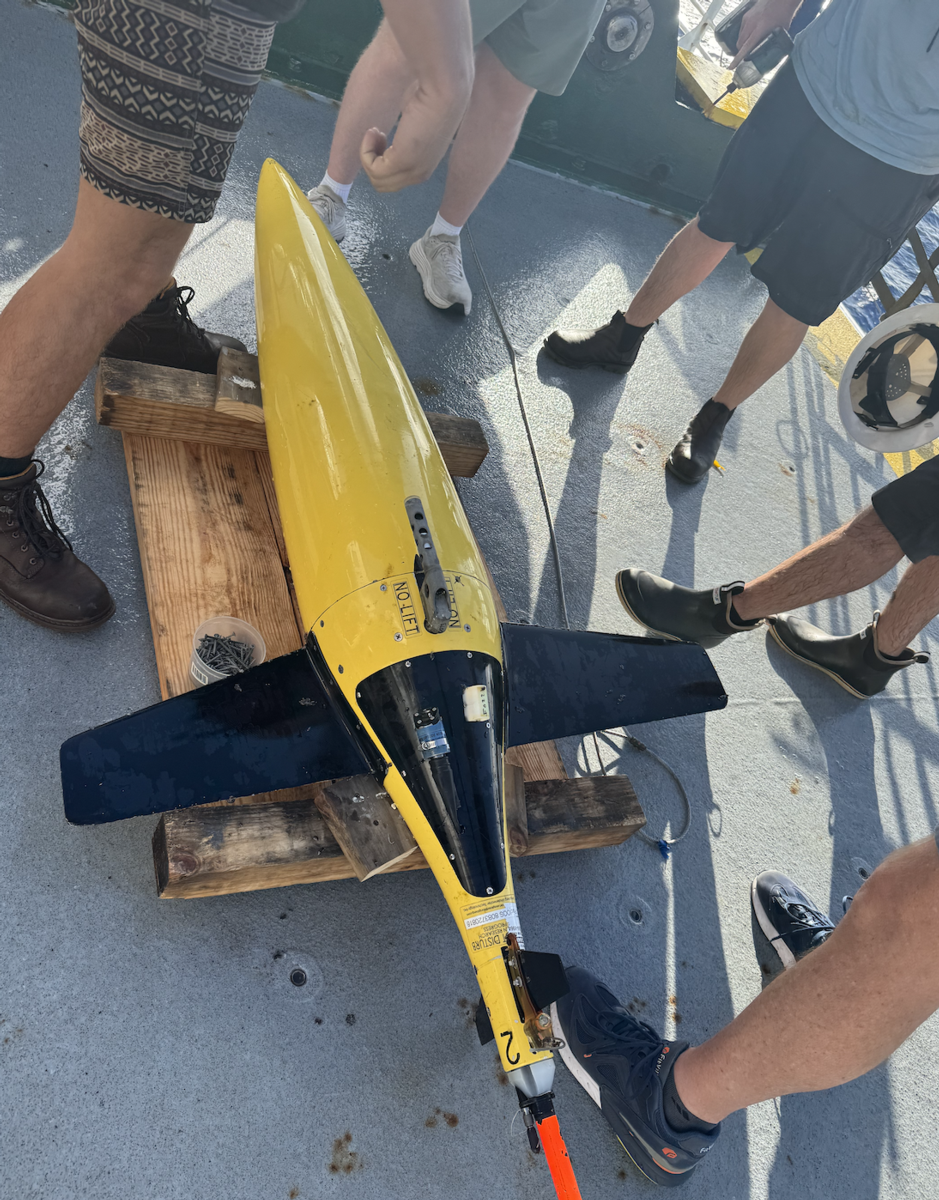
The remainder of our transit back to Honolulu was relatively uneventful, save for a rogue glider recovery. This successful multi-hour operation involved locating, backing down on, and tagging a glider with a dog catcher wire loop – a great way to conclude our cruise. Soon after, we returned to Honolulu and demobilized, marking the end of my long-term MATE internship.

So what can I say other than that the past several months have been nothing short of an amazing adventure.  Across two MATE internships sailing aboard the R/V Hugh R. Sharp, R/V Atlantic Explorer, and R/V Kilo Moana, I’ve had the incredible opportunity to grow as a technician and interact with a community of hardworking, passionate, and like-minded people. These internships provided more than just technical training; they offered lessons in adaptability, teamwork, and problem-solving. Working with exceptional technicians who encouraged initiative and provided constructive feedback, I learned to safely tackle challenges with attention to detail. Each leg of this journey was a unique learning experience that not only grew my technical skills but also developed and affirmed my passion for this field and the opportunities it holds. From performing deck operations to troubleshooting instrumentation, I gained hands-on experience that transformed me from a lime green novice to a more confident and capable technician.

As I transition into my current role as a SUBSEA project Ocean Technician at the University of Hawaii at Manoa, I carry with me the invaluable lessons and memories from this transformative experience. Over the last few months, I’ve traveled around the world, made new friends, gained a multitude of experiences, all while investing in my future.

I want to express my heartfelt gratitude to the amazing team who made this impactful opportunity possible. A special thank you to Maria Osciadacz for her constant hard work and dedication to the program’s success. Thank you to Dan Fitzgerald, Carolina Funkey, Tully Rohrer, Trevor Young, Ben Duncan, James Harris, Lance Frymire, Tim Deering, Christian Kernisan, Alex Dominguez, Rory O’Connell, Lydia Sgouros, Emily Tate, Jace Innnis, the crews of the R/V Kilo Moana, R/V Hugh R. Sharp, and R/V Atlantic Explorer, and all the scientists I’ve had the privilege of working with over the last year. My internship experience wouldn’t have been the same without any of you, and I am forever grateful for your mentorship and support.

Now, I look forward to contributing to this field as I work with the University of Hawaii at Manoa and Schmidt Sciences OBVI project to help research the unique biogeochemistry of the North Pacific and South Atlantic Subtropical Gyres. For those interested, you can follow this link to learn more about the OBVI and SUBSEA projects: Schmidt Sciences OBVI

Thanks for tuning in, and to any future MATE interns reading this – I hope to see you out there soon!

All the best,

Hunter

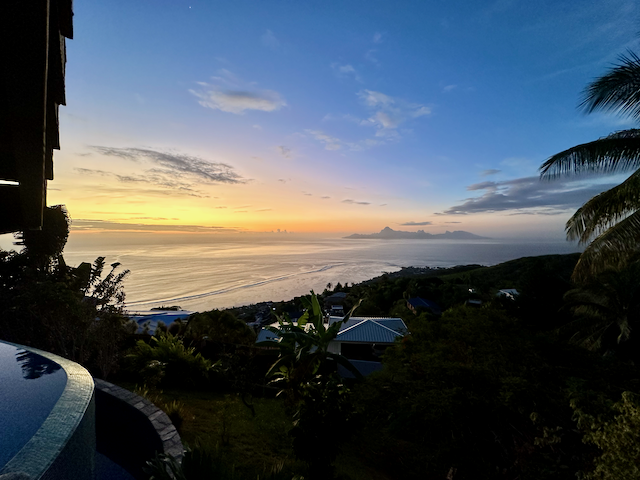
– View of Moorea at sunset
 

– The KM at dock in Papeete

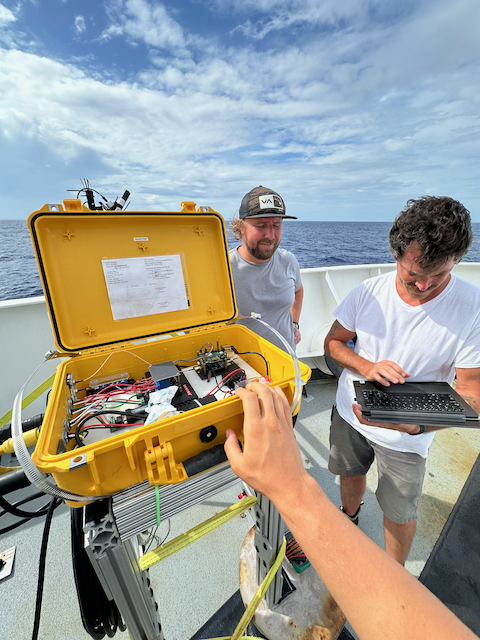
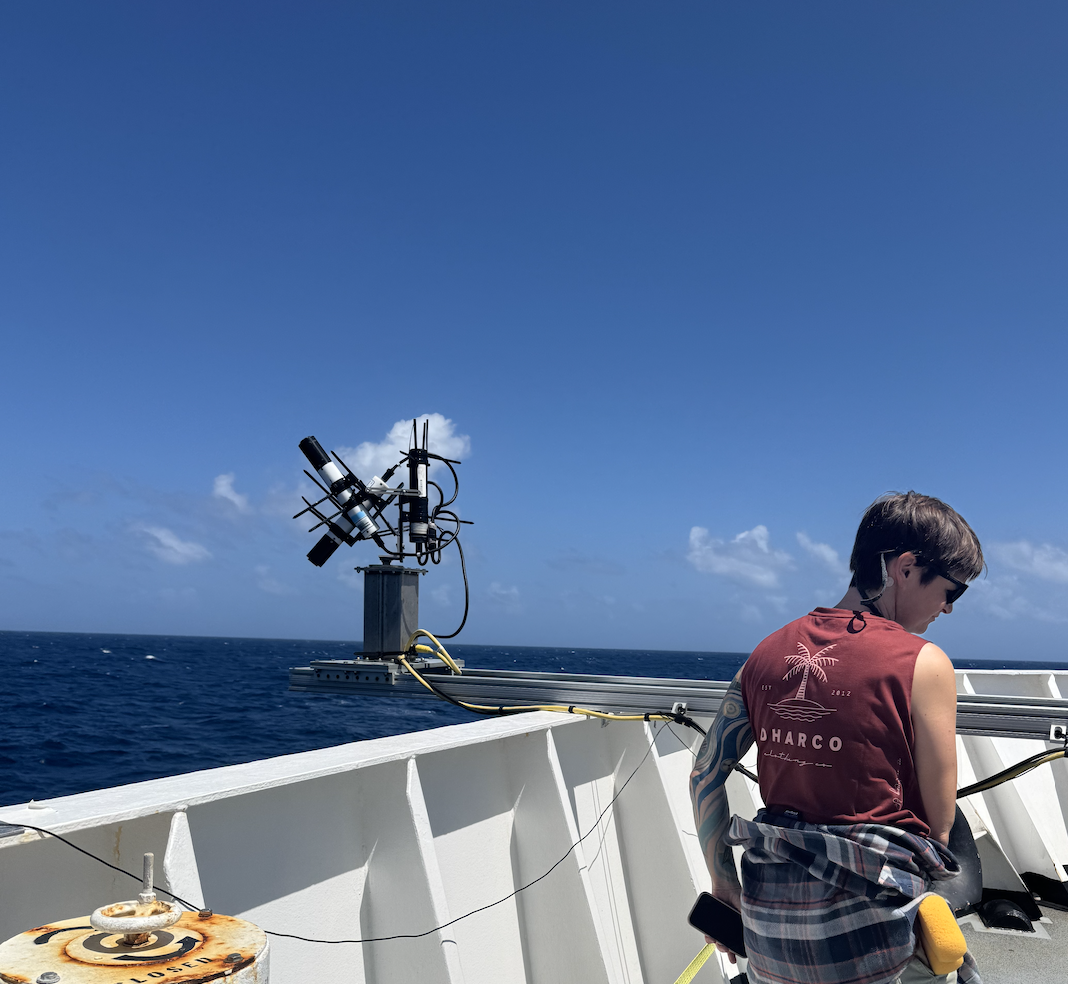
– Day 1 of the mapping cruise. Troubleshooting the pySAS autonomous solar tracker and surface ocean radiometer system (ended up being a grounding issue for one of the relay boards).

– The KM’s magnetometer. Ben for scale.

– Troubleshooting the IFCB (an automated image capture microscope) for humiditiy warning

– Briana exploring the engineering spaces of the KM

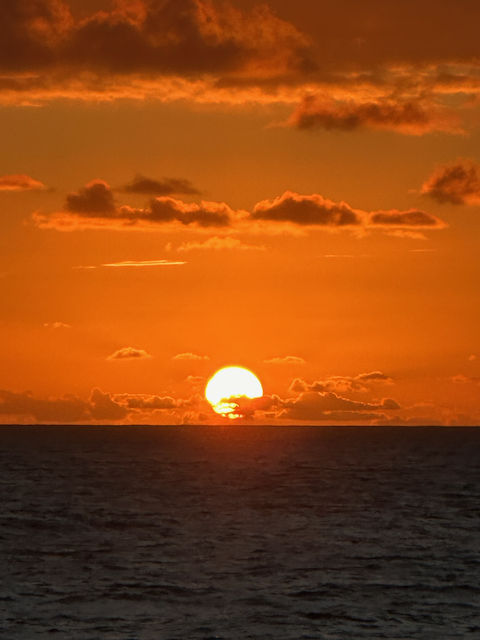
– The last sunset of my MATE internship

DeMob Mob Party (Week #10, Briana Prado)

DeMob Mob Party (Dec 10th – Dec 19th) 

While in transit back to Honolulu, HI from Tahiti, the Kilo Moana team was tasked with collecting a sea glider that had lost its way home. Unfortunately, the glider had a damaged compass board, which made the $300,000 instrument disoriented. Futhermore, its battery was near close to dying with only 14% battery left which would make it unrecoverable due to the inability to track it.

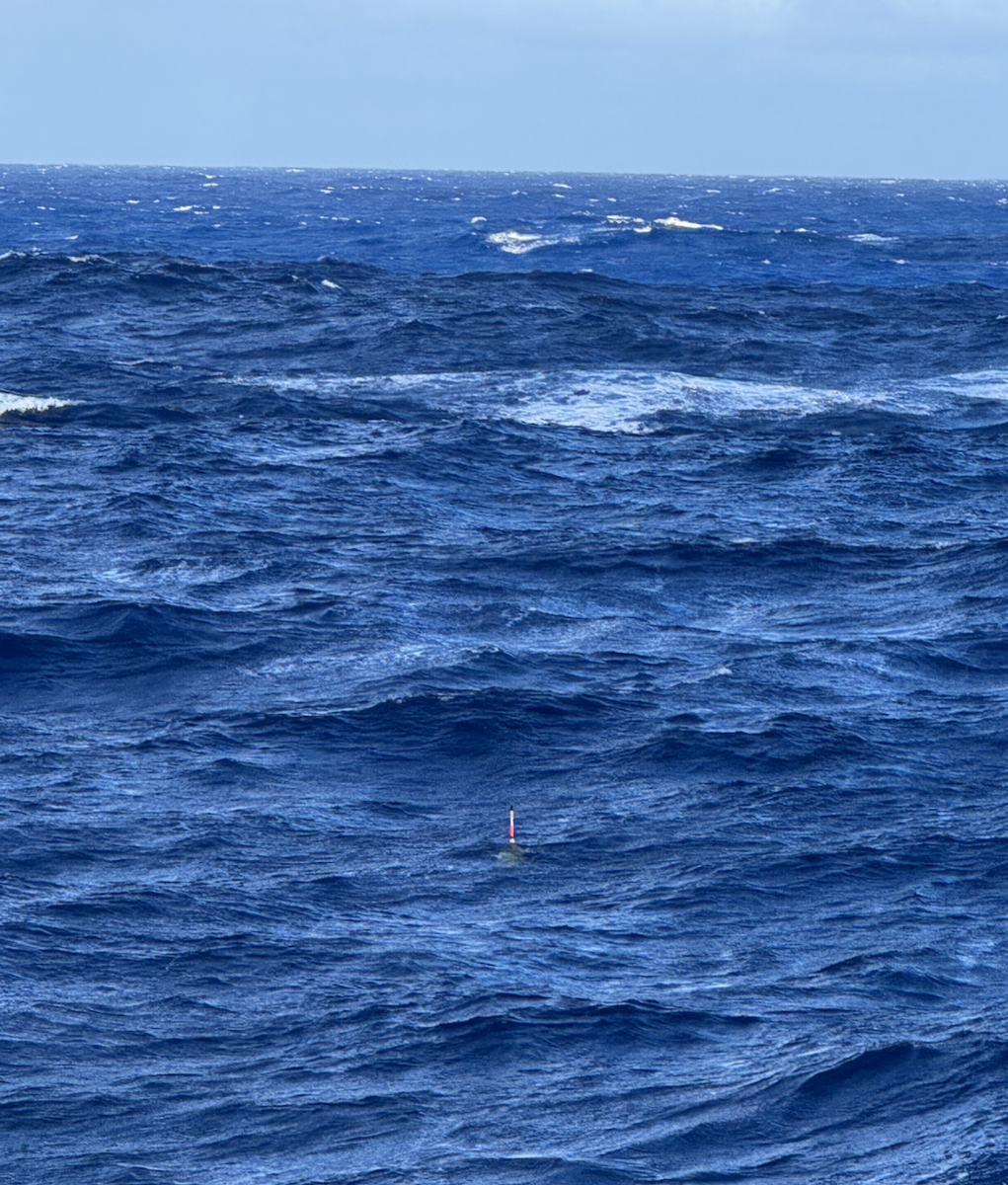
The glider was about 200 miles away, so we slightly rerouted to pick it up. The whole operation was a test of patience and trust. Due to its erratic flight path, it was decided that the best way to retrieve it was to back down on it, which meant turning the stern to the waves and risking waves crashing onto the back deck… which happened. Keeping an eye on it, felt a bit like searching for a needle in hay stack, as it had a tiny attena that would bob in and out 

The Office Technology Group (OTG)  also faced the challenge of bringing the glider onto the vessel during a high swell period, where it could take the glider from being feet away from the stern to being 15 feet below the ship. It was a high-stakes operation because you don’t want to be too close to the glider, where it can go below the ship and get crushed, which would virtually destroy the instrument. 

Thankfully, none of that happened, and after 3 hours of trying, we were able to bring the glider onto the ship and start heading back to Honolulu. We arrived on the outskirts of Honolulu on the evening of Dec 15th. It was surreal seeing Honolulu, HI appear on the horizon, first as a tiny ridge that could easily be confused for low-hanging clouds, then as a shimmering city situated at the base of the Ko?olau Range. Due to the uncertainty we faced regarding our arrival time at the port, customs assigned us an appointment for Dec 16th at 7 am. Despite having arrived at the vicinity at least 12 hours before, we still had to wait for our appointment.

Meanwhile, that evening, Hunter and I helped Dr. Ali Chase clean and pack away most of her instruments: Hyper BB, LISST, IFCB, ALFA, FRRF, ACS, and pySAS. As a team, we got most of it done and went to bed at a reasonable hour. The following morning (Dec 16th, 2024), we were quickly cleared for customs and allowed to enter the harbor. Once we reached berth #35, we were greeted by the Agriculture people, who checked the ship before finally clearing us to open the gangway and let people off. It was nice to be back on land. Going out to sea is fun, but it also makes you appreciate land just a little bit more.

Once the gangway came down, a whole bunch of HOT people came to help us unload. The crew was busy craning vans off the ship, enforcing safety, and mobilizing. Since we were taking stuff off the ship on foot, we loaded it onto the UH Van and dropped it off at a beach lab. I ended the day with a solid 20,000 steps, which says a lot about how much there was to unload.

The following day was also jam-packed, with everything that hadn’t been finished unloading the day before and the mobilization for HOT Cruise #355 happening the following morning. After my first HOT cruise, I learned that due to the holidays, there were few volunteers, so I asked if I could volunteer after we got to port, since the HOT Cruise #355 was set to sail a day after the Tahiti cruise. Thankfully, I was accepted to volunteer, and my internship was subsequently extended a few more days. This was exciting as it would allow me one last opportunity to revisit all the things I learned during the first week of my internship and see how much I’ve grown. 

Dan Fitzgerald and I worked on creating a new termination for the CTD! It’s a HOT cruise tradition to always re-terminate before a HOT Cruise to prevent any issues, but this time, Dan let me take a bit more ownership of it, letting me unravel the wire, clip wires, hammer in terminations, and more. It was nice to reflect on my first HOT cruise experience and feel how much more my confidence has increased in performing basic marine tech tasks. It felt like a great moment, given that the termination was one of the first few things I learned about when I first started my internship.

There are still a few more days left of the HOT cruise, and I’m going to savor every moment. It’s been fun working with this amazing team and always learning something new on the water. I am eternally grateful for the chance the HOT team took on me and only hope I can pay it forward by supporting more scientific expeditions across the UNOLS fleet.

Cheers,
Briana


– Hunter Adams, Briana Prado and Dr. Ali Chase celebrating the last pySAS cleaning at the bow

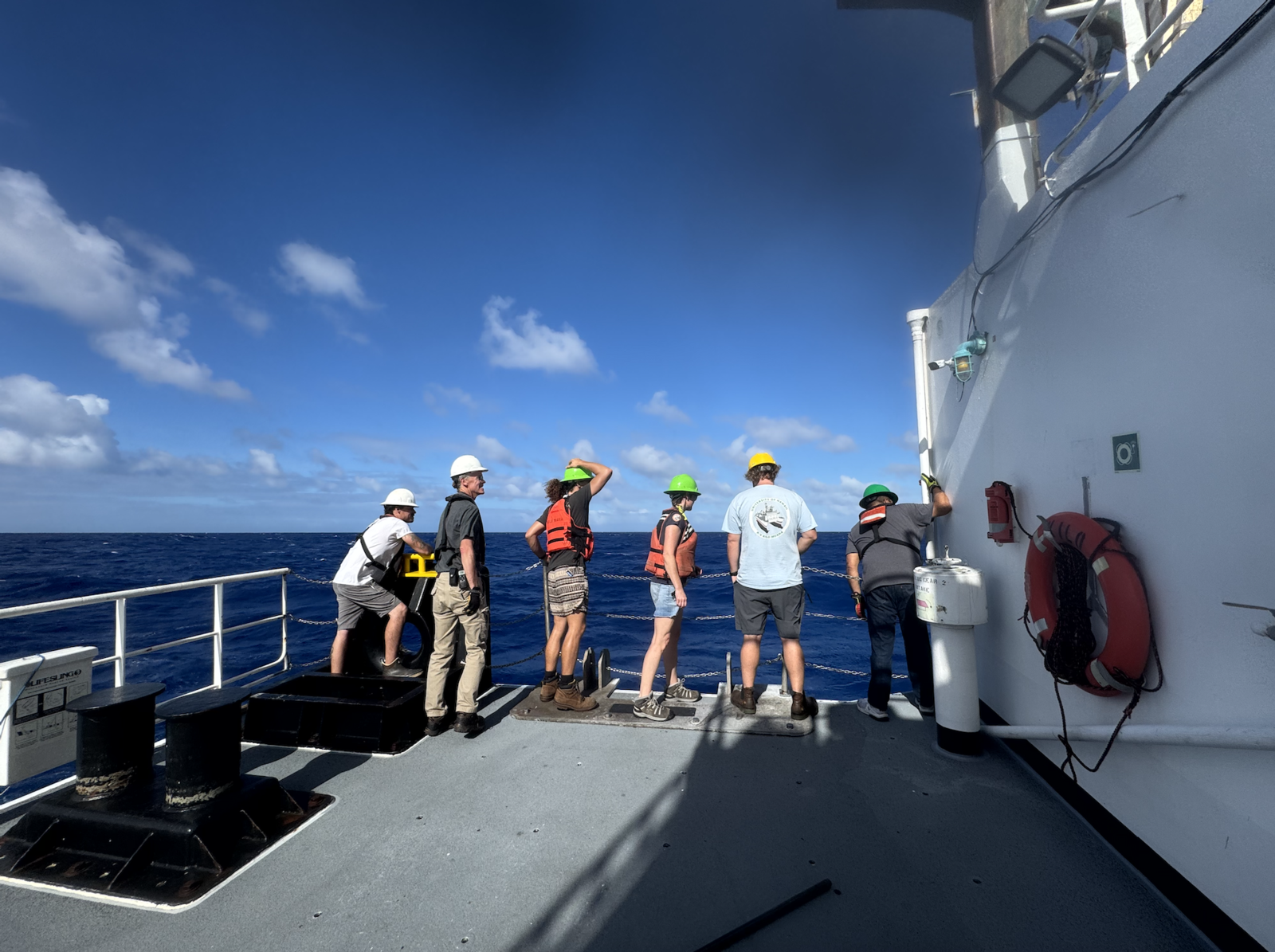
– Folks looking for the Glider on the port side of the ship

– This photo features the little attena that pokes out from the glider I’d like to call it Looking for the “needle in the hay stack” 

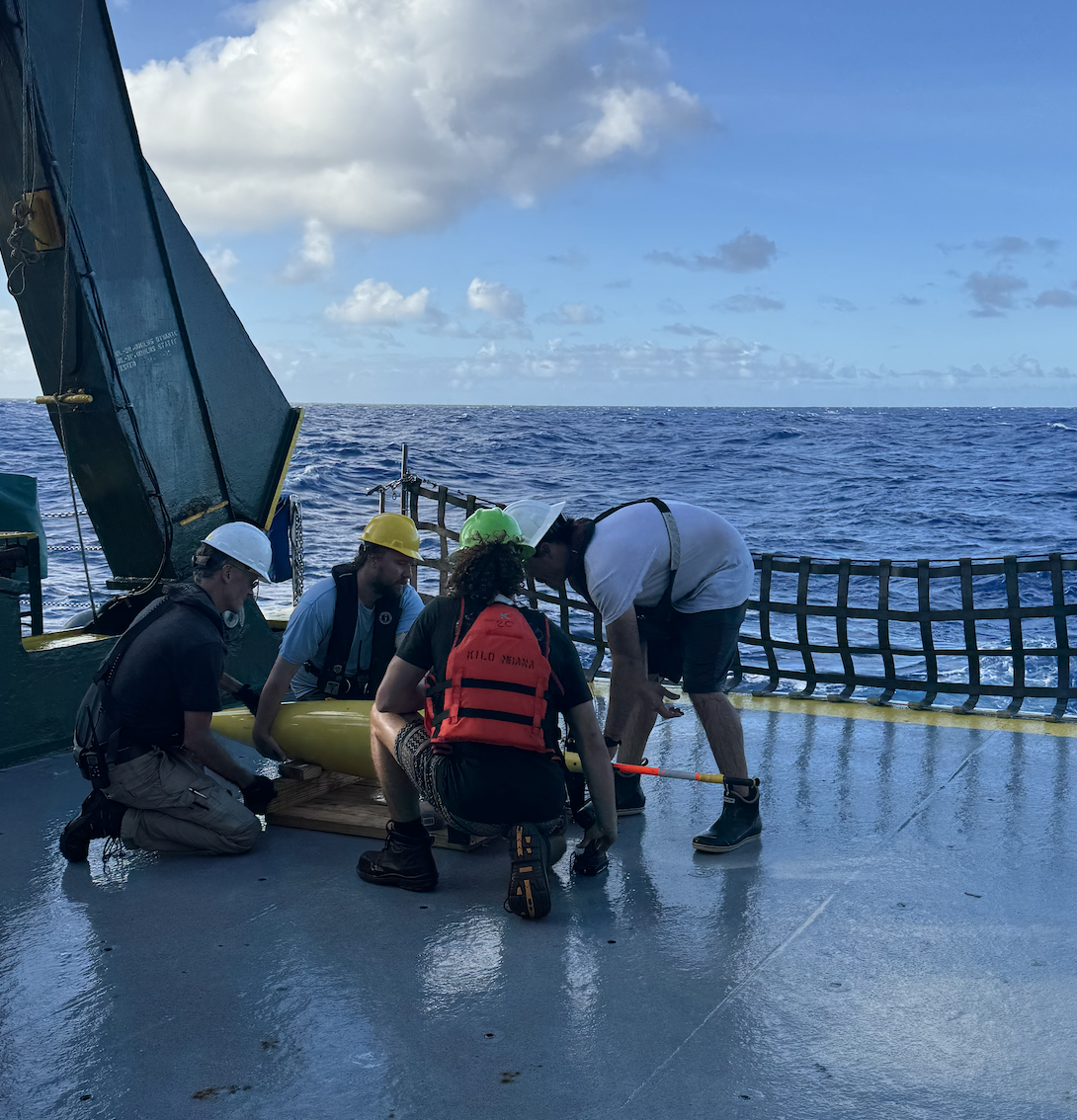
– OTG and Chief Mate investigating the glider for any damages

– Glider safely on board after a suspensful 3 hr operation

– looking at Honolulu from a couple miles off shore waiting for our Border customs appointment the following morning


Bubble Troubles (Week #9, Briana Prado)

Bubble Troubles: Week #9 12/02/2024 – 12/09/2024
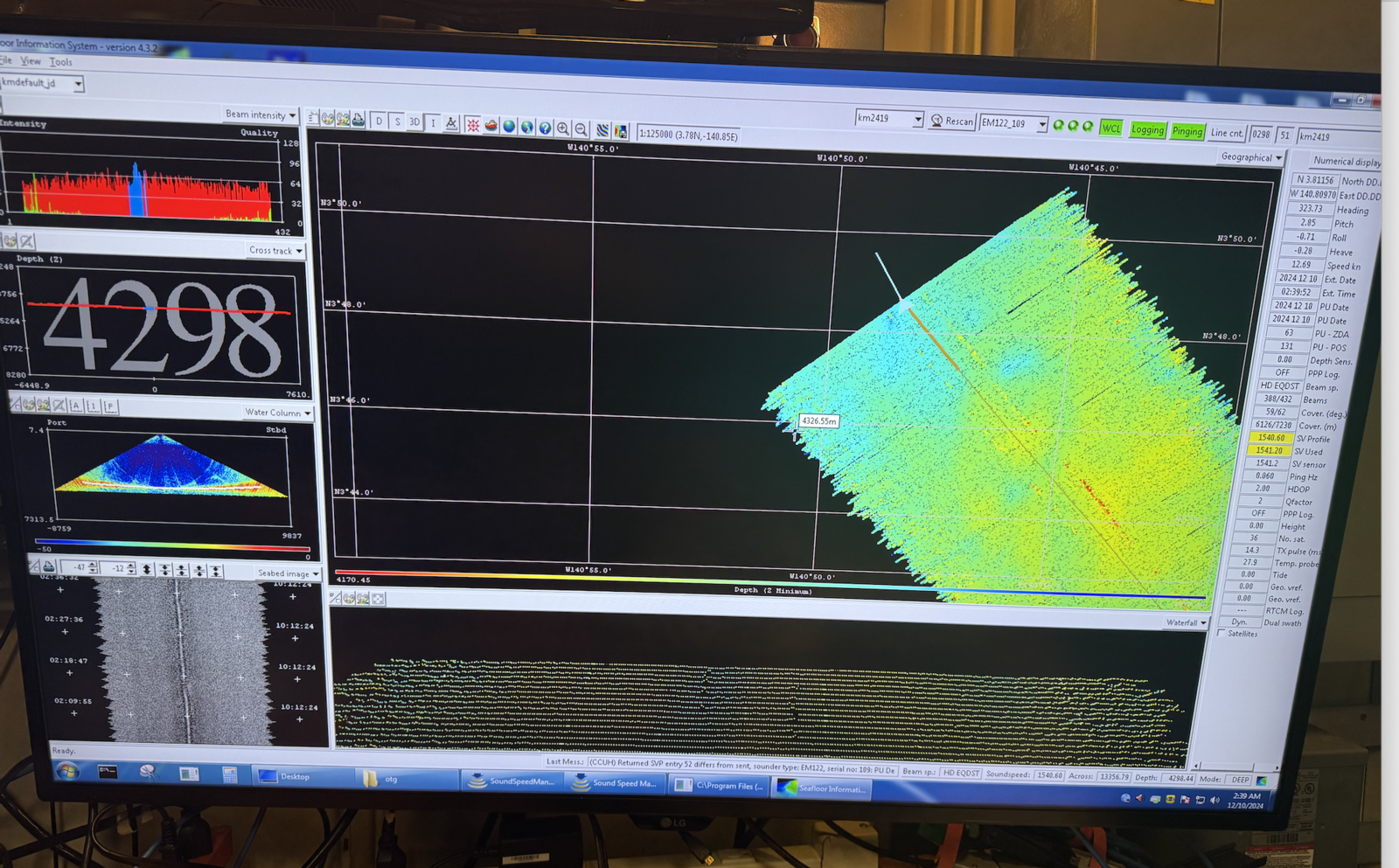
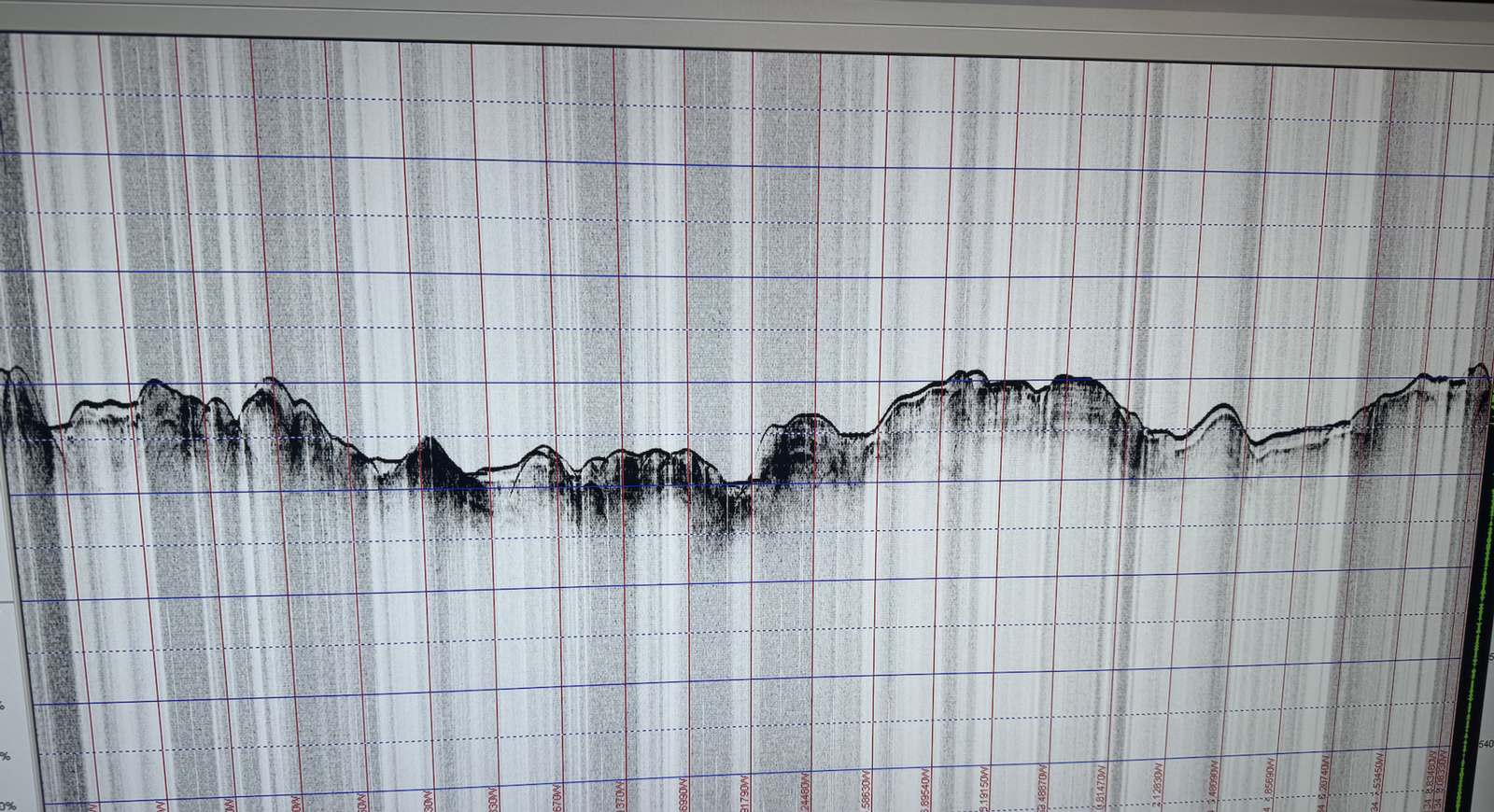
On Nov 28th, we set sail back to Honolulu, HI. While underway, we’ll be mapping a remote corner of the ocean using the Acoustic Doppler Current Profiler and a magnetometer for Dr. David Sandwell from the Scripps Institute of Oceanography. His team is interested in studying gravity anomalies called Haxby Lineaments and seeks to figure out the origin of these features using Sound Navigation and Ranging (SONAR), the Acoustic Doppler Current Profiler (ADCP), and a magnetometer. The SONAR and ADCP are already on the ship, but the magnetometer is towed from the back of the ship in the regions of interest.

Dr. Ali Chase, Hunter, and I have also been keeping busy cleaning different instrumentation: AC-S, HYPER BB, ALFA, FRRF, LIIST, pySAS, multispectral radiometer, and IFCB. I’m still trying to wrap my mind around what each instrument does, but I do know that they are orchestrated together to help build a comprehensive picture of the properties of microscopic organisms like plankton and debris taken up by the ship’s underway seawater collection system.

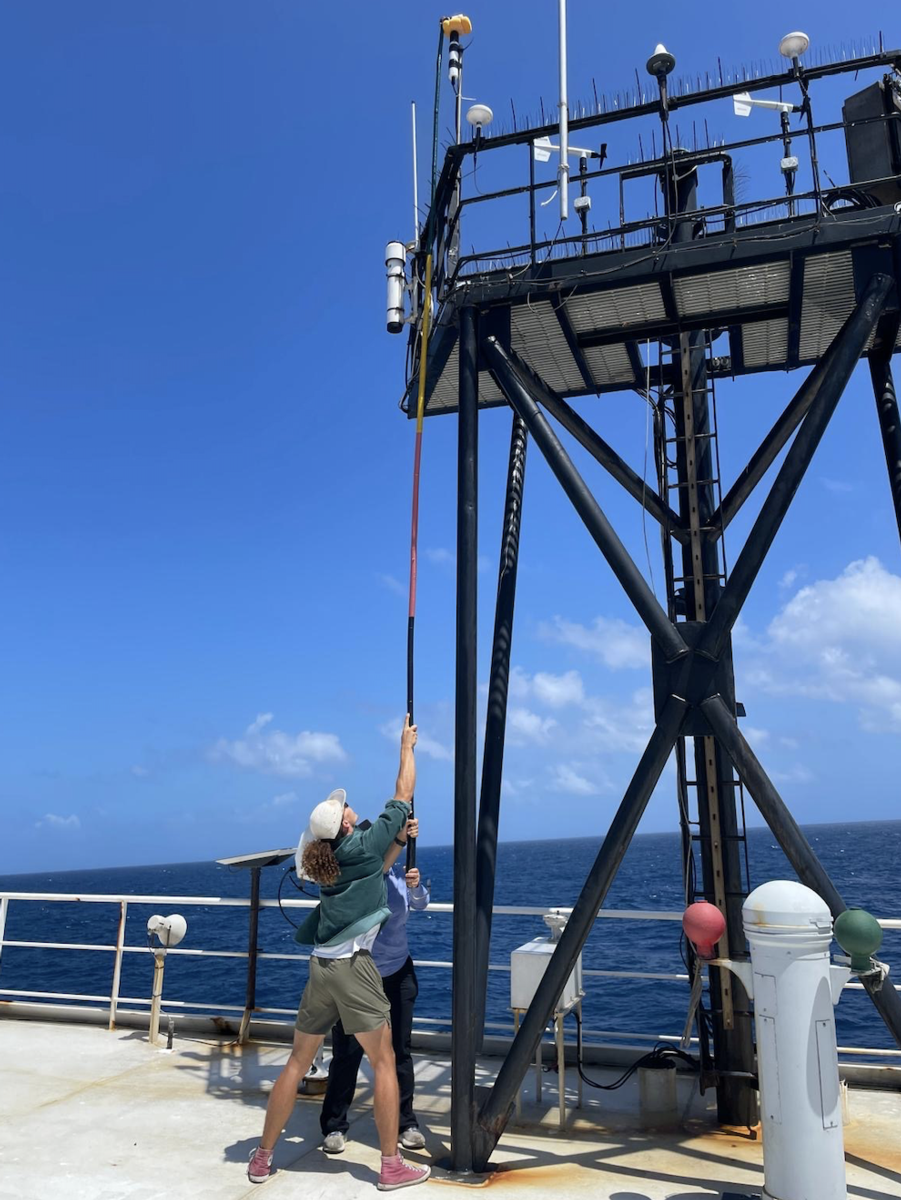
Every morning, we clean the pySAS instrument, making sure that it is clear of salt crystals and debris that may have become entrapped on the lenses in the past 24 hours. Then we also climbed up to the top of the bridge and clean the Hyperspectral Radiometer with a 5-meter pole, sponge, and lens paper to fight the wind and also dust off any salt crystals on the instrument. In the evenings, we alternate between cleaning the AC-S, LIST, and HYPER BB every other day, and we clean the ALFA and FRRF instruments daily. While maintaining these instruments, we also clean the optics of each sensor with thin lens paper, alcohol, and Milli-Q water, as well as running Milli-Q water to hopefully push out anything that may be trying to grow inside the tubing.

Another thing to keep an eye out for is bubbles. I had never given much thought to bubbles or their effects until I hopped on board the RV/Kilo Moana. Although fun to blow, bubbles can be quite troublesome when they get into your instrumentation or experiments. In the case of Dr. Alison Chase, bubbles inside your instrumentation must be avoided at all costs. Bubbles can cause light to scatter differently, which is not what you want when you’re studying backscatter using the HYPER-BB. Bubbles can change the flow of things, causing instruments to overheat due to not receiving the proper amount of flow. This happened multiple times to the ALFA, halting data collection for a couple of hours each time. In the case of the Imaging Flow Cytobot, the resolution of the phytoplankton images for several samples shifted and was reduced. Thankfully, Dr. Ali Chase caught the issue quickly, and we were able to fix it by running a debubbling procedure. This entails stopping the IFCB, plugging the intake line with soap, and letting the soap flow through for about 5 minutes to pop and push through the bubbles.

In the meantime, I’ve been reading manuals of the different instrumentation we’ve been maintaining, learning to code in Linux, and starting to learn more about how the ship is networked. The days left on the RV/Kilo Moana are starting to dwindle, so I’m trying to learn as much as I can before departing. I’ve been talking more to the crew and asking them the specifics of their jobs as well as  taking in as many sunsets and night skies as possible.

Cheers,

Briana

– Magnetrometer profiles

– ADCP that remains on during the duration of the transit and later uploaded to Google Maps and other data bases!

– Magnetrometer after a succesful mapping session

– Hunter Adams and Briana Prado cleaning the Hyperspectral Radiometer ontop of the Bridge

– Dr. Alison Chase cleaning the pySAS early morning

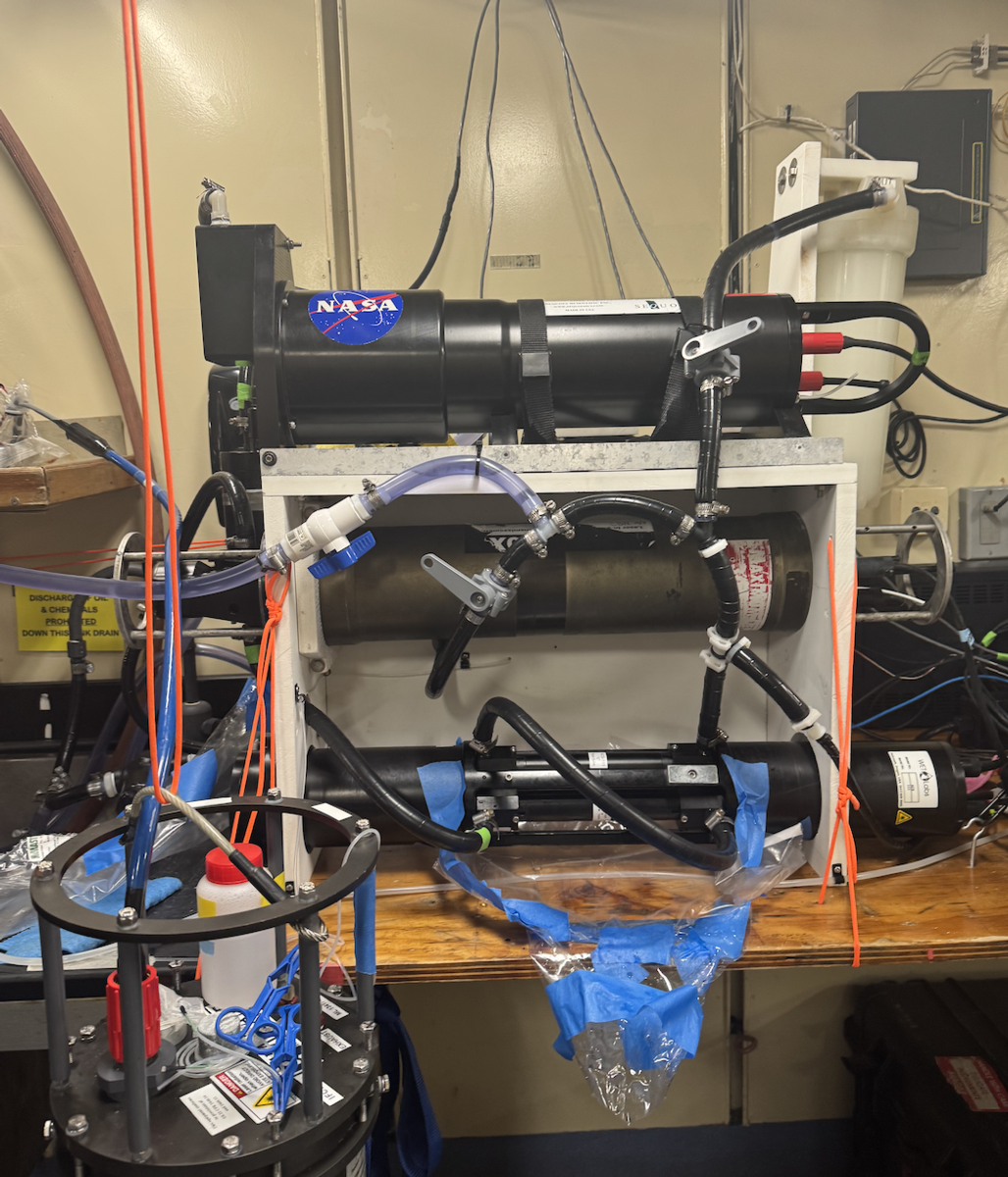
– Top to Bottom: HyperBB, LIIST, AC-S and IFCB instruments which we clean regurlarly

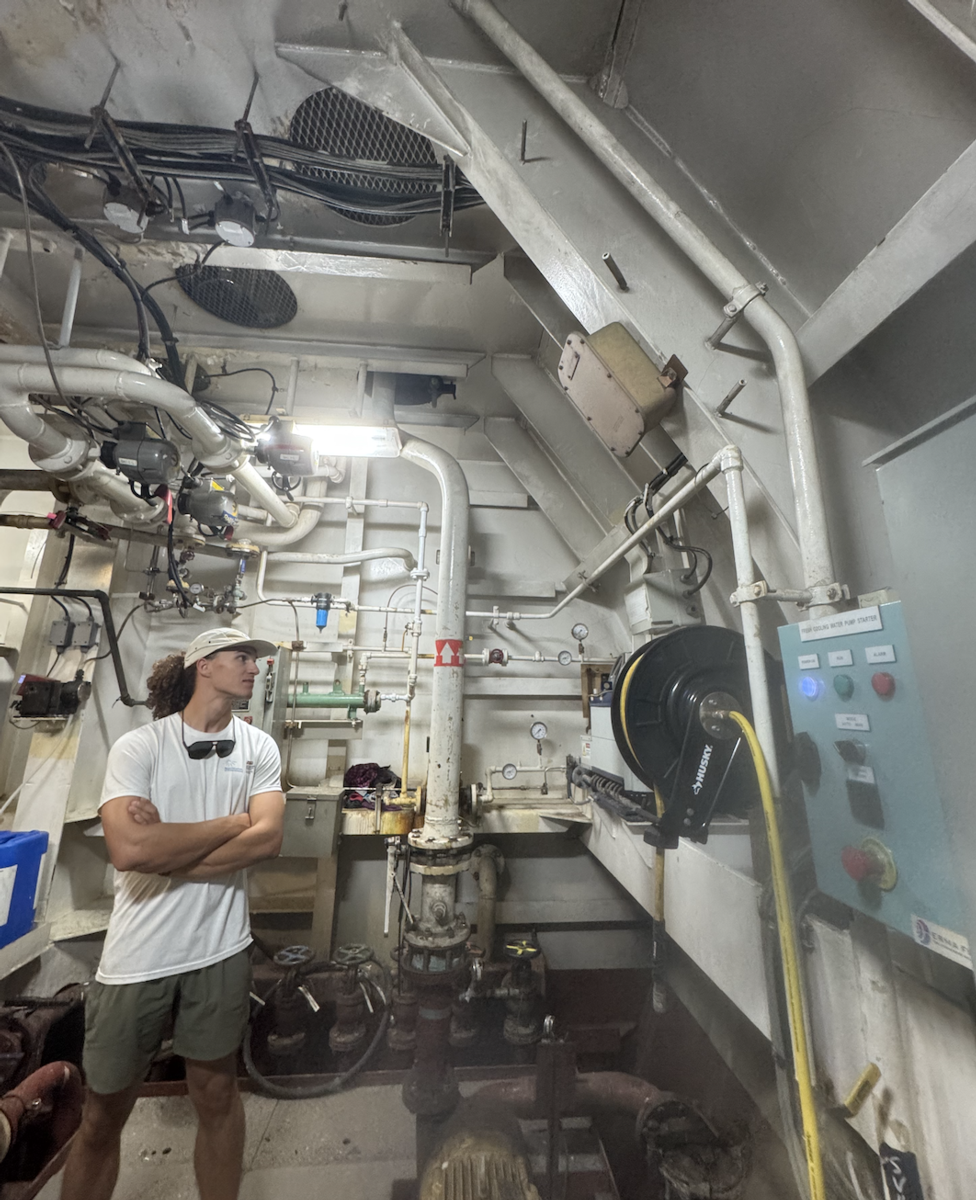
– Hunter Adams and I receiving a tour of the inner workings of the ship by Chief Engineer

A Tahitian Escapadé (Week #8, Briana Prado)

Week #8 Tahitian Escapade (11/25/2024 – 12/1/2024)

– The SPOC 2418 Science team!

We wrapped up our last station a few days before reaching Tahiti leaving us with enough time to acid wash every bottle, spigot and syringe used during the cruise. As well as enough time to tidy up lab spaces; sweeping, mopping and wipping down counters in the labs and moving stuff into specific labs for storage while on transit back. 

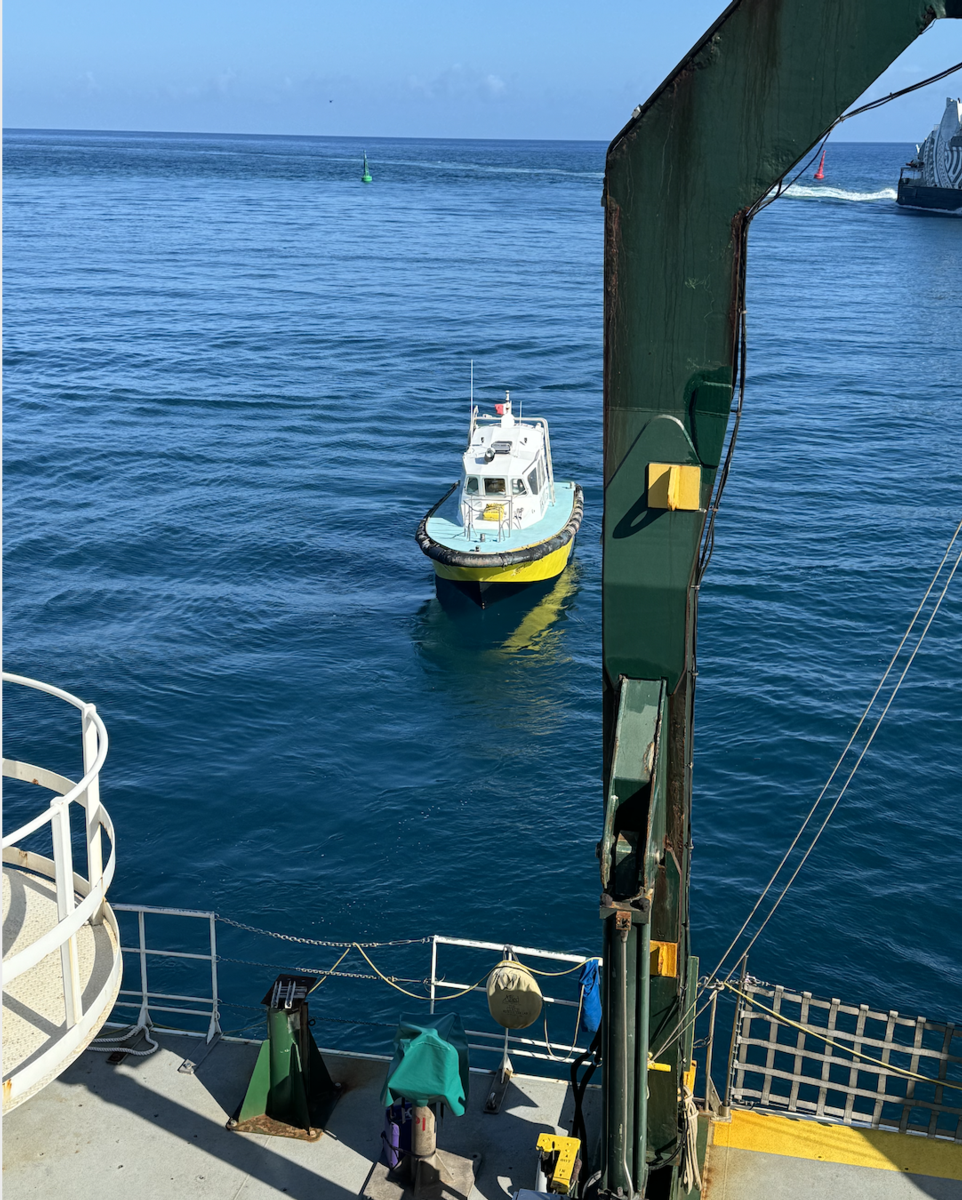
We arrived in Tahiti on Nov 26th, at about 7am after 34 days at sea. Once near port, the Tahitian Port Captain came onboard using the ladders on the back deck.  The port captain then headed up to the bridge to drive the boat into the dock safely, which was a really cool and swift operation to watch.

– Tahitian Harbor Police moving towards the ship to begin driving the RV/Kilo Moana to port.

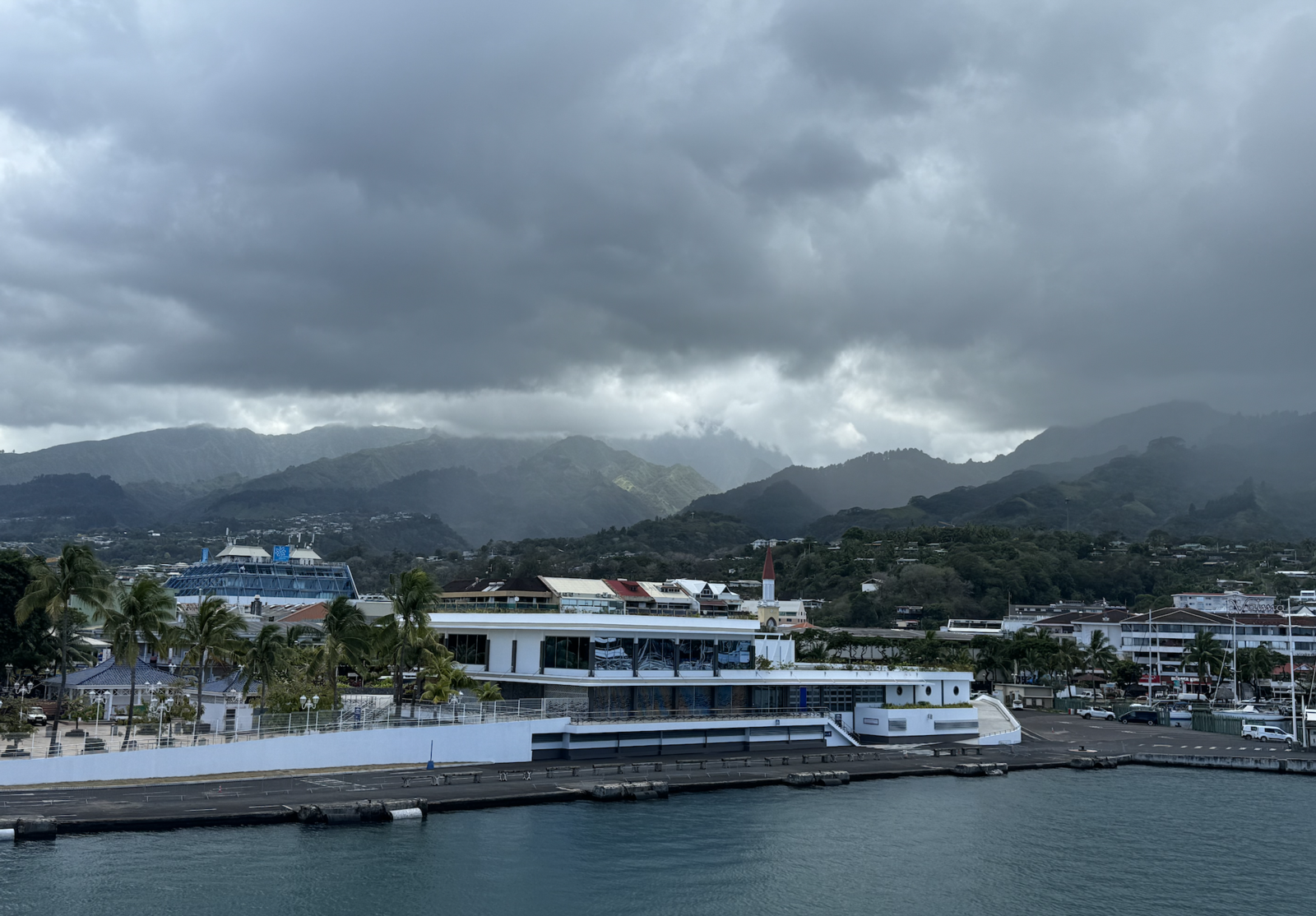
As we slowly drifted into port the anticipation kept building. Land! So close yet so far. From the ship we could now see green volcanic-jagged hills, palm trees, birds and dolphins as well as the hustle and bustle of cars and people going about their day. As the port came into focus, I felt a bit like an alien peering into a civilization of French billboard signs and aquamarine water. I think I breifly forgot cars and trees existed. Whoa, we made it! In the middle of this ginormous Pacific ocean there are people living their life on a beautiful tropical island, quite remote from any mainland and we’ve reached them, how lucky are we!

– View of Papeete as we arrived to port on the RV/Kilo Moana

The energy was high and everyone was in a bit of a scramble getting their bags downstairs, cleaning out state rooms and putting all blankets and dirty linens away.

Once we cleared immigration, we were allowed to get off the ship. Since most people were leaving that day, we got straight to action, checking out the Tahitian open air market, shops and restaurants. The scientific team picked out a place for lunch and we enjoyed tropical refreshments before tearfully saying our goodbyes. 

The following day, a couple of us took a rental car on the ferry to Moorea to circumnavigate the island and to visit some snorkeling spots. We visited 3 different beaches and saw tons of cool fish and even a sea turtle! 

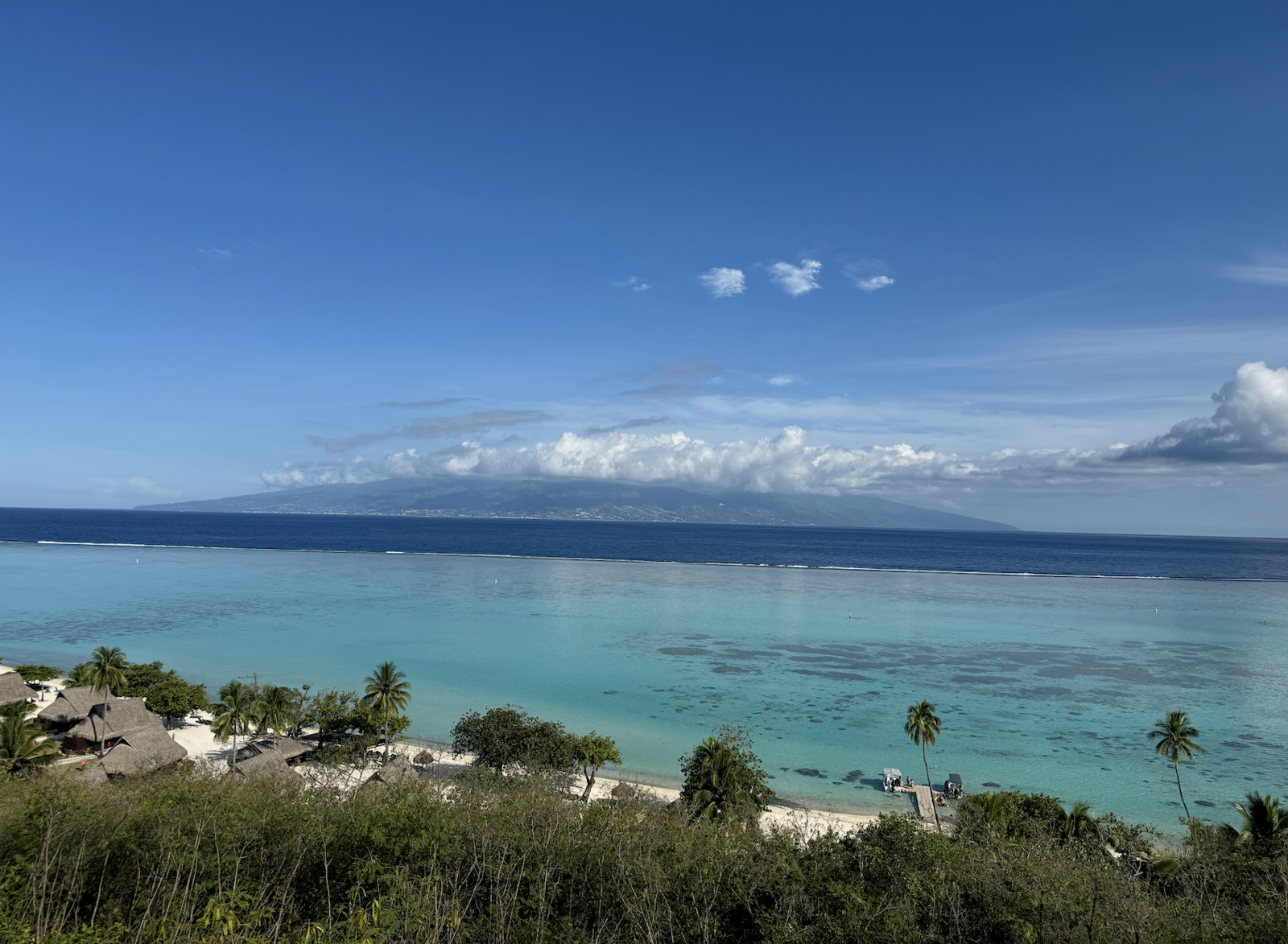
– View of Tahiti from Mo’orea, note the beautiful aquamarine color from the shallower parts

The following morning, immigration came on pretty early and cleared us to leave, thus concluding our Tahitian escapadé. We then set sail back to Honolulu, HI at 10am on November 28th, with only 20 people, 5 science members (Hunter, Dr. Ali Chase, OTG and I) + 15 crew members. Today also happened to be thanksgiving. For Thanksgiving, I couldn’t help but feel really thankful for this opportunity to learn at sea with an amazing group of scientist and crew members. I have so much grattitude for everybodies willingness to share knowledge and the ropes of doing science at sea (pun intended). That evening the galley crew cooked us a lovely dinner of turkey, stuffing, mac and cheese and more which was really nice. 

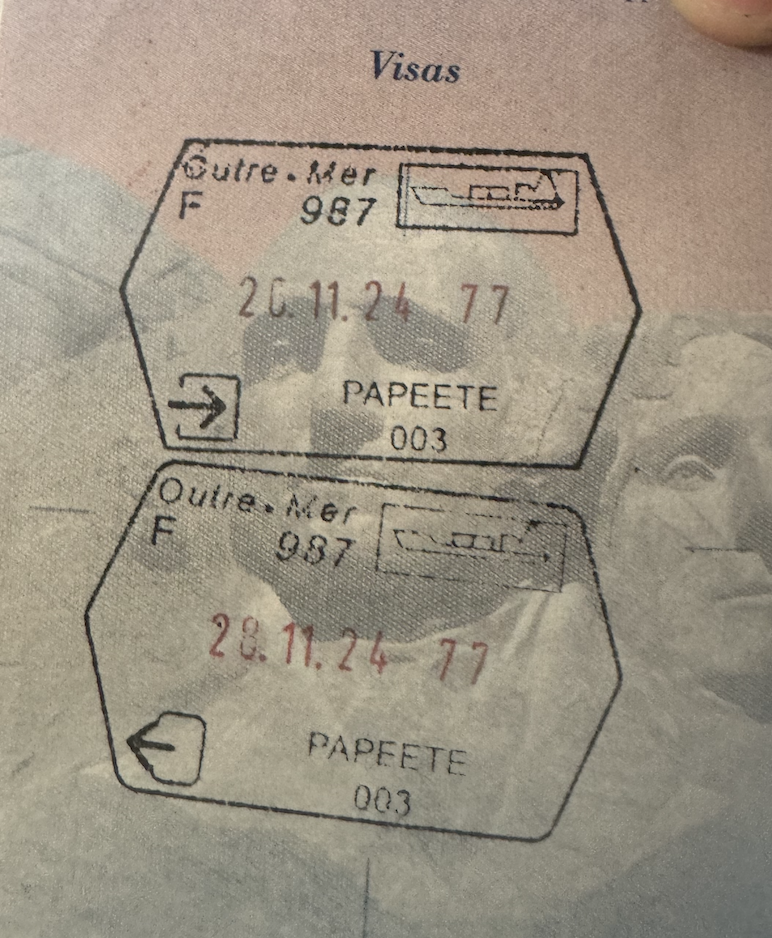
– Two new passport stamps, peek the lil’ ship symbol on the stamps.

Nonetheless, it was time to get back to work. By noon, we were helping Dr. Ali Chase get a pySAS instrument set up at the bow, since it had been decomissioned going into port. The pySAS instrument is an open-source autonomous sun-tracking system that records incoming and reflecting solar radiation from the atmosphere and ocean. The data collected is used to cross reference and validate remote sensing and satellite data and can also be used to elucidate oceanographic properties of the water surface. Since the one on the bow gave us a bit of trouble, we decided to start working on the spare that her lab also has. It was fun getting a quick dive into the different parts of the instrument, moving wires around and checking whether things are working using a voltmeter. 

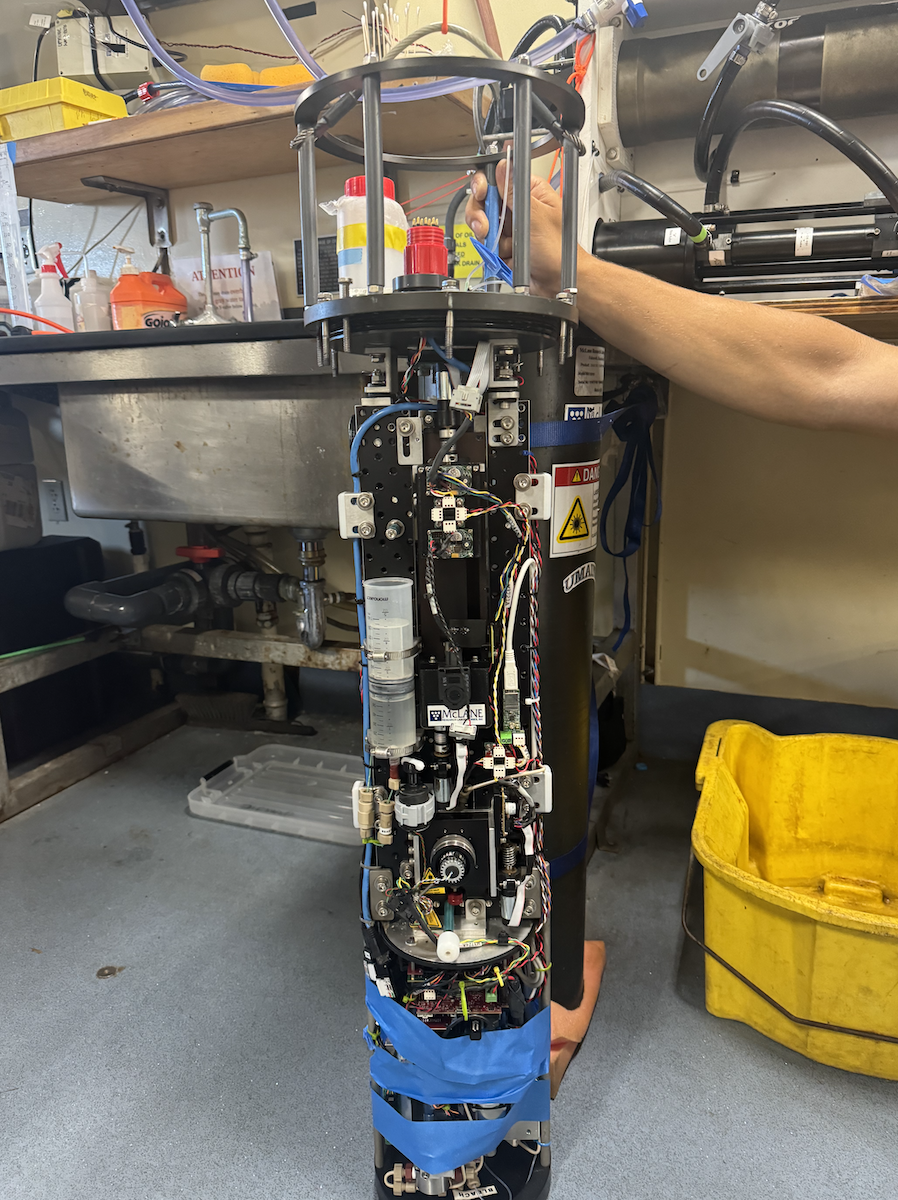
 – IFCB outside of its Titanium Case
This week, I also got to learn more in depth about the imaging flow cytobot instrument (IFCB).   An imaging flow cytobot is used for multiple things but it can detect, size and image cells floating in the water. It’s a great tool to get an idea of community distribution of phytoplankton in real time. Most labs have a program they run the samples through that also help identify the species of phytoplankton. 

However, there’s genuinely no better way to learn more about an instrument than when you’re learning to troubleshoot it to diagnose a problem. Due to the humid nature of the ship, we suspected that the humidity may have interfered with some of the sensors on the instrument. Therefore, we spent a couple of hours investigating until it was finally decided to just call the manufacturer and have them walk us through the different parts of the instruments and its troubleshooting. 

Ali’s set up also features Spectral Absorption and Attenuation Sensor (AC-S),  Submersible Particle Size Analyzer (LISST) and the Hyper-Spectral Backscatter Instrument (HYPER BB) all linked up to the ship’s underway system to take a look at the different properties of the water. It is super cool to say the least and I look forward to diving into more about it next week.

Cheers,

Briana

– Ferry Terminal in Mo’orea, French Polynesia

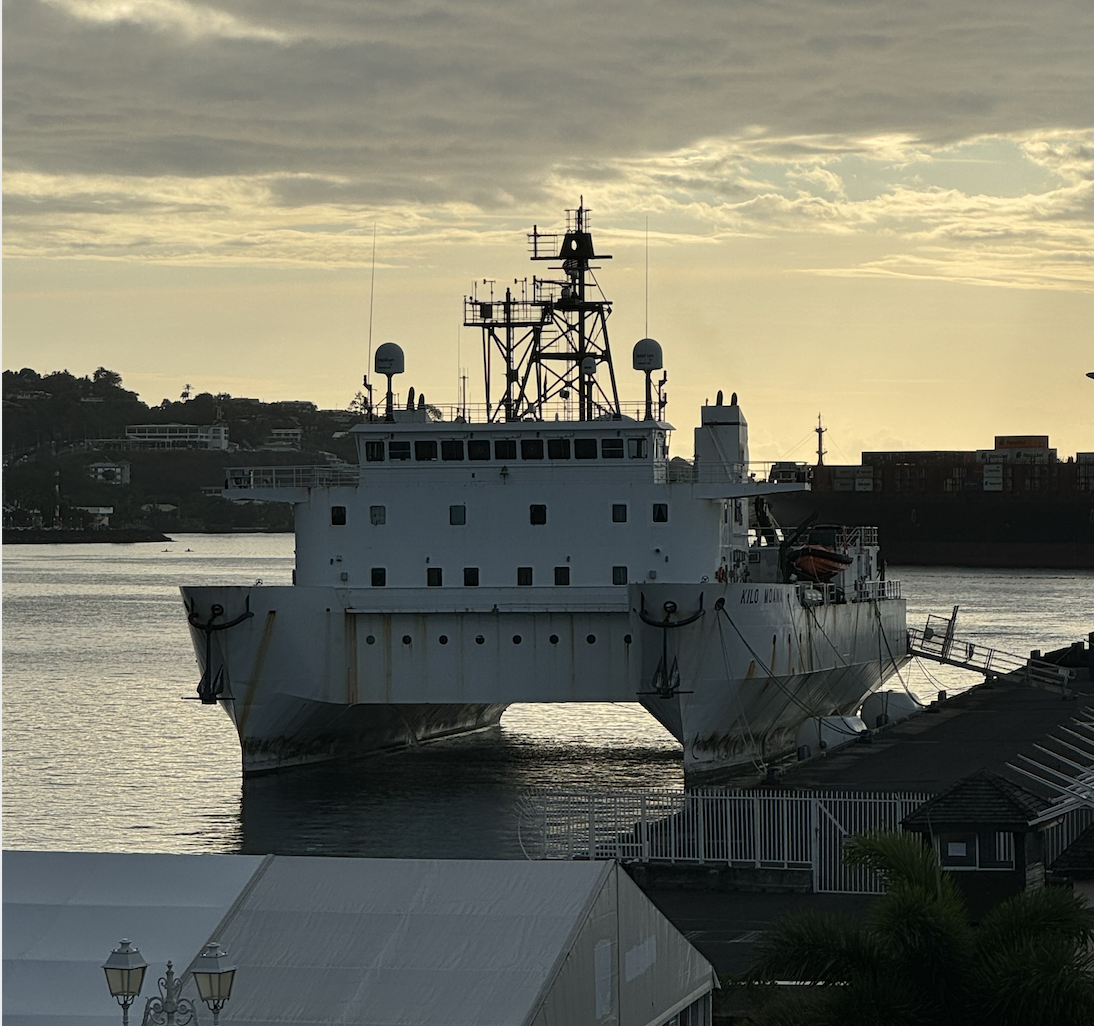
– The beautiful RV/Kilo Moana in Papeete, French Polynesia

L3W8: Swells and Station 13

Howdy all,

What an awesome journey we’ve had over these past two months of leg three! We’ve hit some major milestones over the last two weeks – completing all our long station sampling, wrapping up our uCTD casts, finishing the underway system collections, and getting the ship clean and packed up. Our next stop is Papeete, Tahiti, where we’ll resupply and exchange our crew and team of scientists!

Long Station 12 went off without a hitch with more successful deployents and recoveries of our CTDs and arrays. But Station 13 (appropriately named) threw us some curveballs. Our intended location for Station 13 was at 30° S location, but severe weather forced us to pivot to 27.5° S. Even there, we faced some of the roughest seas of our entire cruise. With high winds and large swells, deployments were more challenging and stressful for our equipment. Particularly pushing our CTD/rosette’s .322 electro-mechanical wire close to its safety limits.

Despite the challenges, Station 13 proved to be a triumphant finale to our main research operations. We successfully:

  • Deployed all ARGO and NKE floats
  • Secured all arrays
  • Collected, processed, and stored valuable hydrographic and biogeochemical data sets
  • Completed our 161st (and final!) celebratory uCTD cast

One of the most rewarding aspects of the SPOC cruise has been getting hands-on with our the various types of equipment. There was something special about not just operating but truly understanding and maintaining instruments like the LISST, UVP, uCTD, HyperPro, wirewalker, and various GPS beacons to name just a few. Developing this understanding has improved my confidence when working with this equipment and my technical abilities as a whole. 

We’re now transitioning into the final phase of my third leg- KM2419, an ocean floor mapping cruise from Tahiti back to Hawaii. The labs are cleaned and packed, ready for the transit home and subsequent HOT cruise. Stay tuned for updates for my experiences in Tahiti and the start of the mapping cruise!

All the best,

Hunter


– Sunset from Station 12

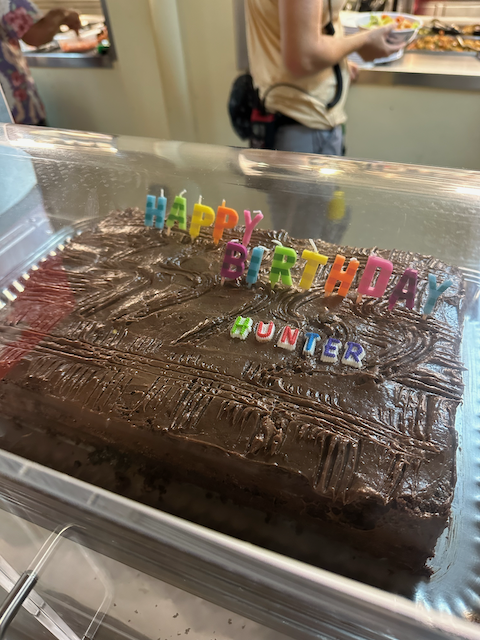
– The birthday cake that the galley crew was kind enough to put together for me

– One of the last uCTD recoveries near 30 degrees South complete with high winds and large waves

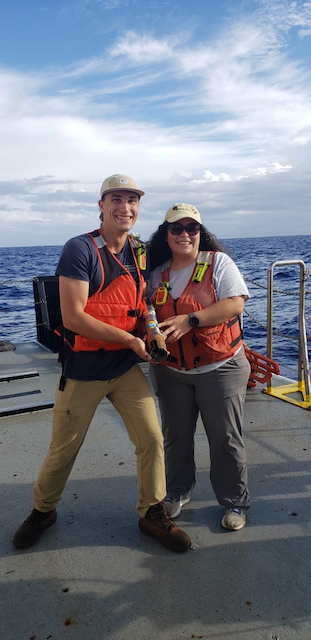
– Briana and I post uCTD #161 recovery

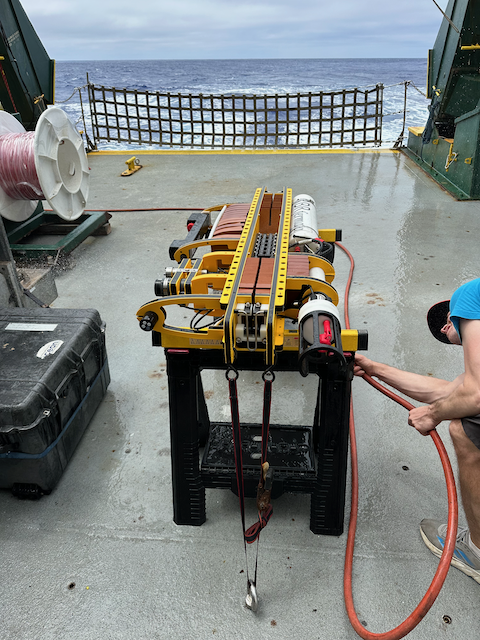
– The Wirewalker stripped down for cleaning before we packed it up

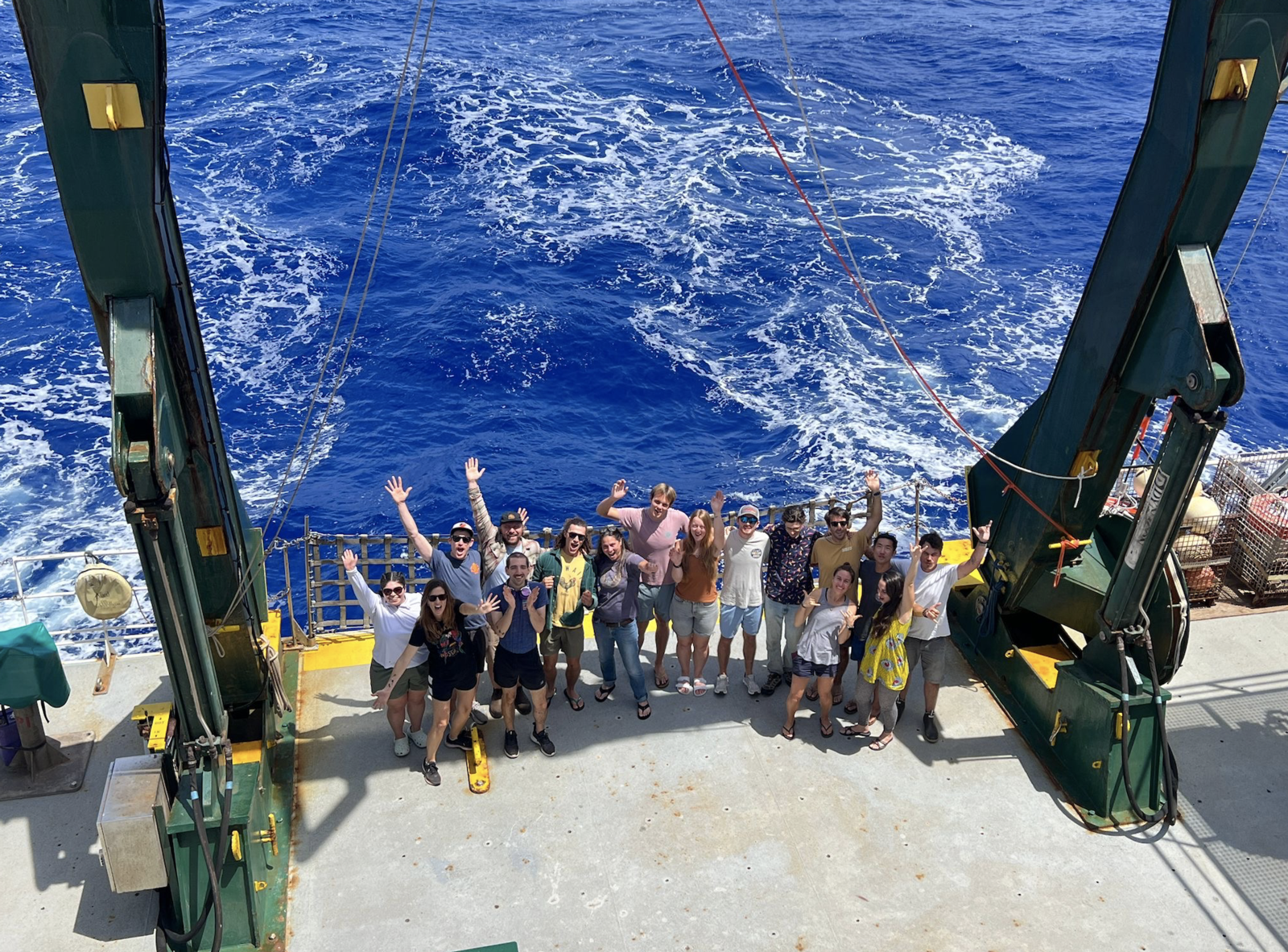
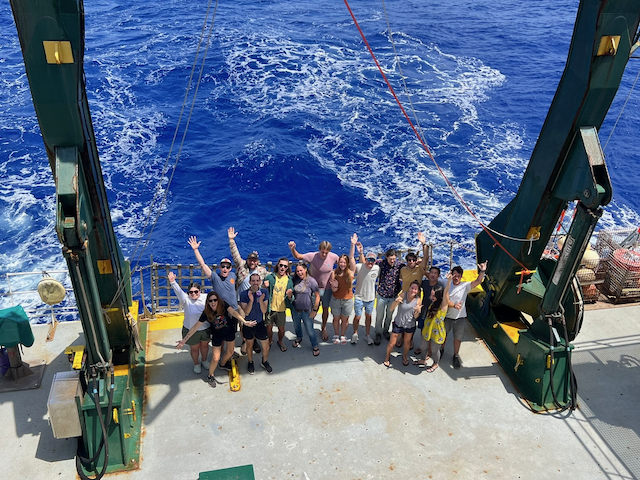
– A team of awesome people celebrating the conclusion of the SPOC cruise!


Page 14 of 103

Powered by WordPress & Theme by Anders Norén