Day 0 (7-13):
I landed at the airport in Melborne 07/13 around 2pm. Funny enough, my luggage didnt land with me! I had to wait for the next flight to arrive with my giant duffelbag (thanks again, Andy!) around 7pm before I could actually leave for port. After approximately 4 hours of waiting, a 45 minute car ride to Cape Canaveral, and LOTS of nervous excitement, I finally arrived at the dock!
After getting through the guard at the gate, I saw the ship for the first time. It was dusk, around 8pm, and The Langseth was truly a sight to see. Underneath the darkening sky and ‘parked’ just behind a SpaceX vessel used for transporting various launch equipment, the Langseth looked like some kind of industrial-sci-fi-pirate-ship.
4 decks were visible from the outside, each brightly lit and showing off the variety of gear on board:
Four HUGE spools, 20+ feet high to hold the 12 kilometers of tether to be used for taking seismic data once the boat was far off the coast
Two equally large cranes
A massive satellite-communicaitons antenna housed in what seems to be a giant balloon on what I later learned is the OBS deck, and
piles and piles of rope.
I had never been on a ship like this before, and the gangway (the removeable bridge used to get on/off boats) had rope hand rails–it made me think of Muppet Treasure Island. 😉
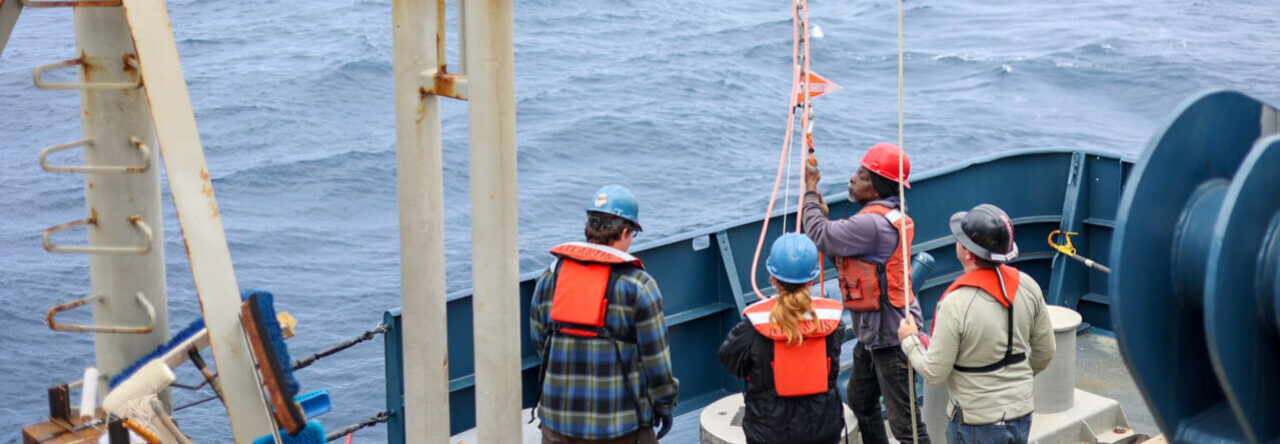
I met Cody, the ship’s CSO (Chief Science officer and my mentor), and Claire (the other MATE intern) immediately when I arrived. They explained to me the in/out board used to keep track of crew while we are in port, and then Claire showed me around the labarinth of passageways and doors that is the ship.
After meeting a few other crew and members of the science team, Claire showed me our room and the laundry area–where we get towels and sheets. We became fast friends, and chatted for an hour or two as I settled in and asked questions. Claire took the top bunk in our room (the bunks are so cozy–check out the little privacy curtains in the picture!) and I was happy to take the bottom one since I am much shorter than she is (lol). After putting the sheets on my bed and climbing into the little cubby, I closed the curtain and felt myself sink into the comfy little bed and relax–I hadn’t realized how tired I was from the trip and anticipation.
I slept wonderfully, which was just as well, since Claire and I were told to report to the Main Lab at 6am for work the next morning.
No rest for the wicked or for crew members!
Days 1 (07-14):
Claire showed me the way to the lab at 6am (it is on the very bottom of the boat) and today the real fun began. Introductions were in order, and after getting to know the other senior crew members we would be working with and getting a tour from Cody, Claire and I were off to begin the science-ing!
We helped calibrate and assemble Digibirds that first day; these are pencil-like robots with wings (they look like little birds, approximately 1m in length with wings the size of your face–see the pic below) that attach to the streamer, the long cable that gets towed behind the ship for collecting seismic data, and help keep the streamer at a stable depth.
Claire and I took notes, writing up procedures for calibrating the “birds” using their SYS3WOI software, and generally had fun while we disassembled, changed batteries, plugged in, pressure tested, checked compass headings, calibrated wing angles, assembled again, and so on.
Most of the day was spent doing this, until lunch and dinner that is — and wow. Do we have the best chefs on board. Shout out to Ricky and Jim!
I dont know what I was expecting with food on the ship but I certainly wasnt expecting the deliciousness we were served.
Ill spare you all ongoing praise and descriptions of the food, but there is a salad bar that is always available, plenty of sweet and salty snacks and fruits for munching, and just to give an example of the dinners and lunches, there was grilled cheese sandwiches with tomato basil soup in the afternoon, and cottage pie with broccoli in the evening — and I havent even started talking about the sides and secondary options to go with the mains. Oh, and the desserts.
All in all a wonderful day getting work started. I was happy and tired by the end of the day around 6, but the friends I had made on board (shout out to Claire, Nicole, and Bronwyn) and I decided we would take advantage of our time in port and hopped an uber to the beach down the road.
Couldn’t have asked for a better start!
Day 2 (07-15):
Today was spent continuing digibird calibration–but even more exciting was that we were issued coveralls for working on the streamer deck! Uncoiling meters and meters of (streamer) tether we checked electrical connections, I asked a million questions about the kerosene-filled tethers (this helps with acoustic coupling when the streamer is in the water) and their embedded hydrophones, and spooled even more–you guessed it–tether!
The tethers and streamer deck can get pretty dirty, grease tends to be everywhere, but I didnt mind, it was a fun break from our digibird task (which was fun but the change of pace working outside was nice).
See attached photo of the coveralls — I am a huge fan!
I just might have to get my own if I work on a boat again. 😉
Again the friend group went to the beach after work in the evening — there are no swim calls on the boat, so we wanted to take advantage of our chances to jump into the saltwater while we could.
Day 3 (07/16)
Turns out we needed even more digibirds! Since these devices are placed every 300 meters on the streamer, and the streamer is 12 kilometers in length (crazy, right?) we needed to have 55 of them ready (the extra ones were for incidentals).
Claire, Klay (a crew member that helped us learn the ropes on ‘bird work), and I got an assembly-line of sorts going and we finished them up today.
We learned a tremendous amount about how the digibirds communicate with the ship, how to change their wing angles, attach the collars that will keep them hooked onto the streamer, how to attach SRDs (Safety Retreival Devices in case a bird comes loose of its collars or drops too deep in the water column), etc.
Food was delicous as always and we are all making friends as the science team, engineers, PIs, crew, interns, etc. get to know one another; all personnel have arrived.
Tomorrow the ship takes off out of port at 8am, so after work the girl group made a final pilgrimage to the beach. It was sprinkling when we got there, but we jumped in anyway. We certainly got lucky because after ten minutes the weather cleared up and we sat on the empty beach enjoying one another’s company, discussing books to read, and making final calls home.
Picking up goodies at the supermarket is a common occurance before ships leave dock, and once the sun started going down we picked up goodies for the trip and met the crew at a restaurant/bar–a last hurrah before our trip starts in earnest.
That night there was a rocket launch at the Kennedy Space Center as well — the docked boat certainly has one of the best seats in the house! I missed it, funny enough, since it was in the middle of the night, but luckily we can see them while we are on the ocean sometimes. Fingers crossed, its on my bucket list.
Also of note–our ship, the Langseth, was docked behind one of SpaceX’s ships. Named, wait for it–Bob. lol
Day 4 (7-16)
And we are off!
I woke up again at 6am today but since the ship has left port I will officially begin my on-board schedule. The Langseth is a 24/7 ship, so shifts are staggered to ensure the operation is up and running at all hours. I have the night shift (what I lovingly call the phantom shift) from midnight-noon.
Today the transition will be a 6am-12pm shift then starting again at 12am. Fingers crossed I can go to sleep early enough!
Anyway, around 8pm we left Cape Canaveral. We passed a few cruise ships on our way out and said good-bye to Bob (the SpaceX ship) as the Langseth left the dock.
Standing on the boat’s tower (which I later learned is called the “PSO Tower” for “Protected Species Observer” — more on that later) I watched as the boat moved into bluer and bluer water. Nearly everyone was outside to bid the land farewell, and at one point or another nearly all of us were on the phone making final calls using our cells. You could hear “I love you”, “talk to you later”, and “see you soon”, “excited”, etc. in small snipets of conversation as you moved to different sides of the tower to see the ocean.
After making my own phone calls I just watched and waited. It was a beautiful day to set sail; the sun was shining and a steady breeze seemed to invite us out to sea.
Strangely excited to watch my phone slowly lose reception, I enjoyed the time outside chatting with my new team mates. There were a few of us who had never been on a research cruise or on a boat for this length of time and we were all thrilled to get going.
Cheers to five weeks at sea!
Day 5 (7-17)
12AM start. My first official day on the job! Today consisted of a lot of observing. My job, once the streamer is deployed, will be mostly in the main lab, monitoring the screens at what I call mission control. I am a Navigation Intern, and while yes, this involves learning the ins-and-outs of assisting in the navigation of the ship, I am excited to report that the internship will touch on a bit of everything related to the depolyment and acquisition of the scientific data!
Since the streamer hasnt been deployed yet, I was given a run-down on how the streamer, digibirds, air guns, and hydrophones work.
I also learned how to use a software called ORCA–used for path-planning and satellite-integration of the travel path with the desired shot-points to be made by the air-guns. See the illustration below for a better understanding — since the air-guns are typically made to fire at a specified distance, by entering a starting and ending lat/long into the ORCA system, ORCA creates a “line” with “shot points” marked at those intervals. Satellites then determine when the boat has reached each 50 meter mark, and the air guns then fire.
Pretty cool, huh?
Around 10am today (near the end of my shift at noon — it is strange and wonderful to leave work to the sun shining outside!) the streamer was fully prepped and beginning to go in the water. Since it is 12 km long there is something called a “Tail Buoy” that gets deployed first. The TB both keeps the tail end of the streamer from falling too deep in the water column, but also communicates its GPS position to the ship. 12 km is OVER THE HORIZON LINE.
Isnt that crazy?
On very, very clear days, I heard that it might be possible to spot the Tail Buoy with the powerful binoculars on the PSO tower.
After watching a portion of the streamer go out with Bronwyn and Nicole on the back deck, I went off to read before bed time, which is now 330pm. Luckily, the transition to this new schedule went incredibly smoothly!
Day 6 (7-18)
During Claire’s shift (we are on opposite shifts, she works noon-midnight) the entire streamer went out! While there is one streamer that is 12km long, there are four gun-strings, aka gun arrays. These are only a couple hundred meters long, and are towed immediately behind the ship. Each gun string has several air guns on it, all of them calibrated and positioned such that the pressure wave created travels almost entirely downwards and does not spread spherically; I believe it is approximately 98% of the energy of the pressure wave travels directly downwards. How cool is that? Not only is this good for the environment (for protecting species in the area) but it makes for a much more precise pressure wave striking the seafloor below the air guns, meaning that more energy is going into the ground, and we have a stronger signal to work with. See my very precise drawing/schematic of this below. lol
Today I was tasked with keeping an eye on the depths of the digibirds while the gun arrays were being prepared to be put in the water. I also learned today that when repairs are needed or the streamer array has to get recovered for adjustments, the boat needs to circle so that we can make sure we capture all shot points on our “lines”. With a 12km streamer loops take approximately eight hours!
When I got off shift today I checked out the onboard gym. It is really quite nice, since the treadmill is placed in front of a window, and you can run with the ocean in front of you. 🙂
Day 7 (7-19)
Today there was still some work being done on the streamer before we could officially start shooting the line. I got to see what an SRD (safety recovery device) bag looks like! There was one in the lab–they kind of look like large yellow arm floaties, but more rectangular, and they dont have a hole in the middle.
A lot of watching and waiting in the main lab today, learning more about how ORCA works, and adjusting to the environment of observing many (15+) processes at once: bird depths/compass reading/wing angle, tail buoy angle from the line (called “feather” angle), gun string separation distances, SRV (shot record value, which should stay above 20.1, this is the time in between shots), conncection status of gps pods 1-8 (these gps’ tell us the positions of the gun arrays), streamer tension, streamer speed through water and over ground, satellite connections with Seapath, the current speed and direction, etc. whew!