The weather finally gave us a break on Wednesday after two days of 35 knot winds, churning up the sea into a white mountainous mess. Its amazing high the swell can get after a sustained substantial blow. The Labrador Sea had taken on lake like qualities before the weather hit us, glassy and flat, perfectly reflecting the incredible sunsets and making for smooth sailing. You could almost forget you’re in the middle of the North Atlantic, regaining the ability to walk straight lines instead of bouncing off walls to your destination. Alas, a low pressure system moved in to remind us where we were and what the ocean was capable of. All the forecast predicted that we’d be riding tandem with remnants of the hurricane for the rest of the trip.
As the majority of the work is done for the trip, I spent a fair amount of time this week working through Matlab codes, making vector and contour plots with the ADCP data along the tracks of the seven CTD sections. This is not really the realm of a marine science technician, but I’ve found that the ability to code is essential to so many facets of ship board data collection and processing, so any experience I can get with it will be applicable or helpful in other situations.
We had a fire drill on Thursday which went off an hour before I was ready to wake up. I dragged my survival suit, PFD, and tired body to the lab for roll call. I always appreciate the training, especially when it could help me survive in a disaster.
When the alarm went off again an hour later I ran down to grab my suit and realized it was the real thing. Smoke and steam was filling the first deck. The smell of burning rubber and steam hung in the air. I got to the lab, surrounded by the same disheveled group of people as earlier, yet everyone’s eyes were keenly fixed on the SSSG giving instruction this time, knowing this was real. Luckily for us (not for the engineers), it was only an overheated engine and a few burst pipes. The situation was under control. It was actually a little scary not knowing if this could be one of those rare occurrences when we’d need to leave the boat and drift off into the forbidding building swells beyond the guard rail of the ship.
We had a great presentation on Thursday given by the chief scientist Bob Pickart on the present theories concerning the North Atlantic’s water circulation. He gave us a good overview of the topic and then went specifically into the meridional overturning circulation which we’re here to study, the goals of this cruise, and what we’ve found so far. Toward the end, he showed us figures of an amazing cyclone that we serendipitously collected data from with the CTD. Researchers had known cyclones developed in the deep western boundary current, but were unaware that they were an intact phenomenon this far south of the Denmark Strait. It was really incredible to see the high resolution CTD and ADCP profiles of the cyclone that Larik and I had collected the data from.
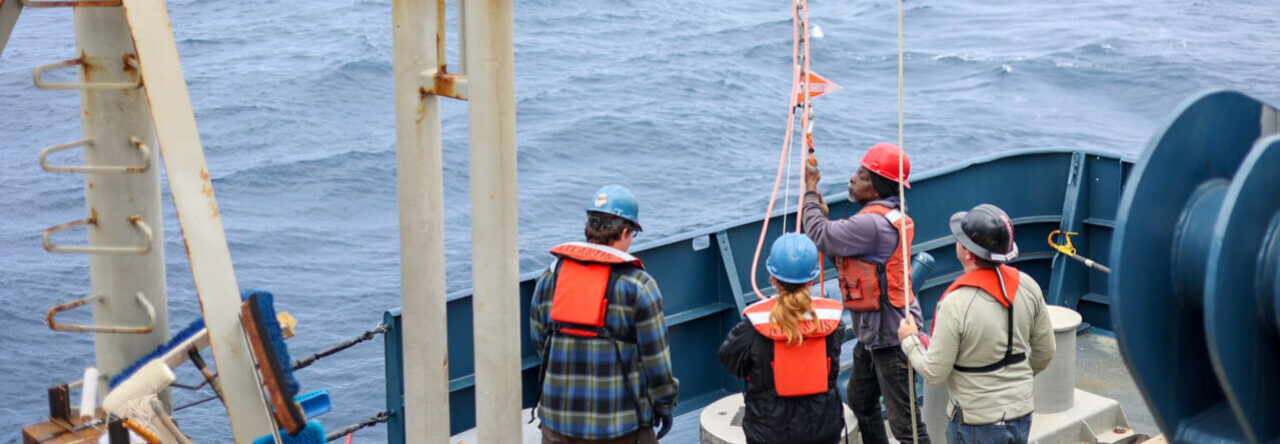
We headed to the Cape Farewell on Thursday night to do two more CTD sections, thus developing a better picture of the whole cape current system. These sections were unplanned but allowed more time for the hurricane leftovers in front of us to move north. The swell was pretty big Thursday night and all of Friday, due to the 30+ knot winds, which made CTD work wet, hard, and fun. The instrument would fly erratically out of the water on every recovery. Even when we had it hooked and tightened on the tuggers, the unit would buck around wildly in the wind. It was kind of intimidating at points, wondering how much pressure the weakest link of this operation could take.
We were pretty beaten up on the trip back to Iceland. The wind speeds were between 30 and 40 knots all weekend, which added energy to an already sizable swell. Waves pounded the side of the haul, sounding like car collisions, and from the bridge I watched the bow get continually buried by the waves. The ship pitched violently, sometimes reaching just beyond the limit of our shelf rails and table lips, sending the lab cascading to the floor. The same happened in the galley launching all the juice against the opposing walling causing a Jackson Pollockesqueexplosion. Half of the science team became drowsy Dramamine drugged crew members, limping in and out of their rooms, seized again by sickness.
The weather cleared and we came into Reykjavik on Tuesday morning. It was amazing. Cities tend to look so good when you are coming in to them from the water. The smell of the shore was so raw and inviting. Walking off a ship, after a month long sea voyage, back on to land is a very primal event. My legs wobbled; as if they’re unsure how use the solid surface underneath them. I was a freshly evolved animal, walking out from the water, making terra firma my home again.