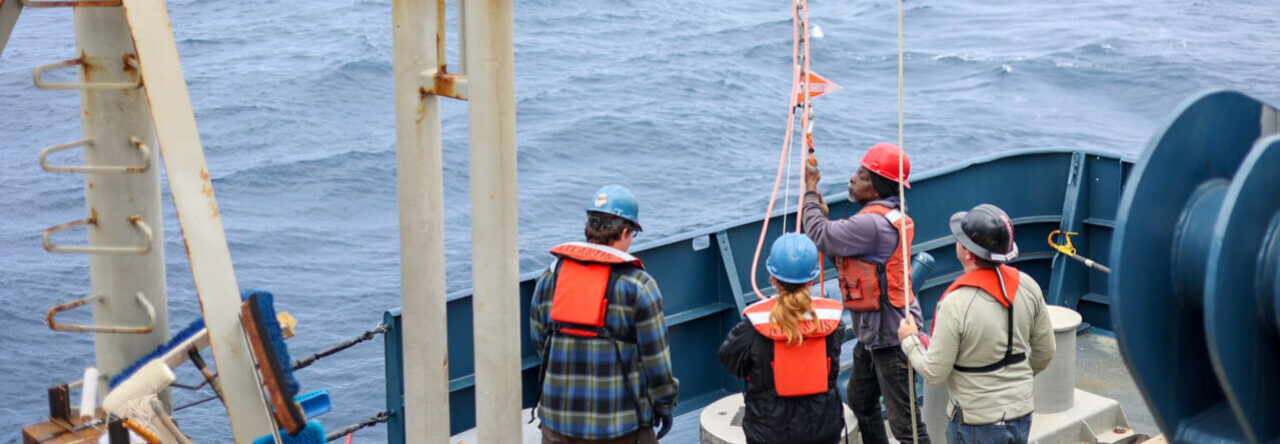
I’m on the night shift. A schedule I tend to prefer when doing something out of my ordinary– though I’m working hard to make this technician life my every day. Nights are so incredible on a boat. I am up to see the arctic summer sun set and rise again in the span of a few hours, over the tumultuous North Atlantic Ocean. At 2:00 this morning I got to see a remarkably colorful moon rise, with an unreal deep orange hue, peering through the shroud of blacken clouds. On overcast days, work is done engulfed in an inky atmosphere, giving you the feeling of being at the edge of oblivion.
A research vessel never sleeps, which induces the fear of missing out. There is a little trepidation of skipping a potentially interesting CTD cast or whale sighting when you decide to nap for a few hours, but that fear dissipates when your head hits the pillow. The same action and excitement is going on night and day, with moorings being assembled, birds soaring, and problems quickly resolved. It’s a dynamic chaos that works toward producing amazing discoveries.
I’ve been running the CTD watch from 20:00 to 4:00 every day with Larik, a student of the University of Moscow. He is a really smart guy and great to work with. He’s amazed by the safety standards of U.S. boats as compared with a cruise he took on a Russian research vessel. It seems the Russian ship did not emphasize the use of helmets, gloves, or thorough training on what is expected to be accomplished. He wears one of those striped Russian navy shirts to every shift, which cracks me up. He’s really playing the part of a mariner.
There is a lot of friendly and knowledgeable technician from Woods Hole and SAMS (The Scottish Association for Marine Science) to talk to and learn from on this cruise. The ship is alive, sort of like a bee hive, with mooring assembly and preparation for deployment—chains, shackles, glass buoyancy balls… Maybe it’s the giant yellow floats and copious strips of electrical on everything that has put the bee idea in my head. The SAMS mooring have been going out first, so I’ve done the most observing, helping, and learning with them. I’d never seen releases attached to the CTD to test their triggers at depth or their teardown and internal predeployment inspection. Both of the SAMS technicians are very generous with their wealth of technical knowledge and excellent conversation.
I’ve been helping Liz, formally a Woods Hole technician and now working for a research facility in Germany, with her current floats she’s preparing and deploying. They look like giant (2 meter!) test tubes, which are weighted to have neutral buoyancy at 2500 meter. After released, they will flow with the currents logging its position and velocity data, which will be transmit back to Woods Hole after a set interval. It’s unbelievable that something so fragile on the boat is going to survive years at sea, traversing the open ocean.
Dan, from Woods Hole, has been showing me how to use a Linux system to create an ADCP data collection program. We’re using this setup for the ADCP’s that are mounted on the CTD. I’ve had pretty limited exposure to that operating system, so the tutorials have been really insightful.
It’s only a few days into the cruise, and I already feel like I’ve learned so much.