
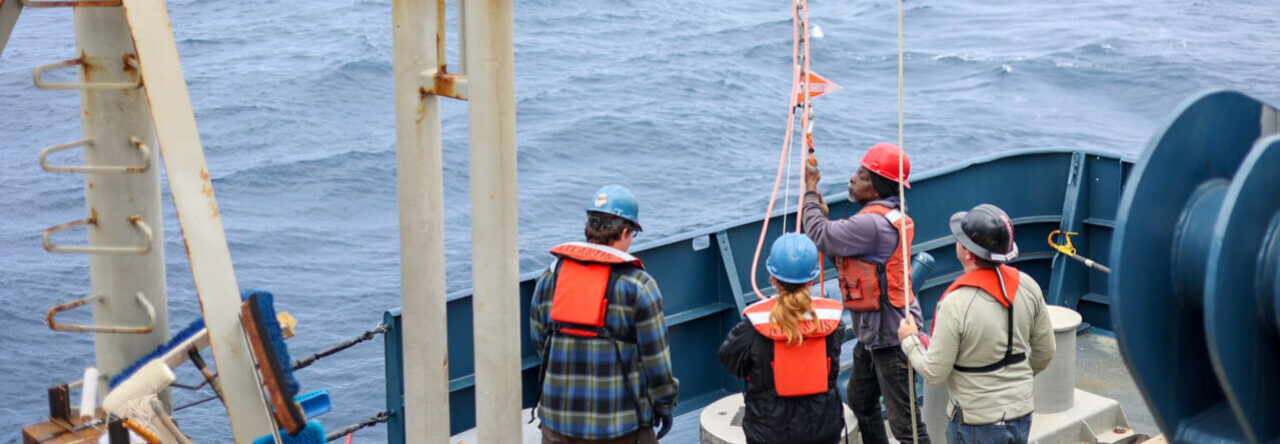
On board the R/V Knorr after a couple days in Reykjavik. The boat is tied up at the Marine Science Institutes dock, situated behind the Harpa, the city’s Opera house. The Harpa is really pretty during the few hours of darkness, as it has a constantly changing light show, dancing from window to window. It looks great from the boat.
As I came in on the bus from the airport, I felt that the Reykjanes Peninsula was reminiscent of Alaska, with its rocky tundra covered in low shrubs and grass. It is what I’ve come to think of as the classic subarctic plain, yet this seemed more alive. The occasional Arctic Tern or Puffin would soar from behind a pile of volcanic rubble, do a few loops, and then disappear behind a cloud of belched geothermic steam. The ground is alive. There is a serenity to the landscape that doesn’t fully express its violent beginning and continuing cataclysmic tectonic metamorphoses’.
It has been very interesting learning about early Icelandic/Viking history at the local museums. Such incredible maritime developments were pioneered by the Norse people, which allowed them to make safe(ish) passage across the North Atlantic, and thus discover Iceland (though there is some debate as whether Irish Monks were here first, but no evidence of their existence on this Island has yet to be found) and, very likely, the New World. It is in the wake of those innovators and artisans of blue water sailing that I get to experience for the next month of sea spray and science.
I’ve been serendipitously put on the boat with a shipmate named Nick. He just happens to be a past MATE intern, having just completed the six month internship, which consisted of two different passages in the Southern Pacific. Nick’s now working on the Knorr as a Marine Science technician, very happy about the results of the program and his job. It’s really inspiring to hear how well someone is doing with the opportunity I’m just embarking on.
We cast the lines off tomorrow morning at 8:00 and steam toward Greenland. We’re half a day out from our first mooring deployments for a group from SAMS, a research institute from Scotland, whose technicians have been busily assembling their mooring on the dock for the last two days. We all can’t wait to get going.