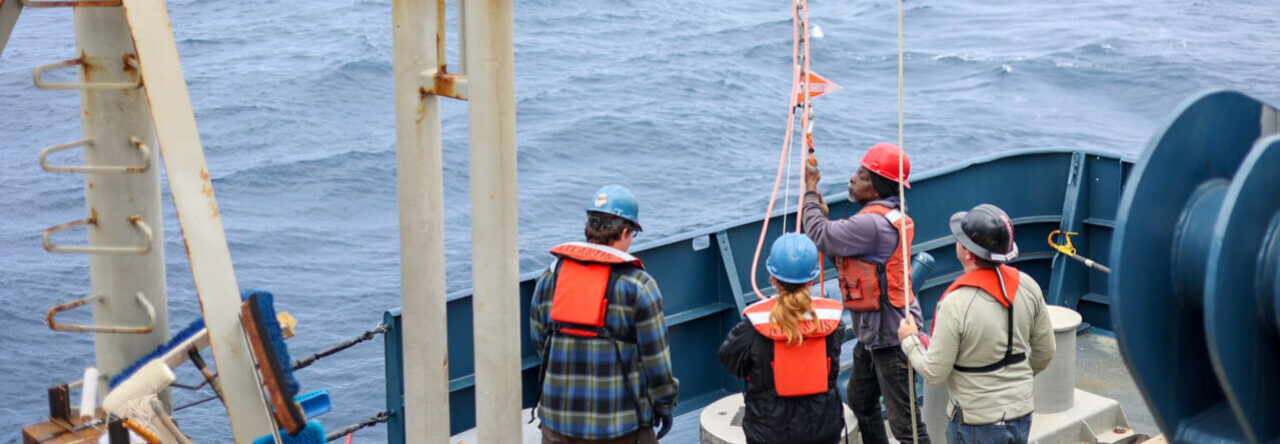
During our stop in San Diego, many things on the ship changed. We disembarked the science techs and all their gear, which I must say makes the ship look so much bigger, garnered provisions and got the ship’s winch back. The secondary marine techs were switched out and once under sail, we fired-up all that data acquiring equipment that we run and maintain as SOP (standard operating procedure). So now what? Today has been a day like any other while in transit. We made work lists and knocked out the items on the list. For example, we removed sensors from the CTD that are due for calibration, replacing them with ones from the ship stores, ordering replacements for the store from shore to be brought with the oncoming tech and updating all the logs that pertain to that activity. We trained on CTD terminations, so in the event there is a problem during operations, we will be prepared to make that happen efficiently. We spend our day ensuring that all the details that make operations efficient and smooth are addressed before the heat is turned up. We prepare. We anticipate. We pay close attention to the details, so the details don’t come back to haunt us at a critical moment. In addition, as we are headed for dry dock we have to coordinate with the engineers that power requirements are meet as we have certain equipment that needs to remain online no matter what state the ship is in. And, for me personally, it’s time to start tidying up my internship and personal details, like this final blog and laundry. The party’s over, so turn the lights out. Adios, Thomas G. Thompson.
Author: Pamela Ward
Since joining the vessel, I have learned how to cast a CTD, deploy ARGO floats and drifters, and what the processes entail to launch and recover TAO buoys; and those lessons, were mostly closely associated with the maintenance aspects specific to this expedition. However, those maintenance tasks were the easier part for me to absorb as I am not a novice sailor, nor do I lack mechanical skills. I also learned a lot about how to operate a plethora of electronic equipment that allows us to collect meteorological and oceanographic data; these are the ones I feared the most and all the while being fully aware that these are the bread and butter of a marine tech’s job description. Working as a marine tech is a lot as I anticipated and really stretched the limits of my knowledge base. See, the one aspect of the internship that gave me the most cause for pause, even while I was applying for the position, was knowing that the depth of my computer skills would be my Achilles; and, it has been. Yet, I have strengthened that weak spot and overcome some of the hesitation that is hallmark to such inadequacies. The picture I’ve chosen to accompany this article is a collage of all the different equipment that minimally, I have learned how to operate and maintain, and some, I have even learned how to troubleshoot and repair. From the multibeam that sends signals to the ocean floor for mapping, to maintaining our internet for communications to shore, which is so important professionally (and for a happy crew), to the SCS (Scientific Computer Systems) which monitors and logs no less than 168 sensors (at the moment), I can walk into the computer lab, and know when something is amiss, what that something is, why and how it is monitoring, how critical it is to operations and sometimes, EXACTLY what to do to fix it! Take that Achilles!
The dynamic fashion of the marine environment makes the idea of placing something like a grid (or a buoy) in a spot and expecting it to be there the next day, let alone a year later, a special task. The buoy, or what’s left of it in the photo, is just one of the issues we encountered that caused our route and plan to be adjusted. We had set this buoy and did the obligatory checks to ensure it was functioning properly before moving on to out next destination, just to be recalled to it within a day; we had lost all transmissions. In route to another maintenance recovery, we were informed just about a day before scheduled arrival that the buoy had moved 12nmi before losing contact; we didn’t find that one. Add to the fluid nature of the ocean, the corrosive environment and punishing ultra-violence of the sun, it’s little wonder that buoys have been such a reliable source for data at all. For instance, we’ve had to cut the mooring line twice now as the release mechanism did not respond properly to the release code, yet we recovered the buoys and most of the moorings. We cannot say with any certainty why the mechanisms did not release as average depth for these two devices hover around 3500m. The ocean is a world filled with hazards and unknowns. In spite of all these variables and possible derailments, the science team, through triangulation, determined that the last two buoys were located within 3m and 1m respectively of their designated stations, and we have managed to stay on schedule, pretty impressive. I believe these accomplishments speak volumes about the entire team’s ability to communicate, prioritize and function as a unit to fulfill our best laid plan.
While in transit, my mentor has shown me the ropes (no pun intended). The list of responsibilities of a marine technician seem as long as the day, but to button hole the job description, I would say, marine techs are here to serve the mission, which includes the needs of the many as well as the few, professional and personal. In addition, one tries to throw in whenever and wherever possible to get the job done. In general, we are the keeper of data, the link in communication and the glue that holds all the parts as a whole (next to the steward, of course, the food has been AMAZING!). Casting CTD’s has become mostly a night time event as the TAO buoys have to be done in the light of day. The CTD’s can acquire much more than just conductivity, temperature and depth; in fact, they can be outfitted with various sensors or equipment to measure or sample just about any parameter that the science crew requires. The one in the picture is loaded with this vessel’s standard equipment, which includes 24 bottles to sample water and oxygen sensors. Oh, and the catching? When we pull a buoy out the fish follow, and we get out the mitts because they practically jump on the deck! Fresh and local fish are a staple on this ship!
I arrived to the ship on Saturday the 4th, meet the other two techs, Brandi and Jenny (behind me in the photo) and got the orientation tour. No time to waste as we prep’d the ARGO floats for use. Disappointment of the day? trying to find my cabin again! The next day was Easter, but there’s no rest for the wicked .. or in our case, the Easter Bunny! He found us in spite of our undisclosed location and was very generous, leaving sweets and coins. Easter was our last day to go ashore, so we spent some time relaxing a bit and laughing a lot. Today we pulled out of port, and I am in the umpteenth hour of my watch. I’ve been shown so many aspects of my job already but have many more to learn. My training is interesting and going very well in large part due to my mentor (Brandi) who is organized, patient, relaxed and funny; it’s gonna be awesome!
The stress of knowing that if you forget something you’ll have to do without or rely on the kindness of strangers and the thrill of knowing a new adventure is on the horizon. I am feeling all of this at the moment. Lucky dinosaurs have no idea … but they did miss out no?
Image courtesy of Dan Regan