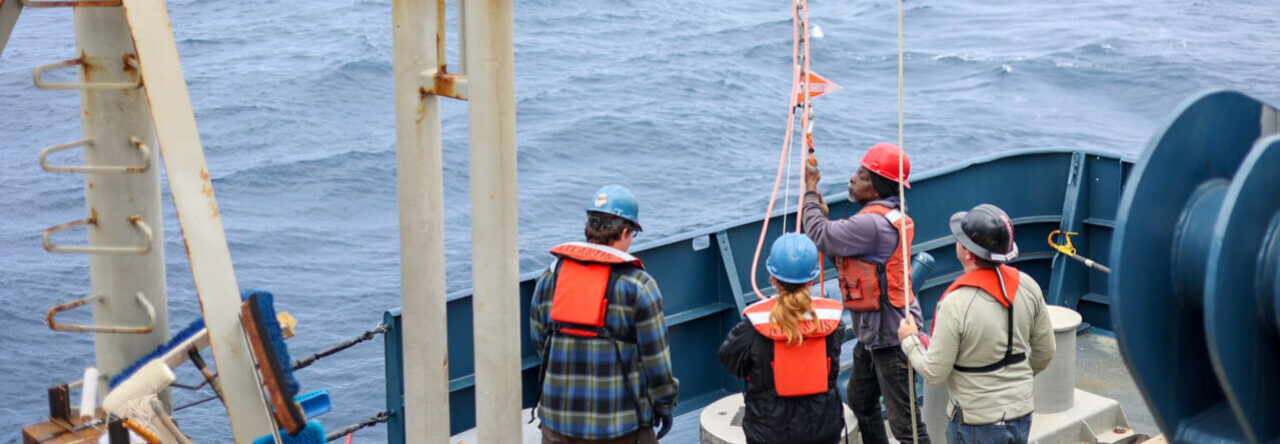
Since joining the vessel, I have learned how to cast a CTD, deploy ARGO floats and drifters, and what the processes entail to launch and recover TAO buoys; and those lessons, were mostly closely associated with the maintenance aspects specific to this expedition. However, those maintenance tasks were the easier part for me to absorb as I am not a novice sailor, nor do I lack mechanical skills. I also learned a lot about how to operate a plethora of electronic equipment that allows us to collect meteorological and oceanographic data; these are the ones I feared the most and all the while being fully aware that these are the bread and butter of a marine tech’s job description. Working as a marine tech is a lot as I anticipated and really stretched the limits of my knowledge base. See, the one aspect of the internship that gave me the most cause for pause, even while I was applying for the position, was knowing that the depth of my computer skills would be my Achilles; and, it has been. Yet, I have strengthened that weak spot and overcome some of the hesitation that is hallmark to such inadequacies. The picture I’ve chosen to accompany this article is a collage of all the different equipment that minimally, I have learned how to operate and maintain, and some, I have even learned how to troubleshoot and repair. From the multibeam that sends signals to the ocean floor for mapping, to maintaining our internet for communications to shore, which is so important professionally (and for a happy crew), to the SCS (Scientific Computer Systems) which monitors and logs no less than 168 sensors (at the moment), I can walk into the computer lab, and know when something is amiss, what that something is, why and how it is monitoring, how critical it is to operations and sometimes, EXACTLY what to do to fix it! Take that Achilles!