Author: Matt Scheuer

RVHRS Scallop Survey – Last Leg

After having to stay in Woods Hole one extra day for radar repairs, we left with a mostly-different group of crew and scientists.  I was now on night watch instead of day. Transitioning between opposite sleep schedules was tough for the first couple days, but turned out alright. I was happy to get on night watch just to see how it is. Turns out it’s pretty much the same, but darker. I prefer day. Night watch doesn’t have a “lunch” and you eat breakfast for dinner and dinner for breakfast. But a lot of people like the night shift better because it’s slightly more relaxed and you don’t get sunburned. It also goes by quickly. Photographing is harder, but some night shots came out very cool looking.

As we left Nantucket sound we were met with relatively rough seas. The plan was to do over 70 dredge tows and very little habcamming. I’ve gotten better at all the steps in the dredge process on deck. I’m always amazed by what we pull up and wish I had more time to study each sculpin and identify each strange item. I really don’t like how much bycatch we kill and waste. Most things come up dead or dying in the net, and there is very little effort to save things or at least eat whatever we can. We usually keep the best flounder or haddock, but a lot gets thrown back dead. The scientists count the fish but don’t measure most, so we get some data on some things but not as much as we could. Certain critters tend to survive, like skates (no swim bladders to expand) and most crustaceans but we could definitely do better with the bycatch. Of course our fine-meshed research dredge is tiny in the vast ocean, we do short tows, and the whole purpose of this research is to help protect marine environments. But it’s still tough to watch things suffer and die on deck. That’s one awesome advantage of the habcam- it doesn’t harm the benthic habitat or organisms at all. New marine technology can do some wonderful things.

Eventually the seas subsided. The weather was remarkably good the entire time, only a few rainy watches. There was a lot of fog out on Georges Bank though. The bottom was rockier on this leg of the cruise so we sometimes used the crane to switch in our rock chain dredge for certain areas. Rock chains are simply chains across the mouth of the dredge that exclude huge boulders. Some tows come up full of rocks. Several areas were very dense in big, old scallops. Going home with a big bag of sea scallops is one of the best perks on this cruise.

Another great thing about being in my specific position on this trip is that I’m in the middle of everything. Surrounded by a perfect combination of often-separate marine fields, I can get experience in all of them. I’m working with both the scientists and crew (groups that generally end up divided). The purpose of this scallop survey is to assess stocks for regulation, so my interest in marine policy ties right in. I’m learning hands-on about research, biology, fisheries, technology, computers, engineering, and seamanship all at once. Gaining experience as a technician and an understanding of how data is really collected will be valuable in any field. Being a technician is a nice balance of everything; I never felt confined to one role. Being able to interact with everyone on board was great. There’s a rich mix of very interesting people on this trip. Several of the crew came from commercial fishing backgrounds, and the scientists work for the government. The scientists, engineers, mates, captains and technicians all have a wealth of expertise in their fields. I tried to learn as much as I could from everyone.

We finished our marathon of dredging and spent the last couple watches habcamming. I piloted and copiloted a bunch. The display computer for our flowthrough system suddenly broke on one of the last watches and we spent a while trying to diagnose and fix the problem. Eventually we switched everything over to the data computer and got the (problematic) network of monitors back and displaying water information around the ship.

We had a few more dredge tows to finish up the survey, then pulled in to Woods Hole once again. The 2014 sea scallop survey was successfully completed! The ship unloaded equipment and I disembarked, concluding a truly awesome voyage.

RVHRS Scallop Survey – Second Leg

The storm passed without much intensity. Just some wind and rain. We left Woods Hole to cooler, clearer, beautiful weather and headed out to Georges Bank through Vineyard Sound and Nantucket Sound. On the way we had an abandon ship drill, passed one of the cape wind test towers, and saw a big colony of seals on Monomoy Point. We deployed the habcam and zigzagged with it for a couple of days. There has been a lot of wildlife already- both on the bottom and at the surface. The habcam was recording lots of scallops, sand dollars, sea stars, and hake with occasional skates, lobsters, and goosefish. On the surface we saw schools of small fish being chased by tuna, pods of dolphins riding our bow wave, and several whales. There were numerous petrels and shearwaters gliding over the surface and picking plankton out of our wake.

Within the first couple of days, seas began building and were forecast to continue increasing. Soon we had 10-15 foot swells, made more dramatic by intermittent failures of our hydraulic stabilization fins. The boat was rolling pretty hard at times. To be honest I kind of enjoyed the waves. In addition to the stabilizer problems we had a few strange, sporadic, hard-to-diagnose communications issues with our winch data network and our CTD. Troubleshooting these systems kept us techs and the engineers well occupied. As a whole, the important stuff has been working fairly well.

I learned to pilot the habcam, which is a little tricky but overwhelmingly cool. The pilot carefully watches incoming images, a sidescan display, and the depth/altimeter readings while using a winch control joystick to pay out or reel in cable. Ideally the camera sled flies two meters over the bottom. Keeping it there is easy when seas are calm and the seafloor is flat, but underwater dunes and a pitching boat complicate things.  

Dredging takes a lot of hard work out on deck. Working the dredge and sorting the catch is fun and good exercise, but tiring when we have a lot of back-to-back tows. The habcam is less work-intensive- for better or worse. Once in the water, the scientists control it from the dry lab and there isn’t much to do other than help fly it and annotate images. I do my daily sensor logs and maintenance, work on small projects or problems, clean the ship, help with whatever I can, and talk to the scientists in the lab and crew on the bridge. Until something goes wrong.

At one point we were on the bridge when a radio call came through from the lab saying that they lost all control to the habcam winch. The captain already had the ship at at full thrust so there was nothing the scientists could do but watch their picture feed and cringe as their million-dollar instrument plowed along the bottom. Ted, Casey (an engineer) and I ran down from the bridge, through the engine room, and to the winch room where we reset the winch controls and hydraulic power unit. Science raised the habcam to inspect it- luckily there was no serious damage.

We had a few more days of heavy seas and a whole lot of dredging. The variation in our dredge contents are amazing. It’s almost always a different mix, even between nearby stations. Sometimes it’s all scallops and fish, sometimes the dredge is filled entirely with sand dollars. It was cool to see all the life down there and I wished I had more time to study everything we caught.

Eventually the waves calmed down to the point that the sea became glassy. I don’t know if it was the calm water making things easy to see or some situation with currents, upwelling, nutrients and temperature- but one day we saw dozens of blue sharks, breaching and feeding whales, jumping tuna, schools of smaller fish, and enormous basking sharks leaping fully out of the water.

After a week and a half we began to work our way back towards Woods Hole to restock and change out scientists again. Ted, Max, and I disassembled part of the CTD carrousel and swapped out the sensors. This is done periodically so they can be sent in for maintenance and calibration.  We had a day in woods hole, loaded fuel, did the crew change, and bought so much food at the supermarket that their checkout computer crashed. Another MATE intern, Ali, is now on board as we set sail again.

RVHRS Scallop Survey – First Leg

June 30th. The motor is finally fixed and ready. We went out for a sea trial at 10pm and everything worked perfectly. We finally got underway soon shortly afterwords. Two things struck me as soon as we started the generators and disembarked. First, the Sharp is extremely quiet (for a big ship) even when she’s not in “quiet mode”. Second, she can maneuver in pretty extreme ways. Sharp can rotate around a point, drive sideways away from the dock, and do anything in between.

The first leg of our cruise was a short trip from Delaware up to Woods Hole with a bunch of data collection along the way. Adjusting to the 5am-5pm watch schedule took a day or two, but I like the 12-on 12-off watch system. I began the first week learning how to run CTD deployments by talking to the crane operator on the radio and processing station data. I also learned how to do my daily checks of the ship’s sensor readings and maintance of the flowthrough system.

In addition, I work on deck when we deploy/retrieve the habcam or scallop dredge. The habcam is an incredible piece of technology and does its job very well. It can stay in the water for days at a time and is towed at a relatively high speed; covering a lot of ground without doing any damage to the seafloor. We’ve already seen a ton of interesting benthic creatures on the camera and picked up a few shipwrecks on the sidescan sonar. The sidescan also allows us to see tracks on the bottom left by trawlers and dredges. In some places, especially off Long Island, the entire seafloor is crosshatched with dredge scars.

When towing fast, the the habcam’s tensioned cable starts to vibrate hard. In an effort to mitigate this, I helped the scientists attach zipties and rubber fringe to the cable.

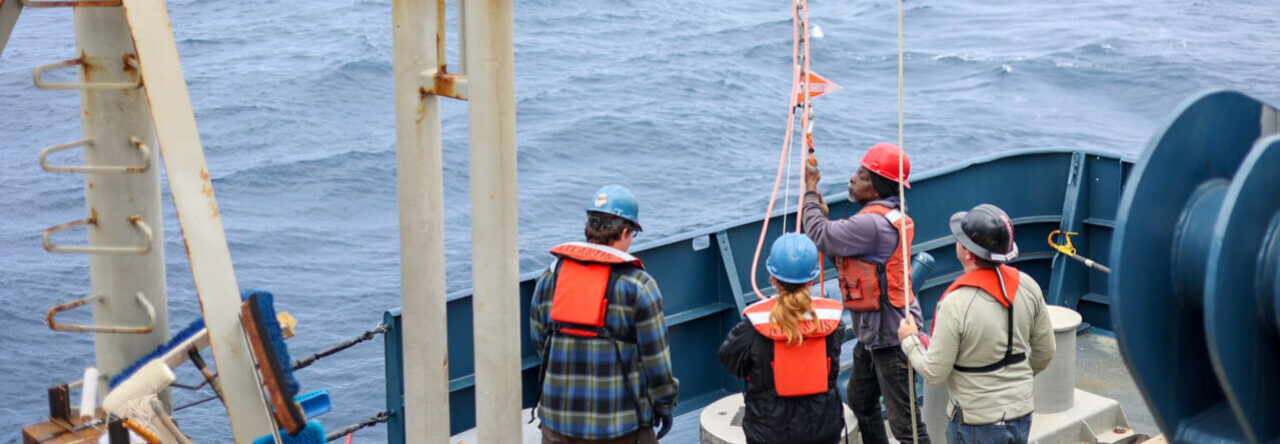
I learned to launch and retrieve the scallop dredge on deck with Ted. It’s fun physical work but getting the dredge safely retrieved, emptied, and ready for its next deployment takes a lot of coordinated steps. Two experienced people can get it done quickly and fluidly, but I’m still slowly getting the process down. Once the dredge is emptied onto the sorting table and secured I help the scientists sort out scallops, fish, crabs, and everything else we catch.

The food has been great, our first dinner at sea was steak with vegetables.

Everything on the ship is working flawlessly. But Apparently we can’t catch a break- as soon as we we put to sea a hurricane started building up off of Florida. It’s forecast to track up the Atlantic coast just like us. The captain decided to do as much science as we could then run up to Woods Hole a day early and wait out the storm at the WHOI dock. We had a nice little break at Woods Hole, watched the storm, changed out some of the science crew, and got underway again once the coast was clear.

Third week on the Sharp

    June 23/24
Lots of boat cleaning. Vacuumed, scrubbed, and organized. Max and I worked on making cardboard mockups of equipment that will go in one of the lab vans for another trip. Packing tape is the worst I rescued a terrapin that somehow got itself over the seawall was stranded in the hot parking lot.

https://lh5.googleusercontent.com/-rU32dKLAh8U/U7G6eleNyXI/AAAAAAAAJeg/Xet_6Tv5s94/s1200/_MG_0126.jpg A terrapin. 


    June 25
Still waiting for the replacement control board, it should be on it’s way from Italy. Since we know the motor itself works and we won’t have to re-open the deck, we finally mounted the ramp and sorting table for the scallop dredge.

    June 26/27/28/29
We found out that the part actually never shipped from Italy and it would be another few days. There was even a rumor that the part made it to America but was accidentally shipped back. It finally got here but it was stuck at the shipping place in PA over the weekend. So close but so far. Thats a few more lost days. 

A new plan has finally come together to get the trip going on this boat. Sounds like it’s not getting canceled. The scallop trip is critically important because NOAA can’t set regulations without good population data. Fishermen are very opposed to regulation based on old or extrapolated data, and rightfully so. Somehow NOAA and/or NSF made a deal with the next cruise (or just bumped them) and added about 11 days to this trip. Hopefully I’ll be able to stay on for those. If we ever get off this dock.  

Max and I got to go for a short ride on UDEL’s brand new R/V Joanne Daiber, a 46’ boat built for coastal research and ROV work. It’s very nice and had a bunch of ROV’s onboard. It was great to actually get on the water for a little while.

https://lh3.googleusercontent.com/-btTUVuhdQEo/U7G6kNFZU8I/AAAAAAAAJe8/baFG5r2mtiI/s800/_MG_1392.jpg Finally offshore, temporarily.

I organized some shelves of wires and wrote up instructions for the next person who has to clean out the followthrough system.

    June 29
Woke up to lots of alarms going of on the bridge. Turns out we temporarily lost shore power and the equipment freaked out. The chief mate got everything back in order. Later we had a little problem with the air conditioning but got it fixed pretty fast.

The motor part should get here today and hopefully we’ll be out to sea tonight or tomorrow.

    June 30

The part got here! The engineers installed it but had some problems with the software. If everything works out we’ll be able to do our sea trial tonight. The situation seems to be getting better. The scientists are on their way back from woods hole. I really hope they don’t get turned around again- for their sake and everyone else’s. The engineers are working hard and things are looking good for a sea trial tonight.

https://lh5.googleusercontent.com/-Ky14OyRPBwM/U7G6k5GkgVI/AAAAAAAAJfU/X3L2JGuD_lE/s1200/_MG_3870.jpg Better than Christmas.

Something went wrong on the CTD crane and the cable got kinked. Ted, Max, and I had to re-terminate it. I cut apart the old seals and made a diagram of the wire connections. Re-terminating involves cutting the end off the cable, resplicing the wires, reattaching the cable to the connector, and resetting the connections in a waterproof potting compound. To mechanically attach the cable, the end is bunched into a “birdsnest” which is placed in side the metal connection fitting. A chunk of soft metal with a very low melting point is heated and poured in around the cable. When it cools it creates an extremely strong connection. I took some pictures of the process for the procedure manual.

https://lh5.googleusercontent.com/-v3nnp2ON_74/U7HWI0aUbMI/AAAAAAAAJhs/ECSsgA41svM/s800/_MG_3930.jpg Casting the cable end

Second week on the Sharp

    June 16th
I spent the whole day rust busting and sanding the box corer. One part had an extremely rusty weld, I kept chipping and chipping without finding the bottom of the rust. Tim came over, jammed a chisel in there, and snapped the part right off. I didn’t think the weld was THAT weak! The whole device will be sent in to get assessed and re-welded once I get the rust taken care of.

The motor arrived back from the company- all fixed! It was lowered through the big deck plate and the engineers set about reinstalling it and reconnecting everything. The guys from the motor repair company were here too and I talked to them about the problem. They suspected the same thing as the engineers- that one of the rectifiers went bad and fried the DC drive motor by sending AC power into it. But nobody knew for sure.

https://lh4.googleusercontent.com/-Ey9FRFbkXd0/U7G6qYG5-_I/AAAAAAAAJgw/PUrJ-mDo6Dk/s800/_MG_8488.jpg Motor is back!

https://lh4.googleusercontent.com/-JRiQdEXFhHY/U7G6q-LPUfI/AAAAAAAAJg8/aoyioZgKcac/s800/_MG_8585.jpg Engineers reinstalling it.

We temporarily test-mounted a big new sideframe that can deploy equipment over the port side. It’s not for this trip, but is another cool piece of equipment and we know it will work next time.

    June 17th.
The scientists came back since the motor was fixed.

I finished cleaning and applying corrosion-inhibitor to the box corer.

The engineers worked on fixing the bow thruster, which wasn’t working because a cooling fan went bad.

One weird thing I’ve noticed is that most of the electronics on the ship are always left on. I’ve asked about it, and the answer is “so that we know if it stops working”. It doesn’t really make sense to me. But Sharp is usually at sea running everything, not sitting at the dock waiting. At least we’re on shore power which probably comes in large part from the wind turbine nearby.

The ship is rigged with cameras all over the place so that people can remotely monitor other spaces/equipment if necessary. The scientists fly the HABCAM from their control center in the dry lab, and wanted a camera view of the winch like the doghouse has. Ted and Max had been trying to get this set up for the last couple days, but none of the splitters or signal amplifiers they got seemed to work. I thought about it suggested we check the doghouse monitor for a video-out port that we could plug directly into. We found it, and it worked! Solving real problems on the ship is a great feeling.

https://lh4.googleusercontent.com/-n9Y1ppHf7dU/U7HTUXBljTI/AAAAAAAAJhc/pBpSVC8FgHk/s800/Screen+Shot+2014-06-30+at+5.11.36+PM.png The computer setup in the dry lab where science crew will “fly” the habcam.


I organized some of our drawers and installed a smoke detector in the lab van.

Rumor has it that the motor will be all ready for a sea trial tomorrow. Great news!

    June 18th
Motor didn’t work. Turns out it probably is something wrong with the rectifiers. A specialist is coming in from PA to figure out our rectifier problems. Like a lot of stuff on this boat, It’s a highly complicated and unusual system made by a company that doesn’t exist anymore. Parts and expertise are hard to come by. Apparently the New York ferries have a similar setup and this motor guy works on those. Hopefully he will solve our problems.

I went for a nice bike ride into town. It’s a beautiful little beach community with historic sites and nice little shops that are too expensive to buy anything from. I checked out some of the parks and museums, including a lightship and a house with a cannonball stuck in it.

I did a little fishing and taught Earnest, a student with the scientists, how to fish. We saw lots of baitfish and a saw a blacktip shark feeding on the surface but didn’t catch anything.

June 19, 2014

The motor problem was in the rectifier and we’re still stuck here for a while.

I spent most of the day hanging out with the scientists. We had breakfast at Surf Bagel, everybody’s favorite bagel shop. In the afternoon we rented kayaks and went for a paddle in the mash. It was gorgeous. I had wanted to kayak in there since I arrived but figured I’d never get the chance. It was good to get a long workout and have some fun away from the boat. We saw a lot of cool wildlife. I brought my camera gear with me and got a few nice pictures. Some people are horrified to watch me change lenses in a kayak- but bringing it into risky places is the only way to get good pictures. Ultimately, it’s what the camera is for. I really enjoy shooting from a kayak because animals don’t see you as a threat for some reason. It was interesting to note the differences in wildlife (and people) between Delaware and New York. These places are not that far apart, but things are distinctly more “southern” here.

https://lh3.googleusercontent.com/-YsrPakLwLOs/U7G6gyoqBzI/AAAAAAAAJeE/L2_DYhx3hok/s1200/_MG_0460.jpg Kayaking

Earnest and I fished more in the evening and saw a cownose ray. All we caught was a someone’s old lost lure- but catching a fake fish is still catching a fish in my book!

All in all a fun day.

    20/21/22
Not much going on these days; still standing by to stand by. The boat is still not working but we are progressing toward a solution. The engineers swapped parts between motors until they found the problem- one of the rectifier control boards. They have to locate and order a replacement part, but once we swap it in everything should work. That’s great news. But a new circuit board is hard to find and may take a while to get here. Every single part of this boat comes a different foreign company and everything is extremely complex.  

https://lh5.googleusercontent.com/-HJevXeyvmu8/U7G6emCVIEI/AAAAAAAAJeQ/apztvPMHGV8/s640/IMG_0313.jpg The root of all evil.

I biked to town a few times to get stuff and go to the beach. I also went for a bike ride into what I thought was going to be part of the nature preserve, but I ended up finding cleared woods and a new housing development. Saw a fox and got some cool pictures though. Also biked into town more.

https://lh4.googleusercontent.com/-peMSeJ2u1Eg/U7G6jrgsaBI/AAAAAAAAJg0/jWI100w80qw/s800/_MG_0923.jpg

https://lh4.googleusercontent.com/-Tv5FYxKuHFA/U7G6hvV8jMI/AAAAAAAAJec/__5jXA_PVBE/s1200/_MG_0767.jpg

I went out to dinner with the scientists again. Lots of talk about canceling the trip and other options. Sharp is by far the best boat for the job and there aren’t a whole lot of other ways to do it. They left again the next morning. Everyone is very worried about the trip getting canceled. We’ve sat at the dock too long. It’s costing a lot of money.

First week aboard Sharp

June 7th
Got picked up from Salisbury along with Brent. TR, the deckhand who picked us up, broke some bad news when I got in the car. The ship had suffered a pretty serious motor failure the previous day. Nobody knew what happened or how long the repairs would take, but it sounded like we wouldn’t be going anywhere for a while. During the car ride TR told us all about the scallop survey, the crew, and life on the ship. I learned a lot- some exciting and some worrying.

I got to the ship and was welcomed aboard. I was actually here! Everything on the ship was unfamiliar and overwhelmingly cool. The scientists were loading equipment with the deck crane and everybody was working. I met a whole bunch of people in quick succession including my mentor, Ted. Ted started as a MATE intern and is now Sharp’s lead technician. He showed me my room, which I had to myself for now, and gave me a quick tour of the ship. I pretty much followed Ted around for the rest of the day asking questions.

R/V Hugh R Sharp is a relatively new and incredibly high-tech vessel built to conduct a wide range of research. There are computer displays everywhere, an special crane system for the carousel, a big A-frame with two large winches (one fiberoptic). Four big diesel generators power the ship and run two electric Z-drives. Actually, only one z-drive at the moment. The modular deck is set up to be reconfigured with different equipment, as are the large dry and wet labs. The dry lab is currently packed with computers from the scientists. The ship can hold two 20 foot vans (interchangeable container-like rooms) one of which is onboard and set up to measure scallops. The bridge looks like something out of star trek: Three big chairs, a semi-circle of screens, several control panels, and joysticks instead of a wheel. The bridge wraps all the way around for a 360? view and has a mini-control center in the rear for steering or operating cranes.

Already I felt like I should be doing something and helping. But I had no idea what to do or how to do anything. Everyone was talking about the motor and waiting for information. Standing by to stand by. I helped the cook load some groceries, then we were all given the day off. We spent it at the beach. Definitely exactly what I was expecting for the first day of my internship, but a great way to get to know some of the crew and hear their stories, advice, and opinions about working on the ship.

The plan is to work on maintenance and preparations while we sit at the dock. It sounds like there’s a lot to do, the ship has a long list of neglected and broken things. In port we work 7am-3pm monday-friday instead of a rotating watch. Most of the crew live nearby in town and are not staying on the ship overnight. The scientists stay here though.

The starboard drive motor has been removed through a large deck hatch and brought to a repair company in dover. I don’t know the extent of damage but I’ve heard people say it was pretty bad. While we wait for the motor, we’re fixing broken/neglected stuff, preparing equipment, and the scientists are setting up their gear.

    June 8th
Two main sampling techniques are going to be used for this scallop survey: a simple scallop dredge and the HABCAM v4. The HABCAM (Habitat Camera) is basically a big towed camera that photographs the sea floor and creates a continuous ribbon of pictures. It doesn’t disturb the bottom the way a dredge does and can provide a whole lot of interesting data. Its heavy stainless steel frame is just smaller than a car and holds the camera, flashes, and several other sensors including a sidescan sonar unit. It’s towed just over the bottom and sends images up our fiberoptic winch cable.

https://picasaweb.google.com/lh/photo/D1HSs3TnSdOSaUJf-RjAGrmVY76ceysKV-lKjL5QGt8 HABCAM being positioned on deck whith the crane.

The scientists spent the day working to re-terminate and attach our fiber cable, which  apparently is not an easy task. The cable is spliced and epoxied into a large metal fitting which bolts to the habcam. They had to do a pull-test to set the cable into the epoxy and make sure it was strong enough. We attached the fitting to the deck and pulled 11,000 pounds of tension on it with the winch. It held.

https://lh3.googleusercontent.com/-cfmF468GCz4/U7G6l_U6lFI/AAAAAAAAJfg/yavRFiFBEXo/s1200/_MG_4529.jpg HABCAM cable termination

https://lh3.googleusercontent.com/-Wcmm716_W-k/U7G6YKMlHcI/AAAAAAAAJcw/j7JsApE7RL0/s512/IMG_0086.JPG pull test

https://lh4.googleusercontent.com/-RIFy4pzf5gI/U7G6mfBZ0BI/AAAAAAAAJfk/CiVJ8l4nP2g/s800/_MG_4562.jpg and dunk test

Later in the evening I went to the movies with some of the scientists. It seems like the crew and the scientists tend to separate themselves. Technicians are in an interesting place in the middle. I like our science people and want to get to know them better.

    June 9th
There was supposed to be a fiberoptic internet cable running under the parking lot so that the boat has high speed internet while in port. We hooked it up but it wasn’t working. Instead, we ran a few hundred feet of cat5 cable from the building, high over the driveway and to the ship. It didn’t work immediately and we spent a few days messing with network stuff.

Brent, the technician who came to the ship with me, left. UNOLS can’t pay him to sit around without the ship going anywhere.

To be honest, things here are a little more chaotic, unregulated, and SNAFU than I was expecting. I’m slightly worried about some of it. Sharp, though young, has streaks of rust down the sides of her white hull. A bunch of systems are broken. Stuff isn’t strapped down for heavy seas. All the high-tech design features add over-complication and more things to break. I’ve already heard plenty of complaints, “office politics”, and seen some questionably safe things. There’s less of an oppressively safety-first atmosphere and less motivation that I’ve experienced elsewhere. I suppose I got used to the procedures and attitude at Sea Education Association, where they go WAY above and beyond with safety, caring for the ship, keeping order, and doing everything exactly by the books. But SEA has to- they’re training people and bringing new students far out to sea. Things on the Sharp are a little more “practical”. I think the problems are mostly due to us being stuck at the dock without most of the crew aboard. Everybody says that it will be entirely different once we put to sea.

    June 10
Apparently the motor “lost it’s field” (whatever that means) and burned out. It’s salvageable but needs new brush mounts. These are a pretty simple-looking part, however they’re made of a weird alloy that has to be special ordered or custom forged. Nobody seems to know what actually caused the motor to burn out. Hopefully we can get the parts and be out in a few days.

We went into town to buy some tools, equipment, and gear. It turns out that the foul weather stuff is for working with the scallops and dredge; we need the real heavy fisherman kind instead of what I had. My boots also aren’t tall or waterproof enough. They got me a set of Grundens.

Max (one of the ships techs) and I spent a lot of this week cleaning out the flowthrough system. The followthrough system allows scientists to continuously collect basic water quality data by pumping sea water through a series of sensors that take measurements. Someone had run it improperly and left salt water sitting in it. Everything inside was coated with sludgy algae. Max and I drained the system then disassembled the tubes and machines to clean everything out. Somehow, there had been full-grown barnacles living in this thing! Hopefully they weren’t eating too much plankton before it got to the fluromoeter. Not that it would read properly anyway because they were living in the cuvette as well. We thought that the cleaning the flowthrough system would be an afternoon project at most- just snaking out the pipes. In reality, it took about four days.

https://lh3.googleusercontent.com/-q1Id6oPyKIc/U7G6aBmZ8RI/AAAAAAAAJdA/mD2HnFhi2HI/s800/IMG_0130.JPG Working on the flowthrough system.

https://lh4.googleusercontent.com/-uso7pdrJNbQ/U7G6ZkHAH0I/AAAAAAAAJc8/6ekj8Gn4alE/s800/IMG_0122.JPG That’s a declicate cuvette completely full of barnacles.


    June 11th
Finally finished with the flowthrough, Ted asked me to design a waterproof box for an ethernet hub in the doghouse (winch control booth on deck). I took measurements and found an otterbox that will be perfect once modified. Ted ordered it.

The Sharp has a tall flybridge which raises our center of gravity but is a great platform for mounting antennas and spotting things in the water. Today us techs ran cables through the ship and installed a new set of 4g antennas up on the top. These will give us a pretty good internet connection when we’re within range of cell towers.

https://lh5.googleusercontent.com/-D3s-gi3cXiM/U7G6clKNHWI/AAAAAAAAJdY/E9_GgZnxoxU/s800/IMG_0151.JPG There are definitely not enough antennas up there. Lets add more!

Working aloft was a lot of fun. I already feel like a real part of the crew. I think we all mesh very well- in large part because we share a similar crude and sarcastic sense of humor. I love it, it makes every job more fun.

The engineers fixed a problem with the sewage system and also got the bow thruster back online. It was a good day. Things got done.

We saw a huge sea turtle right here in the harbor, probably a loggerhead. There are also diamondback terrapins all over the place. Our marina is right at the mouth of an estuary, next to a big salt marsh and nature preserve. There’s a remarkable amount of life here. Schools of fish, diverse birds, and plenty of fishermen. It seems to be an strikingly healthy, flourishing ecosystem. There are several osprey nests, one of which is on a pole about a hundred feet from the ship. In it, two attentive parents are raising an adorable fledgeling. The Sharp’s flybridge is just about level with the nest, we can easily see them bring fish back and feed the baby.

https://lh6.googleusercontent.com/-I6meiyMbWVY/U7G6oXJvoOI/AAAAAAAAJgI/AFHgLXTstc4/s1200/_MG_5503.jpg See? Turtle.

https://lh6.googleusercontent.com/-LUM_7zT5_SE/U7G6nbirj8I/AAAAAAAAJf0/NIX_ehk8pwM/s1200/_MG_5408%2520srgb.jpg
Osprey family.

Speaking of food, the food onboard has been great! Paul is a good cook.

    June 12
We had to take the sketchy parking lot ethernet cable down, then put it back up again. Sort of annoying and dangerous. Anything for that high speed connection though!

The scientists finished their setup and went back to woods hole at 5am. They can’t sit around while the boat isn’t going anywhere. I feel pretty bad for them, hopefully this delay doesn’t impact their projects too much.

Ted asked me to organize our spare parts, which are kept in the forward storage room. That bow compartment is also where all the nonperishable food and drinks are kept. Since we had recently taken on food that nobody put away, I couldn’t get past it to reach most of our tech stuff. I spent most of the day cleaning up and organizing food stores. I wasn’t really supposed to move all the food around, but it was in my way. Luckily the cook and captain both said they appreciated it. Once our food was out of the way I straightened up and consolidated the boxes of tech stuff and made sure they were as secure as possible. I couldn’t properly inventory everything because I’m just learning with most of the random cables are for. This was a perfect way to start getting familiar with what we have onboard.

https://lh5.googleusercontent.com/-5vHNt5hyfp0/U7G6d4B0pDI/AAAAAAAAJek/8yH3Jj7Borg/s512/IMG_0178.JPG before

https://lh5.googleusercontent.com/-kakSc7xmYsQ/U7G6ehglQfI/AAAAAAAAJds/hu9Z4N7_8Ag/s512/IMG_0179.JPG after

Tim, who’s in charge of the tech department, lent me a bike to get around on. It’s a big help while we’re here in port.

    June 13
I Helped TR with his project- renovating and organizing one of the deck lockers. Then I was given the job of cleaning up an old box corer. It’s a heavy metal device that’s dropped to the bottom and takes a large sediment sample. It’s very rusty. I learned how to use a needle gun to remove rust. The needle gun is a pneumatic tool with a bunch of quickly reciprocating rods that chip rust away very effectively. Rust busting is hard work, but actually pretty fun.

https://lh6.googleusercontent.com/-SC04JN-cPCE/U7G6oz6xlpI/AAAAAAAAJgU/0JpFL9hThpM/s1200/_MG_5535.jpg Cleaning up part of the box corer.

The marina shop here is amazing. It’s a small warehouse with everything from a machine shop to a woodworking space. There’s a multi-story garage called the high bay with big doors and a 5-ton lift that can travel across the ceiling. Awesome place to work.

There was a beautiful lightning storm in the evening, I took some pictures from the bridge.
https://lh4.googleusercontent.com/-89u8WM2u_1g/U7G6ozlfBUI/AAAAAAAAJgc/xyBE3YMnVgc/s1200/_MG_5710.jpg Life is dangerous when you’re an osprey.

    Weekend June 14/15
Saturday I slept late, relaxed, and did a little work. Sunday I was just getting ready to spend the day in town when Max showed up and took me to a cookout at Ted’s house. We played lawn games and grilled scallops that were frozen from the last cruise. They were delicious.
Applying, packing, and travel

Applying, packing, and travel:

I guess I should start at the very beginning. I found the MATE internship program completely by chance. I recently built a simple ROV and was looking at MATE’s website to see if it qualified for the ROV contest. I noticed the internships tab and realized that it was a really unique opportunity. It offered serious time at sea doing real hands-on work on research vessels. And they pay you. And cover travel. Most comparable positions aren’t available to undergrads. Excited, I applied and hoped for the best.

MATE  got back to me saying that I may be placed on Healy and Oceanus, then that I would be on University of Delaware’s R/V Hugh R. Sharp for a whole six weeks. I was ecstatic. Sharp would be conducting an annual survey of sea scallops to help set fishing regulations.

Most of my preparation consisted of paperwork and emails. MATE wants participants to enroll for credit, so I signed up for my home university’s summer internship course.  Big mistake. It is not set up for this type of program, it’s more expensive than MPC’s, and it requires a whole lot of paperwork and homework- some of which is impossible for me to do at sea. By the time I realized what I got myself into, it was too late to drop it. Be careful what you sign up for!

Packing. It’s always hard to know how much to pack. MATE’s “what to bring” list, though helpful, seemed very normal and I felt like I would need more things. My mentor said I’d need steel-toe boots and foul weather gear, but the ship could buy them for me. I packed my sailing foulies and found some steel toed boots in the closet. I brought enough clothes for about two or three weeks on a ship, which is significantly less than one might need for the same amount of time on land. The Sharp has a laundry machine but I didn’t expect it to be usable all the time. I brought some bedding, toiletries, snacks, a flashlight, and my leatherman multitool. I charged up my camera and brought a wide lens, a long lens, and a bunch of other gear.

Where I live in New York isn’t that far from Sharp’s port in Delaware. I was sort of surprised that MATE decided to fly me there instead of using a train or bus. Whatever works! I weighed my bag on a scale to make sure it was under the airline’s 50lb limit and moved some stuff to my backpack.

June 6th 2014 – Adventure begins.

4am. My airport taxi got there early to bring me to my 6am flight. His headlights shined into my house from the inky night as I got my things together and scrambled downstairs. My flight went to North Carolina, then Salisbury, Maryland. I stayed in a hotel overnight and was picked up the next day along with another UNOLS technician.


Powered by WordPress & Theme by Anders Norén