June 30th. The motor is finally fixed and ready. We went out for a sea trial at 10pm and everything worked perfectly. We finally got underway soon shortly afterwords. Two things struck me as soon as we started the generators and disembarked. First, the Sharp is extremely quiet (for a big ship) even when she’s not in “quiet mode”. Second, she can maneuver in pretty extreme ways. Sharp can rotate around a point, drive sideways away from the dock, and do anything in between.
The first leg of our cruise was a short trip from Delaware up to Woods Hole with a bunch of data collection along the way. Adjusting to the 5am-5pm watch schedule took a day or two, but I like the 12-on 12-off watch system. I began the first week learning how to run CTD deployments by talking to the crane operator on the radio and processing station data. I also learned how to do my daily checks of the ship’s sensor readings and maintance of the flowthrough system.
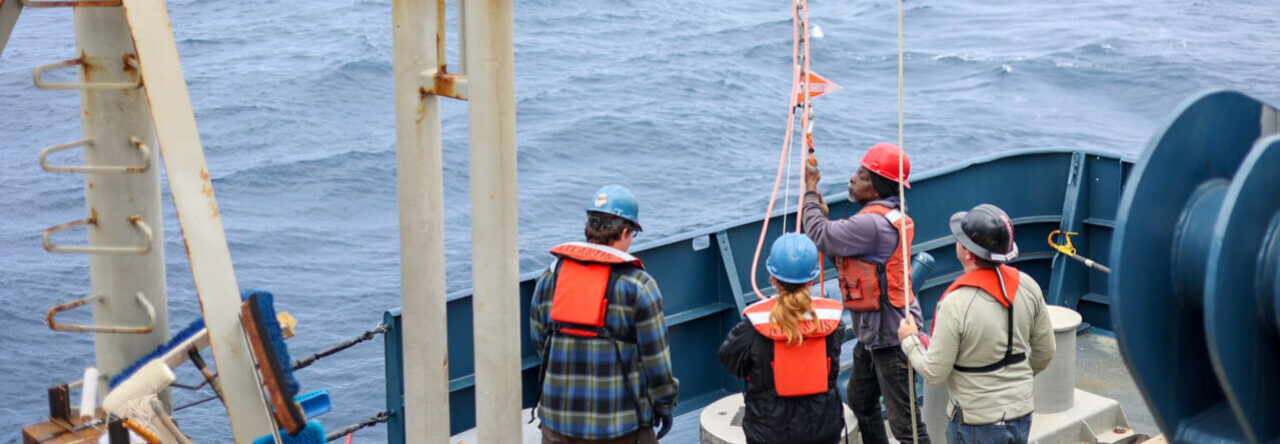
In addition, I work on deck when we deploy/retrieve the habcam or scallop dredge. The habcam is an incredible piece of technology and does its job very well. It can stay in the water for days at a time and is towed at a relatively high speed; covering a lot of ground without doing any damage to the seafloor. We’ve already seen a ton of interesting benthic creatures on the camera and picked up a few shipwrecks on the sidescan sonar. The sidescan also allows us to see tracks on the bottom left by trawlers and dredges. In some places, especially off Long Island, the entire seafloor is crosshatched with dredge scars.
When towing fast, the the habcam’s tensioned cable starts to vibrate hard. In an effort to mitigate this, I helped the scientists attach zipties and rubber fringe to the cable.
I learned to launch and retrieve the scallop dredge on deck with Ted. It’s fun physical work but getting the dredge safely retrieved, emptied, and ready for its next deployment takes a lot of coordinated steps. Two experienced people can get it done quickly and fluidly, but I’m still slowly getting the process down. Once the dredge is emptied onto the sorting table and secured I help the scientists sort out scallops, fish, crabs, and everything else we catch.
The food has been great, our first dinner at sea was steak with vegetables.
Everything on the ship is working flawlessly. But Apparently we can’t catch a break- as soon as we we put to sea a hurricane started building up off of Florida. It’s forecast to track up the Atlantic coast just like us. The captain decided to do as much science as we could then run up to Woods Hole a day early and wait out the storm at the WHOI dock. We had a nice little break at Woods Hole, watched the storm, changed out some of the science crew, and got underway again once the coast was clear.