After having to stay in Woods Hole one extra day for radar repairs, we left with a mostly-different group of crew and scientists. I was now on night watch instead of day. Transitioning between opposite sleep schedules was tough for the first couple days, but turned out alright. I was happy to get on night watch just to see how it is. Turns out it’s pretty much the same, but darker. I prefer day. Night watch doesn’t have a “lunch” and you eat breakfast for dinner and dinner for breakfast. But a lot of people like the night shift better because it’s slightly more relaxed and you don’t get sunburned. It also goes by quickly. Photographing is harder, but some night shots came out very cool looking.
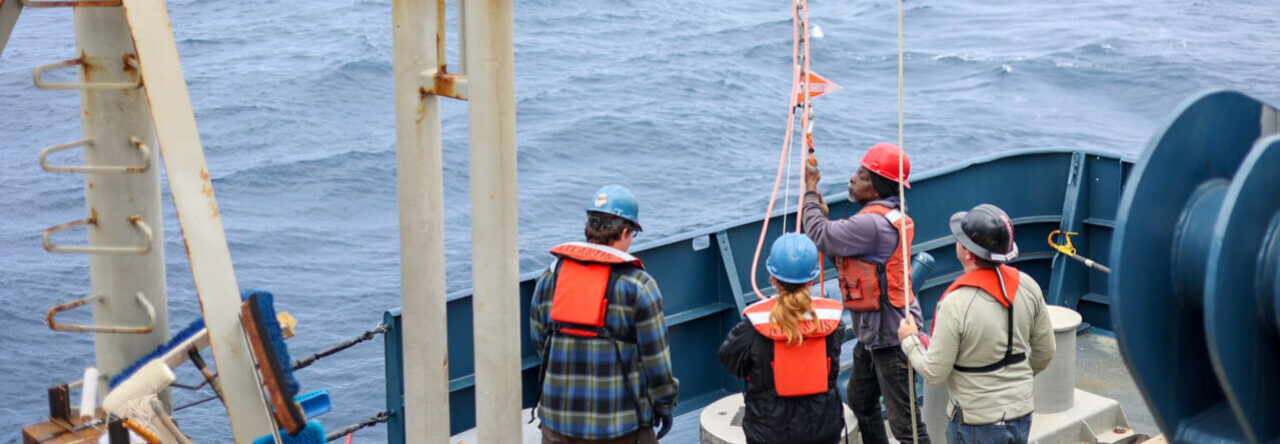
As we left Nantucket sound we were met with relatively rough seas. The plan was to do over 70 dredge tows and very little habcamming. I’ve gotten better at all the steps in the dredge process on deck. I’m always amazed by what we pull up and wish I had more time to study each sculpin and identify each strange item. I really don’t like how much bycatch we kill and waste. Most things come up dead or dying in the net, and there is very little effort to save things or at least eat whatever we can. We usually keep the best flounder or haddock, but a lot gets thrown back dead. The scientists count the fish but don’t measure most, so we get some data on some things but not as much as we could. Certain critters tend to survive, like skates (no swim bladders to expand) and most crustaceans but we could definitely do better with the bycatch. Of course our fine-meshed research dredge is tiny in the vast ocean, we do short tows, and the whole purpose of this research is to help protect marine environments. But it’s still tough to watch things suffer and die on deck. That’s one awesome advantage of the habcam- it doesn’t harm the benthic habitat or organisms at all. New marine technology can do some wonderful things.
Eventually the seas subsided. The weather was remarkably good the entire time, only a few rainy watches. There was a lot of fog out on Georges Bank though. The bottom was rockier on this leg of the cruise so we sometimes used the crane to switch in our rock chain dredge for certain areas. Rock chains are simply chains across the mouth of the dredge that exclude huge boulders. Some tows come up full of rocks. Several areas were very dense in big, old scallops. Going home with a big bag of sea scallops is one of the best perks on this cruise.
Another great thing about being in my specific position on this trip is that I’m in the middle of everything. Surrounded by a perfect combination of often-separate marine fields, I can get experience in all of them. I’m working with both the scientists and crew (groups that generally end up divided). The purpose of this scallop survey is to assess stocks for regulation, so my interest in marine policy ties right in. I’m learning hands-on about research, biology, fisheries, technology, computers, engineering, and seamanship all at once. Gaining experience as a technician and an understanding of how data is really collected will be valuable in any field. Being a technician is a nice balance of everything; I never felt confined to one role. Being able to interact with everyone on board was great. There’s a rich mix of very interesting people on this trip. Several of the crew came from commercial fishing backgrounds, and the scientists work for the government. The scientists, engineers, mates, captains and technicians all have a wealth of expertise in their fields. I tried to learn as much as I could from everyone.
We finished our marathon of dredging and spent the last couple watches habcamming. I piloted and copiloted a bunch. The display computer for our flowthrough system suddenly broke on one of the last watches and we spent a while trying to diagnose and fix the problem. Eventually we switched everything over to the data computer and got the (problematic) network of monitors back and displaying water information around the ship.
We had a few more dredge tows to finish up the survey, then pulled in to Woods Hole once again. The 2014 sea scallop survey was successfully completed! The ship unloaded equipment and I disembarked, concluding a truly awesome voyage.