Personal Adjustments
As a marine technician one is generally faced with many adjustments. These can include things such as climate and time differences, but also larger changes such as the upheaval of ones regular schedule and living situation. As a MATE intern one of the easiest adjustments I had to make revolved around the time and temperature changes. As mentioned in my previous blog I generally live in Seattle, Washington. What this means is that I am accustomed to rather mild weather. Summers are generally in the 70s-80s (though the week that I left we had a heat warning due to the consistent 90 degree days…I know some people will be laughing at this, but for some reason Washingtonians don’t know how to deal with 90 degree weather). Winters are also relatively mild, usually in the 40s-50s with plenty of rain. Similarly to the 90-degree days when the occasional snow shows up everyone freaks out. I should also mention one more thing…. there really isn’t such a thing as “humidity” in Washington., every once in awhile we have a “humid” day…but its rare. Then there’s Georgia. Honestly I have loved Georgia so far, but one thing is for certain, it is much hotter and I was pretty sure the humidity was going to be the death of me that first day. Luckily ones body can adjust to climate changes relatively quickly and I was fine by the day we left.
The second small change that I will quickly address is one of time differences. This is another change that your body can adjust to relatively quickly, however it is still strange to jump 2 hours ahead of time. For my flight to Georgia I left at midnight Seattle time before arriving at Chicago O’hare airport at 7ish am Chicago time before finally arriving in Savannah Georgia at 11 am Georgia time. I can definitely say I was jet lagged even with such a short time change, it probably didn’t help that I never seem to be able to sleep on planes.
The last topic I’d like to address is the separation of marine technicians (as well as crew members etc) from their families. While researching this position one of the most common negativities that I heard was the loneliness that came with the job. Many marine technicians and crew are separated from their wives/husbands/kids for days to months etc. After awhile this can cause a toll on their relationships. While most are able to handle it it still is something to consider if you want a career on a ship. While I do not have this particular issue (no kids etc) I can imagine that it would be tolling after awhile.
Scientific Adjustments
In the scientific community there is one thing for certain…. it doesn’t matter how fool proof your plan may be…. things happen. Going into this internship I have been lucky to have a good scientific background with a double major in oceanography and aquatic and fishery sciences. This is nice since I am able to pick up on the research that is being done much quicker then I might have without this background. Since my background is in the marine sciences I am also familiar with a decent amount of the scientific instruments in use by the current science party (or at least understand the deployment mechanism if I don’t understand the actual data).
When it comes to the relationship of scientists and the marine technicians I always remember the description our Intro to Oceanography professor gave us on our first day cruise; “Marine technicians are there to translate the science parties demands in a way that will make the ships crew not want to murder them. This includes telling the scientists straight up if their plans will not work [due to limited equipment, ship capability, weather/time constraints, etc] and how to adjust their ideas. As you can imagine scientists that are limited on ship time and by budget constraints do not like hearing that they cannot collect the data that they would want/need. “ Overall my classmates and I gained an understanding that while we may get disappointed if we are told our original plan may not work we needed to remember that the marine technicians were there to keep us and our equipment safe and if you ask they will more then likely be willing to help you come up with an alternate plan for your data collection.
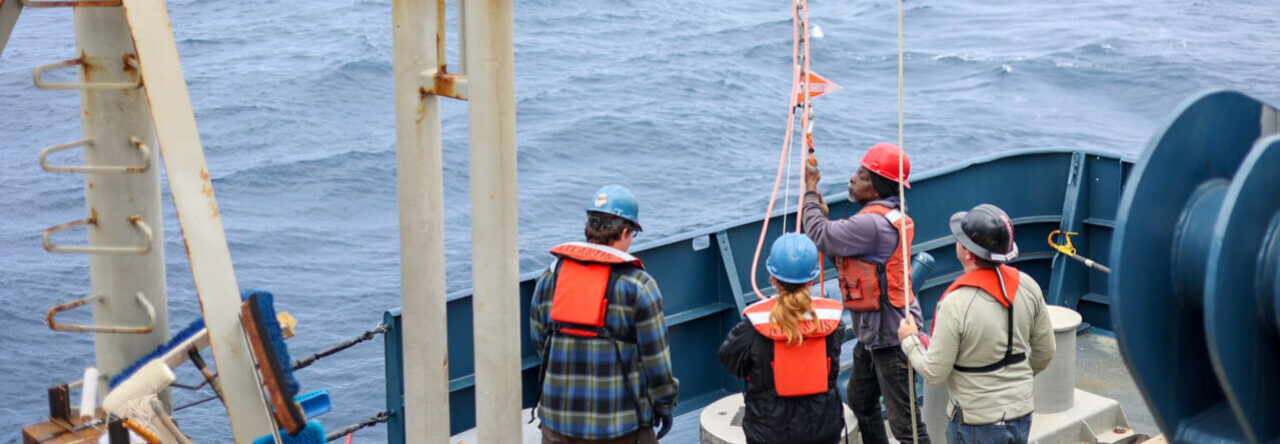
With this mindset I went into my internship knowing that things would most likely go wrong and that I was there to make sure that science could still be done. So far during this cruise things have been going relatively smoothly. The main issues we have faced revolve around the CTD as well as a device use to collect ocean optical data, which we nicknamed “the donut”. For the CTD we have had random misfires, where the niskan bottle will fire yet the bottom plug will not set all the way resulting in the bottle draining as soon as its out of the water. While this is generally just a random occurrence with no particular fault my mentor and I are currently taking off the niskan bottles one by one to adjust the way the bottles are cocked. This may not help the setting issue but it will surely make it easier to cock the bottles while prepping for a CTD cast. The second issue we’ve had on this cruise so far is the “donut”. I have included a picture of the device. Overall it is merely an intertube with a Pelican case cooler with electronics attached in the center. Coming out of the pelican case are two pvc pipes, one enters the water and measures the optics at the surface and the other points upwards to measure the amount of sunlight hitting the device. When we first deployed the device it did not have enough weight to successfully float away from the ship by itself, so we had to “bump it” by turning on the thrusters. However the lack of weight also made the device prone to flipping if the bump wave was too big and the lines weren’t taught. So of course during one deployment the device flipped. Luckily we were able to retrieve it and none of the electronics had gotten wet. To make the device more stable we decided to attach a weight to the wooden board on the bottom of the device. So far this has worked out great.
Conclusion
Overall I am still having a blast. The crew and science party has questioned me multiple times as to why I would ever want to do this job. The funny thing is as more days pass I’m starting to clarify why I want to be here, and what it comes down to is adventure. At this point in my life I have multiple job opportunities that I can pursue, but I really don’t want another old lab position where you might get the funding to do one research cruise a year. I love being on the water and working on ships too much. By working as a marine technician intern I not only get to meet new people but I get to constantly learn about new science and explore new places. I know the good always comes with the bad, but I think I am willing to deal with that.