

We boarded the R/V Kilo Moana early Sunday morning. After our safety and cruise meetings, I worked on sampling CTD casts for chlorophyll, nutrients, and dissolved oxygen. I was also able to assist with the deployment of the HyperPro, hauling the cable in and out by had. This time around, I was working day shift, so I went to bed early to get up at 3 am!
On Monday, I practiced recording meteorological observations for a second time. I continued taking samples for each CTD cast, and shadowed the deck crew as they trouble-shot a problem with the CTD winch. The cable was allowed to go slack, and the slack started to work its way up the drum as they tried to pay it out. Dan Fitzgerald taught us that in order to prevent the slack from moving down the line, we needed to cover the unaffected wraps with a ratchet strap. After that, we were able to pay out the slack and then re-wrap it around the drum with proper tension.
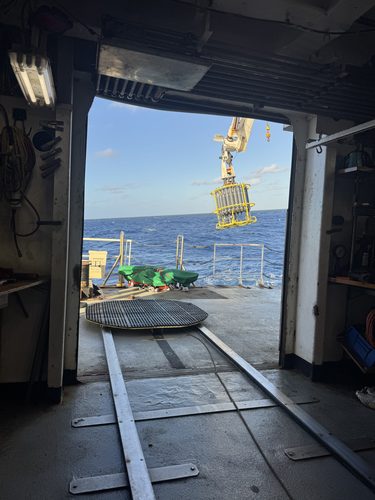
In my down time between casts, I practiced tying knots and learned how to collect grab samples from the ship’s seawater flowthrough system. Next, I entered the temperatures from the cast sheet to the spreadsheet for dissolved oxygen samples, and worked on Winkler titrations.
On Tuesday, we were supposed to deploy our gas (nitrogen) and primary production (PP) arrays, but the weather and waves were less than ideal. Typically, we collect water, spike each bottle with carbon 13 or seawater enriched with nitrogen, and then place them back at depth on an array to mimic natural light, pressure and temperature conditions for ~12 hours. Instead, we collected all the water samples from ~5 meters, and kept them in the top deck on an incubator. The incubator also uses the ship’s seawater flowthrough system, which most closely reflects surface conditions.
After that, I continued helping with CTD sampling and ran chlorophyll samples. I also assisted with DNA filtration and the preparation of flow cytometer samples. The flow cytometer samples were spiked with formaldehyde and flash frozen with liquid nitrogen.
Next, I shadowed SUBSEAs as they recovered their Vertical Microstructure Profiler (VMP), using a fishing rig attached to the back deck. I also had the chance to talk to Dr. Benedetto Barone, who explained how the shear sensors function. They use piezoelectricity – electricity accumulates across a thin metal sheet in response to physical stress. The instrument is designed to free fall down through the water column, and can detect differences in velocity shear and temperature at vertical scales of less than a millimeter.
Next, I shadowed Blake Watkins as he conducted a plankton tow and collected samples. He used a splitter to divide the sample, preserving half in formalin for his archive. The remaining half was divided again: one quarter was run through a series of screens and filtered, to separate it by particle size. Back on land, these sample filters will be combusted, to quantify the quantity of organic carbon and nitrogen.
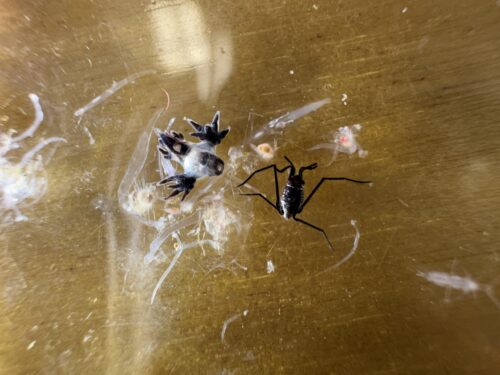
The remaining quarter of the sample can be used for plankton counts or given to other principal investigators. We took some time to look through it and found a blue dragon nudibranch and a pelagic waterstrider from genus Halobates!
Before dinner, I met with Trevor Young, who gave us an introduction to computer networking. He built the networking system on the R/V Kilo Moana himself, and it was great to have the chance to ask questions to someone so knowledgeable!
I finished off the day with more CTD sampling and headed for bed.
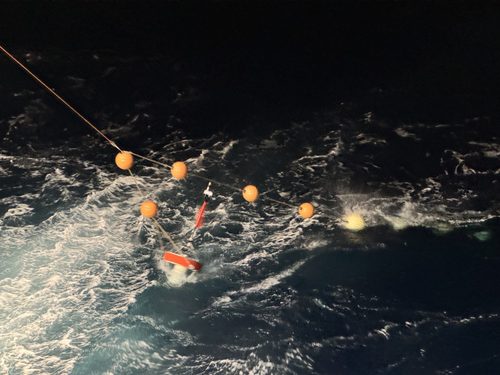
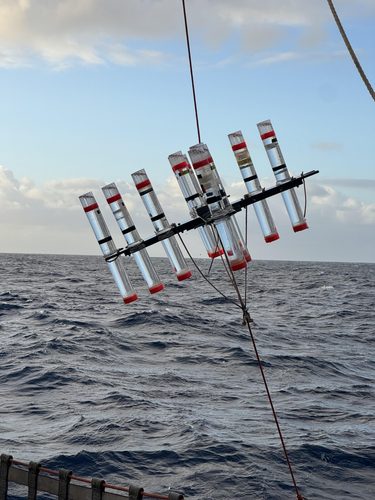
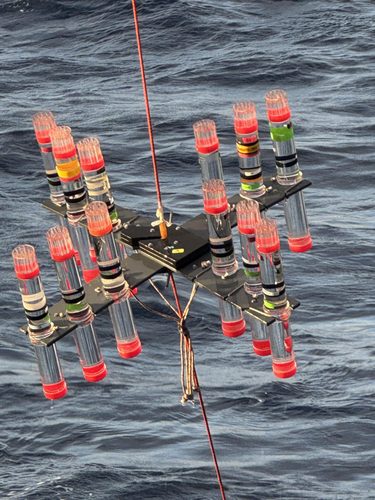
On Wednesday, I focused on watching and learning more about deck operations. I shadowed the SUBSEAs and HOT team as they recovered their Wirewalker and sediment trap arrays. Each array is first caught by a grappling hook, pulled closer to the ship, and then connected to a line fed through the A-frame on deck to lift it onto the ship. I learned how to throw grappling hooks and had the chance to practice driving the deck winch while changing out cable in between recoveries. I also learned how to pass line along through the A-frame by hand to maintain tension.
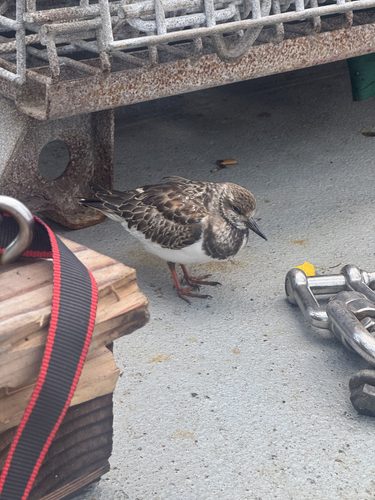
While working on deck, we gained a new crew member: Rusty, the Ruddy Turnstone!
Next, I helped out with the deployment and recovery of the Visual Plankton Recorder (VPR), which collects in-situ imagery of plankton in the water column.
Finally, I took some time to look at the ship’s sonar mapping interface, and shadowed the team as they triangulated the position of a mooring anchor from a previous cruise. They pinged the anchor from three different locations, then used the return time to determine the distance from each point and the final location.
We finished up all our operations by dinner, and we’re returning to port tomorrow morning. The day after that, I’m flying home. I’ve had a great time working with the HOT team – they are not only knowledgeable, but amazing teachers. I’ll miss the time at sea, the community, and the amazing food, but I’m sure that everything I have learned will carry me through to the next adventure!
Thanks to everyone who helped me make the most of this opportunity! It was a pleasure to work with your team.
Leave a Reply