

Hello all!
This week, cruise prep continued for HOT368.
Tuesday morning, we were able to break away for a tour of the Hawai’i Institute of Marine Biology (HIMB) on Moku o Lo’e Island. A huge thank you to HIMB’s Vivian Chan for the excellent tour.
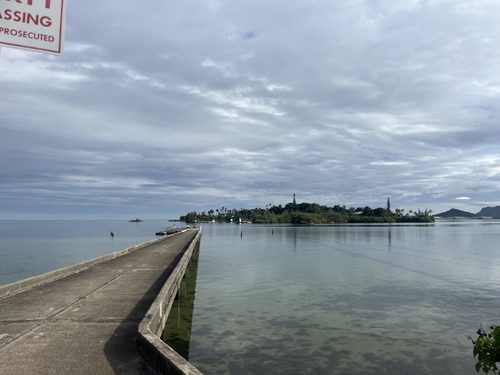
Moku o Lo’e Island (aka “Coconut Island”) is only accessible by small boat, and we were lucky to not have our visit get rained out despite some ominous weather.
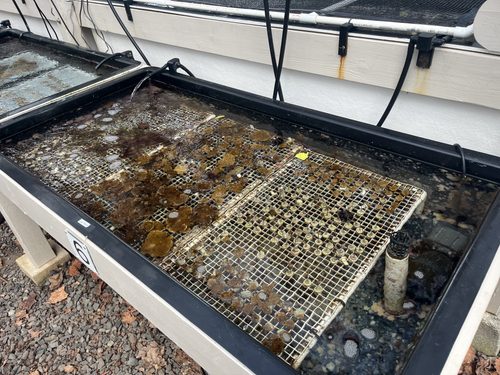
HIMB’s Coral Resilience Lab has a whole section of tables setup with various conditions to rear corals that can tolerate a variety of temperatures, radiances, acidities, and salinities. Above shows one table with the center full of medium-aged corals (~5 years old) that are brown due to their healthy algal symbionts. On the right of the table are coral “plugs” where individual polyps are seeded onto coin-sized metal plugs.
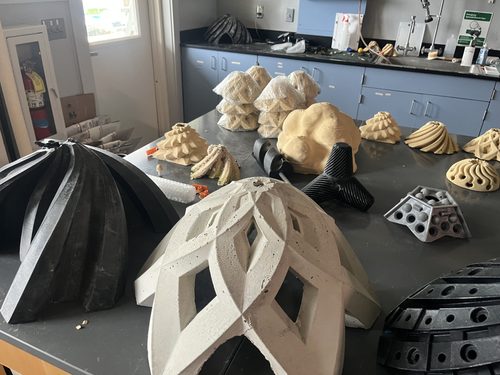
The tour also included stepping inside Dr. Joshua Madin’s Geometric Ecology Lab, who test coral colonization and survivorship on mounds of various shapes. Smaller prototypes are created using 3D-printed ceramics kiln-fired and tested to see which corals like best. The most successful shapes are scaled up to mold-cast concrete structures for further testing with the hopes of incorporating these designs into future marine construction (such as breakwaters).
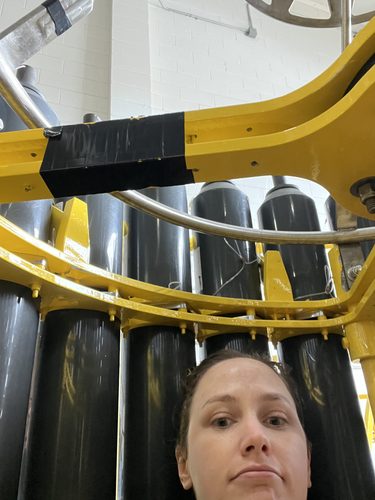
This week I got all up in the CTD Rosette to take apart and check the condition of the Sea-Bird SBE 32 Carousel Water Sampler.
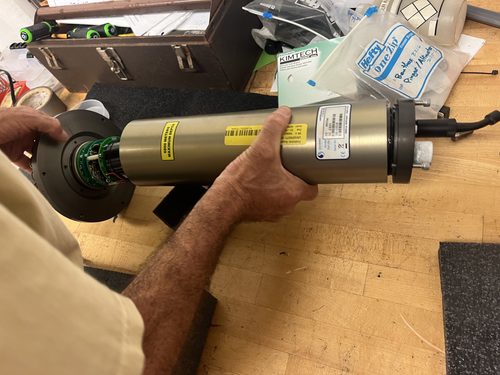
Dan Fitzgerald helped take apart the carousel water sampler so we can check all the o-rings and regrease the seals with critical anti-seize material. This instrument allows autonomous bottle firing at specific depths as controlled at the surface onboard the R/V Kilo Moana. In Dan’s left hand is a plate with ceramic solenoids which generate small electromagnetic fields to fire mechanical switches attached to each Niskin (not pictured). On the other end is an RS232 cable port to connect to the Sea-Bird CTD unit.
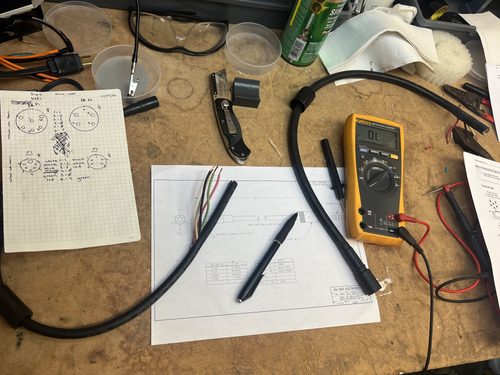
Later in the week, we practiced our RS232 serial cable splicing to create custom cables for PAR to CTD Aux (Cable 1) and BENTHOS altimeter to CTD Aux (Cable 2, not pictured). After pulling up the proper schematic and testing/mapping all pin connections using the multimeter, we guaranteed we had all the necessary components for this AG-206 to MCIL-4F cable.
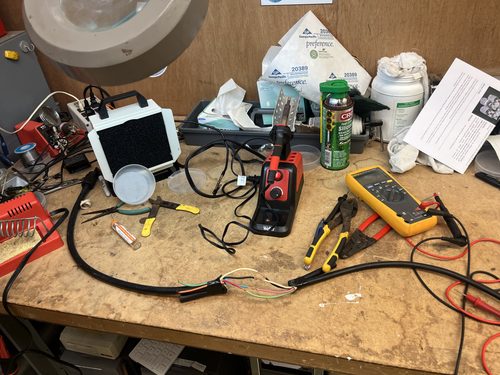
With wires for Cable 1 connected using the Western Union splice, we then soldered the connections and waterproofed the whole connection using Scotchfil insulation putty and electrical tape. We’ll test our new cables tomorrow once we get the CTD Rosette setup on deck.
Tomorrow, we’ll load all our gear for HOT368 onto the R/V Kilo Moana, and head out early morning Sunday. The weather forecast is looking a little iffy, so please, everyone, keep all your fingers crossed for us.
Leave a Reply