

Last Thursday, I arrived in Barbados and had a couple of days to explore the island before heading out on the RV AE for the transit back to Bermuda. On Saturday, I went over to the port to meet the marine technicians (Emily and Rory), some of the crew, and to get a bit of a walkthrough of the ship. I also got to overlap with the science group from the previous cruise, who had been sampling in the Amazon River plume region. It was neat to hear about their successful mooring deployments! Later that afternoon, we had some free time and went snorkeling nearby. We went looking for a shipwreck (found it!) and were lucky enough to spot some sea turtles! After one more night in the hotel, I boarded the ship “for real” on the 18th.
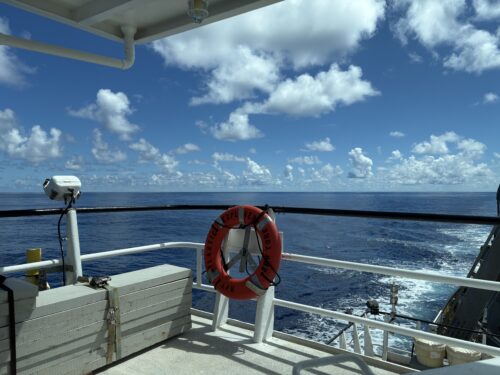
From Barbados, we’re now transiting back to Bermuda with a group of scientists from the Bermuda Institute of Ocean Sciences (BIOS) working on the Bermuda Atlantic Time-series Study (BATS). The first couple of days were mostly spent transiting, which gave me a great opportunity to get more familiar with the ship and start working on a few projects.
One of those projects involves the ship’s winches. The RV AE has several winches on board, and the wires they use are borrowed from the East Coast Winch Pool (ECWP). As part of the agreement, the ship sends in an annual wire sample for break testing, along with a report documenting how the wires have been used. I’ve been working on a script to automate the processing of logged winch data, summarizing things like maximum tension, wire speed, and the amount of wire deployed during each cast. So far, it’s going well! I still have some work to do with the technicians to fine-tune how the script identifies individual “casts,” or periods of wire use. The goal is to make it easier to generate these reports and keep track of wear and tear on the equipment.
On the 20th, I spent some time with Emily and Rory talking through other projects I might work on during the internship. We also went over the process of deploying and recovering the CTD rosette, how to coordinate with the crew, and how to set up the software for data acquisition. The plan is to watch the first few deployments before doing it myself.
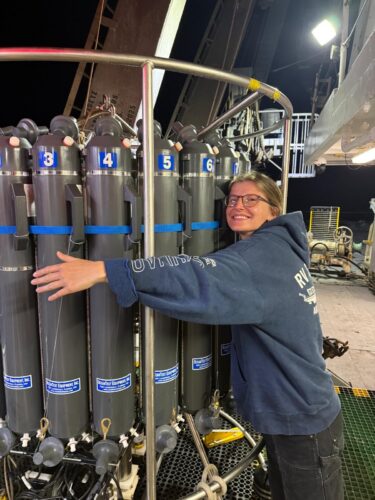
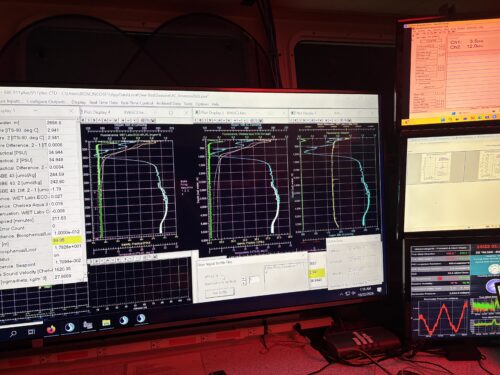
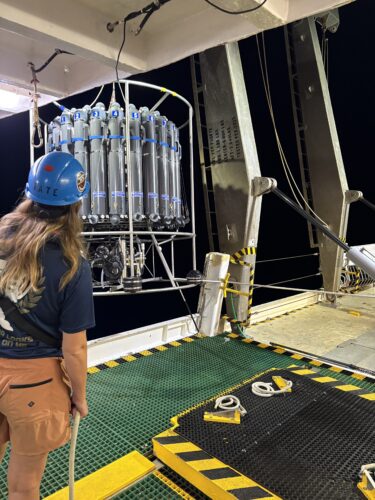
Around 1 a.m. on the 21st, we completed the first CTD deployment of the cruise, all the way down to about 5,800 meters! Over the next few days, we’ll be doing a CTD cast roughly every 12 hours, with most reaching depths greater than 5,000 meters. The atmosphere on board is pretty relaxed during these long CTD casts (~5 hours), so there’s plenty of time to get comfortable with the operation and work on some side projects.
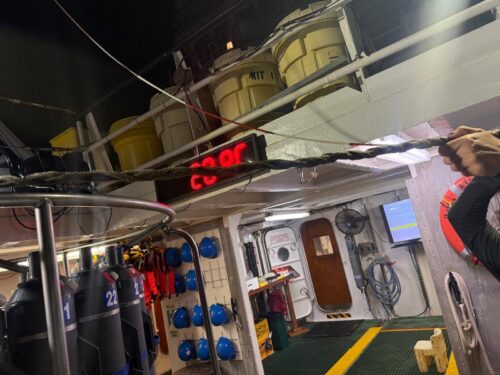
After one of the casts, Emily noticed that the Yale Grip on the CTD wire was a bit looser than she’d like, so she showed me how to re-wrap it. The Yale Grip is a “braided” wrap that grips the wire and acts as a backup to the primary mechanical termination. If that termination were to fail, the grip provides an additional way to keep hold of the wire and rosette. We wrapped up the last CTD of the night around 1 a.m. and called it a night (or morning?). There was a pretty spectacular lightning storm outside, which was wild to see and hear from the ship, but it set up a cozy mood before crawling back into my bunk for some sleep.
video credit: Emily Tate
Leave a Reply