Hello all!
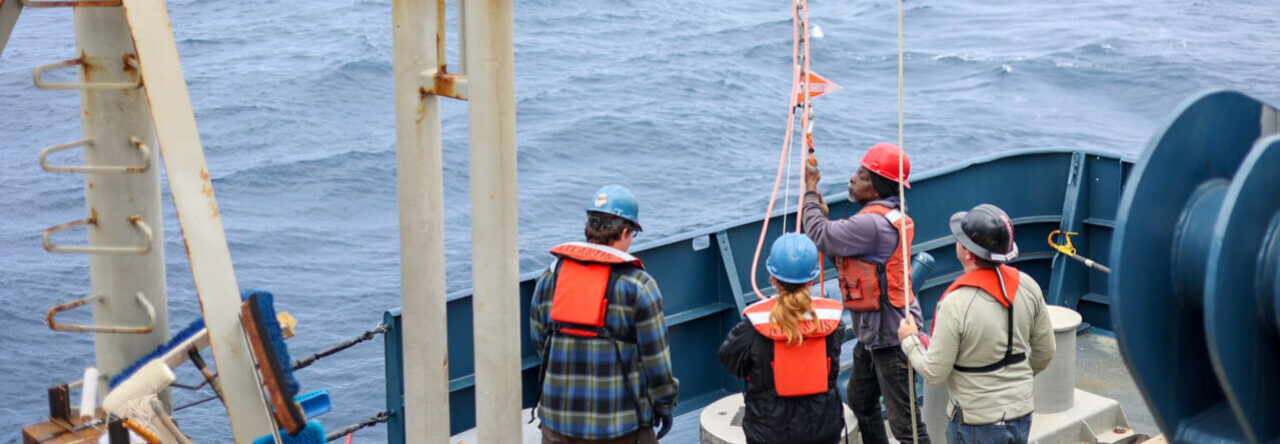
We’ve successfully returned from Cruise HOT327, in and out from Honolulu. I got a chance to assist with lab and deck operations throughout the day shift (3:00-15:00). This is the HOT team’s 327th cruise in the time series, so it’s been fun to see the rhythm they’ve worked out to consistently sample across the ALOHA site.
Below are some photos, when I remembered to take them:
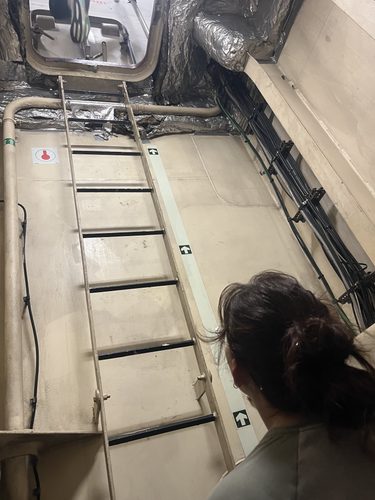
HOT scientists got a tour of some of the engine room spaces. Since the R/V Kilo Moana is a catamaran-style ship, these spaces are broken up into 16 individual compartments (with 16 separate ladders) across the two wings of the ship.
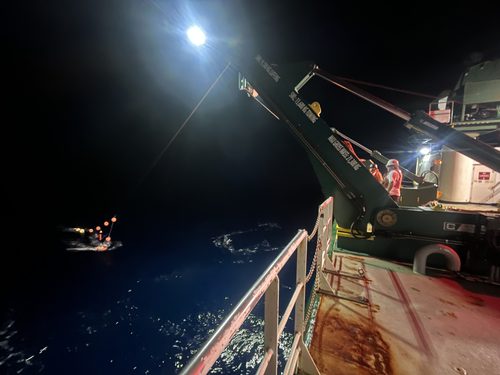
Recovering the sediment trap after 2 days at sea suspended at 150m. The array is left to float to see what particles are collected within the baffled collection tubes. To retrieve the array, grappling hooks are used to catch the float, and the image here is after pulling up ~150m of line to reach the cross that holds the sample collection tubes of very dense brine spiked with formaldehyde. The sample is then collected in bottles and on filters to be processed for HOT and collaborators’ many measurements.
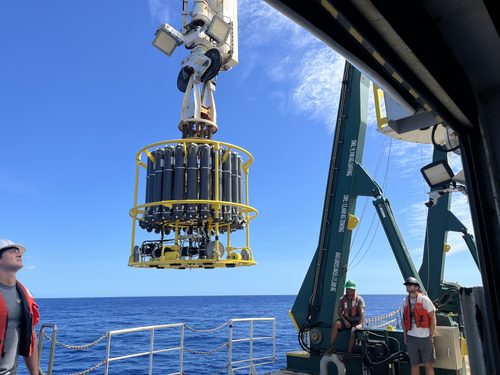
CTD Rosette being sent out over the back deck. Since the R/V Kilo Moana is a catamaran that sits very high on the water, the ship uses a specialized Hawboldt crane that can compensate for the ship’s motion (without taglines!). The 24 Niskin bottles are set open ready to snap at specific depths along the cast. At the bottom of the rosette frame are the conductivity, depth, temperature, O2, and altimeter sensors that provide a live data feed across the cast.
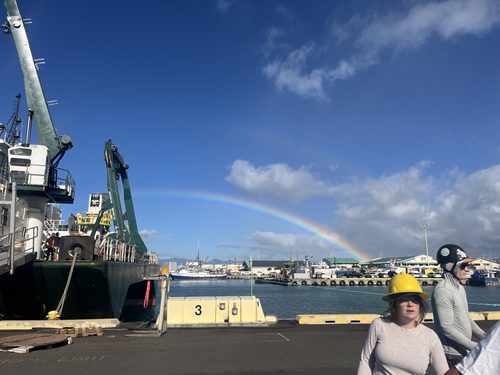
Safe and sound back at the U Hawai’i Manoa Marine Center. While we had a few sprinkles, the weather was otherwise perfect for us to offload all our gear for storage and sample processing.
I’d like to give a special shoutout to LeeAnn De Leon, an undergraduate volunteer from U Hawai’i Manoa who was supremely helpful and coming out for her last time in a while before starting her new job with Hawai’i Fisheries. I’d also like to thank the crew of the R/V Kilo Moana, and the Ocean Technology Group technicians Pete Felicijan and Joseph Soltis.
Leave a Reply