1230 Local time
Greetings from the icy North! (and land of very limited internets – hence, just the one image this week)
Apologies for reaching out to all of you a day late, but I worked straight through the evening yesterday on a couple of troubleshooting projects. More on that later.
We just hit the two-week mark for this mission and our science operations have taken us above 72° N where sea ice and walrus sightings abound. Being an icebreaker, the Healy is at home up here and she has no problem getting through the various patches of sea ice we have come across. It’s a stunning site and quite impressive to experience the roll and hear the crunch as we plow through to the next station. A couple of our scientists were even taken out on the small boat this week to collect ice samples and to service this incredibly advanced piece of technology from NOAA called a saildrone. Here is a link with more information from a fellow blogger on this cruise.

This is easily the most diverse mission I have been on during this internship. We have 39 scientists (and one Washington Post reporter) representing 14 different research groups each utilizing their own lab equipment and over the side nets, moorings, corers, and drifters. This has kept the STARC team incredibly busy both in the labs and out on deck. Through all the operations also comes an established routine to ensure continued data quality and efficient operations. Our daily maintenance regime includes maintaining science seawater flow rate and header pressure to our sensor manifolds, pCO2 flow rate and gas bottle pressure management, imputing new waypoints into our navigation software display (160 stations and counting!), converting and displaying updated satellite ice imagery, providing Milli-Q water, taking Gravimeter readings, performing tests and adjusting resolution and sound speed velocity profiles for the two echosounders, and some serious CTD TLC. Unfortunately, we are having some issues with jelly fish and one even found its way into our pump intake during one cast. Our Chief Scientist is relying on the quality of the CTD cast data and so I flush and fresh water rinse sensors and bottles between stations though some of the stations are only 15 minutes apart from one another.
With this sort of manic schedule in sub-zero temperatures, you can imagine that the crew and science party can feel quite tired and stretched thin. As a reminder of why we are here, the science party have taken turns giving lectures on Thursday and Monday nights to present their work and how this cruise is benefiting their particular line of study from fossil records of bivalves to ocean acidification. It’s been really cool to see this hard won data collection at work. Additionally, as a bit of a breather, every Saturday night is the morale meal. Each department takes a turn making dinner for the rest of the ship. This past Saturday was Operations turn and I just so happened to be in the galley when brownies needed making. I leant a hand and two massive trays resulted. I have never had to measure out 7.5 cups of sugar before and mix it in with 3.5 cups of butter but am glad for the experience.
Yesterday, we had a last minute change to our planned station route. The Chief Scientist wanted to survey a couple of additional lines using expendable probes (XCTD). We got all lined up on station after lunch only to have a couple of them fail to transmit clean data. As these probes are $$$, we started troubleshooting each inch of the serial cable run from the probe launcher all the way up to our server. We made several improvements and ran each wire through multiple continuity and insulation tests. We tested various probes, cleaned contacts, changed grounding straps and were still experiencing intermittent loss in data transmission. We are now planning on redoing the entire cable run after science departs. I think it will be a very useful transit project and have already learned a lot about this system from having opened up the launcher mechanism.
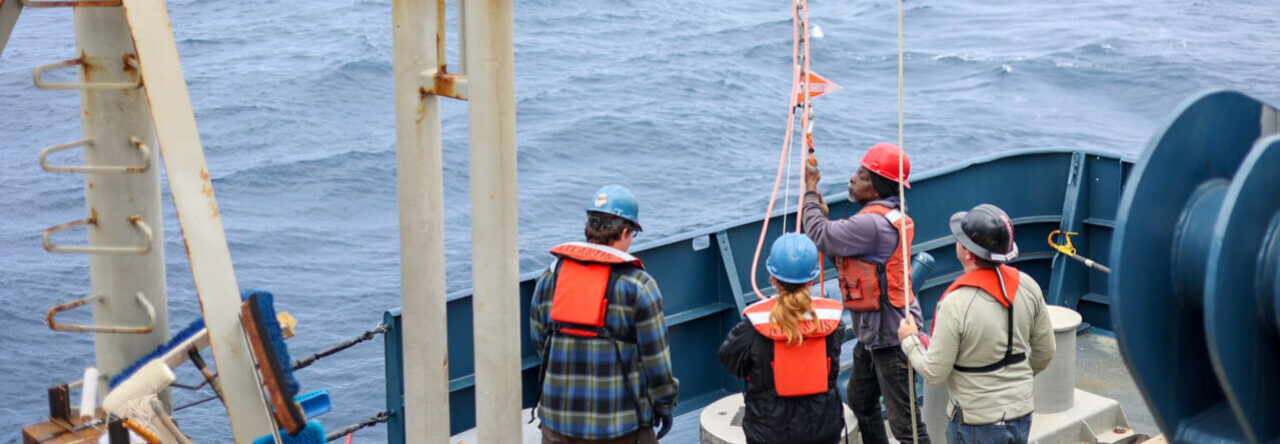
While that was happening, we were also called down by the deck crew to investigate the 0.322 CTD cable. After inspection, we realized that a couple of strands of the outer wraps of steel wire were starting to jump the lay of the cable. This is a concern as the integrity of the wire is in jeopardy and could lead to salt water intrusion and a full twist and snap (as you may recall from my pictures on the last Sally Ride cruise). We consulted with the Bridge and with the Chief Scientist and took the CTD out of commission to do a complete retermination. From start to finish including getting the original termination unsecured, the outer and inner armor layers unwrapped and cut, splicing, soldering, and water-proofing the cables, testing the new connections, doing a pull-test on the new Guy Grips, and then reattaching everything to the frame took 3 hours and we were done before the ship reached the originally intended water sampling station. Woo!
– Emily