This week marked the completion of all the dives Alvin will partake in for this cruise, for a total of 10 dives. It truly was an amazing sight that I am sad to see come to an end; I felt like I was finally getting into a rhythm of completing pre- and post-dive activities somewhat independently. However, I do have many fun memories to share.
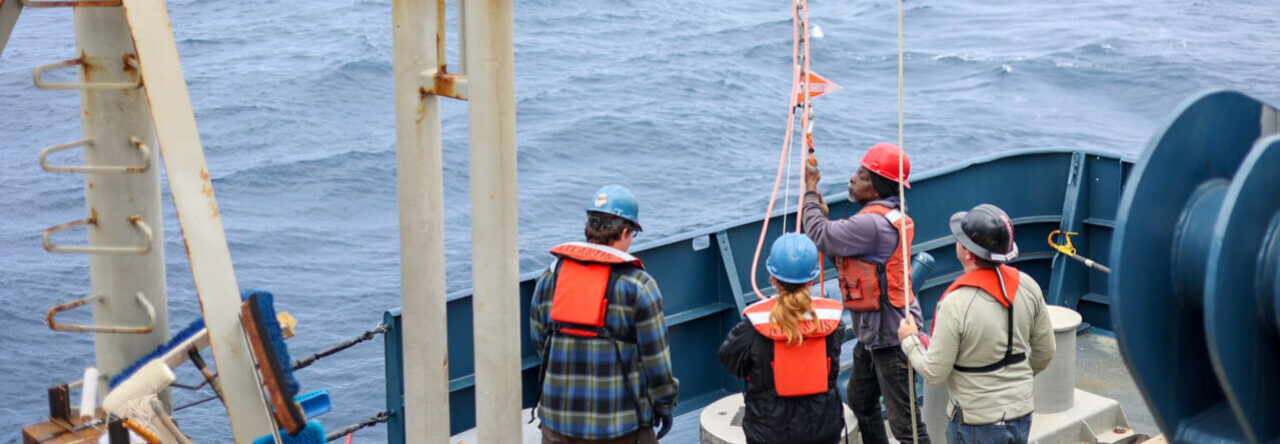
One of the highlights this week was getting another perspective of the recovery process by riding in the lifeboat that brought the swimmers to Alvin upon resurfacing. During this process, I witnessed how the swimmers contacted the pilot and observers in the sphere using a standard plug-in phone, secured the safety lines on the science basket, retrieved the tow from the stern of the ship, and swiftly attached the tow line to the sub. It was a beautiful day out on the water, and I am so grateful to the crew and Alvin team for allowing me to see this part of recovery up close. At that moment, I realized I could definitely do this as a job one day.

At the start of the week the swell picked up, which made me a little sick, but I have since acclimated and now enjoy the rocking. It can be quite fun when it gets bumpy, but I also learned how important it is to secure items even when the swell is expected to be tame. At one point, a random wave came through at just the right angle for the ship to roll significantly; I braced myself in the hangar as I watched crates of ratchet straps and hose clamps come flying out of the shelves. We made sure everything was strapped down tight after that. Otherwise, we had wonderful weather and some great sunrises and sunsets, with only a couple of rainy days.

We solved the mystery leak we were experiencing last week with the main ballast blow box—a faulty check valve! Although it passed testing, we swapped it for a ready spare and, after the following dive, there were no more leaks. The work was predominantly the same as the previous week, except for the last dive. For the final dive, we had what’s oddly called, in my opinion, a “skin party.” This is where we removed all the “skins,” or protective plating, from Alvin to be washed. It was like a car wash for a submersible and quite fun; whenever we scrub the hangar or deck we put on music, which makes it a good time.
Additionally, I learned a bit more about the sub’s navigation. The ship has piezoelectric transducers that locate the sub and then relay its position back to Alvin. Once the sub is at the bottom, it can set its current location as a reference point and use the Doppler Velocity Logger on its tail to track movements from there. I also learned about an important safety protocol: the sub must contact top lab every 30 minutes using FM frequency. If this does not happen for one hour plus the time it would take the sub to return to the surface from the designated dive location, the top lab must notify the Navy and other authorities. They have very strict regulations for diving to maintain safety.

As for the science this week, we completed a couple of lander deployments. The lander was used to collect video data of the hydrothermal vents and Alvin itself. I also spoke with some of the scientists on board and learned about their equipment. I helped set up some IGTs on the science basket, which are water samplers designed to maintain the pressure, temperature, and gas content of the sample as it was collected. Since the team is studying nitrogen cycling, they are adding tracers to these samples to understand how microorganisms process chemicals under these conditions. This may be a bit of an oversimplification—I tried my best to follow their explanations, but it’s not really my background. Apparently, IGTs are rare, with only about 20 in existence, making it a very cool sight!

Anyway, the dives are done, but I still have a few weeks left in the internship.
More to come,
Katie