
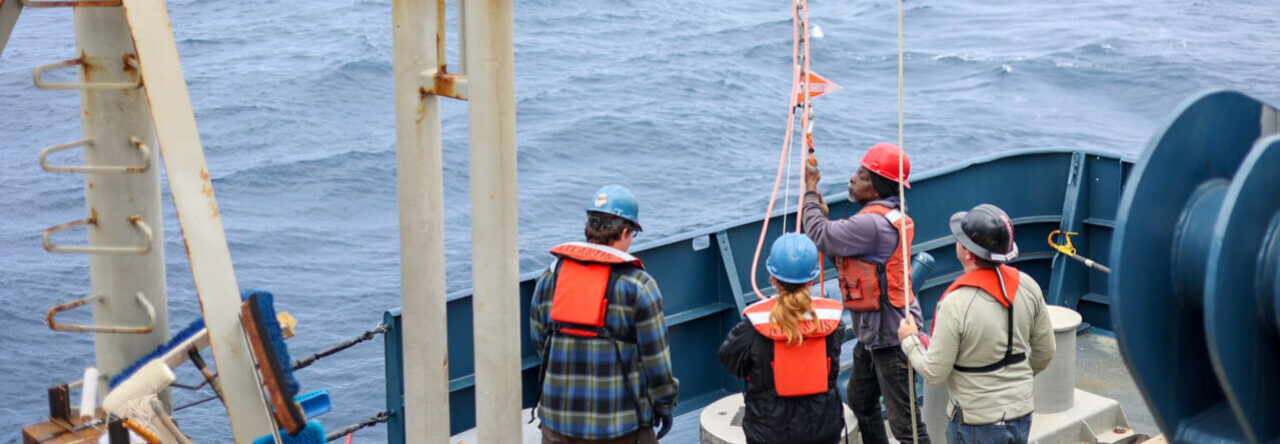
This week was all about gliders! Underwater gliders are torpedo-looking instruments that glide up and down across the water column while autonomously collecting data similar to that of the CTD and moorings. When I did an REU internship with the Northern Gulf of Alaska Long-Term Ecological Research program, I worked with data from Slocum gliders, so I had a little experience going into this. While the University of Washington Seagliders used here are fairly similar, I’ve been blown away by how much there is to learn!

One of the most interesting things about underwater gliders is the simple principle of how they zigzag through the ocean. Rather than using a traditional engine or propeller to dive up and down, they instead rely on buoyancy by changing pumping oil in and out of an external bladder. To rise, they pump oil into the bladder, increasing their volume and making them more buoyant. To descend, they pump the oil back into an internal reservoir, decreasing their volume and making them less buoyant. Little wings on the side of the body help turn this vertical motion into horizontal propulsion.


In tandem with this, the gliders also utilize gravity. The heaviest part is the battery, which powers them to travel through seas until recovery a year (or sometimes accidentally two!) later. The scientists use this to their advantage by placing the battery on a track, allowing the weight to slide from one side to the other, causing the glider’s path to tilt or bank in the same direction. Typically, scientists can communicate with the gliders while deployed to adjust their path, but out in the sea ice, it’s more of a “godspeed and hope to see ya next year!” In the meantime, the gliders will communicate with the moorings to check their position and with satellites if they can find an open patch of water to come up to. This can be tricky with so much ice coverage, so the glider first checks for freezing temperatures above before trying to surface.
With the hide-and-seek of glider recoveries also came small boat operations, which were fun to watch as the Coast Guard cruised around. After two recoveries and three more deployments of fresh gliders, science for the cruise was officially concluded. Onto the transit home!


Tyler and I have been continuing our organization and documentation projects. Now that we’ve retired from the cable factory, we’ve moved on to organizing other parts related to the CTD and water walls, including instruments, mounts, hardware, and tubing. I was, of course, stoked to be printing more labels on everything. I also finished up more diagrams, including ones showing the setup of the water walls themselves. Turns out, you can even make them into GIFs! At turnover, Micah has been teaching new knots, while Maya and Tyler have been assigning skills to both of us, such as making our own Ethernet cables or learning to successfully drill and tap like pros.


Just as quickly as we came, we’ve now left both the sea ice and the Arctic Circle behind. While it’s a bummer we didn’t have a polar bear encounter, the open waters have brought the spouts and graceful breaches of whales aplenty! The transit through the Bering Sea has also brought us into the motion of the ocean that the ice secluded us from. Storm days have always been a part of being on a ship that I love, as I’ve never been seasick before. But as I’ve often heard in oceanography, “it’s not if, it’s when,” or as Christina said, “everyone has their frequency.” Turns out, big boat, little waves is just the right combo to chip away at my hubris. But nothing a power nap, whole wheat Goldfish, and some Bonine couldn’t solve! Now that we’ve moved onto some bigger 9- to 11-foot waves, I’m back to having a grand time sliding around the computer lab on my rolling chair.

It’s also been totally bizarre to experience the pitch black of night again as we head south. The first night, a beautiful full moon kindly welcomed us back to growing darkness. Now that science is complete and the changing sky makes our late shift end extra apparent, we’ve been using our spare time to take on some goofier tasks. This week’s non-exhaustive list includes: watching The Princess Bride while diagramming, testing all the sports equipment in the hangar, reading Endurance, darning an office chair, and teaching Tyler foosball (a feature that inexplicably exists in the forward machinery room). Until next week!


Polar bear count: In the Coast Guard, if you spend 21 days or more above the Arctic Circle, you unlock “polar bear” status and are allowed to wear the highly coveted and fashionable red gear. This week, Micah and I joined Maya and Tyler in achieving that! So, you could say there are four polar bears pictured below. And Micah drew me an exceptionally wonderful polar bear on a snow day, so let’s call that 4.5 for this week…

