My first few days on the R/V Kilo Moana (KM) involved doing whatever was needed at the dock. First, I started helping the R/V Ka’imikai-O-Kanaloa (KOK) which was going to head out to sea the same day as the KM, but for very different reasons. It had been sitting at the dock for over a year recovering from some major engine problems. Now it was getting ready to do some sea trials to see if it was capable of lengthy cruises again. It had been awhile since the ship’s winches and wires were used so some of the techs from the KM and I helped do a pull test on the wire to calibrate the load cell (which measures wire tension). Since we were at the dock, we got creative with it and hooked up the wire to a giant forklift on dock. It looked like we were trying to tow the forklift into the water, but we were just using the weight of the forklift to put tension on the wire. We hooked up an external load cell to the system and gave the forklift a big tug. After calibrating the wire for several incremented tensions, we called it a day. We were lucky that at the very last minute we thought of putting a foot on the brake of the forklift before we started pulling or else there would have been a very expensive splash.
After helping the guys on the KOK I went back to my ship, the KM, and helped the German scientists load their equipment for their Manganese Nodule surveying cruise. This is a six week cruise and they have a lot of equipment that I’ve never seen before like a giant box core, a huge multi-core, a large camera sled, a big basket dredge, and a humungous epi-benthic sled. I’ll explain it all later in greater detail.
Before I knew it, we were cruising southwest in the direction of Mexico! The study area is 4-8 days cruising from Honolulu so we had plenty of time to kill. I spent the time watching over the other tech’s shoulders as I got acquainted with new systems on the Kilo Moana and recalled systems that look similar to what I was used to on the Thompson. I also did my research on what makes the Kilo Moana unique: its Small Water Plane Twin Hull (SWATH) design, which makes for a really steady ride. Even in rougher sea states, it just feels like you’re on a subway with minor jerks and twists.
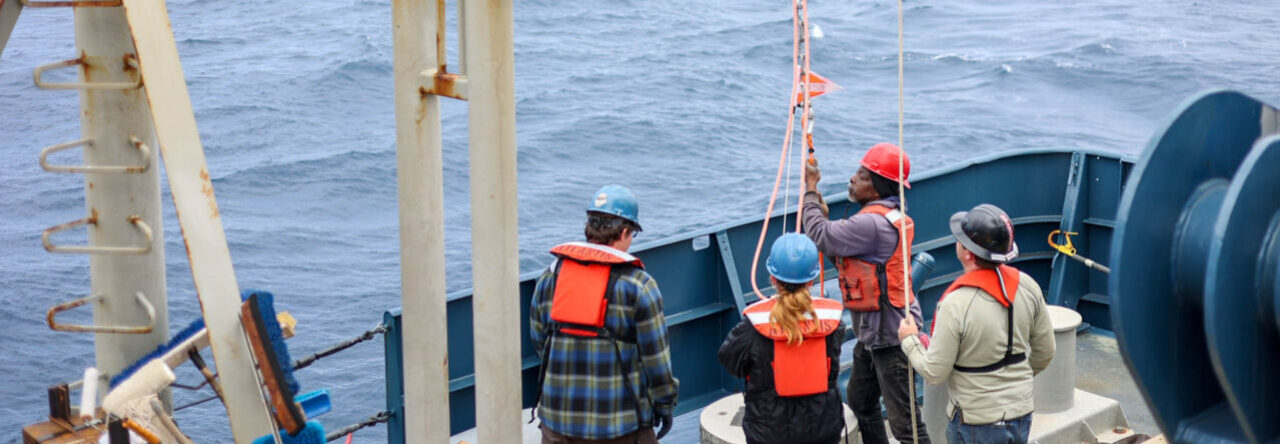
The transit went by really fast. We started off with a camera sled. This is absolutely new to me, so I stood back and watched for the first deployment and recovery. As we did it more and more I started helping out a little more, with handling lines and deck equipment. The main reason I didn’t jump right in is because this ship operates completely differently than the Thompson, so I made sure I understood the role of the marine tech very well. My mentors, Steve and Rob, explained to me that the Kilo Moana uses different hand signals for the crane, that you need explicit permission from the bridge before starting any operation, and most importantly that the marine tech is in charge of all deployments and recoveries of science equipment. This is different from the Thompson where the marine tech was only in charge of CTD deployments and recoveries. So, after a few days I was starting to ‘learning the ropes’ of the Kilo Moana deck operations, and once I started to feel comfortable enough to start being more involved, everything starts going downhill.
Not even a week into science operations on this six week cruise, one of our AB’s has a medical emergency and we have to go all the way back to Hawaii to drop him off. This is unfortunate for so many reasons, but the lesson learned is that there is no predicting what will happen out at sea. As a marine tech, scientist or crew member, we need to be prepared for absolutely everything.
The next day was my birthday, and the cooks made me a really nice birthday cheesecake and I opened a few birthday cards that my family had given me before I left in January. The crew was nice enough not to embarrass me by singing to me. I also got an extra hour of sleep, because we were heading west, towards Hawaii, and that was the best birthday present I’ve ever received. My first birthday at sea was a happy one and it improved morale a little bit, after learning that we were losing 8 days of science due to this medevac.
It took us four days to get back to the closest Hawaiian port, Hilo. One interesting thing about this port call was that we were one crew member short, so I was enlisted to fill the vacancy. This meant that I was helping with the docking procedure which included throwing the mooring lines to the guys on the dock, pulling it tight with a capstan and fastening the line to the bits on the deck. Then I helped with craning the gangway in place. It sounds simple enough, but when we’re dealing with tying down a 186’ long hunk of floating steel, it can be intense. The mooring lines are as thick as my arm and are pulled to very high tensions. There is no room for error as it can get dangerous very quickly.
After we tied down the ship and put the gangway across, we had another mission: refueling. Since we added a lot more cruising than we originally planned, we figured we might run out of fuel before we get back, so we had to get ready to take on fuel. My involvement in this was to help lay out the fuel boom around the ship to contain any spilt fuel and prevent an environmental disaster if a leak occurred during the refueling process. It was pretty straightforward; we had a small boat circle the ship while towing the boom.
A few short hours past, we performed the medevac, loaded some supplies from one of UH’s small supply ships, finished refueling, and started heading back out to the next study area which was eight days away! I got to help out again as we left the dock, but once we were underway, it was a waiting game.
Altogether, this medevac cost us eight days of science, and thanks to the great administration of UH, they were able to extend the cruise from six weeks to seven weeks for the scientists. So they will get to do most of the science they had planned.
We kept busy by maintaining the underway science systems. Steve showed me how to set up the meteorological data collection, start logging the multibeam bathymetry, and we put out a magnetometer to record the magnetic signature of the seafloor. These were all especially important, because we were going across an area where there is very sparse magnetics, bathymetric and meteorological data.
This transit did not go without its own problems, though. First, our multibeam bathymetry system underwent a routine hardware self-test and came back with a failure. Something was wrong with one of the boards in the giant rack of processing computers. We tried replacing it and it went dead! Nothing else we could do about that.
Second, our magnetometer stopped working, so we reeled it in and it came back with several deep shark bites. It bit through the Overhauser sensor and when we went to take the case off of the magnetometer it started spewing out methanol which was an indication that the sensor had been ruined. A little bit of methanol got in my mouth and, being a hypochondriac, I immediately emailed my mommy and went to the ship’s doctor. It turns out that I’ll be fine, but the magnetometer is down for the count.
Third, the Kilo Moana is brilliantly designed in a lot of different ways, except one. Every time you need to switch which type of wire is going through the block on the A-Frame, you need to cut the end off so it’ll fit and then reterminate the wire. This is time consuming, but it gives me a lot of opportunity to watch and practice the termination methods. So far I’ve gotten experience with feige fittings for trawl wire, normal serial feed conductors in .322 and .680 wires, and even learned how to terminate fiber cables for the .681 wire.
When it comes to winches and wires and cables, I’ve gotten a lot of experience troubleshooting and learning from user error in the past four months. Unfortunately, the best way to learn about something, in depth, is to have it break or be misused and have to fix it.
During the transit back to the study area, we were spooling on the .681 wire so we could spool out the trawl wire for the next operation. This involves passing it through the deck of the 02 level where the spool is, having it enter the winch room, run through the traction winch a couple of times, then out across the main deck and through three massive blocks in the A-Frame. There is no line of site to keep an eye on every part of the wire during this procedure, so good communication is necessary to do it safely and effectively and avoid having the wire bunch up in any one section.
So, as we were attempting to spool the trawl wire, we noticed that the controls weren’t moving the traction winch. We kept pushing the lever out more and more to see if it just needed some more juice, but no reply. Meanwhile, nobody was up on the 02 deck and we didn’t know what was going on up there. So it turns out that only the spool on the 02 deck was turning because we hadn’t had a switch in the right place. Once we realized that we were probably spooling out wire on the 02 deck we ran up to the trawl wire spool and realized we had bird-caged it. If you’ve ever gone fishing, you know this is one of the worst things that can happen to a spool of wire. It took us all afternoon in the blazing sun to correct this mishap.
Currently we are in the dark about another problem that seems to have fixed itself. We were going about our daily business and all of a sudden we went to start up the winch for an operation and it showed no ‘proof of tension’. What this means is that the traction winch (the middle man between the spool and the load hanging off the ship) is feeling the weight of the load, but not feeling the pull of the storage drum. In order for the traction winch to do its job, it needs to have tension on both sides, and the ‘proof of tension’ light is indicative of having the proper amount of tension to operate. Therefore, when the light doesn’t come on, it means that either the storage drum’s hydraulics is damaged or that there is an electrical issue.
As I said, this problem seems to have fixed itself, and what I mean by that is that it suddenly started working after poking the relay switches in a junction box. Lucky as we may be, we are still very cautious about having it happen again. The current orders are to leave it running at all times since restarting the hydraulics seems to have done something to have triggered the problem with the proof of tension. We suspect it was an electrical problem. However, in the scheme of things, science equipment failure isn’t the worst thing that can happen out here.
In this case we are thousands of miles from the closest civilization, and there is nothing out here except that what we took with us. We are further from civilization than the astronauts on the International Space Station. It is a very sobering fact to be at the mercy of the giant unforgiving ocean and it’s a fact that we all must come to live with. In the case of a nearby Chinese fishing vessel, they lost everything that they brought with them in a fire that ended up sinking their ship, stranding them on a life raft in the middle of this endless oceanic abyss. Since we were the closest vessel to them, and we happen to have a medical doctor on board, we were called by the coast guard to go attend to their burn victims and drop them off in Mexico. This would have been the end of our cruise all together as it would have taken weeks to do this. Somehow, we lucked out of this operation when the Air Force took over the rescue operation by flying a helicopter over 1000 miles to save them. That is an amazing feat for a helicopter and it was a risky operation, but they succeeded. We were only on this mission for a couple of hours before we got called off, but I am really glad we didn’t have to deal with another traumatic medical emergency. I am now even more aware of the reality of the danger of working at sea in the middle of nowhere.
The coup de grâce to all of the mess that has happened on this now seven week German cruise so far came in the form of sewage water flooding all of the heads on the lower two levels of the ship. Straight out of a nightmare; somebody came out of a bathroom screaming that there was sewage everywhere. Lo’ and behold, the engineers had flushed the sewage in reverse, which means that instead of flushing the sewage overboard, they flushed it, with the speed of a fire hose, up into the plumbing of the ship and out the toilets. The result: four inches deep of toxic sewage water in the heads of some of our staterooms and all of the public heads. It was sloshing around with the roll of the ship, spilt over into the carpets in the staterooms, got into the walls, trickled down the hallways, was tracked around by people walking through it, and dripped down the ladders.
Science stopped once again. The mission was cleaning up the ship and making it livable again. Since no science was happening, I pitched in, doing my duty as a member of the ship, I donned a full-body Tivex suit, latex gloves and booties and started cleaning an epic mess. We used shop vacs to suck out the sewage water from the heads and dumped it overboard. There was an actual bucket brigade of sewage water going through the ship. Talk about building camaraderie.
After a few hours of doing this, and spreading as much bleach as possible, I was recruited to go help the chief engineer down in the pump room with removing the old pump and replacing it with a new one. This pump was extremely heavy and there was also sewage sloshing around down in this room, so I was slipping and sliding all over the place. Eventually we got it replaced and I went outside to get out of my Tivex suit. I think I had lost about five pounds through sweating, but I think I earned a little more respect from the crew.
The lasting effects of this spill were that we had to rip up a lot of carpet and basically keep an eye out for more sewage that might be seeping out of the walls. Our staterooms were a biohazard site during the day, but after hours of bleaching and cleaning we felt somewhat comfortable sleeping in there. Thankfully, the rooms will be professionally cleaned and the walls will be taken out and cleaned once we get back to port, but unfortunately this incident occurred before the halfway point of our seven week cruise.
After all of these setbacks, I think I am starting to get a real understanding of the pros and cons of working on a ship. There are a lot of different perspectives that people can take about stories like the ones in this blog, but I’m observing that these extreme situations definitely can bring out the best in some people and if not, it definitely builds character. I’m still loving what I do, every day!