Category: University of Washington, School of Oceanography Page 6 of 7

Preparations

Eat Sleep Work Repeat

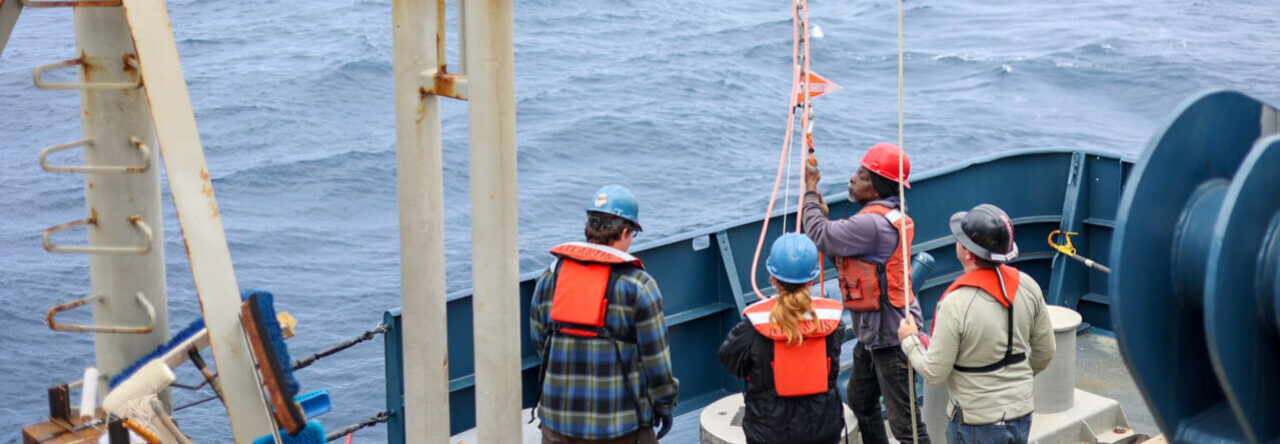
I have been assigned to work with the Lamont Doherty Observatory of Columbia University for this cruise. After many delays from Navy inspections we finally left port and headed to recover the scientific instruments from the sea. There was overcast throughout the first and half of the second week so it all looks the same whether it is 9AM or 9PM. The sun doesn’t fully until about 10PM so there’s a lot of daylight on the west coast. I was part of a team if 6 charged with retrieving 30 Ocean Bottom Seismometer or OBS for short. More than half of them were TRM which are Trawl Resistant versions of the OBS. Encased in a steel shell weighing about a ton each the TRMs were difficult to get on board. Operations were for 24hrs so we rest whenever we can in between each instrument. We were equipped with a winch which had a heave compensation system allowing it to adjust for the pitch and roll of the ship to maintain the stress of the line when hauling a TRM out of the water. We had the help of JASON from WHOI, a remote under water ROV to help us find some of the instruments that didn’t respond to our radio. The crew of the Thompson was a HUGE help of which I cannot emphasize enough, without them we probably would have taken at least twice as long. And also the student that came along also gave us a hand. Once on board we had to strip and clean the TRM of all its parts leaving but the steel shell to get refurbished for the next deployment. Before the previous deployment they used a lot of Aqua Shield which is some teal colored lithium based grease to help water proof some of the cables. It is terrible to deal with and it never gets off your clothes or your hands. Along with the TRM came many creatures of the deep and a lot of sea mud, which smelled terrible, made from organic waste it’s about the closest thing you can get to manure that isn’t excrement. There were many sea stars and other stranger creatures. On this cruise we were also able to see some whales, dolphins, and even a sunfish. Overall I had a great experience and met a lot of people. The MATE program had presented me the best opportunity I could ever ask for and following this I will continue to work with the Lamont group.

End of my Thompson Hitch

                Well, as they say, all good things must come to an end.  After dropping off the MoorSPICE scientists in New Caledonia, we embarked on my final voyage on the R/V Thomas G. Thompson.  It was a short transit to Auckland, New Zealand.  I had very few marine tech tasks to do as I was mostly planning my six day vacation in New Zealand and tying up some loose ends.

                One of the loose ends was a table I had to build out of basically whatever scraps I could find.  This table was for the next cruise which was a 40 day cruise with the ROV Nereus.  They wanted a table with a sink so they could wash and strain their sediment cores without getting the deck full of silt. 

                The building of this table is actually a pretty funny story.  After spending days scrounging up some sturdy legs and cutting a sink hole in a piece of plywood I went to paint it.  I was painting it outside on the back deck, and it was getting late, so a colleague told me to put it downstairs in the hot winch room because it would dry quicker.  After a few more coats of paint the next day I put all of the pieces together. 

                Then I realized it needed some support in order to withstand heavy use on the back deck, so I enlisted some help from engineers and found some plywood to screw in as supports.  After hours of hard labor in the hot winch room it was time to take it upstairs to the now chilly air blowing hard on the back deck, and… wait. It’s way too big to fit through the door!  Ahhh!

                After taking it all apart and putting it back together on the back deck it was time for bed again.  I finished it the next day with a water-tight caulked sink and furnished a way to bolt it to the deck. The next morning I woke up and the Nereus guys were already onboard and thanked me graciously for building this table out of the very little materials on board.

                So, we had docked in the middle of the night and I spent the morning cleaning my room.  After clearing customs I was whisked away off the ship by my friends Damien, Troy, and Tina who were also at the end of their hitches on the Thompson.  A cab awaited us and we drove to our hostel in downtown Auckland.

                After spending a lifetime total of four and a half months living on the big hunk of steel that they call the R/V Thompson G. Thompson, I was sad to walk away from it. I barely got a chance to give people hugs as I was leaving, but I knew we would all keep in touch via Facebook.  My memories and everything I learned on the Thompson will never be forgotten.

                Nostalgic as I was feeling, I also was extremely drained and practically burnt out.  I had worked 84 hours per week for over 13 weeks straight!  Sometimes I felt ambitious and worked more than 12 hours per day and some days I just felt as though sleep was way more important.  Either way, my mind and body needed a break.

                The wonderful people at MATE were nice enough to give me six days to myself in New Zealand!  I did not waste it.  The very same day I got off the ship, I also jumped off the Auckland Bridge twice with the 3rd mate Damien.  This was the first time bungy jumping for both of us and we absolutely loved it!  It was the same place where the inventor of bungy jumping first jumped.  Later we cheered on the Iron Man competition that was going on in the streets of Auckland and headed to our hostel for an early restful evening.

                After one night in Auckland, Damien, the third engineer, Troy and I all hopped on a bus and went to a small town south of Auckland where we would start hiking the Tongariro Crossing.  It is involves hiking up and across  Mount Ngauruhoe which is better known as Mount Doom from Lord of the Rings!  This is arguably the most famous hike in New Zealand as it gets over 1500 hikers per day on a 7 mile trail in peak season.  However the day we went was not ideal for hiking, so we saw very few people.  The winds at the top of the mountain were 40-50mph and the wind chill was near freezing.  It was quite a challenge considering I had spent the last few months living on the equator!  Our only hope of things warming up was the volcano erupting beneath us which happened as recently as last year!  Thankfully, it did not erupt and we survived the cold.

                After a long and challenging day of hiking I said goodbye to Damien and Troy and headed back to Auckland alone; they were continuing south on a month-long vacation in New Zealand.  After a crashing for a day in Auckland, I got out and explored the city. 

                Some friends I made at the hostel and I went to Viaduct Harbor to watch Prince William and Princess Kate race each other on authentic “American Cup” sailboats.  These racing sailboats are more expensive than the R/V Thomas G. Thompson, and have a lot of history, but the thousands of people that showed up were not there for the boats.  Everyone went crazy after waiting for hours just to see these people sail by for a few seconds on their way out into the bay.  It was a huge event.

                The following days were lazy for me as I tried to unwind.  However my 3 roommates egged me onto another hike that took us through the giant parks in Auckland and up to Mount Eden which had a fantastic view of the city.  From there we could see the harbor, the surrounding towns, some small islands in the distance, mountain ranges and the skyline of Auckland. Then we spent the evening at Mission Bay swimming under an orange and pink sunset.

                The last night I was in New Zealand, I went to some bars with some people from the hostel and we ran into three crew members from the R/V Thomas G. Thompson!  After dancing and chatting for a while we said our final goodbyes as they were leaving in the morning and so was I.

                The next morning I bid farewell to Auckland and all of my new friends.  Before I knew it, after a short bus ride to the airport, I was asleep on an airplane to Fiji.  After arriving in Fiji, my connecting flight to Hawaii was delayed.  I ended up staying eight hours in a hot Fijian airport, but it gave me ample time to organize the heaps of photos I’ve taken on the Thompson and relive all of the great memories.

                After the plane touched down in Hawaii I gave a quick phone call to my loved ones for the first time in three months and then a short cab ride to Snug Harbor where I meet Scott Ferguson, the manager of the marine technicians at the University of Hawaii.  He gives me a quick tour of the Kilo Moana, shows me my room and lets me get acquainted with my new home.

                My first impression of the Kilo Moana is that it’s 100 feet shorter than the Thompson, but after getting on it, I realized that it was almost twice as wide as my previous ship.  My stateroom is impressive.  It is carpeted, has a small television for viewing deck operations, and most of all: It has a Window! 

                I expect that it will take me some time to get used to this new ship.  Changing ships is like changing families, if you can imagine that.  It has a different atmosphere all together, but nothing to be worried about.  I feel like this ship will spoil me with interesting stories and plenty of smart brains to pick.  My first cruise is the longest cruise I’ve had to date, 43 days.  Let’s hope it doesn’t take me that long to get acclimated to my new home.
 

No More MoorSPICE

                Well if you read my last blog entry http://www.marinetech.org/internship-blog/bid/1100 then you know that the MoorSPICE cruise started off without a hitch!  However, as I am learning about life at sea, nothing goes exactly as planned and everyone needs to be prepared for anything. 

                Some of the troubles we encountered since the last post were minor like the less-than-salty scientists getting seasick and disappearing into their rooms for days.  Another problem was that some scientists couldn’t get sleep because their beds are near the bow thruster which was pounding away all day and all night on this cruise, but these were minor personal problems.

                We did encounter a few technical problems which spanned from leaky bottles to haunted water sample processing equipment.  First, there were several Niskin bottles that boggled the techs.  When we send down the CTD, we send it down on a strong metal cable that has a few metal wires in it that transfer data up to the ship and commands down to the instrument.  The commands are to close the caps to the bottles which captures a water sample at a certain depth.  Now in order for this to work properly it needs to be sealed water tight.  In a growing number of cases on this trip, there were bottles that were coming up warm; water from the deep ocean should be very cold so this was indicative of a leak.  Oh, and another clue was the fact that it was visually leaking.  We discovered that the culprit was a crack in the bottles and we had to replace a few of them.  Problem solved, but not all problems were this easy to solve.

                A bigger problem occurred during a day that we set aside to download data from a mooring, remotely.  One of the engineers from Scripps, Spencer, was tasked with using a sonar transducer to ‘talk’ with a mooring that was anchored to the seafloor right under the ship.  He then used the transducer to command it to send us data via sound waves so our sonar receiver could download it.  However the data never came.  We tried using his personal sonar transducer and then the ship’s transducer, but neither of them worked.  Luckily we were able to download data from a second mooring in the area.  We called it a success and cruised to the next station.

                The biggest problem for this cruise was the salinometer.  Not only was it the biggest problem, but the challenge to solve the problem was put squarely on my shoulders.  Now if you know anything about salinometers, which you don’t, you know that they’re incredibly touchy, they work only every other lunar eclipse, and they’re susceptible to all sorts of voodoo, but when you finally understand their ways, they give you the most accurate data you could ever need.  Some people know them very well, but nobody on this cruise was one of them.  So I got out the manual and hacked away at the beast until I figured out how to calibrate the thing to standardized sea water (sea water from off the coast of England that costs ~$120/liter) and how to properly clean the thing between each testing sample.  The problem was that the data that it was producing was just wrong; it was way too high to be real.  So I reread the manual over and over and for a couple of days I am completely stuck.  Then I realized that there was a dial to manually adjust the voltage associated with the specific salinity in the standardized seawater, I guess because I’m a millennial I had assumed it was automatic. Then after helping the scientists with their calculations, we finally got some numbers that made sense!  Not the quickest fix, but a fix nonetheless.

                Another big problem at sea is monotony.  The work is exciting and intensity is high, but the routine is, well, very routine.  After doing moorings and CTD’s for a couple of months straight I kind of needed something to break up the routine a little bit. 

                The first thing I do is talk with the scientists and the other techs and bug them to tell me everything they know.  I would go to Mar, the biologist from Spain, and try to get into the mind of a scientist.  It is important to remember that the ship’s crew and the scientists come from very different backgrounds and are on the ship for very different reasons.  The marine tech is responsible for keeping everybody on the same page and making sure everybody gets what they want out of the cruise, safely.

                Another scientist I talked to was Marion from Scripps, who taught me everything there is to know about the Lower Acoustic Doppler Current Profiler and the software that she uses to read and process the data.  It’s also important to know how the scientists use the data that we’re going to such great extents to collect.  If they’re not happy with the data, they’re not happy with the cruise.  Data is the driving force behind all science.

                Helping me understand the data and much much more about the ship’s computers was Patrick A’Hearn, the lead marine tech on this cruise.  He took me to the racks of computers in the computer lab and described to me in great detail over the course of weeks, what each machine does.  I took it upon myself to draw it out in a formal network diagram, but the network is so complicated that it would leave the reader more confused.  He and Tina taught me a lot about what types of data goes between what types of computers and it is a lot to process, but in this age of automation, so so important.

                Aside from filling my head with information, I also like to fill my belly.  On March 14th, the third mate, Marion, and another scientist, Sri, all stayed up through the night to bake all sorts of pies for Pi Day!  I’m admittedly not that great of a cook, especially on little sleep, but we made enough pies to last for days.  Luckily that night the cooks set up a barbeque on the bow.  It was really neat to enjoy our creations with the beautiful Gizo Island almost a stone’s throw away.  Since all of these islands are scarcely inhabited, it was incredibly unique that we saw two people rowing a canoe out in the shallow reefs around us.  Then to top it off, we had a beautiful sunset.  What a Pi Day.

                More from the battlefront against monotony: The 2014 MoorSPICE Ping Pong Extravaganza!  We had a lot of time to kill during a few 30 hour transits, so the chief scientist enlisted me to set up a tournament to keep everyone busy and our spirits high.  With the help of an exceptional AB, Pam, we set up a ‘random selector’ machine to pick opponents for the first round of the tournament.  This was a lesson in mechanical engineering as we built an actual lottery machine with floating ping pong balls with numbers on them.  It was quite the thrill and I have gotten really good at ping pong over the past few months, so I kicked butt.

                Another recreational activity we did to pass time was fishing, and as a group we caught one fish.  It was about two feet long, and it was something called a blue runner.  We saw a whole bunch of fish and even a shark way out in the ocean, but we only got one.  I lie, we also had a flying fish fly on deck and dry out on us, although that wasn’t nearly as appetizing.

                 The biggest recreational project we had was the CTD videography.  We wanted to show people at home what we do on a daily basis, and we also wanted to see what it looks like when the CTD descends down into the deep dark blue depths of the Ocean.  So before we got the CTD in the water, we taped a GoPro to the end of a 20’ pole and held it in the water over the side of the ship.  After we recorded the CTD deploying, we brought the GoPro inside and made a timelapse video of the usually four to six hours of watching numbers on a screen to make sure everything is working.  This turned out great and I hope to post it somewhere and put the link here.

                All and all, the MoorSPICE cruise was pretty awesome.  I had a lot of fun and learned a lot of French from some of the foreign scientists.  If you’d like to know more about the science, they made their own blog here http://moorspice2014.wordpress.com/ .

                As for me, after a short stay in the New Caledonian port which included a long hot day of unloading all of their mooring stuff followed shortly by a well-deserved pool party, I was nearing the end of my hitch on the Thompson.  I cannot even imagine being on another ship, but after a short transit to Auckland, New Zealand, I’m getting right on a plane and heading to Hawaii to get on the Kilo Moana!

Solomon Seas with MoorSPICE

                After a few days in Noumea, New Caledonia, the crew of the Thompson and the MoorSPICE scientists put our stern to the island and set course for the Solomon Sea.  It was hard to leave another tropical paradise, but we found solace in the fact that we’d be seeing more tropical paradises, albeit from a distance, throughout this cruise. 

                On our way out we saw sharks, sea snakes, and flying fish playing in the wake of our ship as we navigated our way through the 10 mile wide barrier reef.  Once we go to the edge of the reef we saw some pretty impressive Pacific Ocean waves crashing and some equally impressive wind surfers zooming over them.  It was quite strange seeing surfers out 10 miles from shore.

                The next few days we spent transiting to the first station.  The marine techs spent this time teaching the scientists how to be safe during deck operations, what to do during a CTD deployment and how to use some data processing equipment.  In turn, the scientists each taught us a little about their scientific missions during this cruise.  We had New Caledonian Biologists on board tracking the Nitrogen content in the water column, we had the LADCP ladies tracking the ocean currents and we had a mixture of French, Papua New Guinean, and Fijian physical oceanographers measuring the temperature, salinity and oxygen content in the water.  Thankfully for me, everybody spoke very clear English, but the trip certainly inspired me to start learning other languages. 

                The MoorSPICE cruise was similar to the Wave Chasers in that they both study physical oceanography of the southern Pacific Ocean with CTD casts and moorings; however this cruise was unique in several ways.  The most noticeable change was that the mooring’s buoys and instruments are smellier.  This was because they were in shallow water where there is a lot of biological activity.  The mooring lines had brought up a lot of jellyfish tentacles and barnacles when we recovered them.  My fellow marine tech, Tina, was even stung by one of these tentacles!

                Another unique aspect to this cruise is the narrow straits that we’re surveying.  We’re weaving the ship between almost all of the Solomon Islands and the currents and waves can get treacherous where the islands create a wind/current tunnel.  These currents can be up to 5-7 knots!  (If you need a reference, the top speed of the ship is ~12 knots).

                These straits are also heavily trafficked by cargo ships and fishing boats, so the mates driving the ship had a difficult time keeping the ship where it needed to be while avoiding other ships that were either heading towards us or the moorings we were working with (which sometimes laid out several kilometers behind the ship). 

                The heavy traffic and strong currents are the key suspects in the curious case of the missing mooring pieces.  While we were in the Vitiaz Strait, which had 7 knot currents, we had quite a problem with retrieving the moorings that were purposely well below the sea surface.  We put a transducer over the side and ‘pinged’ the mooring’s anchor releases.  This mooring had two releases, which are devices that wait to hear the ‘ping’ from the ship and then release the positively buoyant mooring from its anchor which sends it floating to the surface, and as far as we knew neither of them were working. 

                We tried for hours trying to triangulate the mooring’s position and get the releases to release.  However, we saw nothing at the surface.  A fear set in that the mooring had released and was floating downstream and out of sight.  This was a real possibility, because it was raining and very cloudy so our visibility was extremely low.

                Then, lo’ and behold, someone spots a float in their binoculars!  We all breathe a sigh of relief and the ship slowly heads in that direction.  We set up the back deck to retrieve the mooring and got the small boat ready to get in the water to hook a line into it (because the seas were too rough to hook it from the ship). 

                The visibility was so poor that it took until it was about 100 feet away until we realized that it was just a big piece of Styrofoam trash.  So since we were all standing there at the ready and being good stewards of the ocean, we dipped a net in the water and picked up this giant piece of trash.  That makes it one point for the environment, and zero points for physical oceanography. 

                 Afterwards, we eventually got the mooring releases to work and the recovery happened as planned.  However, the top portion of the mooring was missing!  There was a clean cut through a Kevlar line (you know, the stuff they make bullet proof vests out of), and our worst fear was partially realized, the top half of the mooring had washed away in the incredible currents of the Vitiaz Strait.  It took with it most of the data that it’s been collecting for the past year and a half.  This was the case for two of the moorings in the Vitiaz strait, but thankfully the third one was fully intact. 

                As I mentioned before, the cruise track had us going very close to islands in the Solomon Sea.  Some of these islands had a great deal of interesting history.  Everybody knows about the fight between Japan and the USA for Guadalcanal, and we were in the very waters where the naval battles took place right off the shore of the island!  We also went through the waters where John F. Kennedy’s ship sunk, when he was a soldier in World War II, and he swam to shore carrying an injured soldier with him. 

                There was no evidence of the war history apparent from the ocean, though.  The only indication of human life we saw was a few beachfront bungalow communities and some locals on canoes.  At nighttime we it was a light show with the huge bonfires on the shores of some of these islands and the fantastic lightning from the stormy straits. 

                Seeing land almost every day was an incredibly weird experience for me.  Waking up and walking outside, I usually expect only to see the infinite blue of the ocean and the sky.  However, on this cruise I was surprised all the time by majestic sea cliffs, rolling forested hills, giant cone volcanoes that ascend into the clouds, and even some coral reefs!  It was a wonderful change of pace from the usual endless seascape. 

               What’s more is that we saw sea life!  The deep blue water of the Pacific is barren compared to the turbulent, nutrient-rich waters of the coastlines.  We saw pilot whales, the frequent flocks of flying fish (one even landed on the deck), shark, squid, sun fish, blue runners (the one fish we actually caught!), the biggest schools of tuna I’d ever seen, and loads of dolphins that even jumped out of the water as high as 10 feet (up to the deck level)!

               All together it was a fantastic cruise that went like clockwork.  We had no major problems and the scientists got all of the data they needed.  I am now at the point where I have enough experience to run a vanilla cruise where we just do CTD’s and/or moorings and only some basic troubleshooting.  Hopefully my next cruise on the Kilo Moana will give me experience in another field of oceanography, because I’m still a padawan learner when it comes to being a full-time marine technician.

Transit to New Caledonia

                So we arrived in Apia, Samoa on February 18th with every piece of the Wave Chasers’ science equipment packed neatly in two large shipping containers ready to be lifted by a crane and carried to shore.  The amount of equipment in these containers was substantial, because all of the floats and buoys and sensors and kilometers of wire that were used on the moorings had to be sent back to the states.  This required one of the biggest cranes on the island which arrived in the morning to lift our containers off the deck, and thanks to organization and preparedness of Matt Alford and his team we should have been able to go snorkeling by the afternoon. 

                Well, not everything goes to plan while the ship is at sea, and the same applies to when the ship is docked.  The neatly packed containers full of mooring equipment must have been too much for the crane on the dock.  As it went to lift it off of the ship, the crane’s boom bent ~30 degrees due to the heavy load.  We broke it.  So now there was nothing to lift our containers to shore! 

                We ended up spending the rest of the day unpacking the containers and carrying everything across the gangway and placing it on the dock, piece by piece.  No snorkeling happened this day.  However, it was cloudy and I enjoyed my last chance to work with the Wave Chasers before we parted ways. 

                That night I said goodbye to my supervisors Brandi and Jason who were leaving the next morning.  I also got to know my new supervisors a little bit more.  Patrick A’Hearn replaced Brandi as the lead marine tech and is also from the University of Washington in Seattle.  He knows an awful lot about marine science and is very familiar with this ship.  Tina Thomas replaced Jason as the second marine tech. She had worked as the marine tech at Duke University for the R/V Cape Hatteras until it was discontinued a few years ago which is when they put her in the marine tech pool (which means she gets to go on any UNOLS ship that is looking for an extra marine tech).  Between the two of them, they have a great deal of experience and I am excited to see how much I can learn from them!

                The next day was quite eventful.  Before I said my farewells to the science team, we had a very special visitor come to tour our ship.  A caravan of police cars fancy SUVs drove onto the dock and a number of large guards in sandals and lava-lavas escorted Tuilaepa Aiono Sailele Malielegaoi, prime minister of Samoa, over the gangway and onto the ship!  This is a man whose face appears on all of their currency and must be referred to as “his Highness” exploring our geeky way of life.  The stewards prepared a nice lunch for us and the co-PI, John Mickett, gave him a tour of the bridge, computer lab, main lab and back deck.  We ended the afternoon with presenting him some official R/V Thomas G. Thompson paraphernalia and some deep sea salt from the Samoan Passage.  The University of Washington had a banner day for outreach.

                After all the excitement, we had a handful of Glosten engineers come board to assess the condition of the ship for its upcoming midlife.  During the midlife, the ship will be in a dry dock and will undergo millions of dollars of renovations to help it last another 20 years on the water.  The engineers did everything from take suggestions from the crew to performing 3d scans of the entire engine room, bridge and all of the labs! 

                Patrick and Will (from Glosten) took me down into the depths of the ship where everything is made of rust and the breathability of the air is suspect.  It is pitch black and very hard to walk around, especially for taller guys like myself.  The reason we were there was to check out the transducers and do a 3d scan of the area.  On the bottom of the ship there is a multitude of piezoelectric acoustic transmitters and receivers; in other words: things attached to the bottom of the ship that make a pinging noise.  There is one pinger that pings at a frequency that will reflect off of little particles moving through the top 100 meters of water.  It then receives the reflection of the ping and determines how fast the current is moving via the Doppler effect; they call this the Acoustic Doppler Current Profiler (ADCP). 

               There are several other types of pingers mounted to the hull that are more useful to a geologist, such as the EM302 which basically uses sound to snap a picture of an area of seafloor below the ship.  The ‘snapshot’ shows changes in elevation and allows you to display the basic bathymetry of the seafloor in three dimensions.  Another pinger is the Knudsen CHIRP sub bottom profiler which, unlike the EM302, it shows what is going on under the surface of the seafloor. 

               All of these pingers are either hard mounted or on a retractable stem.  The retractable stem allows you to bring the device inside the ship and then drain the seawater before opening a door and being able to work on it.   During the midlife, they might be adding or fixing some retractable stems to the transducer well, but nobody is certain about anything when it comes to the midlife refit.

                So after a few days of testing and tweaking things on the winch we finally saw New Caledonia!  We had some huge swells during the end of the transit to Noumea, and a few of them rolled us more than 30 degrees!  This is enough to knock a tall guy like me off of my feet unless I’m holding onto something.  It is also enough to slide all of our papers, coffee mugs, glass beakers and laptops off of our desks, and enough to roll a mini refrigerator across the room.  The end of these big swells left broken glass on the floor, chairs toppled over, papers and books strewn everywhere and electronics broken or misplaced.  When I walked into my usually clean cabin it looked like someone had ransacked it.  This taught me a valuable lesson about rogue waves that I will not soon forget.  From then on all of my equipment has been strapped down tight or is on a rubber mat.

                Cruising into Noumea, New Caledonia in the late morning was perhaps the most picturesque thing I’ve ever seen.  First we met the pilot boat so many miles away from port that you could barely see land on the horizon!  This is because the barrier reef off the coast of Noumea is the second largest barrier reef in the world!  Seeing huge waves crash on the edge of this underwater world, while land was still a shadow in the distance, was a surreal experience.  Then we saw tiny white sand islands all throughout the reef as we approached the big island with big buildings, resorts and some smaller mountains covered in trees.  This was much more upscale than Samoa with the big hotels, but nothing like Waikiki.  It was the goldilocks of Pacific Islands that I’ve seen so far.  As we entered the lagoon where the port was we saw helicopters taking people on tours over the mountainous forests, giant cruise ships filling up with passengers and sailboats as far as the eye could see.

                Once we docked we had to wait for customs to clear our ship and passengers before we could get off.  It took them all day to check off everything on their list, including having us put up rat guards on our mooring lines.  Meanwhile we were stuck on the ship with almost nothing to do.  So the third mate and I found a project for everyone to do that was fun and killed a lot of time.  The A-Frame on the stern of the ship needed to have a line strung through one of its blocks.  In layman’s terms that means we needed to get a rope through a hole that is 30 feet off the ground.  There is a ladder that we could’ve climbed up and then used a pole to put the rope through the block, but that’d be too easy.  So we made a monkey’s fist (a big ball of a knot) on the end of a rope and made it into a contest to see who could throw the monkey’s fist through the tiny hole in the block.  Fast forward four hours and we eventually got it through, and had attracted the entire crew to give it a try! (I was the one that threw it through).

                After the customs people left, we were able to start loading the equipment for the next cruise, MoorSPICE, with Janet Sprintall.  This is a cruise with moorings and ctd’s much like the last one with Matt Alford.  However, this science team is a worldwide collaboration with 2 French Mooring guys, 2 Californian Mooring guys, 4 French scientists, 1 Fijian scientist, 1 Papua New Guinean scientist, 1 German scientist and 2 Californian scientists.  Quite an eclectic group of people and there will be some slight language barriers, but I feel as though this group will teach me an awful lot about their cultures and new science!

End of the Wave Chasers Cruise

                During the last two weeks of the Wave Chaser’s cruise in the Samoan Passage, problems grew exponentially for the marine techs.  The tow-yo troubles continue; and as we work the winch harder and harder, it shows more and more signs of exhaustion.  A bearing broke in one of the sheaves that guide the wire onto the spool as we’re pulling it up.  This caused the sheave to wiggle and resulted in a heavy metal cable with thousands of pounds of tension on it to overlap on the spool.  (The cable usually wraps in perfectly even rows to avoid uneven loads or snapping under high tension.) It also has delicate electrical wire inside of it, which can break if stretched or twisted too much.  These are all big problems, but the sheave replacement was not a marine tech problem.  The engineers handled the replacement of the bearings in this sheave and they even let me help!

                Towards the very end of the cruise, while all of our attention was focused on the reoccurring winch problems, yet another challenge presented itself.  The Internet went down and the pressure was on to fix it!  We keep an oscilloscope hooked up to the antenna which tells us if we are transmitting and receiving satellite signal.  The signal disappears whenever the ship rolls a certain way.  My marine tech advisors, Brandi and Jason, explained to me that this is usually due to the mast getting in the way of the satellite dish, which is almost directly below it.  So we waited until the next time the ship changed its heading. Once we turned, we hoped that the mast would no longer be between the satellite and our satellite dish.

No luck.

                The next day we went up into the dome!  The dome is a large, weatherproof, fiberglass container where the satellite dish lives.  It has an air conditioner to keep the electronics cool, which was nice on a hot afternoon, but it is not easy to walk around inside of it.  Once you climb up inside of it there is only a narrow pathway to walk around while having to duck to avoid hitting the gimbal mount.

                Our first plan of attack was the classic question—“Have you tried restarting it?” But once again, we had no luck. Upon further investigation and e-mailing, though, we came to the conclusion that the problem was that it was having trouble pointing towards the satellite.  (We have an extremely small spare satellite Internet dish for emergencies like this.  However, it has a very small bandwidth.)

On a ship nothing stays still, and with this satellite dish we need to point it directly at its satellite.  So, the perfectly balanced gimbal compensates for the pitch, roll, and yah movements of the ship and it also has motors to adjust where in the sky the dish is pointing as we cruise across the ocean.  So, we figured out where it needed to point and told the motors to point it in that direction; however, it couldn’t do what we told it to do.  This is indicative of a mechanical problem.  So we investigated up in the dome again. 

We turned on the gimbal motors while we were inside of the dome.  This was scary.  The satellite is very big and takes up the upper half of the dome, except now it was tilted all the way down and pointing at the horizon.  So, we were squished on the other side of the dome with nowhere to walk.  Then the satellite went into “searching mode” and started chasing us around in circles inside the dome.  It was quite the thrill.  We eventually realized that the satellite is actually above us and the dish is not pointing upward.  We concluded that the motor that turns the satellite from the horizontal position to the upright position wasn’t working.  (Think of the act of tipping over a birdbath and picking it back up.) Luckily, we did have a replacement for it onboard!  So Jason and I went up into the dome for a few hours and swapped out the motors very delicately.  Once we turned the dish back on, we check our e-mails and there was much rejoicing!

The combination of the failing winch, losing an instrument, and the Internet being down is a perfect encapsulation of the uniquely challenging job of being a marine technician.  These problems could cause a panic, but it is our job keep calm and make the smartest use of the shipboard resources we have and get as much data as possible for the scientists.  Every day there is a new, difficult, and exciting project to tackle; and I couldn’t ask for a more intellectually stimulating experience!


Tow-Yo Troubles on the Thompson

We’ve hit the midway point in the Wave Chasing cruise! Up until this past week, almost everything has gone according to plan.  So, it was about time that a challenge presented itself, and what a challenge it has been!

The art of the tow-yo is simple enough to understand.  The goal is to be able to look at the ocean in two dimensions, basically a side view map of the temperature and salinity differences.  In order to get a continuous cross section of data, we must raise and lower the CTD sensors like a big yo-yo (hence the name) while the ship is moving slowly forward.  We do this for as much as 27 hours straight!  Now the challenge arises when you figure the amount of stress that puts on the winch, the scientists and the winch operator.    

The CTD is a half-ton jungle gym crawling with electronics and expensive sensors, and it hangs miles below the ship by a single cable that is not even as wide as my pinky.  It is so far away that if it were to look up at us, we would be look much higher than most skydiving planes ever go.  Not only is it really far away, it is also in a harsh dark alien world, under bone-crushing pressures and surrounded by a concoction of salts that is constantly trying to corrode and short-circuit our conductors.  It is not the easiest place to send our heavy jungle gym of expensive electronic equipment.

So, the story starts out with a seamount creeping up on us while we have the CTD close to the bottom.  It accidentally hit this seamount and may have even tumbled a little bit.  After bringing it back on board to be inspected, we found seafloor sediment and a few broken sensors.  Then we discovered some kinks in the wire and had to cut off about 250 meters of this 10,000 meter cable. It took six hours until the sensors were replaced and the cable was ready to go back in the water, but that wasn’t the end of our problems. 

After we fixed everything that looked wrong with it, we put it back in the water and sent it back down to five kilometers under the sea surface.  But it only made it to ~3 kilometers before something short-circuited and shut off some of the equipment. Then we had to bring it back up for more repairs!  

This time it was evident to my supervisors that the problem was that there was water getting into the wire somewhere and the most likely place is a soldered connection between the 10km wire and rest of the electronics on the CTD. 

In order to fix this new problem we had to redo the waterproof splicing which we did using the hot glue method.  This proved to be successful and we had 14 blissful error-free hours of CTDing, but then the real trouble started!

In the middle of the night, the display that shows the pounds of tension on the cable started skyrocketing!  We immediately panicked, because the only reason that the tension would have spiked is if we had snagged something on the bottom of the ocean. Straightaway, all chiefs, techs and captain reported to the bridge to discuss what to do next.  The tension normally never goes over 4,000 lbs. and the breaking point on the cable is ~10,000 lbs.  At the time it was showing ~9,000 lbs.!  We stopped the ship instantly, because if cable breaks the CTD plummets to the bottom and we lose all of our instruments then we pretty much have to pack up and go home! In the dark of the early morning, from the bridge we all watch in horror as the display jumps up to 12,000lbs.! Our hearts dropped out of our chests as we strained to see whether or not the cable was still there. 

Thankfully, the cable remained attached to the ship, and as far as we could tell so did the CTD, but how? It turns out that the problem was an electrical problem with the sensor on the winch that measures the tension, the tensiometer.  When we went take apart the electrical components of the tensiometer we found that a junction box of electrical wires was half-full of rain water! Uh oh!

It took me an entire day to go through each and every exposed connection and take off the corrosion that had built up.  Afterwards, we recalibrated the tension and it was back to normal.  Everybody breathed a sigh of relief. 

This was by no means the end of our trouble with the Tow-Yo and the winch, but it is the closest to a happy ending we’ve had with it.  I continue to learn an awful lot about how technology and the ocean do not mix easily, but it’s my job to make it work and keep it working!  I am extremely comfortable with my job security as the Marine Techs are working around the clock desperately trying to fix the wealth of challenges that the ship has to offer.  Also, having things break and getting to put them back together is a fantastic way to learn the nitty gritty details of the equipment I’m working with on the ship.  (Just don’t let the scientists know I said that)

Gray Skies and Blue Marlin

So the days are already starting to blur together.  It’s so spooky how much time flies on the ship after settling into a routine.  However, my shipmates are very good at making sure the routine does not get monotonous.  The cooks have set up an inflatable pool on the bow and cooked us a fantastic barbeque of grilled vegetables, chicken, and lamb-ka-bobs.  We lounged around and had a great time listening to music and the endless stories of the experienced sailors and scientists.  

My favorite storyteller is Todd who is a very experienced at his job and with fishing. He is teaching me how to catch fresh fish for the next barbeque.  Sometimes, when there is no science going on and the ship is just cruising to the next station, we throw out as many as nine hand-lines which drag behind the ship.  Previous attempts on this cruise have been unsuccessful, until just the other day when we had a giant stroke of luck.  I saw Todd leaping with excitement and ran over to help him pull in his catch.  Eventually it took three people to pull in the seven foot Blue Marlin!  The lowest deck on the ship stands 11 feet off the water, so it would have been a real workout to pull it up.  However, after the entire population of the Thompson converged on deck to see it up close we had to let it go on the terms of it being a game fish.  It made for quite an exciting day!

Besides eating outside in the fresh salty air and deep sea fishing, we also have movie nights, play card games, gamble on the Super Bowl (I’m on a ship from Seattle), and my favorite thing to do is sit and watch the sunrise.  We have a beautiful pink, orange and blue sunrise every day that burns away all of the big puffy cumulus clouds that cover most of the sky in the morning. It really makes for a cool and majestic wake-up routine before the brutal mid-day sun starts burning the ship.

The ship and all of the science equipment onboard, also do a great job of keeping the monotony from settling in with their persistent challenges and utter complexity.  There is always something that is acting ‘wonky’, and needs attention from a marine tech.  One particular problem was that the gravimeter was giving bad data.  The gravimeter is a very sensitive and practically priceless science commodity simply because they don’t make them for ships anymore.  They measure minute changes in gravity and they are so precise that even the rocking of the ship skews their measurements.  So there is a double gimbal system in which it sits to keep it perfectly level.  That gimbal relies on a gyroscope that measures the roll of the ship and another one that measures the pitch.  The pitch gyroscope was not working, so we had to replace it.  I’ve never felt more like a surgeon than when I was taking this delicate instrument apart and switching out an old sensor for a new one.  It required lots of patience and care, but I was able to take it apart and put it back together successfully.  It’s really awesome the amount of amazing equipment is onboard and that they trust me to tinker with it!

Every day I’m becoming more confident in my abilities to solve scientist’s problems out at sea!  I am very grateful to have such a classy and intelligent group of people on my first cruise as an intern!  

Let the Wave Chasing Commence!

So after cruising for a couple of days, we are now in the study area where we will be spending the next five weeks.  If you have read my previous blog then you know that I was seasick for the first day.  Well, thankfully the Pacific Ocean has been living up to its name, because the water has been perfectly peaceful.  Therefore, I am able to operate on all cylinders again! Unfortunately, there is a plethora of other types of illnesses traveling around the ship now.  Nonetheless, the show must go on!

We spent the first couple of days retrieving lots of moorings that were in the ocean taking measurements for a year and half. The moorings are extremely long cables that stay vertical in the water between an anchor and a buoy.  Along the line there is an instrument that crawls up and down taking measurements of the entire water column.  Due to all of the components of this system, it is a very complex operation to get these things onboard. It usually takes two or more hours from start to finish, which can feel like a long time out under the tropical sun.

After learning what these instruments can do I started to get curious about the area that we are studying.  So I sat down with someone from the science team and got a better understanding of why we’re collecting all of these data.  He told me that the region we’re in is called the Samoan Passage and it is a very important spot for the Pacific Ocean’s thermohaline circulation. 

Ocean circulation plays a critical role in the global climate.  For example, most of Europe would be much colder if it weren’t for the Gulf Stream bringing up warm ocean water from the tropics. So understanding how ocean circulation works is imperative. There are several ways that the ocean circulates, but this study addresses the thermohaline circulation in the Southern Pacific Ocean. All of the cold water near Antarctica sinks to the bottom and starts slowly traveling back to the equator.  At one point along its journey, the Samoan Passage is the only place deep enough for the very cold and dense Antarctic Bottom Water to travel northward. So it is squeezed through this passage that is only a couple of kilometers wide in some places.  The science party is quantifying the amount of mixing that is happening in this passage.  They call themselves the ‘wave chasers’, because the cold Antarctic Bottom Water is passing over these very deep ridges which form standing waves that are seen best in our temperature profiles.  These standing waves are similar to the ripples you see over shallow rocks in a river or stream, except the amount of flow over these ridges is several times greater than that of the Amazon River.  It is truly exciting stuff, and I am sure that I will learn much more about the Samoan Passage over these next couple of weeks.

The science party would be hard pressed to get the data they needed without the crew and, of course, the marine techs. This week I learned quite a few new things from both of them.  The crew taught me how to hand-line fish off the back of the ship after seeing tuna and marlin one morning.  Thus far, we have been unsuccessful in getting any fish onboard the ship.  As for my main job, I learned a very valuable skill for a marine tech: how to splice a wire and make it waterproof.  Normally, I just twist two exposed electrical wires together, maybe put some electrical tape on it and call it a day.  However, we had some problems with our CTD and had to splice a wire that we are sending 5000 meters under the sea.  This poses quite a challenge.  Even so, we were successful in our waterproof splicing.  We used a newer method that consisted of crimping, soldering, hot gluing, heat shrink tubing and then electrical tape.  I never thought I’d be using hot glue and a blow dryer (for the heat shrink tube) for electrical work. 

So now that I have spent about a week developing my marine tech skills and have good understanding of the science, I feel like I’m becoming a viable member of the ship!  I still have a very long way to go until I get to the level of competence that my supervisors Jason and Brandi have, but I am confident that I can get there! 

Page 6 of 7

Powered by WordPress & Theme by Anders Norén