We’ve hit the midway point in the Wave Chasing cruise! Up until this past week, almost everything has gone according to plan. So, it was about time that a challenge presented itself, and what a challenge it has been!
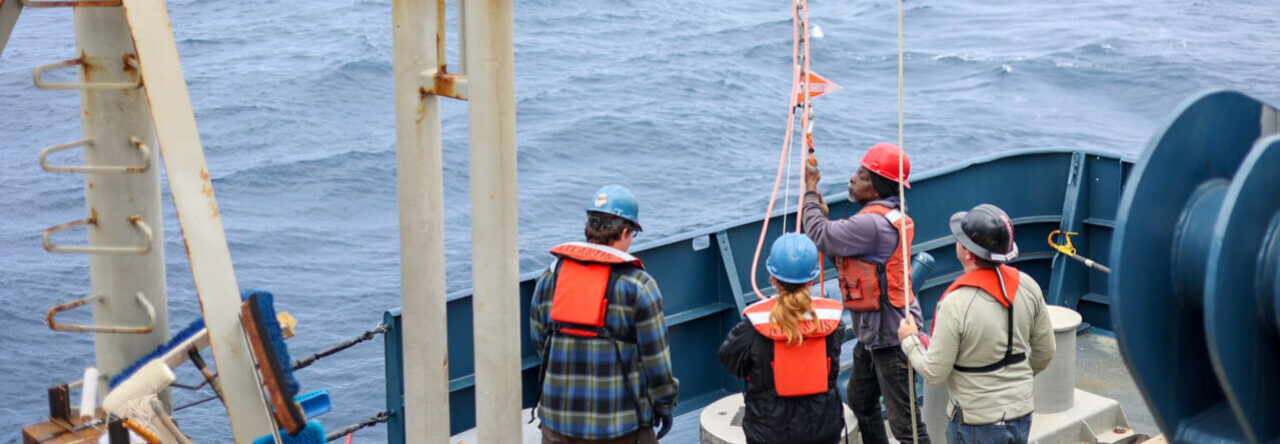
The art of the tow-yo is simple enough to understand. The goal is to be able to look at the ocean in two dimensions, basically a side view map of the temperature and salinity differences. In order to get a continuous cross section of data, we must raise and lower the CTD sensors like a big yo-yo (hence the name) while the ship is moving slowly forward. We do this for as much as 27 hours straight! Now the challenge arises when you figure the amount of stress that puts on the winch, the scientists and the winch operator.
The CTD is a half-ton jungle gym crawling with electronics and expensive sensors, and it hangs miles below the ship by a single cable that is not even as wide as my pinky. It is so far away that if it were to look up at us, we would be look much higher than most skydiving planes ever go. Not only is it really far away, it is also in a harsh dark alien world, under bone-crushing pressures and surrounded by a concoction of salts that is constantly trying to corrode and short-circuit our conductors. It is not the easiest place to send our heavy jungle gym of expensive electronic equipment.
So, the story starts out with a seamount creeping up on us while we have the CTD close to the bottom. It accidentally hit this seamount and may have even tumbled a little bit. After bringing it back on board to be inspected, we found seafloor sediment and a few broken sensors. Then we discovered some kinks in the wire and had to cut off about 250 meters of this 10,000 meter cable. It took six hours until the sensors were replaced and the cable was ready to go back in the water, but that wasn’t the end of our problems.
After we fixed everything that looked wrong with it, we put it back in the water and sent it back down to five kilometers under the sea surface. But it only made it to ~3 kilometers before something short-circuited and shut off some of the equipment. Then we had to bring it back up for more repairs!
This time it was evident to my supervisors that the problem was that there was water getting into the wire somewhere and the most likely place is a soldered connection between the 10km wire and rest of the electronics on the CTD.
In order to fix this new problem we had to redo the waterproof splicing which we did using the hot glue method. This proved to be successful and we had 14 blissful error-free hours of CTDing, but then the real trouble started!
In the middle of the night, the display that shows the pounds of tension on the cable started skyrocketing! We immediately panicked, because the only reason that the tension would have spiked is if we had snagged something on the bottom of the ocean. Straightaway, all chiefs, techs and captain reported to the bridge to discuss what to do next. The tension normally never goes over 4,000 lbs. and the breaking point on the cable is ~10,000 lbs. At the time it was showing ~9,000 lbs.! We stopped the ship instantly, because if cable breaks the CTD plummets to the bottom and we lose all of our instruments then we pretty much have to pack up and go home! In the dark of the early morning, from the bridge we all watch in horror as the display jumps up to 12,000lbs.! Our hearts dropped out of our chests as we strained to see whether or not the cable was still there.
Thankfully, the cable remained attached to the ship, and as far as we could tell so did the CTD, but how? It turns out that the problem was an electrical problem with the sensor on the winch that measures the tension, the tensiometer. When we went take apart the electrical components of the tensiometer we found that a junction box of electrical wires was half-full of rain water! Uh oh!
It took me an entire day to go through each and every exposed connection and take off the corrosion that had built up. Afterwards, we recalibrated the tension and it was back to normal. Everybody breathed a sigh of relief.
This was by no means the end of our trouble with the Tow-Yo and the winch, but it is the closest to a happy ending we’ve had with it. I continue to learn an awful lot about how technology and the ocean do not mix easily, but it’s my job to make it work and keep it working! I am extremely comfortable with my job security as the Marine Techs are working around the clock desperately trying to fix the wealth of challenges that the ship has to offer. Also, having things break and getting to put them back together is a fantastic way to learn the nitty gritty details of the equipment I’m working with on the ship. (Just don’t let the scientists know I said that)