Category: US Coast Guard Page 5 of 10

Week Four: Finishing Science Ops and Steaming Towards Dutch

10/06 – 10/13

Week Four: Steaming Towards Dutch

We have just one more SODA mooring to put in the water and we also have to deploy one last WIMBO and a AMOS float at a secondary ice floe location along the way. We were stuck in an ice floe for approximately 6 hours, which was definitely the longest we had been stuck throughout the duration of the ice cluster stations.

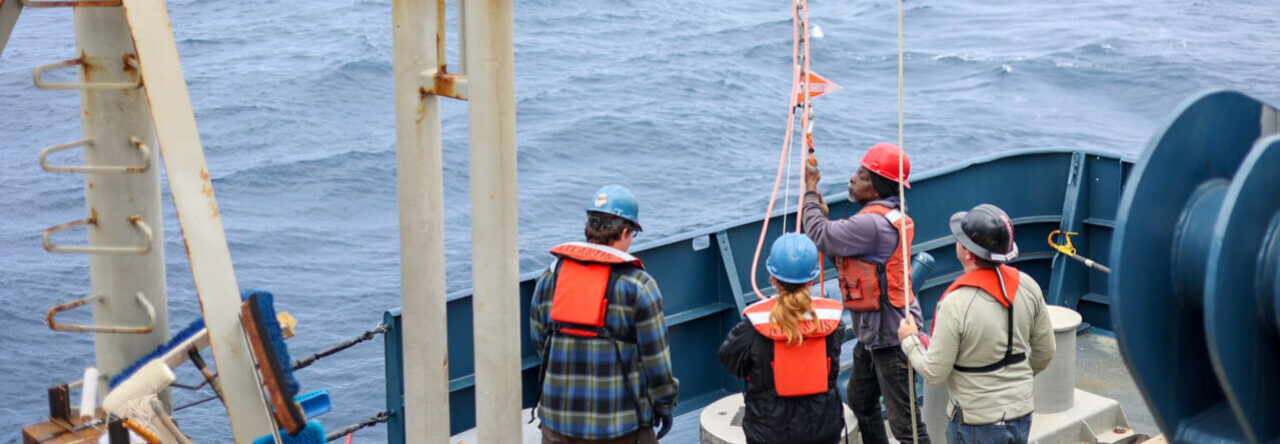
We started science ops for the WIMBO and AMOS floats on October 7tharound 1000. They each went extremely fast. Usually I had been out on the ice the majority of the time to help with the ITP, but for these deployments I just went out during the end to help finalize each deployment. In total, they took about three hours to deploy. After deployments were completed we took a group science photo in front of the bow.

After the deployments commenced we transited south to find a SODA C location. While we transited, Tony, Brett and I were working on the pumps, valves, and piping of the science seawater system down in the motor room. This was a project they had been working on for quite some time and we finally got it done. There are two forms of naming for each valve and the engineering department only had some best guesses as to matching the forms of naming. I sorted everything out and then relabeled every valve with both forms. I also taped each pipe line with orange, purple, or green electrical tape to signify which line was used for what (primary deicing, secondary deicing, uncontaminated science seawater). We ended up deploying SODA C successfully and then having to recover a navigational mooring and redeploy that. Overall we took a few more days to complete this all, but were still on track to pull into Dutch Harbor early on the 18thof October.

The science party had some glider problems and we spent an extra day or two recovering and then redeploying and then recovering some more in order to get them to communicate correctly with the navigational moorings.

More awesome nature news, we saw three polar bears swimming about 50 miles from ice edge and another 300 miles from solid land. It was absolutely amazing and you could hear them all barking as they got closer to the ship. Definitely the coolest experience I saw during the trip. 

-Nick

Preparing for an High Arctic Expedition

10 days before I depart up to Alaska to meet the USCGC Healy! 

It is funny talking about Alaska to people in general conversation. I use to be stationed there with the US Coast Guard aboard the USCGC Hickory in Homer for a year, back in 2006-2007. When I lived there, I would always get the craziest questions like “Do you live in an igloo?, Do you have a pet penguin? and even Do people ride moose to work?”,  so when I mention that I am meeting the ship in Dutch Harbor, everyone always tells “stories” of what they “know” (mostly from the Deadliest Catch), not realizing that I have actually been there before. I am more than ecstatic to go back. This will be my 4th time heading above the Arctic Circle, while participating on this cruise, but I have never been there this late in the season, so I am excited to see the differences from 12 years ago, and compare to my recent time in the High Arctic in Canada, Greenland, and Russia.

With the day light hours dwindling, temperatures dropping, and the Northern Lights beginning their dance high above, I am looking forward to working with the STARC program. Polar and deep-sea exploration has always been my passion, since there is so much we can learn from our oceans, a database can be created of information needed to better understand global change, filling gaps in the unknown to convey reliable and honest science that is foundational to providing prescience about the future. From rapidly receding glaciers and ice caps, to plastics being found everywhere, to oceans chemistry changing, there is a lot we need to still learn, to better help us prepare for the future.

With participation with the internship, I am also fortunate it enough to get to attend the RVTECH and INMARTECH conferences next week in Woods Hole. Luckily it is a short 45-minute drive from my residence! Looking forward to meeting everyone. I am so grateful for the opportunities this internship has already provided for continuing my education, training, and support, and I haven’t even left yet!

Time to start packing!

Week Three:80 degrees north

09/29 – 10/06

This week was filled with ice station deployments and more polar bears. There were three main ice stations in which the ITP, WIMBO and AOFB were all being deployed and then there were two secondary stations in which one more WIMBO was being deployed. The first ice station started off slowly as everyone was getting used to their roles on their teams and figuring out how to do everything. I was personally working with Peter Koski of Woods Hole to deploy the ITP. We first had to use a two-foot diameter auger to drill holes in the ice for the AOFB and then the ITP itself. At the first location the ice was over nine feet thick. This took quite a while to do and ultimately made the day long. The ITP itself is fairly straightforward to deploy. We connected four 70 pound weights to cable and then lowered the weights about 690 meters deep. Then the ITP was connected towards the top of the hole. We ran some tests on the Iridium communications and tested the ITP again. The ITP is set to profile the ice and will move itself up and down the cable to get certain data measurements at specific programmed depths. The scientists back at Woods Hole have decided the best method for surveying, so we were in charge of making sure it was deployed correctly. The cable also holds two Seabird Microcats (small CTD’s) which rest about one meter and two meters below the surface of the ice. Once the ITP was connected we transferred the cable load and then strung the rest of it through the buoy and then slowly lowered everything down. Our first time doing this whole process took about 8 or 9 hours. The second two times we were able to pre-drill the holes the day before and we had a better understanding of what we were doing, this cut down on our deployment time drastically. The image to the left is the finished ITP buoy and Iridium sensor deployed through ice. 

While setting up for the ice stations we had a couple of small setbacks. During the second station, we picked a lot of the equipment to the ice with the crane and then someone from the bridge noticed a crack in the ice. This ended ice operations for that day and all the equipment had to be returned. During the second station we drifted about 50 yards aft of where we wanted to be and the bridge had to take the ship around a full circle in order to better position us to be connected to the floe. Both were small setbacks thankfully and did not eat up too much time. 

We saw a mother and yearling polar bear about 300 yards off the port side of the ship during the morning of the third ice station. It was an amazing sight to see as the sun was rising and the polar bears were just crossing over our path we cut in the ice. Pretty amazing to see these animals above 80 degrees north in the Arctic. 

The science party seems a little pressed for time, and as I was saying earlier, there were setbacks during the mooring deployments that ate up some of our spare days. After cranking out these ice stations though, I think we are in good shape to get done on time or even early. We are unable to pull into Dutch Harbor for port early, but there will not be as much of a rush to get science ops done. 

-Nick


Week Two: The Start of the SODA Moorings.

First on the list of science operations for this week was to initiate the deployment of the main SODA and navigational moorings. There have been some setbacks regarding the SODA moorings and battery packs are being built to complete the sensor array in the stablemoors. Once these are done, we will then be able to continue with SODA deployments, but for the time being we are going to be deploying the navigational moorings first. These moorings are not equipped with the same amount of sensory equipment as the SODA moorings and also do not require as precise of a depth measurement. The SODA moorings need to be in an exact spot in order for the multi-beam data to be as they expect and to ensure the data is at the resolution they want. Thus, the navigational moorings should overall be trial runs for the SODA moorings, but also very important in terms of the big picture. These moorings are going to be integral parts of the glider/mooring data streaming back to University of Washington. Usually I watch the mooring process from aft conn with some of the crew and pay attention to how everything is working out and the safety the boatswain is taking into account. Once they get to the main line (about 3700m) there’s really nothing more to see until the anchor goes in. 

As for personal projects this week, Tony taught me about CTD cable terminations and tests you should do to make sure the cable is in good shape for a next cast. We also did a full termination and re-termination so that I could get some good practice if I ever have to cut some off myself. The process begins with stripping down and peeling back the outer layers of the cable, which prove to be quite difficult, and then getting down to the wire in order to solder it to another connection cable. This was a great experience to learn because it involved a lot of techniques for underwater cable splicing and making sure that everything is water proof. We wrapped the soldering job in multiple layers or protection including shrink wrap, scotchkote electrical splicing paste, and rubber splicing tape. We did about three layers of each and then the main waterproofing was complete. We just were using an old piece of wire to get some practice in, the actual CTD wire onboard Healy is in great shape and didn’t need anything to be fixed. I also removed an extra dissolved oxygen sensor from the CTD and re-plumbed the main pump back to the temperature and conductivity sensors. Quick and easy job, but I enjoyed it. We also launched many expendable bathymetric thermographs (XBT) in order to assure the multi-beam has the best possible sound speed profile for accuracy in the data. We had a lot of trouble getting the XBT’s to perform the way they are supposed to; which it seems the environment is partly to blame. Sometimes the wire can get hung up on ice or blown far to the side and affect the outcome of the data or completely terminate the XBT producing no data. Basically an XBT is dropped over the fantail and then falls at a calculated rate until 1000m where it has then collected enough data in the water column to produce a sound speed profile of that area. 

Couple of cool nature events occurred this week as well! We got the chance to see a polar bear as we were heading out of the ice and there was a small falcon that somehow found its way to the ship.

There’s a lot of new software to be learned aboard the Healy so I try to test things out everyday and see what I can do. I have been playing around with ice imagery on QINSy which gets relayed to the bridge and I have been cleaning and exporting multi-beam data from mooring locations in Qimera. If this group of scientists were interested in the multi-beam data other than a secondary measure of depth, I could do some great things for them and be able to get them good clean data very efficiently. Not a skill I will be using on this cruise too much, but definitely good to get used to these programs for future cruises or science parties that may want to use multi-beam data for other purposes. 

As we get closer to deploying the ice stations, more meetings are taking place about the logistics of the sites and specific coast guard procedures that need to take place before we can do anything. We have been looking for a site to deploy a Weather, wave, ice mass balance and ocean drifter (WIMBO). We will be deploying four more of these in the future as well. I am going to be helping out with the ice tethered profiler (ITP) team and drilling holes for lower the gear down. We had a couple small side meetings about those procedures and things to watch out for while deploying the instrument. I volunteered so that I could secure a spot in getting out on the ice. It’s pretty amazing to be able to stand on the Arctic Ocean around 80 degrees north latitude. Not many people can say they had that opportunity. 

I have been reading Skinny Dip by Carl Hiaasen, watching a lot of movies and playing some cribbage with my roommates in my free time. I am on call from 0600 to 1800 and have about 4-5 hours after dinner to relax and get ready for the next day before heading to sleep. 

I will be back in another week with more ice cluster updates and how we are doing heading into the last stretch of being in the Arctic Ocean. 

-Nick

Week One: Underway from Dutch Harbor and into the realm of the Arctic Circle

This week shaped up to be filled with a lot of new experiences!  USCGC Healy departed Dutch Harbor at 1300 local time on the 15thand began the steam to Nome to pick up more gear on our way to the first mooring locations of the science cruise. The cruise is centered around Stratified Ocean Dynamics of the Arctic (SODA) and involves deploying a series of four moorings used for navigation as well as three more instrument heavy moorings equipped with upward facing multi-beams and CTDs to survey ice floe throughout the duration of the next year. There are also going to be 3 ice stations later on in the cruise where we will deploy multiple buoys and floats to survey ice floes over the next year. Our original plan was to steam to the first SODA mooring location and get going with those as soon as possible, but there were some slight delays, which eventually turned out to be longer than originally intended, that caused us to change plans. Instead we stopped off at a secondary mooring location for University of Delaware and the deployment was successful. This was my first time seeing a mooring go into the water and the process of getting everything together was really valuable to watch. The US Coast Guard does not allow much deck time, if any at all, so I will be mostly standing by to survey exactly what the boatswain and crew on deck are doing to safely deploy all these moorings over the course of the next 4 weeks and try to learn as much as I can from that perspective. 

On our way to the Badiey (UDel) mooring location, my first project was to design and build a mooring release transducer conversion j-box so that Healy would be able to account for multiple types of deck boxes for the science party to use. The deck boxes are used to range and communicate with the moorings they are placing and also to release depth sensors and even the whole mooring if need be. I did not fully understand what my conversion box was going to be responsible for until I watched it be put to use. It felt good to know that I helped a main part of the science and shipboard technology improve and be capable of improving more in the future. Below are some good images of what the finished product and wiring look like inside the j-box. While transiting north to the first mooring location we crossed the line of the Arctic Circle which, if you complete a ceremony through the coast guard, registers you as a “bluenose” for having crossed the line on a ship. I do not think we will be able to do any such ceremony on this cruise, but still a great experience to have done. 

Science operations are changing in what seems like by the hour so we are just ready for anything. We have been working 12 hour shifts in the lab to make sure everything is covered science tech wise, even though most of the ops are going to be happening in the daylight. We were now going to put in one of the navigational moorings and delay the SODA moorings even further. All the moorings from here on out will be over 3700 meters deep. Part of our job as STARC and science technology aid is to run multi-beam surveys over the potential mooring sites so that they are able to better gage the actual profile of the seafloor. Our EM122 multi-beam has been having a fair amount of trouble that we actively troubleshoot and relay to the bridge what needs to be changed to get better data. Brett and I found some great ways to clean the data and then give the scientists various data output formats for them and us to use later. 

A day later, my conversion box was used to release a depth sensor off one of the navigation moorings, and then we proceeded to steam halfway to the next one to deploy gliders on the way. The gliders are going to collect data from the SODA moorings and be able to send it back to the University of Washington via Iridium satellites, that way they will be able to know just how well the moorings are functioning when we arrive back in port and further on into the year. 

 I forgot to mention! We hit ice around 0700 on 09/19. It is really amazing to see for your first time and it reminded me of watching a fire in that you could really get lost in the ice breaking for as long as you want, only it’s below freezing temperatures and extremely windy outside, not exactly as comforting as the fire. 

Overall first week has been full of great experiences and the big SODA moorings are coming up soon a long with ice clusters. I will report back soon with how everything is going with the main part of the SODA mission and how we are travelling in the ice. 


 – Nick


Pre-Internship Healy 1802

Hello and welcome to my blog for the next 6 weeks while I am aboard the Healy 1802 cruise out of Dutch Harbor, AK. I am a recent graduate of the University of Washington with a Bachelor’s degree in mathematics. I was pointed towards this internship by Dr. Fritz Stahr of the oceanography department at UW while on a study abroad program in Australia and thought it would fit my skillset very well and would also be a great opportunity to gain valuable experience. This will be an internship of firsts for me and will definitely be my longest cruise. Seeing the ice covered Arctic Ocean and being able to support the science that is taking place is what I am most looking forward to as welll as taking in anything I can. Overall I am greatly looking forward to getting aboard the Healy and to get things moving. I will be back very soon with another update of how things are kicking off here in Alaska! 

Week Twenty: Last Days In Alaska

2130 Local time

Hello!

(My apologies for the lack of images. The Aleutians are stunning, but our internet is not.)

We are two days in on our transit from Seward to Dutch Harbor, where we will mobilize for the next science mission. Our port call in Seward lasted most of this past week and was the longest port call we’ve had so far this season. We lucked out with beautiful weather and enough time to have a proper changeover between off-going and oncoming STARC technicians. Changeover included walking through updates and changes to equipment and lab spaces as well as getting everyone up to speed on ice imagery acquisition for the upcoming mission, which will be way up North in solid ice. Lucky them!

Seward is quite a lovely town and is also home to the University of Alaska, Fairbanks (UAF) Seward Marine Center and research vessel, the R/V Sikuliaq. We met with their facility technician and picked up a variety of packages that were shipped there for STARC. This included, among other things, our two spare CTDs on loan for the remainder of the season. As you will recall, our only spare CTD had been having faulty pressure/depth readings and needed to be swapped out. One of the deliveries was a “purge kit” for the pressure port of the sensor. The kit consisted of mineral oil and a medical-grade syringe and tubing. Purging, for this sensor, rather simply involves inserting the tubing/syringe assembly into a very tiny well, sucking up any existing oil in there, and then filling it with new mineral oil. At the bottom of this small port we ended up sucking up two perfectly formed water droplets. It could be that the water contamination is what caused the initial bubbling when we last inspected the port due to emulsification and could also be responsible for the faulty readings. The true test will be the data quality that comes in on the first cast for the next cruise. Fingers crossed.

An extended stay in port affords a great opportunity to thoroughly inspect and clean the sampling equipment–namely, the two science seawater manifolds on board, which are a network of sensors, valves, piping, and tubing. Armed with a good audiobook, an armful of rags, my favorite set of wrenches and a bouquet of pipe cleaners, getting this equipment tuned and ready for its next mission is a straightforward and rewarding job.

Difficult to believe as we pass the amazing sunlit peaks of the outer Aleutian Islands, but I will soon be leaving Alaska and heading down to Seattle for my last cruise of this six-month internship. I have been to some far-flung places and think it’s pretty cool to come full-circle in a way. The very first cruise back in April was working within the Ocean Observatories Initiative (OOI) Coastal Pioneer Array in the Atlantic and this last cruise will be recovering and deploying moorings within the OOI Coastal Endurance Array off the coast of Washington and Oregon. The observational data provided by these moorings help in understanding how climate change is impacting the ecosystem here. It’s a really cool project and I recommend reading more about it here.

This last cruise will be on the R/V Sally Ride, where I have spent most of my internship. She’s an amazing ship with a great crew and I am looking forward to getting another trip with her.

More soon!

Emily

Week Nineteen: Aleutian Appreciation

1630 Local time

Hiya and Happy Labor Day!

We are hours away from pulling in to Seward, Alaska and I think the entire crew are buzzing with excitement to finally have several days off in a row before the next science mission up to the ice.

This week has been focused on wrapping up various projects and gaps in documentation. Early on in the cruise we were having faulty depth readings on one of our CTDs. As we only had one spare, this was cause for concern, especially on a CTD-heavy mission. Thankfully, the backup fish performed beautifully, but our issues mean that we are picking up two additional CTDs when we pull in to Seward. One is on loan from University of Alaska, Fairbanks (UAF) and the other is on loan from Orengon State University (OSU) and should be plenty to make it through the season of science operations. During our transit from Dutch Harbor, we stopped off in 200 m of water, attached a weight to the CTD frame, and deployed it over the transom using the A-frame and aft 0.322 wire. This setup had been previously used on the BONGO nets/FastCAT assembly during our science mission and made the most sense for this quick test, as we did not have to take apart our careful rigging of the CTD on the large rosette on the starboard side and we already had a termination ready to plug into on the aft wire. Thankfully, the depth readings looked good both on deck and during the down and up-cast. We did see some small drifting out of the water, but Seabird technicians have assured us that it is within the acceptable range for the pressure sensor.

Another round of troubleshooting cropped up when testing each of the three XBT data acquisition units on board. I can honestly say that this past month was the most XBT system-intensive one I have had throughout this internship; from installing a new DAQ unit to re-wiring the junction boxes and troubleshooting the data drops from what ended up being a faulty launcher splice. This particular day, one of our units worked perfectly during a probe launch but when we switched over to our backup unit, we were unable to establish communication through the network. We power-cycled, swapped cables, switched ports and toggled between static IP to DHCP. We think there is some trouble with the recent USCG firewall updates, and so we wired up a crossover cable directly from the acquisition unit to the server and finally established communication. It is not a permanent fix, but it works for now. The final test was the third unit, which is a legacy unit running off a separate Windows 7 machine. This is the same machine I placed in the server rack after arriving on Healy and had to reinstall the software, driver, and update the firmware. Thankfully, the probe launch worked perfectly.

In addition to hardware and networking fixes, we have also been cleaning up and providing missing documentation for the STARC operation. On my own part, I have been playing with LucidChart in order to make comprehensive drawings for the science seawater system as well as meteorological sensor maps and updated server rack cable maps. I also made a comprehensive SOP for the AutoSal Salinometer in the hopes that technicians and science party members will have some guides to turn to if they have any questions.

Another note I want to make is to highlight the incredible beauty of the Aleutian Islands: volcanic peeks viewed from a distance across the water, ice-capped mountains and glaciers lining remote bays, and falling dramatically away on some of the many hikes I have been lucky to take while in port. If you have a chance, I would highly recommend coming out this way to Kodiak, to Dutch Harbor, to Seward and get up close and personal with these majestic mammoths.

More soon!

– Emily

Week Eighteen: To-Do List

1330 Local time

Hi there!

We are currently hauling over to Dutch Harbor having sat at anchor in Nome for two days to transfer scientists and pick up one Washington Post photographer. There has been a notable pace adjustment and I still catch myself needlessly looking over to our map display from time to time to see when the ETA to the next station is.

In just over two weeks of 24-hour science operations, we did 144 CTD casts, 143 van Veen grabs, 56 Bongo net tows, 46 mooring recoveries and deployments, 18 XCTD launches, 12 HAPS cores, 7 Methot net tows, and about 75 miscellaneous drifter deployments as well as small boat launches for saildrone configuration and ice floe samples. Quite a feat, no?

The last couple of days involved a lot of deep cleaning and helping the science party move and secure their various instrumentation for offloading or for storage. The CTD had, unfortunately, come up through several schools of jellyfish and so the bottles, lanyards, and framing needed scrubbing to remove the various remains. We even managed to suck in a few jellies while the pumps were running.

In preparation for the upcoming cruises, we have created a list of maintenance tasks for ourselves to complete during the transit and our upcoming port calls in Dutch Harbor and Seward. This includes stopping during our transit to do a test cast to 100-200 meters for the original CTD that Mike and I had to pull off the rosette due to faulty pressure/depth readings. We are also planning on launching several XBT probes en route to ensure that we are getting good data from each of our 3 deck units as well as our primary and backup launcher/cable assembly. In Dutch Harbor, we will also open both of our saltwater manifolds to clean and exercise the PVC valves and do a thorough cleaning of the various chambers and sensors.

Holding all of these actions and preparations together is documentation. There is a lot of documentation associated with an operation of this magnitude. This not only includes official weekly reports, but also various SOP updates, coordination emails, running event logs, web-based task tickets, and handover notes. Much like merchant vessel logs, you want to make sure that any operational changes or events are recorded and passed along to the next people coming up on shift. This can be incredibly time consuming but is essential for communication and efficiency.

Amidst all these tasks, I was able to take the afternoon off yesterday and wonder around downtown Nome. It was nice to be on solid ground after 25 days out at sea, and I look forward to stretching the legs again tomorrow night in Dutch Harbor.

More soon!

– Emily

Week Seventeen: Staying Cool Under Pressure

1230 Local time

Greetings from the icy North! (and land of very limited internets – hence, just the one image this week)

Apologies for reaching out to all of you a day late, but I worked straight through the evening yesterday on a couple of troubleshooting projects. More on that later.

We just hit the two-week mark for this mission and our science operations have taken us above 72° N where sea ice and walrus sightings abound. Being an icebreaker, the Healy is at home up here and she has no problem getting through the various patches of sea ice we have come across. It’s a stunning site and quite impressive to experience the roll and hear the crunch as we plow through to the next station.  A couple of our scientists were even taken out on the small boat this week to collect ice samples and to service this incredibly advanced piece of technology from NOAA called a saildrone. Here is a link with more information from a fellow blogger on this cruise.

This is easily the most diverse mission I have been on during this internship. We have 39 scientists (and one Washington Post reporter) representing 14 different research groups each utilizing their own lab equipment and over the side nets, moorings, corers, and drifters. This has kept the STARC team incredibly busy both in the labs and out on deck. Through all the operations also comes an established routine to ensure continued data quality and efficient operations. Our daily maintenance regime includes maintaining science seawater flow rate and header pressure to our sensor manifolds, pCO2 flow rate and gas bottle pressure management, imputing new waypoints into our navigation software display (160 stations and counting!), converting and displaying updated satellite ice imagery, providing Milli-Q water, taking Gravimeter readings, performing tests and adjusting resolution and sound speed velocity profiles for the two echosounders, and some serious CTD TLC. Unfortunately, we are having some issues with jelly fish and one even found its way into our pump intake during one cast. Our Chief Scientist is relying on the quality of the CTD cast data and so I flush and fresh water rinse sensors and bottles between stations though some of the stations are only 15 minutes apart from one another.

With this sort of manic schedule in sub-zero temperatures, you can imagine that the crew and science party can feel quite tired and stretched thin. As a reminder of why we are here, the science party have taken turns giving lectures on Thursday and Monday nights to present their work and how this cruise is benefiting their particular line of study from fossil records of bivalves to ocean acidification. It’s been really cool to see this hard won data collection at work. Additionally, as a bit of a breather, every Saturday night is the morale meal. Each department takes a turn making dinner for the rest of the ship. This past Saturday was Operations turn and I just so happened to be in the galley when brownies needed making. I leant a hand and two massive trays resulted. I have never had to measure out 7.5 cups of sugar before and mix it in with 3.5 cups of butter but am glad for the experience.

Yesterday, we had a last minute change to our planned station route. The Chief Scientist wanted to survey a couple of additional lines using expendable probes (XCTD). We got all lined up on station after lunch only to have a couple of them fail to transmit clean data. As these probes are $$$, we started troubleshooting each inch of the serial cable run from the probe launcher all the way up to our server. We made several improvements and ran each wire through multiple continuity and insulation tests. We tested various probes, cleaned contacts, changed grounding straps and were still experiencing intermittent loss in data transmission. We are now planning on redoing the entire cable run after science departs. I think it will be a very useful transit project and have already learned a lot about this system from having opened up the launcher mechanism.

While that was happening, we were also called down by the deck crew to investigate the 0.322 CTD cable. After inspection, we realized that a couple of strands of the outer wraps of steel wire were starting to jump the lay of the cable. This is a concern as the integrity of the wire is in jeopardy and could lead to salt water intrusion and a full twist and snap (as you may recall from my pictures on the last Sally Ride cruise). We consulted with the Bridge and with the Chief Scientist and took the CTD out of commission to do a complete retermination. From start to finish including getting the original termination unsecured, the outer and inner armor layers unwrapped and cut, splicing, soldering, and water-proofing the cables, testing the new connections, doing a pull-test on the new Guy Grips, and then reattaching everything to the frame took 3 hours and we were done before the ship reached the originally intended water sampling station. Woo!

– Emily
Page 5 of 10

Powered by WordPress & Theme by Anders Norén