Category: University of Hawaiʻi at Mānoa, SOEST Page 4 of 5

Land!

Hello hello,

  Well I have certainly gotten behind with the story of this journey (stupid internet) and instead of catching up with one giant novel of a blog entry I had tried to spread out the tale in several short installments.  Now I find myself in a weird situation where here in real time the cruise is ending (seriously it is 5am and we are just waiting until our 6:30am call in to the harbor for permission to move on in) and in story time I still have some science things to recap!  Ok ok so I guess I will give you an abbreviated version of the science and go from there.

One of the last major sample collection things we did on this cruise was multicoring.  This is quite similar to the box core method except instead of one giant scoop of sediment they pull up 12 smaller cylinders at a time.  The biggest challenge with the multicorer is that the weather conditions play a huge role in success or failure.  If the swells are too big (and by too big I mean if there are waves at all!) the multicorer will hit the seafloor at an angle and they will only recover a few samples or the whole contraption will get jostled around enough to either spring the trap too early or dump out the samples entirely.  It really needs to be very calm for the multicorer to be successful.  The reason the scientists were very eager to use the multicorer is that while the box corer is more reliable and delivers more sample in sheer mass, the multicorer brings up samples with the sediment/water interface still intact.  This little top layer of sediment is really important biologically and is preserved well in a multicore but not in the boxcorer.  A tricky set of pros and cons…

Anyways…the multicorer was very easy to get into the water and later recovered.  Not extra steps, no weird system or extra equipment.  Just grab it and pull it on board.  The hard part is that it moves through the water very slowly.  Only 45 meters per minute to go down and come back up and when it has to go 5000 meters (that is 3 miles for all those non-metric users)…well it takes a while. 

So for a couple of weeks we basically switched between box coring and multicoring all day.  And yes, all day really does mean 24 hours a day.  We just kept putting down corers, waiting, pulling up sediment, and putting the equipment right back in again.  It was not a bad routine at all.

Eventually we got to a point where one of the scientists was ready to collect phytoplankton samples with a big net (cleverly called a phytoplankton net).  The idea here is that the net, which is about 2 meters in diameter at the top and tapers down into a small collection cylinder at the bottom, is very light weight and goes into the water and down to 200 meters.  From there the ship moves ahead very slowly and the net is towed horizontally to collect phytoplankton.  That was the plan.  What actually happened was that the net went down 200 meters, was immediately caught in the current and pushed up against the propeller of the ship and the line was severed.  The net was lost at sea within the first 10 minutes of its first deployment.  Yikes.  I don’t even have a picture to include here because it happened during the wee hours of the morning while I was off shift so I didn’t even get to see it!  Things can happen really fast around here sometimes.

Well so mostly that is the story of the cruise.  By the end of the trip the German scientists have put equipment into the water 106 times during their working window of 21 days.  That is a very very impressive number considering how long it took for each piece of equipment to do its thing.  With the exception of the phytoplankton net, everything else was ultimately successful and the scientists were able to collect everything they wanted to and more.  Even phytoplankton was eventually collected using a different smaller net that was modified so that the scientist would be able to get some amount of sample. 

None of the equipment broke down to the extent that we couldn’t use it.  There were a few mechanical issues that cost us a few hours here and there but nothing that the engineers and deck hands couldn’t fix eventually. 

There were no medical emergencies and everyone has come back safe and whole.

Hard to ask for a whole lot more for a 44 day long voyage at sea:)

For now I have 1 more day here in Hawaii and then I am off to have a short break back home in Minnesota.  I won’t be adding another blog post until I am on my way to my next tropical destination…BERMUDA! Yay!

So with that I bid you all a farewell for now:)

Elizabeth

Moving into sediment

Hello hello,

 Things continue to move right along here.  The video sledge did its thing for a couple of days until the science team was confident that they had collected enough footage.  Once they gave the ok we hauled the thing up and began another round of musical chairs to get to the next piece of equipment.  This time it was the epibenthic sledge and, again, it took quite an effort to get the video sledge out of the way and the epibenthic sledge front and center.  This particular contraption is larger than the others and for deployment out into the water it is meant to stand vertically maybe a little over 3 meters (10 feet or so) tall.  The goal of this thing is to sink down all the way to the bottom of the seafloor until it is actually settled on the ground.  The ship will then move ahead slowly and drag it across the bottom collecting the surface layer and the very small life forms that live there in a filtered net sort of thing.  The bottom of the sledge itself has a big latch release on it that opens the nets for collection but is only OPEN if the latch is depressed (ie if the sledge is firmly settled on the bottom of the sea floor) and that way they know they aren’t collecting samples from the water column on the way down to the bottom or on the way back up to the surface.  It’s a pretty clever way to ensure they are getting samples just from the bottom. 

  So anyways the deck rearrangement completed we got the epibenthic sledge into the water without any trouble.  It is large and heavy but rectangular in shape with plenty of places for tag lines to ensure a safe and controlled entry into the water.  All in all…no problems.  But again, once it gets into the water it takes about 7 hours to complete a run.  With these ones it is mostly getting the sledge to the bottom and back up that takes the most time.  We put out over 6 kilometers of wire from the winch at a rate of between 30-45 meters a minute.  It takes about 3 hours for it to go all the way down and another 3 to get it to come back up.  Yikes. 

Once the epibenthic sledge was recovered we moved into a long long series of playing with sediment.  The scientists brought 2 main pieces of equipment to collect seafloor sediment; A box corer and a multicorer.  We started with the box corer.  This is a tall piece of equipment consisting of a large base to “land” well on the seafloor and a central core that has a big box and scoop at the bottom of it.  The corer is cocked in an open position with the scoop stretched back behind the box and it is deployed into the water and down to the bottom.  When it reaches the bottom (which is determined by the depth reading we have for that location, the length of wire we have put out through the winch, and by the eagle-eye attention of scientists watching the tension readout of the winch.  When the corer hits the bottom there is a dramatic lessening of the tension that the scientists eagerly wait for) the box sinks into the sediment and the scoop snaps over the bottom trapping the sediment in the box.  We then begin the long haul to get it back to the surface. 

The deployment of the box corer is relatively straight forward even though it is awkwardly shaped.  The recovery of it is a little more involved but still fairly basic.  When the scoop has been triggered the central core of the contraption stands almost a meter taller than when it is cocked.  This means that when we want to bring it back onto the ship it is too tall to go under the A-frame.  So to get around that we have to use the A-frame to lift the box corer out of the water and bring it close to the ship, attach a different line to the shackles, move it back away from the ship, then use the different line attached to a different winch to pull it on board.  Really it isn’t overly difficult it is just a few more steps and another piece of equipment thrown into the mix.  Keeps things interesting:)

The box corer is one of the fastest pieces of equipment the scientists are using and it takes just about 3 hours to get one in the water, down, back up, and on deck.  Then the ship moves to the next station while all of the scientists begin to process the sample and re-cock the corer.  By the time we are in position the corer is ready to go down again.  All in all the scientists want 40 box cores so we have been doing this for several days already with many more to come.

Before I let this post get to long I will cut it off here.  Next installment; the multicorer…and maybe some phytoplankton net action:)

Elizabeth


Mapping Complete

Hello all,

Another installment of the story.  Still trying to catch up from our internet lull so just stick with me here.

Finally the seafloor mapping has been finished!  Don’t get me wrong, the data that was collected was super cool and the map that they are assembling is really amazing but it wasn’t a very interactive process.  Once Homeside was in the water we really didn’t need to do anything else.  It was towed behind the ship in very specific straight line.  We got to the end of one line and the ship turned around and we towed it in another straight line the opposite direction.  Not really much to it for 8 days.  Finally the scientists confirmed that they had covered the whole area they were trying to map and we could bring the Homeside up.  Very exciting moment.  Once it was finally up on deck there was a whole new game to play in terms of rearranging equipment.  We had to get Homeside tucked away on one side of the large A-frame, bump the multi-corer and box corer forward a few feet to make some extra room, and then pull out the video sledge from the other side of the A-frame to get ready to deploy.  Now…these things all seem really straight forward until you consider a few extra details. 1) All of these pieces of equipment are large and weigh hundreds of KILOS (our scientists are German so I figured as a nod to them I would keep my figures metric) which means using cranes, winches, and cables to lift and move things.  2) We are on a moving vessel here.  Even on calm days there is still pitch, roll, and heave motion from the swell.  Ever seen a large crane in action while it is rocking back and forth?  Certainly adds a whole new layer of excitement.  3)  There isn’t a whole lot of free space on the deck.  This science team brought a bunch of large equipment that is strapped down on the deck.  It takes a fair amount of precision to maneuver anything around and so I refer you back to points 1 and 2 to see some of the difficulties that arise.  Earlier I gave a strong nod to the technician for being able to do his job very well and save the day.  Here and now I have to acknowledge the stellar group of guys working the deck.  They are really good at what they do and it is impressive to watch.  Their skillful manipulation of the gear and equipment makes even the most complicated transfers go smoothly and safely so hats off to them every single day!

Ok ok I digress.  Back to the action.  Moving the Homeside out of the way and bringing the video sledge front and center took some time but was eventually accomplished.  The video sledge is a rectangular contraption that has several different motion video cameras and one or two still cameras attached to it (See picture below!).  The idea is that it will go into the water and sink down over 4000 meters until it gets near the bottom (near…not actually touching down) and then the scientists are able to use the cameras to actually look at the seafloor while we are moving over it.  The sledge stays down for 8-10 hours at a time and the scientists monitor and document the video feed looking for the manganese nodules that are the focus of their work right now.  It was pretty easy to get into the water and then we just had to wait some more.  Personally I really enjoyed invading the lab space and watching the video.  The scientists had most of the lights off in the lab and everyone gathered around to see the “action” like it was a show at the theater.  The addition of the quotation marks there is because the video itself didn’t actually have a lot of action.  Every now and then there would be a fish, brittle star, or little sea cucumber that would make a quick appearance but mostly it was just looking at rocks on the seafloor.  But it was looking at rocks on the seafloor over 4 KILOMETERS under the sea that made it special to me…in a nerd sort of way:)

Next installment: the epibenthic sledge and sediment collection.  Oooooooooh

Elizabeth

Seafloor mapping out in the Pacific

Sorry for the long delay but we have been having really touchy internet for a while and I haven’t been able to get anything to upload onto the site.  Because of that I have just been adding little paragraphs of new things happening here every few days when I try to post an entry but that entry is now quite long and rambling so I will separate it into several smaller bits.  I have also taken out all of the photographs I had intended to include and will try to upload them separately, once our connection is better, or once we get back to shore…whichever one works first.  So here goes.

   Things have been moving right along here.  We have been mapping the bottom of the sea floor for over a week now and are almost finished covering the small section we were targeting.  This has really been one of the first times I have seen the nature of the troubleshooting aspects of this marine tech position and its importance.  Before I go any further I feel the need to say that there have been other instances of troubleshooting and problem solving over the course of these last few months to be sure but none have really been as make-or-break as some of the issues faced during this particular run.  Keep in mind that it took us about 10 days to get out to our work site.  10 days of nothing but sailing to the destination in the middle of the Pacific.  If things don’t work out here we can’t just stop back in the harbor and pick up parts or a different machine or whatever.  It pretty much has to work.  So right away when we get on station the very first thing the scientists have planned is 6-8 full days of mapping the seafloor using their multibeam system named Homeside.  They put it into the water and started lowering it down as the ship moved slowly ahead (the idea is that it be towed quite a long way behind the ship and fairly deep…both in the 1000’s of meters) and it was immediately clear that there was a communication error somewhere.  The scientists weren’t getting any data from Homeside.  Enter the marine technician.  After some extended searching and troubleshooting it became clear that the device was working and communicating with the ship so Trevor (said technician) starting looking at the settings and parameters entered into the system.  Sure enough…after a covering a lot of ground in relatively complex operating software he found one pulldown option that needed to be adjusted and voila!…the scientists were connected to the device.

Next, the issue was that the information they were getting was not good.  Basically the Homeside system was communicating with the ship’s system and the ship system then transferred the information down to the scientists.  The problem was that the signal the ship was sending out and the signal the scientists could receive weren’t the same format.  That may not seem like a difficult issue to correct but it certainly was.  We needed a format that was compatible for the ship and Homeside to be able to receive and transmit data correctly and wow did it take a long time to figure it out.  We (and by we I really mean Trevor) found a few different places where new settings could be configured.  Trial and error for a couple of hours and bingo…finally the scientists had the right information coming in.  Whew.

There were a few more mishaps and technical difficulties but I won’t rehash them all.  The other issues were either relatively small corrections or issues with the Homeside itself.   The whole point of this entry is really just to emphasize the importance of good troubleshooting skills out here in such a unique environment.  The Homeside was scheduled to operate for DAYS of this trip…one third of the scientific data collection time.  Even though the issues that came up turned out to be things that were correctable after a few hours of troubleshooting, had they not been it could have been disastrous for this cruise and for the science team.  This absolutely had to work and Trevor the tech is the one that saved the day.

OK so again, with internet issues I am going to cut this off now and try to upload it.  Fingers crossed and I will continue to send out pieces of the rest of the story a little bit at a time.

Transit

Hello all,

  Well I don’t actually have a whole lot else to report for now.  Still in transit to our destination work area so things are pretty slow.  We put the magnetometer out along the way but really it didn’t involve a whole lot.  It is a device about 4 feet long that looks like a torpedo.  It is long and slender with little fins on the tail end of it and a cable running out the front (picture of it added below…YAY!).  It is light enough for a person to carry it without using any of the cranes or winches or anything like that so it didn’t take much to put it into the water.  The ship slowed down, the magnetometer (Maggy) was dropped off the back deck into the water, a few hundred feet of cable was let out and secured to the deck, and the ship sped back up again.  Deployment over.  The idea is that the Maggy will be towed behind the vessel all the way to our destination and it will record magnetic variations in the seafloor beneath it.  It will be recovered right before we reach our work site.  Took just a few minutes to get it into the water though so not much else to say about it.

     A few days ago Steve completed a cable termination on the end of the large 681 cable that we have running through the A-frame and main winch now.  I hadn’t ever seen one done before and apparently it is a good skill to have so I’m glad I got a chance to watch.  Steve also prepared the fiber optic cable ends of the wire for use with some of the scientists’ equipment which is a relatively specialized skill that was great to watch.  It didn’t seem very complex but definitely tedious and delicate…especially on board a vessel moving through some moderately rough weather.  It took Steve the better part of 6 hours to finish.  I started out taking some pictures to document the process but eventually started to help hold things (mostly because the vessel was definitely giving us a ride!) so I didn’t end up with much to show add here.  Also while we are at sea it takes me about half an hour to upload a single picture so I will have to keep it to a minimum so a picture of the Maggy is all you get for today.

   Otherwise the last few days I have been sick so even less to report on than usual.  I have been drinking a lot of tea (ungh) and have my very own box of Kleenex that I carry around with me so I’m all set…just a little slower than usual…and maybe grumpier.  We are supposed to arrive at the work area sometime tonight or tomorrow morning so hopefully my next update will include more adventures.

Til then

Elizabeth

Back at sea

   Well things have finally moved along.  We are on the water headed out for our long long long cruise.  Apparently we have about 8-10 days of transit time before we get there which is both nice and kind of a bummer.  Nice because I love the way the ship moves when we are under way.  It is one of my favorite feelings and definitely the best way to fall asleep in my opinion.  The bummer part of it is that there isn’t very much happening during transit.  No deckwork because nothing is going into or coming out of the water.  Not very much system work because none of the systems are being used.  There was a little bit more going on yesterday (the day we left) because turning all of the systems ON has the potential for trouble but everything started up the way it was supposed mostly and any little hitches were figured out pretty quickly.  So here I am with 12 hours of shift ahead of me (make that 11 hours and 31 minutes) and really nothing to do.  Yikes.

   One thing I have been doing in my downtime here is doing a lot of reading about Linux.  For anyone that knows me I’m sure you can sense my excitement…sigh.  I am pretty unfamiliar with such things and most of the systems on board the ship are run through Linux so forward I go.  Surprisingly I don’t mind learning how to DO things in the system.  It is kind of fun even though I am bad at it but I can see the potential power available through it.  My difficulty is that it is a new language and I flounder around for a while before I can get things to work.  I can usually figure out what I want to do and which commands do it…but it takes me a while to figure out the right way to actually type in the command.  Order and format.  Geez.  At least one of the techs here set up a virtual system so I can flounder and flail to my hearts content without being able to screw anything up (thank you Trevor you are a GENIUS!!) and that has helped me practice using it (and be WAY more comfortable knowing I can’t destroy anything important).  But reading about it…oh my is that ever dull.  I manage to get little tibits of useful information here and there and I’m sure it will come in handy…eventually. 

More next time,

Elizabeth

Picture test

Stuck

Hello all,

  Well we are still here in Honolulu waiting for repairs to be completed.  We had to cut short our last cruise because the ship was having rudder issues so we turned around and came home.  It was an especially big bummer for the scientists because they had a crazy schedule filled with all sorts of things they were still hoping to get done and they had to abandon the plans:/ It sounds like everyone was able to get some amount of their own samples so no one walked away without SOMETHING but no one got everything they were hoping for either.  Like I said…bummer.  Unfortunately these sorts of things happen on ships.  You plan and plan and plan and everything is scheduled so carefully and then some random factor rears its ugly head and spoils the whole thing.  But alas…things are being worked on now.  

There was some major nail biting for a few days over whether or not we would be able to have everything fixed in time for our next big cruise but things seem to be going well.  To repair the rudder they needed to take the top off which would allow the bottom to move around and potentially get out of alignment (this is a relatively large oversimplification of the situation but I’m just trying to give you some context here).  One option for preventing that would be to dry dock.  That would get the vessel out of the water so that everything could be stabilized completely before any work was done.  Since we were looking for a much faster turnaround time the next option was to send down divers.  They went down and secured the rudder from the outside by doing some pretty cool underwater welding.  They were out here for a couple of days so I can’t imagine it was an easy fix but it seemed to do the trick.  Once everything was stabilized they were able to take apart the rudder and make the repairs it needed.  All said it seems like it has been a really big job and I SOOO wanted to watch the action but the guys have been working deep down in the ship and I know there is very little room so I would have been in the way but that would have been really fun to see!   

We were originally scheduled to leave on Tuesday for this long cruise and obviously missed that but the hope is Friday (tomorrow).  Still no final word yet but that seems to be the most recent gossip.  I really hope things pan out that way because this is supposed to be a 44 day long cruise and all of the scientists are here and the ship is loaded and everything.  Fingers crossed!

I will have more updates later today or tomorrow and expect a few more posts over the next day or two as I fully commit to trying to upload pictures.  Honest they are coming:)

Until next time,

Elizabeth

Busy busy busy

Ok ok ok…I know I am already behind with my blog posts and I apologize for that but holy cow have things been busy!!  I have to back track a little bit to fill you all in so here goes:

                Last week we went out on a 2 day cruise that seemed pretty straight forward.  There was a crazy contraption that needed to go into the water, sink down, receive a signal from the surface, rise up, and get back on the ship.  Not too bad right?  Well considering this thing was a relatively large, 5500 lbs, and awkwardly shaped it didn’t take long for things to get a little twisted.

                The deployment of the contraption into the water wasn’t really all that bad.  It swung harder than we would have liked when it was lifted into the air and maybe made its way into the water in a moderately uncontrolled fashion but hey…it made it into the water.  Then there were a series of communication errors between the ship and the contraption but I’m going to gloss over most of that because it really didn’t affect me and the crew much…just freaked out the science guys.  Eventually the contraption accepted the signal to rise up from the depths and then we had to find it.  Easier said than done.  With the communication available to the team we were able to get in the right area and even pointed in the right direction but it still took quite a while until it was actually spotted.  It sat quite low in the water and there was no buoy or neon flag for us to see so I’m actually impressed that it didn’t take longer but maybe that’s just me:)

                Anyways…the fun really started when we were trying to get it back onto the ship.  This contraption (well…a similar one anyways) had been deployed before but never recovered so this was the first attempt to get it back on the ship EVER.  The captain was able to steer the ship from the back deck and reverse his way right on top of the contraption which was AMAZING in itself.  A tech was able to get a hook on the one available attachment site but unfortunately the second hook that needed to be attached to secure it to the ship wasn’t able to hook in time.  The result was watching the contraption slowly float away…


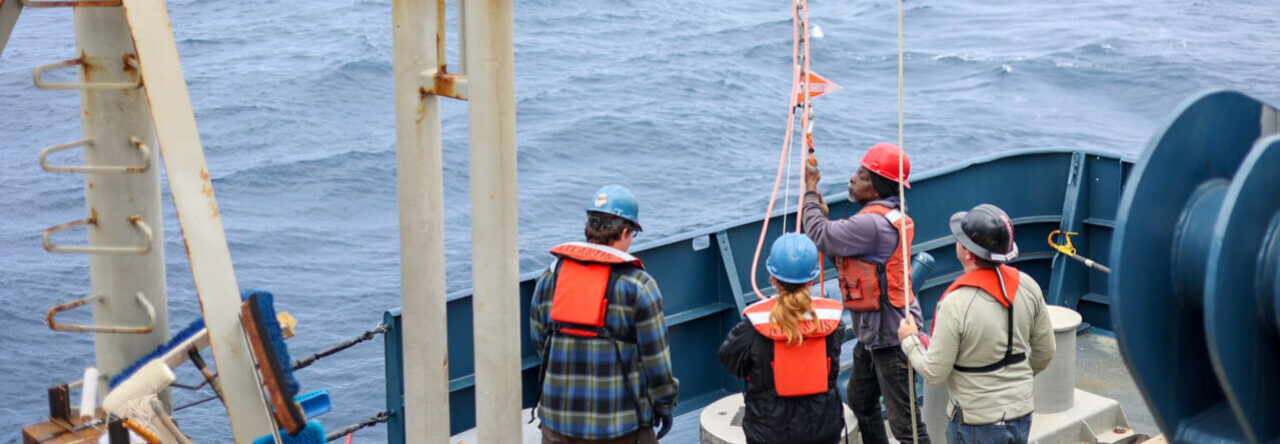
                The captain decided not to try that method again and sent out a small boat to meet up with the contraption, tie it up, and drag it back to the ship.  Thank goodness it was a calm day at sea or that wouldn’t have been an option at all.  Regardless, the small boat went out with 2 crew members and they were able to snatch the contraption and haul it back over to us.  Then the party really got going.  Trying to figure out how to get this thing back onto the ship and into its cradle without damaging anything was tricky.  It ended up taking the giant A-frame and winch, a secondary winch, the crane, ratchet-straps, tag-lines, and basically every able-bodied person that was near the area.  We eventually got it onto the ship and even in its cradle but it wasn’t positioned well so we had to try to get it seated properly which involved lifting the thing again.  It lifted, switched position, a strap broke, the thing fell a very short distance back into the cradle, BOUNCED…well and truly testing the integrity of the cradle and frame builders’ work, and landed more or less just where it needed to be.  Holy cow.

                While a lot of crazy things went on trying to figure out how to maneuver this contraption, at the very end of the day it did all of the things it needed to do, ended up back on the ship, nothing was damaged, and no one got hurt.  Not bad for a 2 day cruise:)

                Right after we got back in from that cruise we turned around and went out again on the 10 day trip I am currently writing you from.  Originally I wasn’t supposed to come out on this one because they were absolutely full and didn’t have any space for me but one of the scientists wasn’t able to make it very very last minute so I got to tag along.  Yay!

                I am super happy I got to come out on this trip…not just because that’s the whole purpose of the internship, but also because it is just packed with science things.  They are collecting almost every kind of sample that you could think of at all hours of the day.  I mentioned right at the beginning of this post that I have been busy and I meant it.  It seems like we deploy some piece of equipment, wait briefly for it to come back up, get it back on the ship and put away, and already the next piece of equipment is moving in.  It is really interesting watching all of these different things go out and chatting with all of the scientists to see what they are collecting and how they will use it and I am learning a TON but wow 12-hour non-stop shifts are exhausting.

                With that note it really is time for bed for me.  I have been working for the past hour trying to figure out how to add my photos (I had a really nice set of photos that helped tell the 2 day cruise story laid out for this post…honest I did) but it seems like I will have to figure out a different way because nothing I seem to do allows me to get an image displayed.  Sigh.  I will get Sonia to help me with it tomorrow since she is familiar with the drill.  Won’t she be excited:)

                 I know I owe a better description of the current cruise and I will get one out soon but I figured I would at least get a little bit of the story posted for now.  More to come as always!

Elizabeth

Week 1

Hello everyone,
  It has been a very busy few days here so I will do my best to recap some of the highlights.  It all started on Thursday when I flew into beautiful Hawaii.  I was picked up from the airport and shuttled out to the RV Kilo Moana where I got enough of a tour to find my room, the food, and the emergency exit and then I was off to bed.  Friday I started that gloriously awkward stage (which I am absolutely still in) where I don’t know what is going on so I mostly just follow other people around and introduce myself all day.  Poor Sonia!  She was the tech that led me around and babysat me all day.  We ended up replacing the central piston and several sensors from the CTD device which took us the entire day.  It was hot and sweaty and required a lot of climbing in, up, and under the CTD carriage.  It was actually pretty fun:)
  The the weekend happened…and really no one else was here.  So I managed to use that time to sit out in the sun and climatize (AKA sunburn) and explore some more of the vessel in hopes that I could get down some of the bizarre layout.  I’m honestly still working on that one though.
  So Monday we finally left the harbor with a group of scientists ready to take some samples and the whole week of working with them was mostly a blur.  I learned the procedure for deploying the CTD (and a few other items) over the side of the vessel using the giant winch and A-frame set-up.  It is a lot of fun to get the CTD into the water and recover it again.  It involves hooks on poles and everything:)  I have also been trying to learn how to tie some real sea-worthy knots and apparently I am terrible at it.  At this very moment I have a string in my pocket to keep practicing.  I do really well with the string when I start with it in the same orientation but on deck I am often forced to tie that same type of knot backwards or left-landed or in some other weird way.  And yes…I’m terrible at it…to the amusement of my mentor…but hopefully getting better:)
  By Friday morning we had made it back into Honolulu and I was able to get through some of the end-of-cruise procedures.  Mostly just shutting down different systems and compiling all of the data collected over the course of the trip.  Nothing too crazy so far.

  With the end of the cruise AND a Friday to boot it didn’t take long for people to scatter.  Another quiet weekend here.  Because I spent so much of this first trip out just trying to learn every little thing that I could I didn’t spend a whole lot of time taking pictures…or writing a blog:/  I am hoping to do much better on both counts as I get better at this and more used to the schedule.  Seriously…I will work on it.

Until next post (with pictures…sigh)

Elizabeth

Page 4 of 5

Powered by WordPress & Theme by Anders Norén