
Hello hello,
Things continue to move right along here. The video sledge did its thing for a couple of days until the science team was confident that they had collected enough footage. Once they gave the ok we hauled the thing up and began another round of musical chairs to get to the next piece of equipment. This time it was the epibenthic sledge and, again, it took quite an effort to get the video sledge out of the way and the epibenthic sledge front and center. This particular contraption is larger than the others and for deployment out into the water it is meant to stand vertically maybe a little over 3 meters (10 feet or so) tall. The goal of this thing is to sink down all the way to the bottom of the seafloor until it is actually settled on the ground. The ship will then move ahead slowly and drag it across the bottom collecting the surface layer and the very small life forms that live there in a filtered net sort of thing. The bottom of the sledge itself has a big latch release on it that opens the nets for collection but is only OPEN if the latch is depressed (ie if the sledge is firmly settled on the bottom of the sea floor) and that way they know they aren’t collecting samples from the water column on the way down to the bottom or on the way back up to the surface. It’s a pretty clever way to ensure they are getting samples just from the bottom.
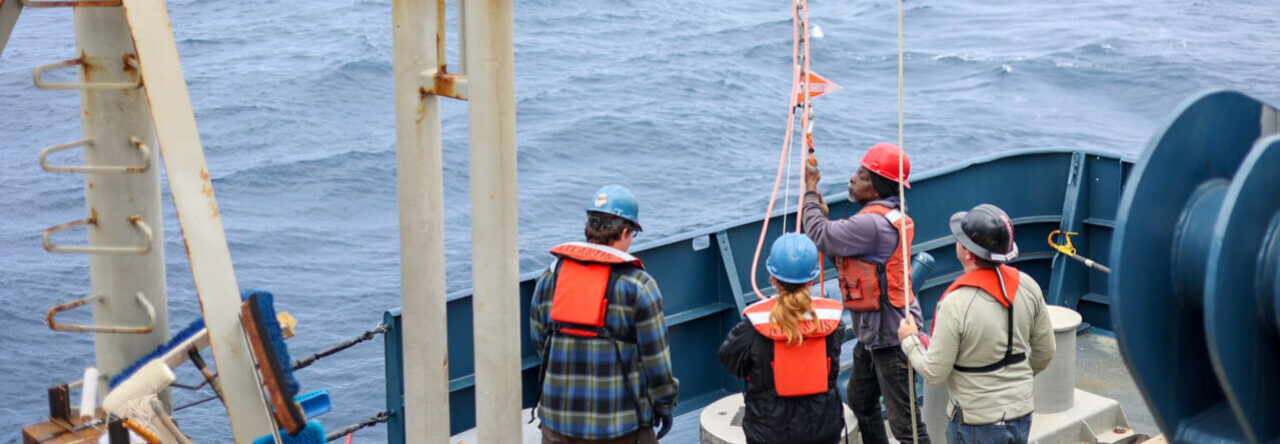
So anyways the deck rearrangement completed we got the epibenthic sledge into the water without any trouble. It is large and heavy but rectangular in shape with plenty of places for tag lines to ensure a safe and controlled entry into the water. All in all…no problems. But again, once it gets into the water it takes about 7 hours to complete a run. With these ones it is mostly getting the sledge to the bottom and back up that takes the most time. We put out over 6 kilometers of wire from the winch at a rate of between 30-45 meters a minute. It takes about 3 hours for it to go all the way down and another 3 to get it to come back up. Yikes.

Once the epibenthic sledge was recovered we moved into a long long series of playing with sediment. The scientists brought 2 main pieces of equipment to collect seafloor sediment; A box corer and a multicorer. We started with the box corer. This is a tall piece of equipment consisting of a large base to “land” well on the seafloor and a central core that has a big box and scoop at the bottom of it. The corer is cocked in an open position with the scoop stretched back behind the box and it is deployed into the water and down to the bottom. When it reaches the bottom (which is determined by the depth reading we have for that location, the length of wire we have put out through the winch, and by the eagle-eye attention of scientists watching the tension readout of the winch. When the corer hits the bottom there is a dramatic lessening of the tension that the scientists eagerly wait for) the box sinks into the sediment and the scoop snaps over the bottom trapping the sediment in the box. We then begin the long haul to get it back to the surface.

The deployment of the box corer is relatively straight forward even though it is awkwardly shaped. The recovery of it is a little more involved but still fairly basic. When the scoop has been triggered the central core of the contraption stands almost a meter taller than when it is cocked. This means that when we want to bring it back onto the ship it is too tall to go under the A-frame. So to get around that we have to use the A-frame to lift the box corer out of the water and bring it close to the ship, attach a different line to the shackles, move it back away from the ship, then use the different line attached to a different winch to pull it on board. Really it isn’t overly difficult it is just a few more steps and another piece of equipment thrown into the mix. Keeps things interesting:)
The box corer is one of the fastest pieces of equipment the scientists are using and it takes just about 3 hours to get one in the water, down, back up, and on deck. Then the ship moves to the next station while all of the scientists begin to process the sample and re-cock the corer. By the time we are in position the corer is ready to go down again. All in all the scientists want 40 box cores so we have been doing this for several days already with many more to come.
Before I let this post get to long I will cut it off here. Next installment; the multicorer…and maybe some phytoplankton net action:)
Elizabeth