What a busy first week it has been. To start my internship off I met all the crew and staff a BIOS (Bermuda Institute of Ocean Science) and was welcomed by all. Right off the bat I was helping get all the gear and equipment on board and helped mobilize so we were prepared to get underway. For this cruise we have been working with the John Hopkins Applied Science Lab as well as a crew from SCRIPPS Ocean Institute. After testing and fine tuning all the equipment as well as going through the briefing we were quickly underway.
The first two days were designated for transit to the work site which was named “Aquarius” and this location is about 300 miles southeast of Bermuda. During transit we mainly focused on our CTD and fine tuned all the senors incorporated with it. The science crew provided us with a few of there gear to mount and connect into our CTD system which took a little extra effort to fit everything on, as well as get the correct calibration coefficients tuned in. Once everything checked out and was tested we could move on to other preparations such as assuring our network was up and running so we could easily transfer data to the science teams with a public folder.
Once we arrived to the work site we quickly were saturated with many different operations that occur at all hours of the day. My first deck operation was a CTD cast which was pretty straight forward and I just played minor roll until I got more comfortable with the ship. After a couple casts, I began take more responsibility and was handling tag lines and taking lead. Later in the evening we deployed a buoy system called OOBS (Ocean Observing Buoy System) which consisted of 3 different buoys with many different sensors (CTD, ADCP, Mets, ect.) all connected with small float buoys in between. It is approximately 400 meters in length and this was the very first time I had seen anything like it. It was a fairly complicated deployment but with a good crew it went very smooth.
Throughout the first week we deployed mainly CTD’s but also deployed a Woods Hole Glider, Wire Walker, Profiler 2 and XBT’s. It felt like once we started it never stopped. There are operations going on about every 45 minutes to and hour unless we are making a lengthy transit across the work site.
By this point on day 7 I am feeling more and more confident in my deck skills and am getting more comfortable with how the ship operates. Everyone works as a team and they work very well. I would like to make a special consideration for the cooks aboard. They make great meals and Randal the head cook makes deserts to die for. A typical dinner could be anything from Lamb shanks with rice and cucumber feta tomato salad to Filet with baked potato and pasta salad. Deserts vary as well from key lime pie, chocolate cheesecake, to fresh baked cookies and everything is make from scratch. A good cook can make or break a crew and on this boat they are the final touch to a wonderful crew.
Unfortunately I could not attach any pictures while underway. The internet is slow and the majority of bandwidth is designated to the scientist (for good reason!) Once I make it back to shore I will be attaching many many pictures of the awesome operations that have been going on!
That is all for this week but can’t wait to see what lies ahead for me on this adventure! 
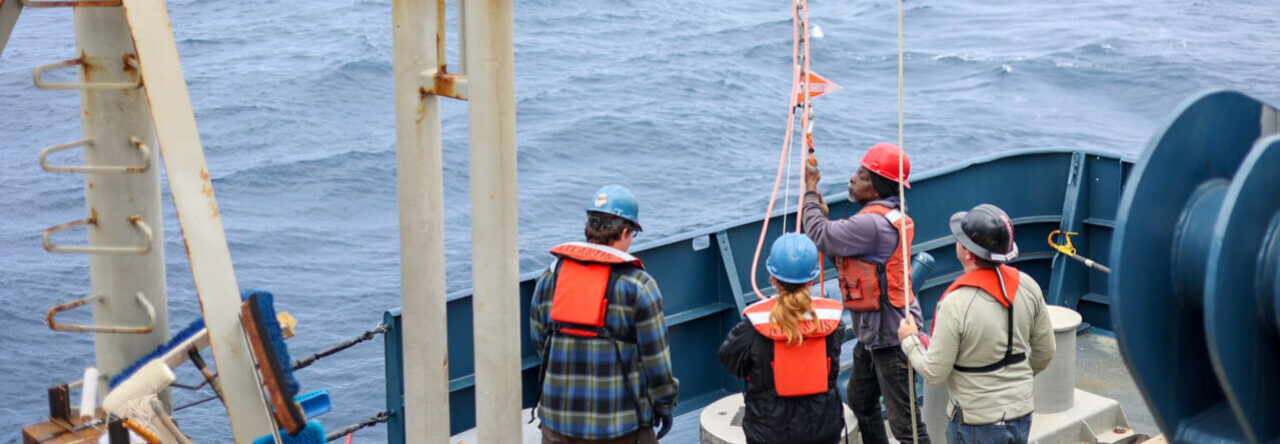
Picture of me coiling up cable from the recovery of the SPMR profiler.
*Photo taken by Peter Rogowski from Scripps Institute of Oceanography