Category: Host Page 17 of 85

Week 2 Across the Equator!

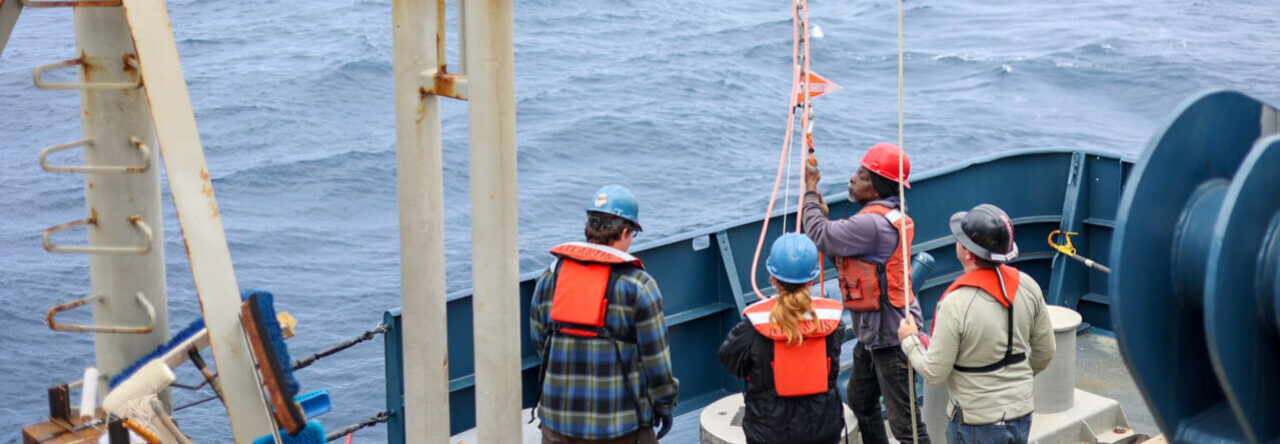
Hey everybody, Ray here giving you an update on my second week across the Atlantic Ocean on the R/V Marcus G. Langseth. This week has been extremely hot, with humidity ranging from 80%-90%, very sticky! As an intern I’ve been assigned to multiple tasks to complete this week. One of my tasks was to troubleshoot and calibrate these semi-autonomous devices called “digibirds” or digital birds. These digibirds are placed in the water which are being guided by a long rope connected to a big winch called streamers. In between the digibirds, there are devices called hydrophones that are also attached to the streamers. The hydrophones main job is to receive soundwaves from the air guns that are being fired and reflected off the ocean floor, or even layers beneath the crust. The digibirds are in charge of making sure the hydrophones are at the correct depth to interpret the sound waves being emitted. The data is then transmitted back to our ship in order to create maps and undergo further analyzations. Some of the features that can be determined from this data include subsurface structures, seabed composition, and other types of geological formations. However, overtime these birds can become misaligned or may require maintenance such as replacing batteries, motors, or compasses. This is one reason why calibrating and troubleshooting is so important! Another task I have been assigned to is collecting data on our gravimeter and entering it into our historical data spreadsheet. A gravimeter is a device used to measure variations in Earth’s gravitational field, also providing information on subsurface features and geological structures beneath the ocean floor. Every day we are using the gravimeter to precisely map these gravitational fluctuations across the Atlantic Ocean. By using a multimeter to verify amps and voltage values, we can guarantee the reliability and accuracy of our data so we can then draw conclusions on the ocean’s geological characteristics and even potential hidden features beneath its surface! 
One last thing I’d like to add is that everyone on this vessel are hardworking people. Especially in this heat and humidity, the fact that we can complete so many jobs and tasks is truly remarkable.

Stay tuned for my next update on our transit!


Josh, our Cheif Source Mechanic is also a great welder!

WEEK 2 – Capricorn, Meridian, Equator


i crave infinity, but love limitation – roon


(5/5/2024 – 5/7/2024)

Continuation of reorganizing server racks with marine technician Riley; installation of new acquisition systems, rearranging cords/data rack interface:

       – Sorted extension cords, made (2) wall-hang areas for power tools on adjacent wall in tech shop for extension cords and power tools. Disposed of old/frayed extension cords. Intermittently checked Serial Data updates and maps 

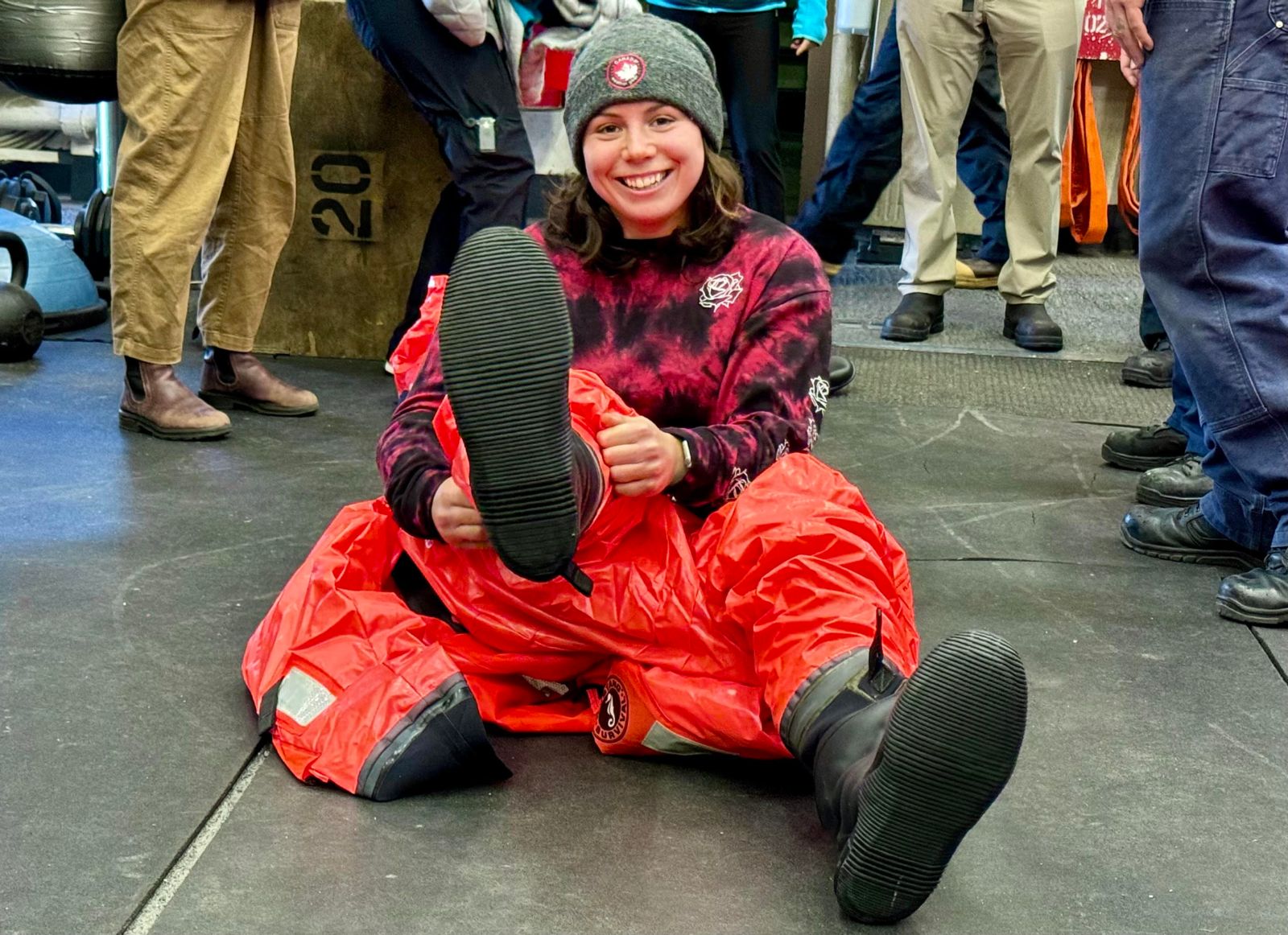
       – Continuation of tech shop reorganization; mounted tools on board, moved/consolidated batteries, vacuumed. Made “No Sitting No Standing” signs (4) with the engraver and attached to top and side of counter with screws. Moved (13) mustang suits out of lower cupboard and into a large box in the side room behind main printer station. Made a sign with the engraver for the fridge, removed cupboard doors from lower cupboard to make room for fridge.

Are you about to jailbreak the sim? Be sure to tell us what it’s like on the other side. Hoping it’s not just racks of servers humming in darkness. – George


5/8/2024 – 5/9/2024

       – Disassembled and cleaned all parts of 1900 LLXT source element (seismic airgun). Reassembled replacing Al o-rings/bolts, tested with shop air for leaks. Cleaned out airguns w/ sandpaper, mystery red oil spray and paper towels. 

Per aspera ad astra. Latin anon 


5/10/2024 –  5/11/2024

 – Made signs on the engraver for various projects (Riley, Chief Mate, and Cody). Small scale organization of various items on desks/tables while waiting for engraver (consolidated ratchet straps/ropes, etc). Put up curtains in wet lab with Colton and Ray.

 – Tech shop organization; organized hoses, cables, ratchet, straps, and miscellaneous tools. Modified shelf space for Combi bins, battery signs/policy up, moved, cables, and chargers, above battery shelf. Drilled metal holes for crisscross rope reinforcement on adjacent shelf wall.

No matter how lost you feel, remember that your whole life has led you here, as a sort of comforting causal tautology. – Yudkowsky


We passed the Tropic of Capricorn, we slept. We passed the Prime Meridian, we slept. We passed the Equator, we slept. The water remains astoundingly blue. We work on several engaging and challenging projects daily in a deep-ocean humidity, all systems go. At days end, we either hide inside or flutter mirthlessly like heavy petals until sunset. 

The sea is everything. It covers seven-tenths of the terrestrial globe. Its breath is pure and healthy. It is an immense desert, where man is never lonely, for he feels life stirring on all sides. – Vonnegut


– Rachael

Week 2: Sunrise to Sunset

5/4/2024 – 5/10/2024


At the time this blog is written we have been at sea for 12 days. I can’t describe the feeling I have each morning waking up and seeing nothing but ocean for miles in every direction. I have seen some of the best sunrises of my life looking out my porthole each morning and the best sunsets after a hard day’s work. There’s nothing like going out to sea and being the only ship for miles to make you realise how small we truly are in this big and beautiful world of ours.


Saturday 5/4 and Friday 5/10 were spent working on the air guns. These “guns” are able to release powerful sound waves that are capable of reaching the seafloor and pass through multiple layers of sediment before bouncing back allowing us to be able see what the seafloor (and below) looks like. The guns need to be routinely serviced to prevent damage and corrosion from sea water, but mainly to replace all of the O-Rings. Once a gun is disassembled, cleaned, and put back together it is test fired on deck to insure that it is working properly. When firing the gun on deck all safety protocols are taken and the guns are fired at approximately 100 psi. At this strength, you are definitely able to feel the force of the blast in your chest, but when the guns are in the water and in use they are fired at approximately 2,000 psi. 


Sunday 5/5, I spent the morning greasing and covering various pieces of equipment on board. The rest of the day was spent inventorying the streamer recovery devices (SRDs). These SRDs allow the ship’s crew to be able to recover the streamer in the event that it is lost at sea.


Monday 5/6 through Wednesday 5/8 was spent working on the Digibirds again. During that time I was able to test all Digibirds on board and create a document that contained information on all of the birds to include: their serial numbers, whether they are operational or not and other problems with the Digibirds. The next step would be to go through all of the non-operational birds and try to fix them.


Thursday 5/9 was spent assisting in installing a new radio antenna on the observation tower. This required a lot of work and planning to ensure that the antena was level and would be secure for the inevitable rough seas. 


Stay tuned for my next post!

WEEK 1 – Sailing the South Atlantic

After flying several hours from Alaska to lower-America, then several more hours over to east-America, then flying 14 more hours over the oceans… I finally made it to Cape Town, South Africa on the afternoon of April 27. After a quick tour of the RV Marcus G Langseth, I unpacked only critical items and fell into a well-deserved slumber in sleep cavern #103. 

April 28: After a generous tour of the 230ft seismic vessel, the other interns (Ray & Colton) and I headed out to explore Cape Town. It turns out that it’s helpful to have the Uber app. Maintain your app, do not be me. We toured the wharf and shopping area, locally known as the V&A Waterfront.

We went to the Victoria Aquarium where I learned how to surf and to telpathically communicate with subequatorial avians, see photos below:

Additonally, we went to the South Africa Trading Post and saw some incredible artworks. Here is a sculpture in front of the trading post overlooking the bay…

April 29: We set sail from Cape Town, South Africa to the city of New York. Good bye Cape Town, I’m sorry my $20 bill was torn and that the local shops wouldn’t let me turn you into any rand.

And now, we work…

April 30: Worked with marine technician Riley rewiring the seapath receivers; pulled out roblox, fed cable through various parts of the ship, crawled into small spaces. Had to fill out paperwork on bridge for permission to feed wire upwards, geared up, went aloft, adhered cable with metal fasteners.

May 1: Climbed up the side of utility closet in the bird lab to remove roblox and feed cable through wall down to the crawl space in the port lab. Organized excess cables in bird lab crawl space to continue feeding cable into the main lab. Removed false walls at top of stairs next to bird room, fed cable through, put walls back and cleaned walls/ceiling.

May 2: Daily walkthrough Wet and Dry Labs (AM/PM). Checked Serial Data updates and maps. Learned how to use and adjust certain settings with the multibeam echosounder. Worked with marine technician Josh in the gun lab learning the basic deconstruction of the air gun, cleaning interior components, testing and rebuilding. Stop looking into the flashing light, Rachael.

May 3: Helped marine technician Josh again, this time to rebuild an airgun cluster; changed main housing, broken spreader bar, and worn flange. Additionally, had a diligent time trying to resolve a seized bolt that occurred during a routine air test^.

May 4: Worked with marine tech program coordinator Cody to learn step-by-step for digibird inspection/calibration/troubleshooting, both in visual and data system. Helped intern Ray with jumper cable project; cable labeling, taping, coiling, and organizing. Assisted marine technician Riley with the server racks; drilling, organizing, zip-tying, lifting, ratcheting, vacuuming, pulling apart, putting together, and labeling various cords and racks.

Been a very rewarding and very fun week here aboard the RV Langseth, very grateful and happy to be here and I’ve said this about one hundred times to anyone that will listen. Quite excited to continue learning under the wings of the fantastic marine technician team while aboard for the next 23 days. (Fyi, the meals are fantastic, so thank you Galley for nourishing us!)

– Rachael 

Week 1 Across the Atlantic!

Hi everyone, Ray here with an update about my first week as an intern on the Marcus G. Langseth research vessel. Colton, Rachael, and I arrived in Capetown, South Africa on April 27th around 5:00 P.M. The following day we had an orientation of the vessel. Our mentor Cody, gave us a brief introduction to the ship and a thorough summary of the different tasks and assignments that will be given to us on our transit. We expected to set sail the following day (4/29/24), so we actually had time to explore Capetown for the rest of the day! Colton, Rachael, and I eagerly explored as much of the city as possible, and the culture was astounding! We finished our evening eating Ostrich Filets and fancy assorted seafood appetizers, all of which was paid for by Cody for which we are extremely grateful! The next day our vessel started to set sail across the Atlantic towards NYC at 5:00 P.M. The past six days aboard this vessel have been incredibly productive, with a multitude of tasks that have been completed. Among these tasks was the disassembly, cleaning, and reassembly of the air guns. These instruments fire at 2k psi, sending signals to the ocean floor, which then bounce back for collection by the hydrophones. This data is essential for creating detailed 2D and 3D images of the ocean floor beneath us. My plan is to continue making blog posts with more updates on our tasks as we approach NYC! 

Stay tuned!

!                                                     

Week 1: The Journey Begins

4/27/2024 – 5/3/2024

I arrived in Cape Town, South Africa on Saturday 4/27 in the late afternoon, by the time I made it to the R/V Marcus G. Langseth (Langseth for short) it was almost dark and time to unpack and get acquainted with my new home for the next month.


The morning of Sunday 4/28, was spent touring the Langseth. Looking at all of the labs and other facilities I would be working in as well as going import rules and safety while on board. The other UNOLS-MATE interns on board ( Rachael and Ray) and I were then given the rest of the day to explore Cape Town. We were able to explore the city for half the day and get a taste of the African culture, which is an experience I will never forget. Nothing was more spectacular than looking up at Table Mountain.


Monday 4/29 was the big day, the day we left Cape Town and began the long transit to New York. I spent the day working with my fellow interns to secure crates, pallets and coolers containing water samples from a previous cruise with ratchet straps and paira cord to ensure that they did not move while at sea. We set sail later that evening.


Tuesday 4/30 was spent working mostly in what’s called the Bird Lab. This is where all the Digibirds, that attend the sizmic streams to keep the stream level in the water column, are dismantled and tested before deployment. This lab was used as a storage area for water samples and needed to be cleaned before testing the Digibirds. I spent the rest of my day working on other tasks throughout the ship.


Wednesday 5/1, I assisted in troubleshooting a solution for the inoperable Seapath GPS receiver antenna. This involved climbing the (name) tower and putting on a harness to reach the antenna. After a lot of trial and error we were finally able to get a clear sign on the receiver after reterminating the wire connected to the antenna.


Thursday 5/2, I spent the morning making labels for all of the unmarked crates and containers on the ship. This was in order to ensure that once we arrived in New York these container crates containing scientific samples and equipment would get to their final destination. I spent the second half of the day learning how to dismantle and test the Digibirds. After looking over the procedures, I was able to test a total of 8 Digibirds.


Most of Friday 5/3, was spent continuing my work from the day before, dismantling and testing the Digibirds. I was able to get through about 25 of them today, but there are quite a few that require some troubleshooting to determine what is wrong with them.


Stay tuned for my next post!

Week 0: Heya MATE it’s Hunter

Howdy reader,

My name is Hunter Adams! I have the privilege of being a 2024 MATE intern and will spend the next six months supporting three different research institutions on their missions to better understand our world’s oceans. I look forward to sharing this amazing experience with you through these blog posts and I hope I can get you excited for the awesome work that MATE interns get to do!

So what about me? What’s my background and why am I participating in this internship? Well here are some answers for ya: I graduated from Texas A&M University with a BS in Oceanography and an MS in Business in 2022 and 2023 respectively (Gig ‘em Aggies!). At TAMU, I spent three years studying methane and nitrous oxide concentration trends in the northern Gulf of Mexico and participated in multiple research cruises as a result. These cruises gave me a glimpse into just how rewarding work at sea can be and I learned how valuable marine operations can be for oceanographic research.  I furthered my interest in oceanography at Los Alamos National Laboratory, performing reduced biogeochemical modeling and preliminary model research over two summer internships. So yeah, I have a research-heavy background. Now you may be asking yourself, “Hunter, this is great and all, but if you love salty water science so much why aren’t you jumping into a PhD or the like?” I’m so happy you asked and I’ve got two answers for you! 

My first answer is that oceanographers and climate scientists worldwide need quality observational data from our oceans. With this data, scientists can better understand our Earth system, improve climate model development, and inform policy decisions (to give just a few examples). One of the best ways scientists get this observational data is by going out to sea and collecting it through research cruises. However, they can’t always be expected to operate the research vessel, troubleshoot instrumentation, manage data acquisition systems, or perform deck operations. That’s where marine technicians and crew come in! Together, crew and mar techs perform all these duties and more, ensuring that oceanographers get the data they need. Marine technicians are needed more than ever due to an ever-increasing demand for data, especially in the face of a changing climate. For this reason, I would like to contribute to oceanographic research as a technician as I feel there is a great need for the work! 

My second answer is that working as a marine technician is FUN! Marine technicians possess diverse skills, are dynamic problem solvers, work with passionate people, and get to travel to some of the most unique environments on the planet. Needless to say, the work can be incredibly engaging and rewarding. I owe my appreciation for this career to the 2023 MATE internship, where I spent five weeks working with the Hawaii Ocean Time-series (HOT) team and OTG techs at the University of Hawaii Manoa. Now, I’m participating in the long-term MATE internship to get as much hands-on experience as possible to become a more effective technician.

So, I hope you have a better understanding of my professional background and motivations for taking part in this internship! Some less-professional fun facts about me include that I like outside activities, motorcycles, Cajun food, memes, reading, and traveling. 

Over the next six months I hope you can get to know me even better through these posts and understand why I’m so excited for this opportunity. As I write this, I am flying to the University of Delaware and the R/V Hugh Sharp to begin the first leg of my internship. Over the next few weeks I will be assisting with a sea scallop and HabCam survey (which’ll be a brand-new experience for me). In my next post, I’ll talk more about my work, who I’m working with, and all the best parts of the internship so far! So stay tuned and don’t miss it!

All the best,

Hunter Adams

Introduction – Ray Barrett

Hi Everyone,

My name is Raymond Barrett. I am a 22 year old college student from Tiverton, Rhode Island. I am in school for Offshore Wind Power Engineering and Technology and have just completed my Offshore Wind Power Maintenance Technician Certification. I will be traveling from Cape Town, South Africa to New York on the R/V Marcus G. Langseth. Math and science are two of my favorite subjects and I love learning new things. I also love to work on cars, it is one of my favorite hobbies. I also like skiing, sailing, and going on adventures. Stay tuned for updates on my journey across the Atlantic Ocean! 

Introduction – Rachael Byrd

My name is Rachael Byrd. I received a Bachelor of Arts/Biology from the University of Alaska Southeast. Over the last few years my studies include marine biology, acoustic habitats of marine mammals, and maritime transportation. I have technical experience with passenger vessels and hydrophone to capture underwater acoustics. I’ve spent the majority of my time in Alaska but also studied abroad at the Ningaloo Reef Marine Sanctuary with Murdoch University in Western Australia. 

I’m a licensed merchant mariner, I love: taking things apart, unforeseen events, early mornings, late starts, long walks on the beach, and inclement weather. As a proud UNOLS intern I’m excited to have this opportunity to learn more about open ocean research vessels and marine technology.

Second to Last Launch Day

Time has been slipping through my fingers like so many grains of sand, especially on this cruise. And just like that, the penultimate dive day is upon us all. There are no words to encapsulate the experience of working on the Alvin Ops team and with the amazing scientists and boat crew! I will have the whole of transit to get used to the idea of leaving, but I definitely am already a lil misty just thinkin about it.

Page 17 of 85

Powered by WordPress & Theme by Anders Norén