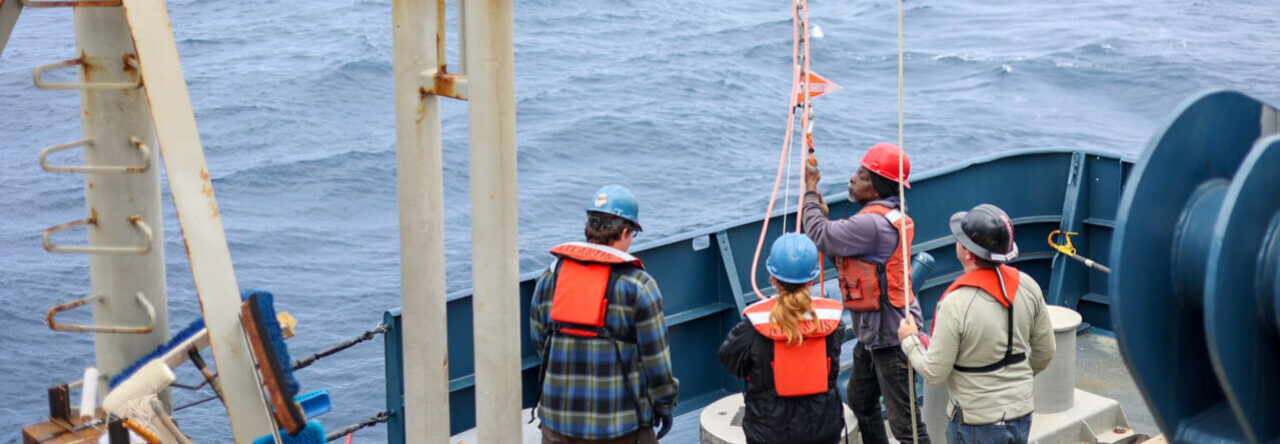
Currently, the ship is positioned on the last Distributed Biological Observatory (DBO) line southwest of St Lawrence Island. This will be the last area where science sampling will take place and the cruise will come to an end after we arrive in Dutch Harbor on the 15th. We have been transiting for the past few days after completing the “wheel spokes” shaped sampling sites. This past week, I have been staying busy finishing up my manuals relating to the Niskin Bottle lanyards and ICE Imagery. I also created a graphical manual on deploying the CTD aboard the USCGC Healy for future reference during different cruises. I have finished my tool in ArcMap, it can be used to help future navigational operations allowing the user to convert multiple satellite images of sea ice into a single blended image.
Also this week I learned how to use a Micro scanner which is used to map out network connections. An Ethernet cable can be connected to the Micro scanner and then a wand like device creates a tone if touched to the connected Ethernet cable allowing me to identify cables by sound. I used this device to trace out network connections of cables in Aft Con (the aft bridge) as well as the scoreboard cables. The Micro scanner also displays the length of the connected Ethernet cable.
Earlier this week, I continued to assist with science operations on deck, helping collect sediment and zooplankton samples. I also disassembled the magnetic carousel, which triggers the Niskin bottles to close, on the back up CTD rosette. After disassembling, I cleaned different components of the carousel. In addition, I learned about the components of a Benthos Pinger which was used on the multi-Haps core in the deep sampling sites which were over 1000m deep. I disassembled one of the pingers, to clean the parts and check the batteries. The Benthos Pinger creates a sound, similar to sonar, which bounces off the ocean floor. Using a transducer, we can listen to the sound and calculate the distance from the seafloor to the location of the package (deployed equipment). The Knudsen echo sounder is normally used during equipment deployment to determine the distance from the ship’s location to the bottom. If the winch operator were to wire out too much, in compensation for the ocean’s current which angles the package, then the possibility of entanglement between the cable and package increases. Between monitoring the Benthos Pinger and the wire tension, we successfully retrieved multiple cores from the depths of the Arctic ocean.
On the deepest CTD cast of the cruise, around 3000m, we sent down pillow cases full of Styrofoam cups to be shrunk under the pressure. We decorated them before sending them down, and now I have a cool souvenir from this trip. With less than a week left of my internship I am wishing it was longer. I have gained a lot of experience and have made professional connections which will hopefully lead to a career.
Photo Credit: Amanda Norcross