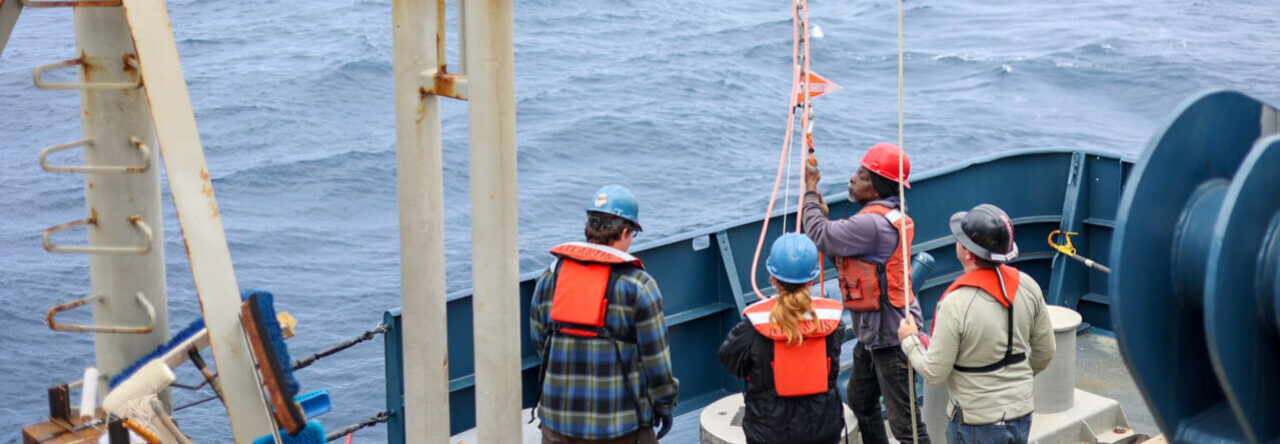
We have been in the Sea of Cortez since the end of March. The science mainly involves the utilization of mud cores and water samplers (niskin bottles or brine bottles). The weather is extremely calm out here, as if we were on a lake. The coast is aligned along one horizon typically on the port side of the ship, and all that can be seen is a silhouette of mountain ranges. There is not much to add from the day to day that differs from my previous posts, so I intend to offer some advice to any potential MATE interns. Network, network, network. Talk to everyone, and pick their brains. Time tends to fly at sea, at least for me. There are some incredible people that work on board UNOLS vessels, and they are all very personable and willing to chat. If you are interested in the science, the scientists are always excited to share their work and talk about their research. Squeeze every ounce out of the MATE internship, because it will get you some very valuable connections, skills, and experience. When it comes to working on board be that person that is always willing to help. If you are left without a task don’t pull out your phone. Start cleaning, organizing, scrub every inch of a space if it keeps you busy. Be enthusiastic and positive, I promise that it won’t go unnoticed. When you are spending an extended period of time on board a ship the world shrinks to the size of the ship, and that means that you stand out more easily. In the good and the bad. A good mood goes a long way as well as a good work ethic.
Author: Noah Bourassa
3/9/2024
We have had many recurring visitors in the submersible hangar. These visitors have all been small, dark feathered birds with webbed feet. Just the other day I was informed that there was one stuck in the hangar and injured, so I put on some gloves and went over to where the bird was located. After carefully removing some metal poles that were keeping the bird’s right wing stuck, I gently cupped it in my hands and brought it out on deck and placed it into a milk crate. It looked visibly healthy, only shaken up a bit from being stuck. After about fifteen minutes I placed it on deck, and not long after it flew away. I kept my eyes on it for as long as I could see it to gauge it’s health in the air, and it looked good as new. I discovered based on some research and image matching that the most likely species of this bird is the Sooty Shearwater. This is a sea bird which travels long distances over the ocean, and lives out here. Not all birds need land to live, however there are some instances where land birds will live on the ship while in port and get stuck on the ship after we leave port. I haven’t seen any of these land birds, and I am glad for that. The day after saving this bird, we found another one in the hangar. I followed the same procedure. Five minutes after I placed the bird in the milk crate it flew back into the hangar, bumped into my coworker, then into my head, and then flew out the side of the hangar. Since that occurrence we have found one or two each night for the last 3 days. I know that there are nests of sea birds near the bow, so I think that is where they are coming from. Good news is that this species is independent once fledged.
We had our first delayed dive this morning. One of the battery cables which alerts of a leak in the starboard battery was not giving a satisfactory continuity reading. What is difficult about this problem is that in order to replace the cable, the main j-box has to be drained. A major component of working on Alvin is pressure compensation. Air is very compressable creating implodable volumes, but replacing the air volume with oil significantly reduces the compressability. So underwater these boxes do not get caved in and implode There are many “j-boxes’ compensated with different types of oils. The main j-box is filled with about 8 gallons of a mineral oil. The box is drained and filled through a small hole so it takes a long time. I worked on draining it and removing the cover so that the electronic technicians could access the cable. After their replacement and successful testing I had to put it back together and refill it. Connected to the box are large tubes with wires which run into the sphere through what are called penetrators. These are very important because they penetrate the sphere supplying the electronics that run the controls and sensors. A sphere is one of the most efficient shapes at withstanding high pressure. When you take a piece out of the sphere to run wires into it, you are creating an area that is less efficient at withstanding pressure. It is extremely important that the air is chased out of these tubes to prevent compression issues underwater. Overall this process delayed the dive time by two hours and it took the efforts of everyone on the ops team to take care of it. A normal morning turned stressful just like that, but I enjoyed it.
We are scheduled to get into San Diego the morning of the 19th, and I found out a couple days ago that I am staying on for the next trip which runs all of April. I am stoked to be able to continue this learning opportunity. I wouldn’t complain if it lead to a job, but we’ll see what happens.
3/22/2024
We have been in port for a few days now running through a list of maintenance that needs to get done before the next trip. In one of the images below I am standing next to Nick Ellis who was a former MATE intern who got a job with the Alvin team. He has been an incredible mentor for me and he taught me most of what I currently know about the technology.


I am currently going on a little over 2 weeks at sea with the Alvin Ops group. It is my first time at sea for this long, and I will say I had some anxiety beforehand. I am currently enrolled in an online masters program, so I was worried about having enough time for both the internship and my courses. Now in retrospect I can say that all of that anxiety is out the window. Even with the long hours of work for the internship I still have plenty of time to get my course work done, and also relax. When you’re on a ship there’s nowhere else to go, so the distractions are minimal. The work days are long with the Alvin group, but I am used to it and because I enjoy the work it doesn’t feel long. Up to this point I have worked closely alongside the mechanics during focused repairs, inspections, and maintenance. I am learning something new everyday, and it is all thanks to this amazing opportunity afforded to me by the MATE program. If it were up to me I would never leave the Alvin Ops group, they are a great team to be a part of and the work is extremely interesting as well as unique.


Last night was a very busy night. Today was the first science dive. After the first couple dives called engineering dives where the Alvin pilots make sure everything is operating smoothly, the scientists can add their equipment to the submersible for sampling. The Alvin ops team were working with the scientists to determine what would be used for sampling on the first dive, and it took a lot of last minute building and machining. Things don’t always go as planned and scientists enjoy making the technicians do more and more. It doesn’t bother me because I am enjoying the work and I am always learning from my superiors. There is a wealth of knowledge among the team members and I am always willing to lend a hand. We are quickly falling into a manageable routine, and I can’t wait to see what happens next.


Week one complete. Boarded my flight out of Boston at 5 am on Monday the 12th, then boarded a connecting flight in Dallas, and found myself in San Jose, Costa Rica. I met with another MATE intern after customs, Emilia TopJohnson, who is on the same cruise. We grabbed food near the hotel and then turned in for the night, awaiting news of wether or not the other team members arriving the next day would be delayed by weather or not. Luckily they arrived on time with no issues, and we all made it onto the chartered flight out of San Jose to Golfito, where the ship is in port. Once in Golfito Emilia and I met many more members of the Alvin and Sentry teams, and we were well aquainted with our mentors by the end of the night. The next morning was a weight party which involves moving and stacking steel plates which are used on the Alvin submersible as ditchable weights. I enjoyed this laborous introduction to work on the ship. After that party we were free to explore the area. My roommate, my mentor, and I found a local dive shop and joined an expedition to two wreck sites. As someone with only cold water diving experience I will say that it will be difficult to go back. Today we had a packed day of working on pre launch tasks. I first assisted in securing spaces with line, and then I helped in the mechanic shop. For the majority of the day I helped the team install new parts onto water samplers which are used to take water samples from hydrothermal vents. I thoroughly enjoyed it, and the time flew by. The team is very knowledgable, and more importantly helpful and positive with teaching me. Tonight is our last night in port, and we are scheduled to depart at 0930, but that could change. Until next time.
