Author: Kyle Hebert

Week 5: Removing Erroneous Electronic Components, Replacing A/C Units, and Fighting Ants

Following a weekend full of exploring the mangroves in a kayak looking for fish and alligators and cracking coconuts on the back deck, we have an ant infestation which we adamantly were pulling up the wood planks on the back deck to find where they were coming from. We discovered a few possible places of entry in the tonnage bulkhead that held the main doorway, that was sealed with 5200 marine adhesive. Upon pulling up the metal from the steps on the interior of the doorway, we discovered the wood was dryrotted and needed to be replaced. I appreciate the great value in how a small problem like ants can lead us down a rabbit hole that discovers a project of a potentially bigger problem such as safety. 

We are still waiting on the arrival of the engines (one of them has shipped) and therefore are continuing working on small projects around the boat, wherever we can be the most help. We got some training on using some more scanners and troubleshooting wires, tracing them throughout the ship, making sure that they were transporting information at the rate they were certified for, and how long they were. Then, we were asked to take out a box that contained all of the electriconic components for the old Dynamic Positioning (DP) system located under the bridge. The system had troubles as the bow thrusters are severely underpowered for the system and size of the boat. Therefore, the box has been sitting there unused and depowered for a long time and the F.G. Walton Smith kept getting hit with not taking it out in their NSF inspections. There is a lot that can be learned from taking things apart like this as each electrical component is attached differently and the connections have to be traced out. It is almost as methodological to remove electrical equipment like this as it is to install it, I feel like. Here is a picture of the box and me in the tight space underneath the wheelhouse control console. 

We have also started projects to to take out some of the old A/C systems left and reinstall some newer (but not marine-grade) A/C systems that are a little more compact and simpler. The new ones we are installing are the same ones we cleaned a couple weeks ago and will update one of the scientist berthings, the dry storage, and the wet lab units. Here is a picture of the old A/C unit removed and a selfie of me on the back deck with it about to throw it away! This was in my room and after seeing the grimy, slimy, thing uncovered I was a bit repulsed! Glad we’re changing it out!

Week 4: Making connections to the Network and Plumbing Projects

I am really enjoying the work environment and crew onboard the F.G. Walton Smith, it is very collaborative as we brainstorm solutions on how best to do projects or how to fix problems that arise. Everyone trusts, respects, and has each other’s backs while also joking around and having laughs all day. It’s the little things. Over the weekend, we went kayaking out to an old wooden shipwreck ~2nm offshore, where we anchored up and went snorkelling, it was super fun! 

On Monday, Alesha and I attacked the Head Vacuum Pump that created suction for the head system and fed into the blackwater tank. It was a dirty job, nonetheless we suited up and took the pump apart, cleaned the duckbill valves, and replaced the torn rubber gasket that created the suction for the pump. This is a picture of us suited up in Tyvex suits, goggles, and gloves:

Tuesday morning, we finished putting the vaccuum pump back together, after the silicon had dried on the rubber seal and pump shaft. In the afternoon, we continued our project with the Marine Tech on running Cat 6 wire from the Marine Tech Lab (where the terminal port is to connect to the switch, which then can be connected to Campus Safety’s server). Eventually, we will set up two more exterior cameras that will look down the port and starboard sides. We will use our newly acquired skills to make RJ45 connections to make a terminal connection in the overhead so that we can run an exterior grade wire out of the main superstructure to an overhang on both bridgewings. The picture below are the common tools that a Marine Tech may use for testing, creating, and removing connections through wire. This includes a multimeter to test voltages, amperages, resistance, and continuities when troubleshooting electrical issues, a scanner that can determine length of wire, connections between pins, wire cutters, and crimpers. 

On Wednesday, we started up the engines at 0800 and got underway around 0930 for a quick jog down through Stiltsville as a Vibration Technical Expert ran a vibration analysis on the hull of the ship. They are testing the ship before and after the engine swap in order to make sure the hull doesn’t lose any integrity from the vibrations of the engines. We made it back around 1100, just in time for lunch. Around 1230 we helped out with some crane operations to get the two life rafts off of the O-1 Deck to send off to get recertified and checked out by the manufacturer. We continued removing bulkheads to find a pathway for our wires in the afternoon. 

On Thursday, we got our wiring figured out, had to make a few cuts in the 2x4s in the overhead and fix some of the wooden bracings in the bulkheads. We then worked with the Chief Engineer to fix the broken check valve in the hot water system. After fixing the hot water system, we attempted to move the commercial sized refrigerator to do a favor for the cook and plug in a cord leading to the toaster. As we started pallet jacking it up, we accidentally snapped an old pipe that was from an older ice-box system, and water rushed out flooding part of the kitchen. We quickly shut off the potable water (part of the system we had just been working on with the hot water heaters) and went to work dewatering with a recipriocating pump. We ended up cutting a hole in the wall to put a permanent plug on the leftover piping. 

It has been a busy but highly productive week and it is rewarding to check some projects off the list and to work with this stellar crew. I learn a lot everyday and enjoy the people I am working with. 

Week 3: Learning Network Infrastructure, Data Acquisition, and Working on Small Projects

After last Thursday (06/02), we prepped the F.G. Walton Smith at the pier for an incoming Tropical Depression over the weekend. The storm itself didn’t seem all too bad, despite rocking the boat a bit more than usual. We have become accustomed to the daily 2pm thunderstorms that roll in fast and leave fast, normally lasting 30 minutes to an hour. The Tropical Depression seemed like one of those just lasted a lot longer, ~12 hours. The top wind speed logged by our anemometer on top of the bridge logged 25 knots. Alesha, Jonathan, and I decided to go rock climbing to pass the time as the storm rolled over South Florida. It wasn’t until later that day, we found out that one of Jon’s friends we were with tested positive for Covid, so we started going through Covid protocols on the ship. 

We started testing ourselves for Covid Saturday evening and then again Monday morning. Jonathan, our chief engineer, unfortunately tested positive. While, Alesha and I somehow remained Covid negative, even taking tests until Thursday (06/09). We had to start wearing masks indoors on the ship and Jonathan was moved into quarantine in the scientists’ bunk down a deck. With some of the major projects we were working through with Jonathan, such as the black water pump seal tear, the hot water/potable water contamination, and A/C compressor contacters/relays on hold, we worked with the Bosun onboard to clean the A/C units throughout the vessel and take care of some odd jobs that needed to be done. 

Dennis, our Marine Tech, came onboard Thursday to show us how to make RJ45 terminations while teaching us about the specs and history of electrical/network connections and wiring. He then gave us a project to fix some of the cameras onboard that are routed from our Local Area Network (LAN) to the Campus Safety’s Wide Area Network (WAN). We used what we had just learned with Dennis on making proper terminations and using the testers to test connections from different areas of the network and cables to fix the camera on the bridge and add a signal jumper box to it, while also troubleshooting what the problem with our port engine camera might be. It is very interesting as Dennis has tools from working with IBM and networking back in the 80’s as well as the tools that are more commonly used by techs nowadays, so he can show us a wide range of what we might encounter or have to deal with in a Marine Tech role. Especially, as ships are a lot of times retrofitted or systems are changed piecemeal (normally when they fail or start to have issues) seeing the old stuff and the new stuff can be enlightening. It is quite funny working with Dennis as he has salt, is reserved, super knowledgeable, and can be a bit grumpy sometimes, but he is a great teacher and has a soft heart deep down. I’ve worked with many people like Dennis on boats before this one and its makes it all the more exciting when you work with them and they get excited in what they are telling you or what we are working on. It is all the more rewarding when you get a compliment or a crack of a smile out of them. Working on these terminations and testing different connections to these cameras physically really helped me understand more of the abstract networking infrastructure we were talking about last week with Dennis. I’m beginning to get a grasp on the data link, how voltages are read through pins of the connections, and how that might communicate with the router or switch to the network. Of course, it’s just the tip of the ice berg and Dennis says, “That was was only a small introduction.” I think what is a small piece of the puzzle for Dennis is a huge learning curve for me, lol. I am enjoying all of the important tidbits of knowledge that are being imparted on Alesha and I.

Week 2: Prepping for engine overhaul F.G. Walton Smith

Following our exciting week out at sea, we have arrived at the dock and are spending each morning with the Marine Tech going through the Local Area Network (LAN) Infrastructure and how the sensors and scientific equipment communicate to each other. We are then spending the afternoons with the Assistant Engineer going through figuring out projects that have been on the list to do for awhile as we await the new Cummins Diesel Engines to be delivered for the Engine Overhaul scheduled on June 16th. These projects include replacing a torn rubber seal on the diaphragm pump for the head system, changing out faulty relays for the A/C compressor system, recharging the A/C compressor refrigerant, and fixing a faulty check valve in the hot water recirculation system as it is mixing with the potable water. 

I have been learning a lot working with the Marine Tech on how data from sensors are packaged, read, transported, and understood by computers as the physical layers of voltages and amps become this sort of metaphysical data stream. It is quite interesting as the further I dive into it, the more boggling it gets, how we can convert something tangible (but not perceptible to the human eye; electrons) turn it into something intangible (a bitt or packet of information) and transport that across atmospheric space, between systems, to receive and be able to comprehend the information on the other side. From working with Dennis, I think most computer engineers would argue that none of it is actually intangible, but to me it is very abstract. However, I am enjoying the process of learning about Internet Protocols (IP), Firewalls, Modems, Switches, Access Points, Software vs. Hardware, and Network Programming. I have been learning a lot about binary and hexidecimal languages as well. I am beginning to understand that is how these scientific instruments are communicating via the network of operating systems and storage devices. This is very important as a Marine Tech as understanding the basics and layers of the local network and how the local network connects to the wide area network (WAN) or satellite connections while out to sea can help when troubleshooting issues that arise in the tech. Dennis has us learning the Open Systems Interconnection (OSI) Model, which describes 7 layers of interfacing with the equipment; the physical, data link, network, transport, session, presentation, and application layers. Dennis has made it clear that 99% of the time when troubleshooting the problem lies in the physical layer between connections and electrical terminations. We are beginning to learn the tools of how to troubleshoot network issues and establish connections to the equipment. It is also in the plan in the next couple of weeks to get some practical experience making new connections and terminations to the 3-2-2 cable and parts of the seabird CTD. Looking forward to that experience!

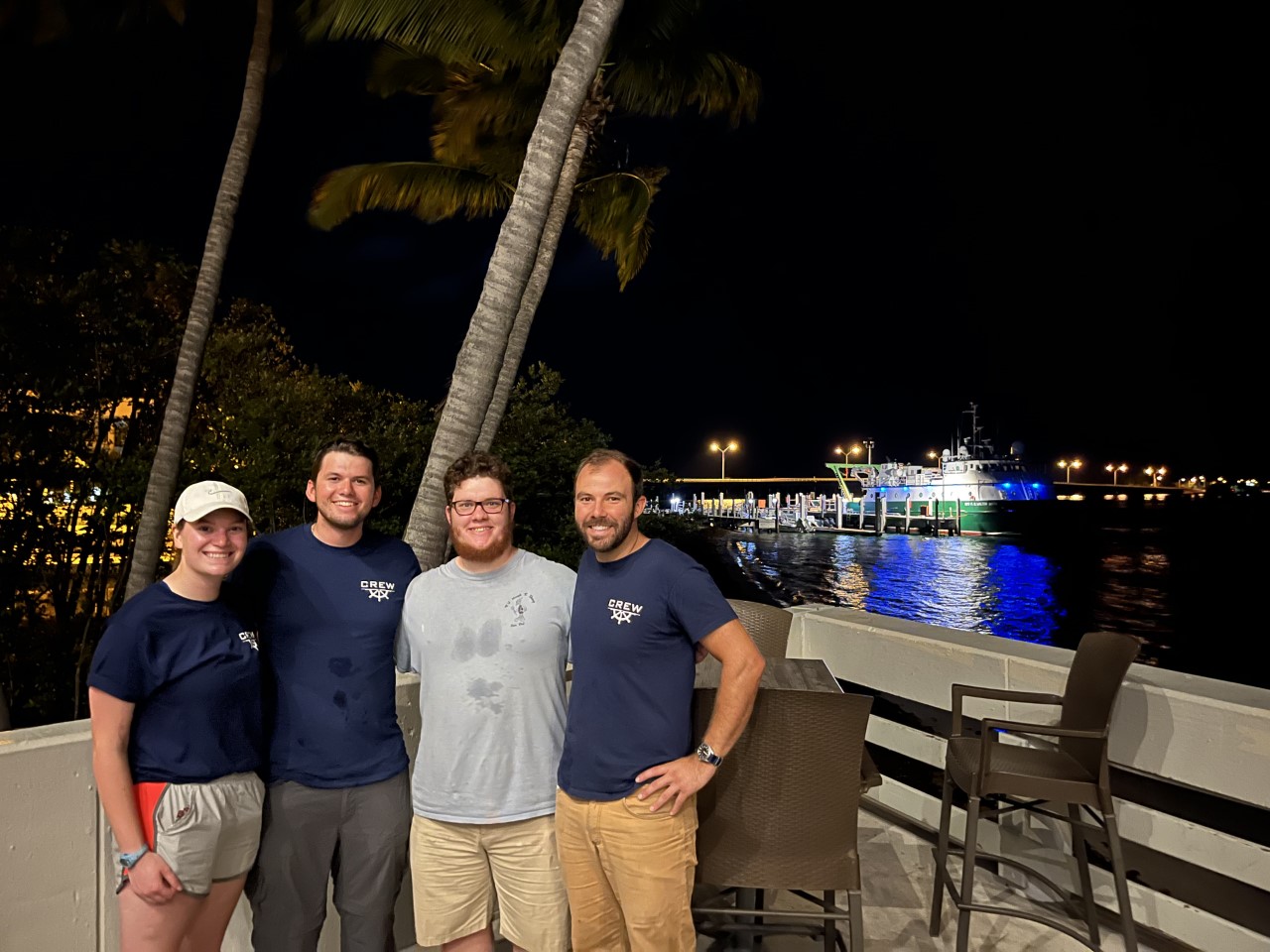
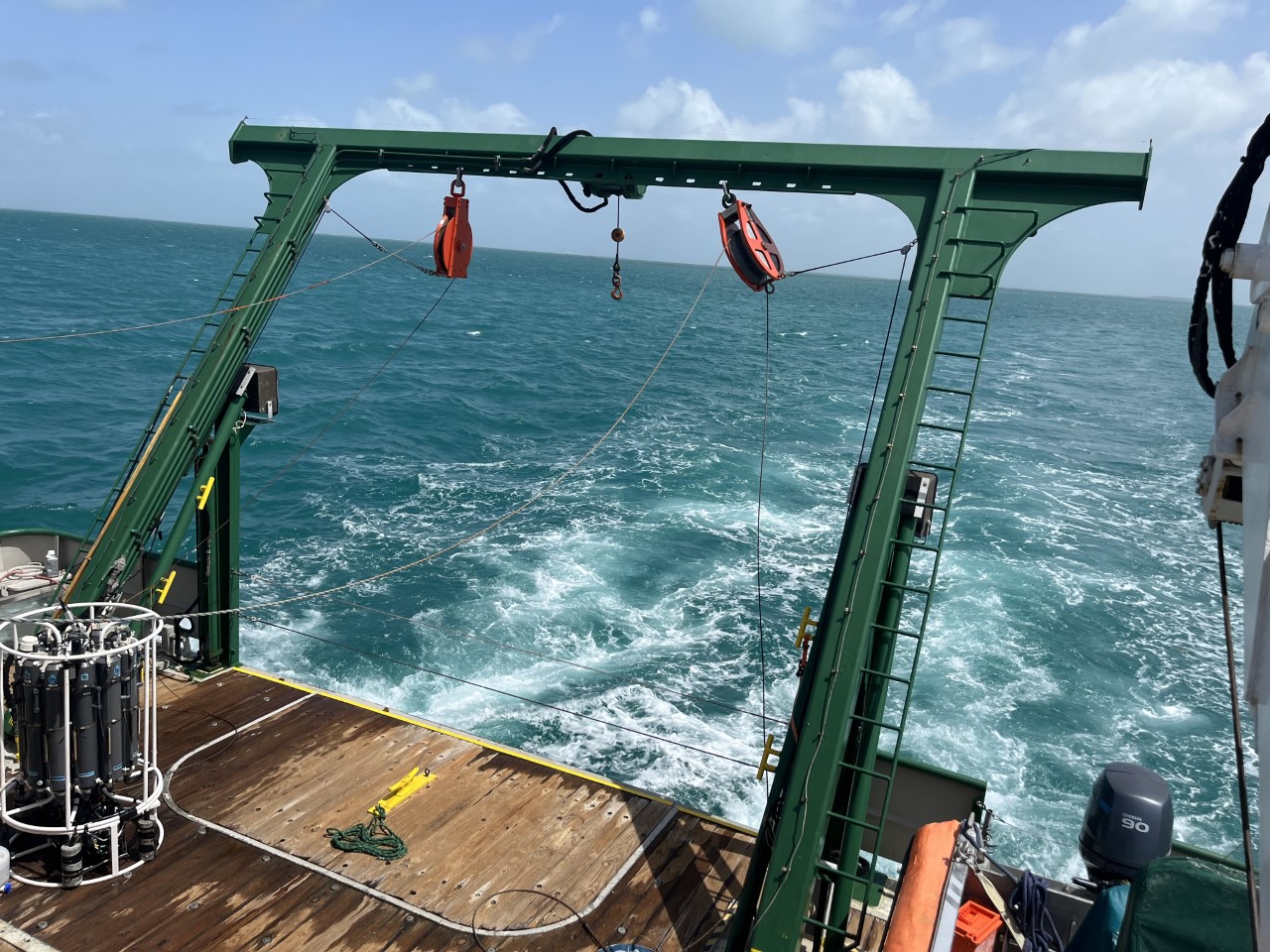
As a tertiary (but also super important) element to this internship I am enjoying the networking and relationships that I am forming with the crew and scientists, as there is a stark contrast from the climate onboard the F.G. Walton Smith research vessel with the tugboats I am used to working on. It is a collaborative, interesting, and thoughtful work environment that is both challenging and rewarding! Everyone shares enthusiasm for the environment, animals, and learning, which promotes everyone to become interested and involved in different areas of research or technical expertise. Here is a picture featuring Alesha Gregroire (left), Jonathan Raymond (Far Right), Sebastian DiGeronimo (Middle Right), and I (Middle Left) all Mate Interns at one point sharing our experiences after the cruise! Below that is a picture of the stern of the R/V F.G. Walton Smith with the CTD connected by the 3-2-2 wire to the starboard side hydraulic winch drum.

Week 1: First Trip with the F.G. Walton Smith

Today, marks my seventh day onboard the F.G. Walton Smith and it has been a bundle of great experiences so far! On the first day, I arrived to the RSMAS campus after a long redeye flight just in time to meet with the Marine Operations Manager, Don Cucchiara, and the whole shoreside team. We caught the lines for the F.G. Walton Smith as it returned from a 4-day cruise diving to recover a few 3-5 year old moorings off the coast of Jupiter, Florida. While underway on that cruise, the crew was having trouble keeping the port main engine alive, so they were limping back to the dock on one engine. 

My introduction to the ship and the crew was quick as I dove right in! Right away the Chief Engineer and previous Mate Intern, Jonathan Raymond, took me and Alesha Gregroire to troubleshoot the engine. We first tried to switch the Fuel Actuator and High Pressure Sensor from the starboard engine to the port engine as we wanted to test if those had gone bad on the portside. We also tested the connections with a multimeter to see if there was a short somewhere in the Engine Control Module (ECM). Finally, we deduced that the ECM was cutting power to the engine when it sensed there was a problem with something internal. As the engines are upon their death bed at a little over my age, 22-23 years, it was decided for the next cruise we would bypass the ECM on the port main engine. Essentially, we hotwired the solenoid of the ECM straight to the battery as we didn’t have time to find out what the internal problem was. 

The second day, we spent some more time with the engine as we figured out it couldn’t be shut down with the bypass wire. So, we added a switch. There was also a problem with the head system as it wasn’t providing enough suction. So, we replaced some duckbill valves by the pump. We helped load stores when the cook arrived and helped load the scientists gear when they arrived as well.

At 0400 on Friday, we set sail with both engines up and running on a 7-day cruise to collect water samples and CTD profiles from stations outside of Miami down to Key West and back around to Tampa and Florida Bay. Onboard there were scientists working from NOAA’s Atlantic Oceanographic and Meteorological Lab (AOML), the MOTE Marine Lab, and Kristin Buck’s Lab at the University of South Florida (USF). This was a great introduction and experience to research vessel operations as Alesha and I learned how to deploy and recover the CTD, Net Tows, and collect trace metal Samples over the side. We also stood navigational bridge watches and learned new card games from the scientists. 

By the third day of the cruise, the F.G. Walton Smith was becoming super hot as the A/C system was struggling in the Florida humidity. Jonathan and I took a look into the compressor system and found numerous pinhole leaks, which were contributing to loss of cooling abilities. We worked to fix the leaks and everyone onboard was grateful to have the A/C back up and running as it was 82 degrees with 90% humidity throughout the trip. 

Watches were exciting as their was plenty of life to watch between pelicans divebombing fish, dolphin pods following the ship, and bioluminescence at night. There were also plenty of boats to avoid as Florida is riddled with amateur boaters and crazy for fishing. 

This has been a great experience so far and looking forward to spending more time with the crew!

Pre-Cruise Introduction


My name is Kyle Hebert. I just graduated from the California State University Maritime Academy as a Marine Transportation major with a minor in Marine Science and a US Coast Guard 3rd Mate unlimited tonnage license. While at Cal Maritime, I enjoyed blending my experiences as a deck cadet learning deck safety, cargo operations, and how to manuever vessels with scientific studies. Including optimizing a methodology to measure ammonium concentrations in the Carquinez Strait, maintaining a YSI 6600V2 Sonde in collaboration with San Francisco State University, and going out on research cruises with the R/V Questary throughout the San Francisco Estuary. I have found a passion collecting samples and working in the lab that has given me direction for my future. I am extremely grateful for the opportunity to work with the Rosential School of Marine and Atmospheric Science at the University of Miami onboard their research vessel, F.G. Walton Smith. I hope to be a helpful hand wherever I am needed and to soak up the knowledge and expertise required to be a well-rounded Marine Technician in the UNOLS Fleet. 

Page 2 of 2

Powered by WordPress & Theme by Anders Norén