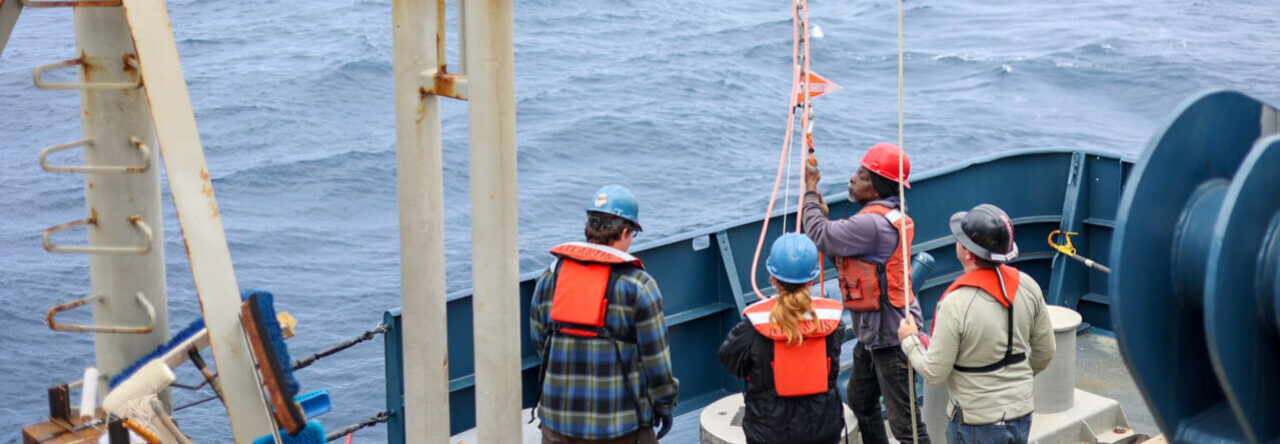
After last Thursday (06/02), we prepped the F.G. Walton Smith at the pier for an incoming Tropical Depression over the weekend. The storm itself didn’t seem all too bad, despite rocking the boat a bit more than usual. We have become accustomed to the daily 2pm thunderstorms that roll in fast and leave fast, normally lasting 30 minutes to an hour. The Tropical Depression seemed like one of those just lasted a lot longer, ~12 hours. The top wind speed logged by our anemometer on top of the bridge logged 25 knots. Alesha, Jonathan, and I decided to go rock climbing to pass the time as the storm rolled over South Florida. It wasn’t until later that day, we found out that one of Jon’s friends we were with tested positive for Covid, so we started going through Covid protocols on the ship.
We started testing ourselves for Covid Saturday evening and then again Monday morning. Jonathan, our chief engineer, unfortunately tested positive. While, Alesha and I somehow remained Covid negative, even taking tests until Thursday (06/09). We had to start wearing masks indoors on the ship and Jonathan was moved into quarantine in the scientists’ bunk down a deck. With some of the major projects we were working through with Jonathan, such as the black water pump seal tear, the hot water/potable water contamination, and A/C compressor contacters/relays on hold, we worked with the Bosun onboard to clean the A/C units throughout the vessel and take care of some odd jobs that needed to be done.
Dennis, our Marine Tech, came onboard Thursday to show us how to make RJ45 terminations while teaching us about the specs and history of electrical/network connections and wiring. He then gave us a project to fix some of the cameras onboard that are routed from our Local Area Network (LAN) to the Campus Safety’s Wide Area Network (WAN). We used what we had just learned with Dennis on making proper terminations and using the testers to test connections from different areas of the network and cables to fix the camera on the bridge and add a signal jumper box to it, while also troubleshooting what the problem with our port engine camera might be. It is very interesting as Dennis has tools from working with IBM and networking back in the 80’s as well as the tools that are more commonly used by techs nowadays, so he can show us a wide range of what we might encounter or have to deal with in a Marine Tech role. Especially, as ships are a lot of times retrofitted or systems are changed piecemeal (normally when they fail or start to have issues) seeing the old stuff and the new stuff can be enlightening. It is quite funny working with Dennis as he has salt, is reserved, super knowledgeable, and can be a bit grumpy sometimes, but he is a great teacher and has a soft heart deep down. I’ve worked with many people like Dennis on boats before this one and its makes it all the more exciting when you work with them and they get excited in what they are telling you or what we are working on. It is all the more rewarding when you get a compliment or a crack of a smile out of them. Working on these terminations and testing different connections to these cameras physically really helped me understand more of the abstract networking infrastructure we were talking about last week with Dennis. I’m beginning to get a grasp on the data link, how voltages are read through pins of the connections, and how that might communicate with the router or switch to the network. Of course, it’s just the tip of the ice berg and Dennis says, “That was was only a small introduction.” I think what is a small piece of the puzzle for Dennis is a huge learning curve for me, lol. I am enjoying all of the important tidbits of knowledge that are being imparted on Alesha and I.