Author: Namith Kennedy

Final – 04

Hello,

I am writing my final blog post now that I am at home and comfortable. My time with the Hugh R. Sharp was enlightening. The number of skills and lessons I learned seemed endless.

Summary of Final Stint

During my final leg of this internship, we had to delay a cruise to August due to issues with the coolant systems, hydraulics, and the Caley level wind not functioning properly. This gave us a short amount of time to prepare a fully functional ship for the upcoming Naval Academy cruise. During the mobilization day for the Naval Academy, there was uneasy chatter and an urgent rush to be able to set sail. Slowly, as the mob day went on, problem after problem was solved.

While the problems with the ship were being solved by the engineers, I was with the Marine Techs. Our job was to fabricate the ADCP and EK80 mount onto the pod system that Sharp uses for acoustic sounders.

Additionally, the techs had to manage and maintain the ship’s CTD, computers, and systems. The last responsibility of Marine techs was to assist the scientists with their equipment setup and be the middleman between the technology and their research goals.

Part of the challenge with being a marine tech and a crew member on a ship is that you constantly have to adapt to what is currently working on the vessel. We had to do this many times at the port and on the sea. This includes alternate CTD rosette mounting designs, adding winches, using backup computers, and much more.

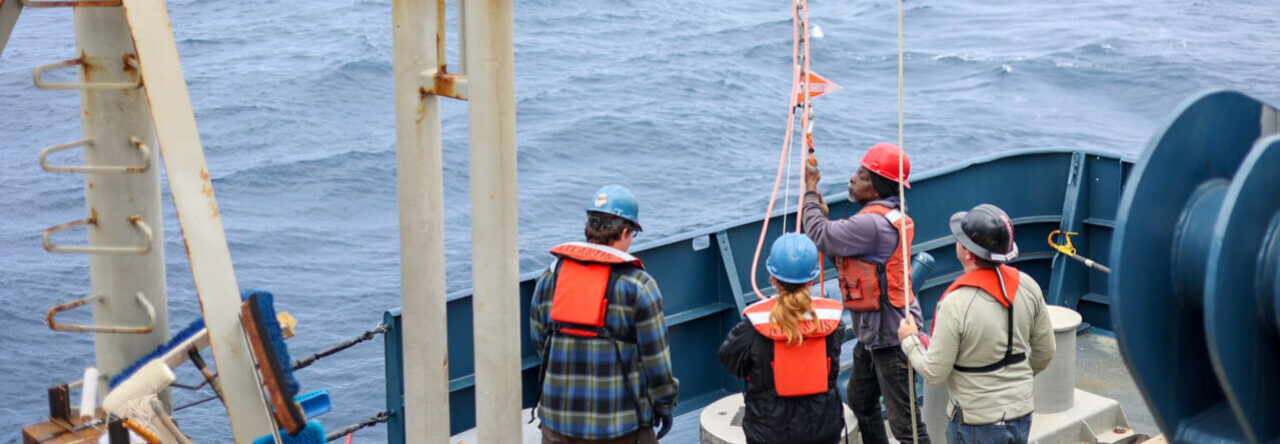
One of the biggest adjustments I had to make at sea was manually controlling the CTD winch, since the sensor on the Caley level wind was broken. Additionally, I had to take an active role in communicating with a walkie-talkie between Science and the Boat driver to get clearance for equipment deployment.

I even had to go below deck near the engine room to communicate numbers on a screen during ROV operations, due to the display not transmitting. It was later found out that the Ethernet cord for the display was not properly plugged in.

I learned a a lot more during this cruise. My learning highlight was definitely communication skills, through successes and failures.

Conclusion

I would like to thank the amazing crew of the Sharp for making me feel at home and treating me as a crew member. Every day was more fun because of the crew. I would like to give a special thanks to my direct mentor, Christian Kernisan, who had the systems to solve everything and taught me many soft skills along with hard skills to increase my efficiency. I would like to thank my other main mentor, Alex Dominguez, who was always there when I needed, for whatever I needed. Lastly, I would like to directly thank Tim Deering, our Marine Tech supervisor (ex-tech himself), for his wise tidbits and help during some of the more chaotic days.

More Hands On Work- 03

Hello,

It’s been hectic and chaotic since I last posted on the blog. I have been learning an incredible amount about what it takes to be a Marine Technician, what it takes to work on a boat, and what it takes to be a part of a small crew.

The cruise that was supposed to happen last week was pushed back to August. This was due to an engine problem and scheduling issues. The chaos and variability during this internship have shown me the importance of always being prepared for the worst-case scenario.

Adapting

The way my incredible mentors have taught and refined my approach to adaptability remains a key skill gained during this experience. Being adaptable is one of the most crucial skills needed to be a Marine Tech, and my mentors and I have had to use this skill set countless times.

During the prep for last week’s cruise, we received schematics for an EK80 single-beam system and assembled a mount based on them. We received the sonar on mobilization day. Not only was the schematic we received wrong, but the sonar already came with a mount.

Conveniently, after a little trial and error, the sonar mount perfectly fit the empty rosette. This empty rosette was originally going to house the EK80 system. Unfortunately, the empty rosette could not be used due to the stern winch not working. Thus, leading us to switch to a rosette frame with a working winch, located on the starboard side. We had to troubleshoot how to attach a sonar and Wombat system to a rosette frame, with 12 Niskin bottles, a CTD, and a fluorometer. The solution was to fabricate an additional mount ourselves for the original mount, remove the last Niskin bottle, and make a couple of small changes to attach the required sonar equipment. In the end, the setup was fully functional. Unfortunately, I was too busy to take a picture of our final result.

The Upcoming Cruise

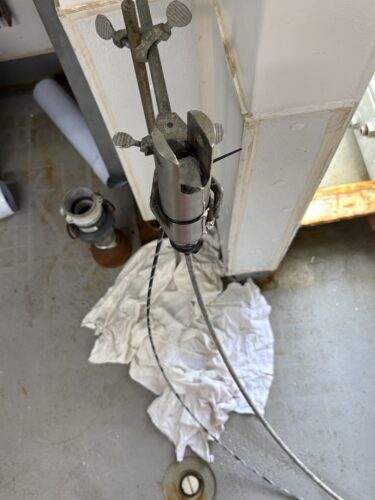
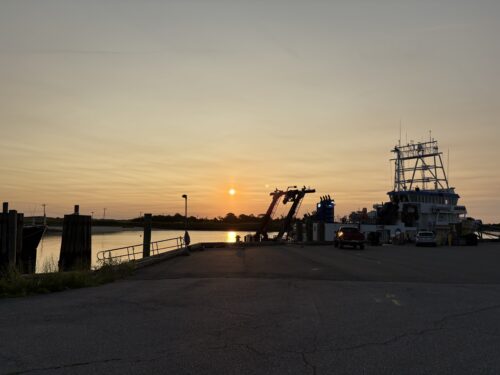
This is the pod system that the Hugh R. Sharp uses. Attached to it is another EK80 system and an ADCP. Commonly, on the Sharp, custom mounts have to be fabricated and meet the required specs. This pod required the EK80 and the ADCP to be flush.

After assembly was finished, my mentors and I spent the day rewiring and lowering the pod via a crane in the Sharp’s adjustable keel. It was a very hot and humid day, around 92 degrees, which felt like 100.

At midday, we had an electrical blackout and had to reset all of the computers. Luckily, resetting the computers did not take long. Now that the day is done, I am finishing writing this blog post.

Conclusion

I will be taking many lessons from this incredible, eye-opening week. I have learned and accomplished many new things in just this week alone. If I wrote them all down, I would have a 10,000-word essay. I am growing through real practical experience, and I cannot wait to tell you what I learned in the upcoming week of this internship.

Thanks for reading!

Troubleshooting – 02

Hello,

I have completed my second week of this unique experience. I had no time for pictures during this hands-on week against the clock. I had the chance to be a part of a small team that needed coordination to overcome major obstacles when the time mattered.

The planned sea trial was canceled due to the CTD winch’s level winder and the CTD with a Rosette attachment not working. At the time of the issue, we had a cruise in a week and needed to become operational soon. The crew utilized a three-team system to tackle both problems.

Part of having a small crew (around 10, including myself) means that we have to adapt our strategy to complete work on an older 146-foot vessel. Often, if it is a singular problem and if there are no other tasks present, all of the crew will get together. The job title is disregarded in these cases. This time, there were two major problems, with the CTD and the Winch level winder. The crew split off into three teams. The first team, made up primarily of engineers, focused on fixing the CTD level winder. The second team I was a part of was made up of four Marine Techs (counting myself) who focused on getting the CTD and Rosette operational. The last team tackled the remaining tasks around the vessel and assisted with the engineers when needed.

Troubleshooting the CTD

During the start of last week, the Scotch cast around the CTD wire termination I completed had turned out good. When we plugged everything in and went to turn on the CTD system, we blew a fuse in the deck box. It was a demoralizing sight, especially knowing I was the one who completed the termination. Luckily, later I would find out that the CTD termination I made was working normally.

I will keep this brief, due to the amount of trial and error we went through. We utilized a multimeter to check for breaks and shorts in the cable and junction box. We also redid multiple terminations, which included the slip ring termination leading to the drum. Then we would test the connection using a multimeter.

In the end, the problem ended up being that the color coding at the junction box was somehow flipped. The black wire, which was supposed to represent common, was the signal. The white wire in the junction box, which was supposed to represent the signal, ended up being common. The way we identified this was when testing at the junction box, the multimeter was reading a negative 270 volts. Thus, the connections were flipped.

Once we got the CTD operational, the techs showed me how to use the CTD with the water container rossette and the software. Then they showed me how to set up all of the ship’s computers to display necessary information about the CTD. Using the software that controls the CTD with the Rosette seemed very straightforward. Although setting up all of the systems and computers was a lot to take in, they will have me operate and control the CTD a lot during our next cruise.

Troubleshooting the Level Winder

The Engineers tried to fix the level winder for the CTD for most of the week. Ultimately, they had to call someone from the manufacturing company to fix the level winder. Once help arrived, it took a full day to get everything fully operational.

Conclusion

Although it was an extremely hectic week, I learned many valuable lessons. I am excited for the next two weeks of this internship and learning even more! If everything stays according to plan, on Monday we should be going on a brief sea trial, then the cruise will start on Wednesday. I hope you enjoy the rest of your day, and thanks for reading!

Pre Mobilization – 01

Hello readers,

I have completed my first week on the Hugh R. Sharp. My mentor was kind enough to have me come a week in advance of the planned missions to help ease me onto the vessel. This week, I learned and assisted with the remaining general maintenance tasks that marine techs must complete before mobilization.

I loved my mentor’s teaching method. He understood that real skill is built through action. From the first day, rather than feeling like an intern, I felt like I was working on the ship and was part of the crew.

A Brief Day in the Life

Since we are still at port, every day I would wake up at 4 am to go to the gym with a crew member roughly my age. We would get back at 6:30 am to eat and get ready for our work day. The day would start roughly at 7 am, and it almost always began with discussing a brief plan for the day. We would have to coordinate with others to formulate our daily plans, sometimes making material orders or checking on part fabrication orders. Once the day was done, I would usually shower, then relax and go to sleep.

First Work Day

From the first day, my mentor allowed me to take an active role.

I spent the first half of my Tuesday touring the facilities and meeting the crew. The second half of the day, I was between a cable spool and a cable-level management system (Caley). I was adjusting, loosening tension, or cutting the slack of wires as needed to ensure the Caley had its full range of motion while having a clean-looking wire management. Once I completed that job, I became a tool fetcher for the engineers of the vessel for the remainder of the day. The engineers needed to complete their checks before we could continue with the tech’s responsibilities.

The Rest of the Days

Shortly after, I was notified that our first mission would be canceled and replaced with a Sea Trial. The University that was originally scheduled had a conflict and was unable to make it.

On Wednesday, I did more wire management. It was a multiple-person job, as one person had to be on the bridge, carefully pulling the individual wire up to spool it, and the other had to signal when to stop pulling and hold the wires in place.

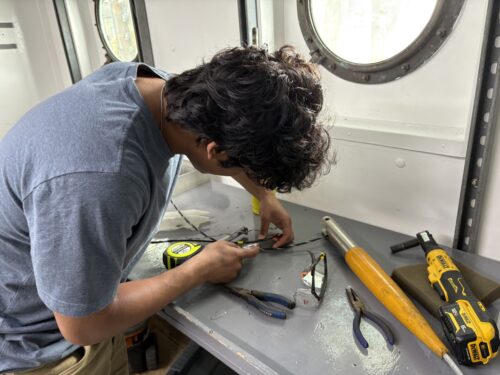
In the latter half of the day, I did a mechanical CTD cable termination under the supervision of my mentor. There are multiple phases to the mechanical portion of the cable termination, one of the last was pouring molten aluminum to secure the cable, and then tension testing our mechanical connection.

On Thursday, I did the electrical portion of the CTD cable termination. This includes stripping the wire casing, then color coding and crimping the wire ends together. I got to use special wire crimper connectors that used solder, helping waterproof the connections. Once the connections were made, we encased them with scotch cast using a mold. The remaining portion of the electrical work is to connect the cable to the CTD.

At the end of Thursday, we needed to get the Caley stats computer (showing stats like tension on the cable) to display its information on the main computer. This would make it easier for the people on the bridge operating the Caley. We found the supposed IP address and Port Number, but we could not get it to connect to the master display software of the main computer. Thus, I thought to look up command prompts to show IP addresses that the main computer can detect. Once I used the command netstat -ano, and saw that the Caley Stats Computer IP was not detected. From this result, I knew either the Ethernet cable was not plugged in all the way at the Ethernet switch, or the IP address was wrong. Luckily, it was the Ethernet cord not being plugged in at the switch.

Friday was a half-day, the marine techs and I went to a couple of places and stores to pick up a custom transducer mount and other materials that we will need.

Conclusion

The whole crew is extremely nice and fun, and helped me have an amazing first week! On Monday, the 9th, we will start mobilization for the Sea Trial. I cannot wait to learn even more during this upcoming week!

Namith Kennedy Introduction

Hello Readers,

My name is Namith Kennedy. I am moving on to my sophomore year of college in Northwestern Michigan College’s Marine Technology B.S program. I am extremely honored and excited to intern with the University of Delaware’s Hugh R. Sharp Team. I hope to learn as much as I can, tackling everything with a growth-oriented mindset!

If you shoot for the Stars,

Worst case you end up on Mars

By Namith Kennedy (realistically someone has probably said this before)

This is one of the quotes I came up with to help nurture a growing mindset that moves through failure.

Where it started

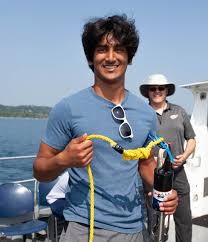
In the picture above, I was an upcoming junior in High School and just completed my first sound velocity cast. Since my sophomore year of high school, I knew of my desire to be involved in marine technology. This interest led me to reach out to the NMC Marine Technology program director at the time, Hans Van Sumeren, to ask for a summer internship. I had an absolute blast with the experience. Everything from the team environment, the work, the views of nature, and the unlimited possibilities helped ignite my growing passion for the field.

A little fun fact about me

During high school, I played football and rugby. Football has been in my life since I was five years old. I love all formats of football, including fantasy football.

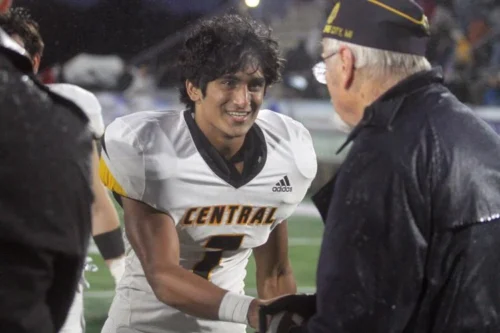
In the picture above, I had the honor of shaking hands with many Vietnam veterans and other service members during a tribute game called the Patriot Game. This upcoming fall, I will pursue my passion for the sport of football by coaching middle school football.

Conclusion

Since discovering the marine technology field, my enthusiasm for it soars higher every day. The opportunity that Unols and the R/V Hugh R. Sharp team have provided for me will act as premium kindling, supporting my growth. I am excited to share my month-long journey with everyone!

Powered by WordPress & Theme by Anders Norén