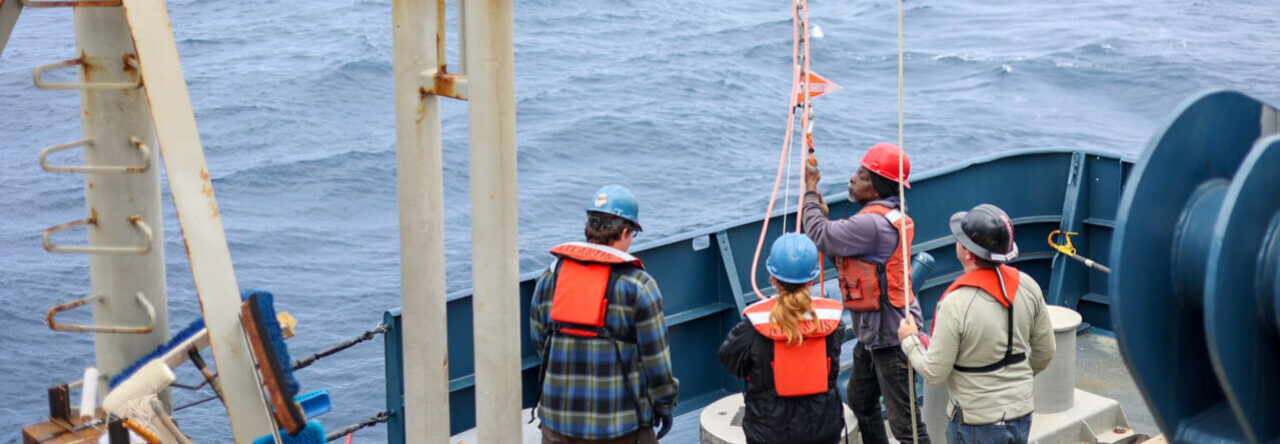
We spent a few more days at anchor in the Chesapeake Bay and then we packed up and headed for Lewes. It took a little less than a day to get back; we steamed through the night and got to the dock early morning. We had a quick turn around off loading some of the science equipment and personnel that would not b joining us on the second leg of my final trip on the Sharp. Around 9 am we left the dock with a few extra people, the University of Delaware’s Provo’s and his family along with some other officials joined us for a little cruise around the bay to see some of the work that the boat can do. We went out past the breakwater and did a CTD cast and our guests were given a complete tour of the boat. After the cast we headed back in behind the breakwater to get some respite from the sea state. There we had a wonderful lunch and the visitors were faired back to the dock with the small boat. Once they had been off loaded and everything secured we headed out. Our goal was to get out to where the water would be deep enough to do a 2,000m cast to look at the water profile and take some samples. The weather was a bit rough and some of the scientist got seasick. I went to bed after dinner in anticipation of our early morning CTD cast that was scheduled for 4 am. I got up bright and early and we ended up having to wait for the sun to come up so that the mate on watch could see the sea state and keep us all comfortable for the nearly 3 hour cast. Right after sunrise we put the CTD over and all when well until about 1200m when the computer lost the connection to the instruments on the CTD, we were able to restart the program and get things running again with out having to restart the cast. After that everything went fine and we finished the cast and then did 2 more, not quite so deep but still pretty deep. After the casts were done, much to the delight of the scientists, we headed back early to make it back to Lewes for the early tide. We got in around 8 am the next day and off loaded the science gear. I spent the day helping get the boat ready for the next trip, doing laundry and making up beds. I also helped clean the CTD and get the computers ready for the next trip. Late in the afternoon, Max one of the techs. brought me to Salisbury, MD where I would fly out of the next day. We went to a cute little city run zoo with free admissions and then Max dropped me off at my hotel in anticipation of my flight the next day. I am now currently sitting in the airport in Philly waiting for my connecting flight home to Providence. I should be getting home right now but my first flight was late taking off so we got to Philly with only 20min till my next flight left. I knew my chances of making it were slim but I ran across the airport like a crazy person with my backpack and carry on in tow but missed my flight. As I sit here in the airport, it has given me a chance to reflect on the past six weeks that have flown by and were such a whirlwind of activity. I learned a lot and had a ton of fun this summer on the Sharp and I cant wait to get back out to sea again.
Author: Alison Mitchell
We made it back to Lewis and off loaded the science crew from the second cruise and loaded the scientist for my final trip. The scientists on this final trip were pretty self sufficient and got most of their gear on themselves. We left Lewis early in the morning on the 18th and spent all day transiting to a site just bellow the Bay Bridge. We stopped every two salinity points as we made our way up the bay and did a CTD cast to get a profile and fire a couple of bottles. Once we got to the site we dropped anchor and did another CTD and did the first of many pump casts. This is a metal frame with different equipment attached to it and a pump to collect water samples. It needed to be lowered over the side of the boat a meter or so at a time, but the winch had no metering device and the metering block was broken. One turn of the winch drum was about 2.5m so I would watch a piece of tape on the drum go around and guess when the appropriate amount of wire had been paid out, which is apparently a hidden talent I have because I got fairly good at it by the end of the trip. The next two days were a repeat of the pump profiler and CTD casts on repeat. The CTD profiles we got while at anchor were some of the coolest I saw while on the boat. We were anchored in an anoxic hole and when the CTD when down to a point the oxygen readings would drop to zero. Today we did some multi coring which was a very cool, very messy process. We sent the multi coreer over twice and completely messed up the cores on the first one and then got some good ones on the second try. The hole apparatus is a metal frame with a top and a bottom part that are locked open when it is not in use. There are 4 plexi glass tubes around the frame that when they dig into the mud and the bottom part gets pushed up into the top it triggers the tubes to close and collect the mud. The tricky part is getting the samples out once back on deck. It was a messy process and after some trial and error we finally figured it out and all went well. The rest of the day consisted of more CTD’s and pump casts and lots of popsicles. I got to make a trip in on the small boat today and on the way back I got some good pictures of the boat!
The rest of the storm chasing trips had been a bit tough. We had some really rough weather and had almost three days when we couldn’t work. We weren’t able to do any science, which was hard on the science crew; they got a bit restless, which is completely understandable. We did finally get to do a couple CTD yesterday in the morning before we had to head for Lewis tToday. Other than that we had a couple of days of good science before the sea state got too bad. We got back out to the drifters and did about a days worth of sampling and then we steamed southwest in hunt of rain. We got to the spot where the rain was supposed to be and sure enough it poured for about 4 hours and then it stopped and we headed back to the drifters and continued where we had left off. We had a few more days of following the drifters around with the same daily routine on CTD, clean CTD, light meters and tow fishing with aerosol sampling at night. On the night of the 11th and we spent most of the 12th and 13th rolling around. There were a few big rollers where I felt like I was on a rollercoaster and my stomach got that sudden dropping feeling, but mostly it just feels like you are on a terrible never ending carnival ride, just enough movement that you can feel it and it effects you but not enough to be fun! Once we were finally able to do science again we did a deep cast that everyone had been prepping for for days with styrofoam cups. When you send a cup down to 2000m it get awfully small!
This trip is off to a good start, we left Lewes on the 30th and headed east to an eddy just west of the Gulf Stream where we hoped to find rain. We spent our first full day out there going through the motions of everything that would happen over the cruise. We practice with our CTD, a clean CTD, the tow fish and drifters. The scientists on this trip are looking at all different things so we are using lots of different sampling methods. We have been doing 2-4 casts per day with the boat CTD fireing all the bottles on most of them. Science is filtering and sampling this water looking at primary productivity. There is another group of scientists looking at trace metal in the water; which is why we have the clean CTD on board. This is a CTD that they brought with them and is put over using a clean winch that has been repainted and coated so there is no metal being introduced. It uses a plastic covered metal wire to lower the CTD. Unlike our CTD the wire is not connected back to the computers so it must be pre programed for when the bottles will fire and you cannot look at the data as it goes down or comes up. We are using a side frame on the back deck to lower the CTD over the side of the boat. Also on the side frame is the tow fish, another sampling method. It looks like a silver torpedo dragging behind a set of wings. In the center of the wings there is a plastic tube that runs up the towline and on deck. Once on deck the plastic tubing runs through a pump and into the lab vans where they can take samples from it periodically. The final piece of equipment we are using are three drifters. They are about three foot long PVC pipes with flashing lights and floats on the top and weights on the bottom connected to a 30ft long tube of black netting. The drifter sits on the surface and the black netting sinks down bellow it in the water column. This causes the drifters to follow the water just bellow the surface instead on the surface water. After this first practice day we got into a daily routine and waited for the rain, which was going well up until the 2nd, when the winch for the clean CTD shorted out, spitting sparks out of the power supply. The winch was no longer in operation. We continued with our routine, minus the clean CTD for a few more days and made our way back into Lewes on the 5th. Unfortunately it only rained once while we were out on the first part of the trip and we have not collected as much rain as science had hoped to. We got in around two and spent the afternoon getting a new winch set up and ready to go, the new winch dose does not have any metering devise on it so Ted and I had to mark the 300 meters of line for the CTD with spray paint every 10m. Then we refueled, had a crew change and had some pizza for dinner and waited for the next high tide, we left Lewis around 4 am, today we are steaming back to where we left one of the drifters in the water to pick up where we left off, hoping for some rain
I have now been onboard the Sharp for just over two weeks, and I am having so much fun and learning much more than I though I would! The second half of last week was a lot of the same, dredging and sorting on repeat! We said good bye to the scallop crew on Friday in Woods Hole and we made it down to Lewis, DE Saturday night, but because of an issue with the engine we spent the night anchored right around the corner from the dock. We got to the dock first thing Sunday and spent all day unloading the boat. Most of the computers and gear got unloaded in Woods Hole with the science crew but there was still a lot to come off once we got into Lewis. We spent all day Monday loading science onto the boat with the plan being that we would leave on Tuesday. When Tuesday came around we still weren’t ready to go so our departure was pushed back to Wednesday, so now all the people are ready to go and the ship has changed its mind! As we got ready to leave the dock early afternoon to ride the tail end of the high tide out the drivers in the engine decided to stop working. The engineers are down in the engine room as I type this working away to get us off the dock but no one seems to know when we will be leaving! This next cruise is a group of scientists looking at the effects of thunderstorms. I am not quite sure of the specifics of what they are looking at but I hope to learn more about it as the cruise gets going. The sciences crew comes from Old Dominion and Penn State. I am very impressed with the amount of gear and equipment they have managed to get into this boat!
The photo I included is of one of the science watches at their last dredge station of the trip, we all climbed up on the table for a photo op!
I have been on board the R/V Hugh R. Sharp for a full week now and am having a really great time. I meet the boat last Monday in Woods HWhole. The plan was to leave on Tuesday evening, but due to a new part for the radar not being delivered we ended up not leaving until Wednesday evening. I got to the boat late on Monday and went to a restaurant near the boat and got dinner. First thing Tuesday Mat, another MATE intern on board, and I accompanied the cook Lee to the supper market to stock the boat for the coming trip. We spent nearly 4 ½ hours at the store and filled numerous carts. We bought so many groceries we had to tie some of them to the roof of ourt rental mini van. When we got back to the boat we spent a long time unloading groceries and putting everything away. By the time everything was put away it was time for dinner and then bed. On Tuesday, I accompanied Max, the technician on board, and TR, a deckhand, to the UNOLS Northeast Winch Pool we were shown how to operate a new winch that we will be bringing with us on our next trip. Most of it went straight over my head but I understood parts of it. In the afternoon my parents came and took me out to lunch and dropped off some last minute things, and at 6 we left the dock. I helped Max with the pre departure check list for all the tech. equipment. Once underway we turned on the flow through system that takes constant seawater measurements. We also dropped the keel so it is flush with the hull of the boat. There is equipment in the keel so itwhich gets pulled up inside the hull when the boat is in port. Depending on the equipment the keel can be dropped down further if necessary. I am standing a 12 hour watch from 5:30 am to 5:30 pm with Max, so after the flow through and dropping the keel I had dinner and went to bed. The first night underway I woke up to the rocking of the boat several times. On Wednesday morning we started dredging at the beginning of our watch. We have a group of scientists on board from NOAA, who are doing scallop surveying. We dredged all day Wednesday, Thursday and Friday. There is a lot of work and steps involved in pulling the dredge up and emptying it onto a table to be sorted. Sometime on Friday night we finished the first group of dredges and switched over to Hap Cam, which is a sort of sled that hovers over the bottom of the ocean and takes video, which is then reviewed by the scientists. The Hap Cam can stay in for days at a time so there is very little to do during this leg of the trip so I have been hanging out on the bridge doing a lot of reading and getting to know the crew better. This cruise goes to the end of the week and then we will bring the boat back down to Lewes, DE where we will have about a day until the next group of scientist joins us.