
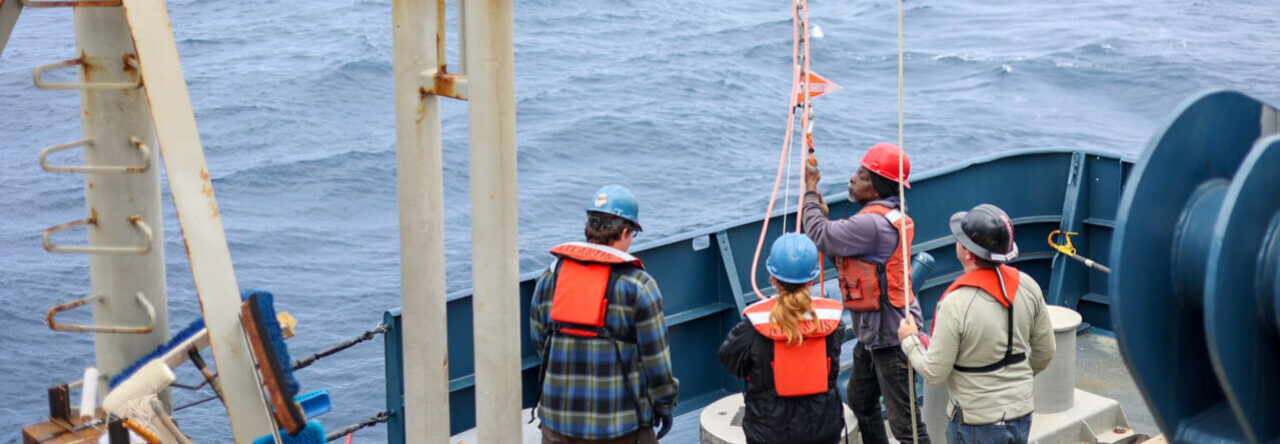
Last week I talked about the general objective of this mission. This week I want to speak more about one of the pieces of equipment that we are deploying frequently and every six hours, an expendable bathythermograph (XBT).
Try to picture a football but one that is overall about three times smaller. That is about the size and shape of this probe. There is a small divot in the nose of the probe, which has a small sensor in it. The probe is housed safely in a plastic tube that is secured with a pin to hold it in place and a plastic end cap to ensure it will not fall out while being transported. These probes are stored in the Bird Lab onboard in cardboard boxes until we are ready to deploy one.
When ready, we then take the plastic tube out to the streamer deck where there is a so-called “gun” that is used to launch it. This gun is made of plastic and metal brackets that are formed in the shape of a gun, hence the name. Attached to it is a wire that runs back and into a deck unit, which looks like a wall outlet in a box. This deck unit is used to bridge a connection between the probe and the main lab, which is three decks below. The probe is connected to the gun via thin copper wire that runs through the plastic tube. This wire is probably two times thicker then hair. It is wound around the end of the probe as well as the end of the plastic tube so that when we drop the probe into the water, they both unravel without any tension because it will break. When the probe is dropped from the ship into the water, it measures the temperature of the water as it travel to its depth of 700 meters where we then break the line.
Measuring the temperature of the water will provide us with more information then just how cold the water might be. Temperature shares an inverted relationship to density because as the temperature increases, the density decreases. Measuring the density will give us the data that we need tied with the salinity and depth of the water. All of these variables are used to determine how sound is affected in the water. Why do we care? Simply put, because we need to determine how the sound is being refracted throughout the water columns as it travels from the ship to the ocean floor. If we did not do these measurements then we would not be able to correctly calibrate the multibeam system that is shooting sound waves to make an image of the sea floor.
More information to come next week!