It has been an absolute whirlwind of a week on the R/V Hugh R Sharp. I don’t think I’ve ever learned and experienced so much in such a short period of time!
After arriving at the ship on Monday the 14th I spent a couple days learning my way around the ship as we loaded gear, provisions, and prepared for departure. We departed Lewes, DE last Wednesday evening as I slept in preparation to go on watch at 2330. During that first night offshore we launched and recovered our HABCAM, a towed camera array that is used to take high definition pictures of the bottom, allowing the scientists to test it and adjust the trim so it flew nice and level above the bottom as we towed it along. We spent three days using the HABCAM during which we had to recover and redeploy the vehicle numerous times to allow the scientists to address some persistent camera issues. The pictures that it sends back from the bottom are really incredible, I was blown away by the clarity and the fact that the scientists can use them to count and measure scallops without having to bring them onboard.
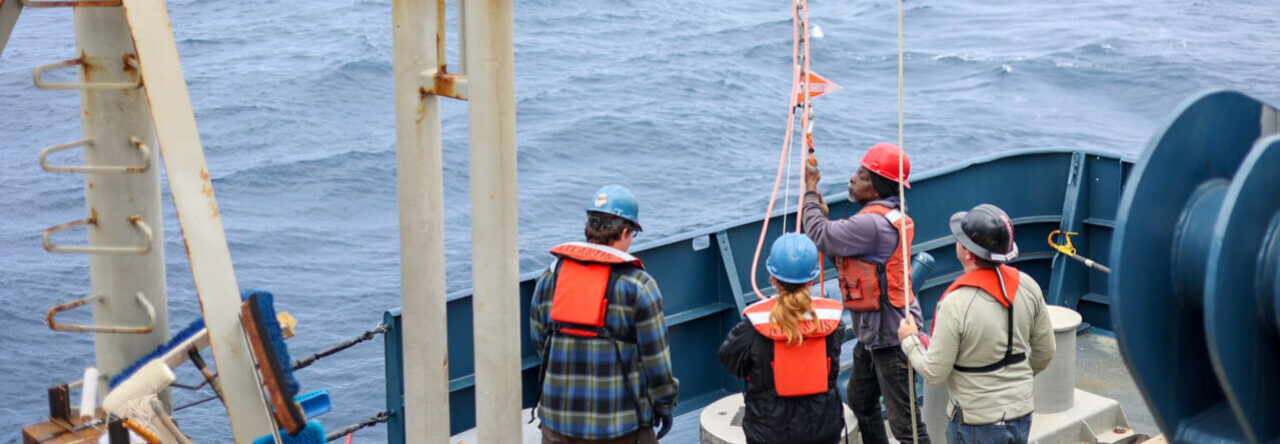
Speaking of bringing scallops onboard….on the 19th we switched over to dredging! My first night of dredging was incredibly busy and a nice change of pace, giving me some great experience working on deck. That first night we deployed and recovered six dredges and three CTD’s. We have been doing a combination of 10 and 15 minute dredge tows from which the scientists have been collecting scallops and sometimes scallops, crabs, whelks, and more! Recovering the dredge and unloading what can be over 1000 lbs of catch is challenging physical work, but a lot of fun!
What I’ve enjoyed the most so far is getting to run the CTD casts. A CTD is a cylindrical array loaded with niskin bottles, which can be remotely closed from the surface to collect water samples, and a suite of sensors that record conductivity, temperature, and depth (hence the name CTD). Every few dredge sites, the captain will stop the ship allowing us to lower CTD down to the bottom, where we collect water samples that are tested for salinity or micro-plastics, giving us a wealth of data for the water column in that location. The head technician on my watch Drew, a former MATE intern, performed the first few casts so I could learn the procedures but since then I have done the majority of the casts. It has been awesome getting so much experience with such a mainstay of oceanography and I’m looking forward to getting more familiar with the system over the course of the next four weeks!
Currently we are transiting to Woods Hole which will conclude the first leg of our scallop cruise. It’ll be nice to have a day to stretch my legs, but I’m already looking forward to getting back offshore and continuing our work!
We are currently on satellite Wi-Fi which is insufficient for posting pictures, but please check in on Wednesday for an edit with some pictures from my first week on the Sharp!
Signing of for now,
Charlie
038 48.26 N, 073 36.37 W


