Author: Charles Brooks

There and Back Again

Three days ago I said good-bye to the R/V Hugh R Sharp and returned home. I’ve been looking back on my six weeks onboard the ship and reflecting on everything I experienced and learned. It was an absolutely incredible experience, which I will never forget! 

The back half of leg 3 saw us return to George’s Bank one more time for four days of HABCAM work. We deployed it a few miles off of Cape Cod and proceeded to run transects for nearly four days before we pulled it to deploy four dredges. It went by far to quickly and before I knew it we were headed back to Woods Hole! We got an amazing farewell from George’s Bank. Soon after pulling out last dredge and turning for Woods Hole we steamed straight into a feeding frenzy of 3-4 dozen whales. We all marveled as we watch them feed and breach at sunset accompanied by countless dolphins. 

Upon returning to Woods Hole the following morning, we had a rapid 4 hour turn around where we offloaded all of the NOAA scientists gear including: three dredges, the HABCAM, and all of the computer equipment located in the dry lab. By 9:30 we were off the dock and headed back for Lewes, Delaware. After a 30 hour steam, during which we cleaned the entire ship, we arrived there and spent the next two days reconfiguring the ship for its next research cruise. It is truly amazing how modular the Sharp is. In only a few hours we had completely reconfigured the entire aft deck removing the sorting table, HABCAM ramp, UNOLS lab van, and inserting a two ton steel wedge into the space where the sorting table ramp lay. The result, a totally open aft deck ready for a new lab van and a new mission! 

I’d like to thank the techs, scientists, and crew of the Sharp that I lived and worked with these past few weeks. I learned so much from you all and I sincerely appreciate your kindness and all you taught me! Being on the Sharp was a dream experience and I cannot wait to continue to peruse my dream of working as a Marine Tech and get back out there as soon as possible! 

Thank-you for following along with my trip and I’ve uploaded images to all of my previous posts which was not possible during my cruise due to poor internet. 

Cheers! 

Charlie Brooks 

The HABCAM Returns

Its been another busy week on the Sharp during the first half of leg 3! We left Woods Hole last week and headed back to Georges Bank, but to the southern end this time. Whereas leg one and two were extremely dredge heavy, with over 80 dredges during leg two, this leg has been primarily HABCAM oriented. We conducted maybe a dozen dredges once we reached our survey area, and then the HABCAM went into the water for over five days. This definitely slowed things down for the techs, but allowed me to focus my learning elsewhere for a few days. I have gotten more familiar with the Sharp’s systems and have been in charge of doing daily data backups, system checks, and processing winch data into plots. The thing I’ve most enjoyed in this down time has been learning more about the CTD! My watch partner Drew has walked me through the carrousel, helping me visually identify all the sensors and instruments and we’ve discussed common issues and troubleshooting. He also helped me delve into the software where I learned how to do my own CONFILE, the file that contains all the calibration info for the sensors, and setup my own PSA, which displays a wealth of information/tools for use during CTD deployments. 

We pulled the HABCAM out of the water this morning and switched back over to dredging for 12 hours before we return to Woods Hole for a brief fuel stop. We secured the dredge within the last hour and have turned towards land! After arriving tomorrow morning we will be briefly refueling before departing for a final four days on George’s Bank later that same day. 

I’m already looking forward to getting back offshore for our final days! 


Higher Latitudes, Lower Temperatures

After a two day stop over in Woods Hole, we’re back on the proverbial road! 

Leg 1 concluded on Wednesday the 23rd with a stop over in Woods Hole to provision, re-fuel, and bring new scientists and volunteers onboard. After a busy day making preparations (with an evening off so the techs could flex their bowling skills) we were on deck at 0500 Friday morning for departure. We headed offshore through Nantucket sound and began dredging to the South of Cape Cod, gradually working North towards Provincetown. When my watch took over deck ops at 0530, we were greeted on deck by the greatest whale show I’ve ever seen in my entire life. There was no wrong direction to look in as humpbacks breached all around us with several pods of dolphins thrown in for good measure. Upon recovering our first dredge the large ammount of krill in it was a good indication as to why we got such a show! As we sailed into the night the fog rolled in so thick that you could not see the top of the Sharp’s VHF antenna and the temperature continued to drop. 

We spent three days dredging hard around the clock. The area we were in was far more rocky than our southerly tracks. Having to roll large rocks, fix busted rock chains, and even swaping out a damaged dredge at one point slowed our progress. While further south we may have been averaging 4-5 dredges per watch, now we were only managing 3-4. After three days as sea conditions deterioarated we had to shut down night time deck ops as it was too dangerous to safely work with the prevailing sea state in the dark. We picked it up the following morning and the next day switched over to the HABCAM. A very welcome break after three days of hard work. We’re currently finishing up our HABCAM tracks on the Northern edge of Georges Bank and expect to return to dredging early tomorrow morning until we return to Woods Hole on Sunday night. Looking forward to another busy few days! 


Signing off for now, 

Charlie 

42 06.50 N, 67 25.11 W 


Wait it’s only been a week?

It has been an absolute whirlwind of a week on the R/V Hugh R Sharp. I don’t think I’ve ever learned and experienced so much in such a short period of time! 

After arriving at the ship on Monday the 14th I spent a couple days learning my way around the ship as we loaded gear, provisions, and prepared for departure. We departed Lewes, DE last Wednesday evening as I slept in preparation to go on watch at 2330. During that first night offshore we launched and recovered our HABCAM, a towed camera array that is used to take high definition pictures of the bottom, allowing the scientists to test it and adjust the trim so it flew nice and level above the bottom as we towed it along. We spent three days using the HABCAM during which we had to recover and redeploy the vehicle numerous times to allow the scientists to address some persistent camera issues. The pictures that it sends back from the bottom are really incredible, I was blown away by the clarity and the fact that the scientists can use them to count and measure scallops without having to bring them onboard. 

Speaking of bringing scallops onboard….on the 19th we switched over to dredging! My first night of dredging was incredibly busy and a nice change of pace, giving me some great experience working on deck. That first night we deployed and recovered six dredges and three CTD’s. We have been doing a combination of 10 and 15 minute dredge tows from which the scientists have been collecting scallops and sometimes scallops, crabs, whelks, and more! Recovering the dredge and unloading what can be over 1000 lbs of catch is challenging physical work, but a lot of fun!

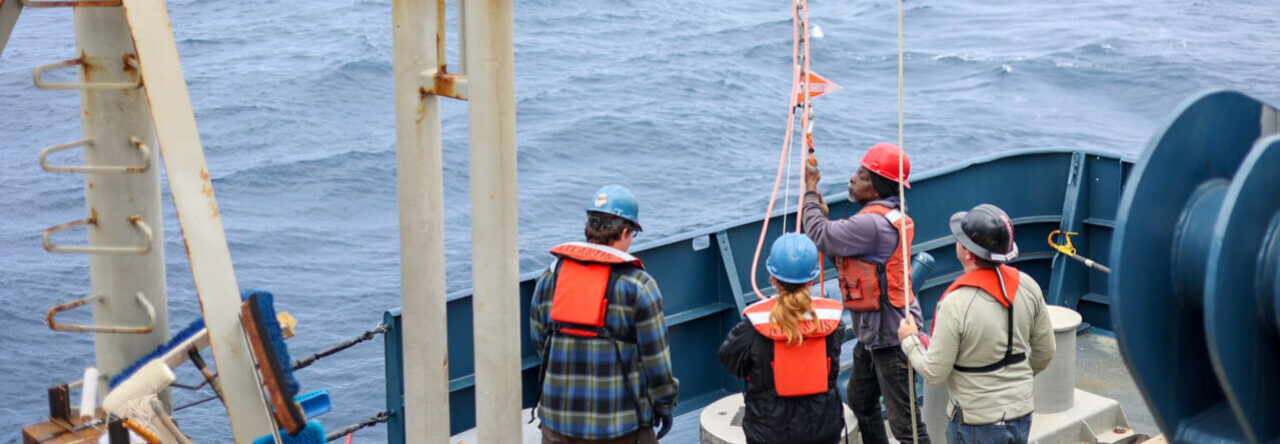
What I’ve enjoyed the most so far is getting to run the CTD casts. A CTD is a cylindrical array loaded with niskin bottles, which can be remotely closed from the surface to collect water samples, and a suite of sensors that record conductivity, temperature, and depth (hence the name CTD). Every few dredge sites, the captain will stop the ship allowing us to lower CTD down to the bottom, where we collect water samples that are tested for salinity or micro-plastics, giving us a wealth of data for the water column in that location. The head technician on my watch Drew, a former MATE intern, performed the first few casts so I could learn the procedures but since then I have done the majority of the casts. It has been awesome getting so much experience with such a mainstay of oceanography and I’m looking forward to getting more familiar with the system over the course of the next four weeks! 

Currently we are transiting to Woods Hole which will conclude the first leg of our scallop cruise. It’ll be nice to have a day to stretch my legs, but I’m already looking forward to getting back offshore and continuing our work! 

We are currently on satellite Wi-Fi which is insufficient for posting pictures, but please check in on Wednesday for an edit with some pictures from my first week on the Sharp! 

Signing of for now,

Charlie

038 48.26 N, 073 36.37 W


Ready to Depart

My Name is Charlie Brooks and I am one of MATE’s summer interns who will be working and learning onboard the R/V Hugh R Sharp for the next six weeks. 

I’ve spent my entire life on and around the ocean sailing, surfing, fishing, and more. It was this love for the ocean that brought me to the University of Rhode Island where I majored in Marine Affairs. It wasn’t until late in my college career that I learned about the incredible work of marine technicians. With the goal of further developing my skills in order to become one, I attended the IYRS School of Technology and Trades for a six-month course in marine systems.

I will be arriving at the R/V Hugh R Sharp tomorrow afternoon and I cannot wait to get onboard to start learning from the scientists and crew! More blog posts ahead in the coming weeks, but for now it’s time to triple check my duffle bag and my camera gear ahead of an early start tomorrow morning. 

-Charlie 

Powered by WordPress & Theme by Anders Norén