The far north reaches of our sea voyage. We’ve lost the internet for about a week, which was a nice change of pace. It’s rather relaxing to detach from the troubles on shore. Some people have a hard time isolating themselves from the world, but that’s not a problem for me. Its kind of funny, I felt more isolated while on land, than while at sea. Some of the best conversations I had were at sea. That’s one thing about working in oceanography; Everyone who is aboard, wants to be here. From the intern fresh out of college, to the chief scientist, everyone has a reason to be out in the Arctic. It’s interesting to hear stories, of tangled and extraordinary lives that brought everyone to this voyage. Some of the scientists had vastly different careers prior to becoming oceanographers. Some were construction workers, others were bartenders, some were merchant mariners, and only a few knew their path from early on. It’s reassuring to me that there is no one way of starting my career, and that sometimes careers depend on luck more than anything. Conversation seems to flow a lot easier when there is one goal at hand. One way or another I’m helping out everyone who asks, learning new methods and building professional networks. As for the work we do, so much has happened in these last few days, it’s hard to put everything down in writing without missing all the details.
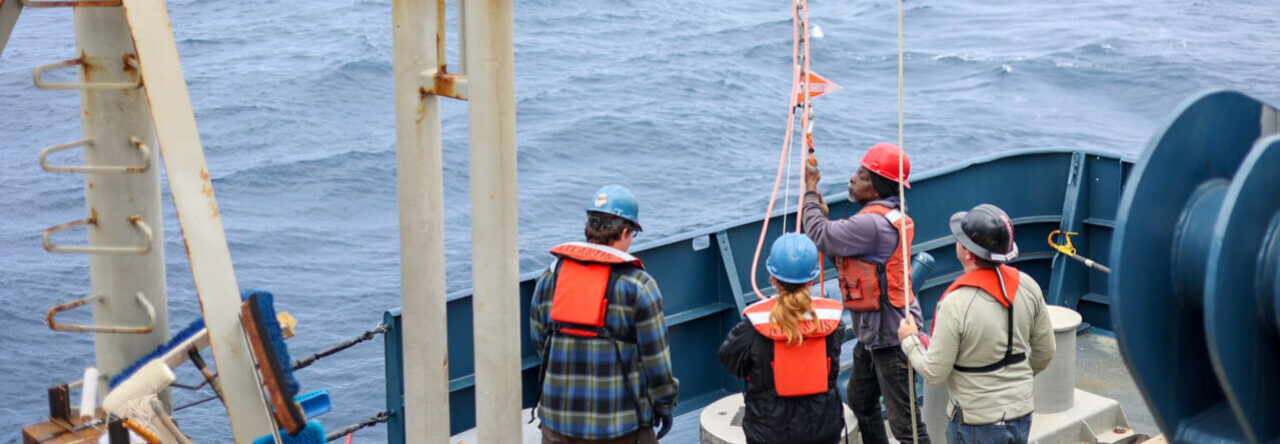
Our expedition has reached thick sea ice, and we’ve been hunting for the ideal ice floe. Ice floe is just a fancy word for a big ice chunk. First the the infrared sea ice satellite imagery is sent to STARC. Then the processed and re-projected images are then given to the scientific personnel onboard from the National Ice Center. The imagery is then analyzed with the use of ArcMAP, an older GIS program. I was somewhat surprised when I saw government agencies using outdated software. There is often a misconception that government agencies have top of the line technology. But for the work that we do, it gets the job done. After the ice floe has been identified Coast Guard sends out a reconnaissance team assisted by sea ice expert from the science party. After the ice has been deemed suitable for working conditions, the work begins. Ice work requires layers of foul weather gear. Mustang suits and ice boots, balaclavas, waterproof gloves; we have to do everything possible to mitigate frostbite. Ice stations are a big deal onboard the Healy. Its one of the few times the routine of everyday life onboard is changed. Both crew and scientist alike volunteer to help with hauling equipment from the ship to the ice. Our first ice station required five separate buoy deployments. I was assigned to the one titled WIMBO, or Weather, wave, Ice Mass Balance and Ocean drifter. We got all of our gear together and began drilling the site that was mapped out for us. Ice drilling is probably one of the most exciting things I’ve done on this cruise. A seven foot tall, twelve inch diameter drill, powered by a gasoline motor that cuts through ice like butter. Handling the ice drill requires a least two people, since there is a lot of kickback. Yet, as soon as we drilled at the original site, we hit a melt pond. Melt ponds are a basins of melted freshwater within the ice floe. These basins are a nuisance for ice buoys because they destabilize the position of the buoy on the ice. So, we had to gather everything up, put it back on the sleds and venture out beyond the perimeter to find a new site. Once again we set the drill, powered up the motor, and began drilling. After about a foot, we hit a melt pond again. Next four or five tries we kept hitting melt ponds, until finally we found the site worthy of buoy placement. We drilled a hole in the ice, and assembled the WIMBO buoy. The WIMBO buoy profiles the water column at a depth of two hundred meters. We lowered a cable riddled with temperature and pressure sensors into the ice hole. The entire operation took roughly four to five hours. The WIMBO buoy is one the most recent programs, seeking to quantify under the ice ocean layer horizontal temperature gradient. As I finished helping the WIMBO group I jumped over to the other buoy deployments. Part of me wanted to learn other ice drifter systems, and part of me just wanted to stay on the ice a little longer. I ended up helping out the Woods Hole group with their buoy drifter. The Woods Hole group was deploying an ITP buoy or Ice-Tethered Profiler. The ITP’s are also quite a unique buoy, as it has two instruments that slide up and down the buoy wire to measure ocean current velocity and heat exchange in the upper ocean layer of the Arctic. Much like scientific mooring buoys the ice buoys also require an astonishing amount of planning. While on ice the lead WHOI scientists leads the team by strict command and fast paced work pace. Unlike conventional scientific work is often slow paced, meticulous and generally safe ordeal, field oceanography is high pressure and high risk. The system of management in field oceanography is much more analogous to military style of management. Everyone knows their place and follows the order given. Yet despite the high pressure during ice operations much of the science party and STARC personnel are patient with me, and try their best to educate me in field techniques.
After our science group finished up the buoy deployment, most of the scientists went back on the ship. Myself and a couple other scientists stayed behind and helped out the coast guard with loading the gear back onto the ship. As we were finishing up cargo operations the ship’s whistle went off. A distinct signal; there was a polar bear sighted close to the ship. He was approaching the ship from the starboard side. After climbing the gangway back onto the ship, I immediately grabbed a pair of binoculars and looked on to where he was sighted. I say “he” mostly due to a semi-educated guess based on the size of this particular polar bear. He was quite massive, as it is the end of summer, which polar bears spend fattening up for the winter. The bow of the ship was full of coast guard and scientists looking at the bear passing around binoculars and quick facts about polar bears. I don’t know which one I enjoyed more, having the experience of seeing a polar bear, or sharing with people equally excited about it as me. Maybe it’s the nature of our work, or the remoteness of the surrounding environment, but there is something to be said about the camaraderie aboard the Healy. It is like no other ship that I’ve been on.Looking at the bear in his natural habitat is one of the few moments that truly make this job special. I was looking onto the horizon at the edge of the perimeter, where no human footprints pollute the view. It almost feels like looking onto a different planet. It’s a surreal experience to be out in the Arctic, to see places most people only see on TV in the comfort of their living room. The beauty and awe of the Arctic has not been lost on me just yet.