Tuesday May 2, 2023
The first half of the day consisted of A-frame testing. In the previous tests (see blog post…) it was noted that the A-frame warped while being tested with weights.
These weights were approximately 4,600lb combined. When picked up by the dush 4 winch and A-frame, it would significantly warp. Today was to test possible causes for that. They did that by positioning weights and lifting on either side. This would isolate the problem. If the A-frame warped equal amounts with the weight lifted on either side.
The hydraulic differential appeared to be a symptom of the problem. One of the differentials was struggling much more than the other. When the weights were tested on the Aft side, these differentials were the same, indicating that the problem lies with the bow hydraulics.
After break Rory took me on top of the bridge where the satellites and antennas are mounted and I got to go inside one of the domes!

Apparently these are some really big domes for this size ship. You can see the picture of me inside them for comparison. We have to make sure these domes are turned off while working on them because of the radiation produced.
After that I went back to working on the code from before. There’s always room for improvement with coding. The current task is to get the code to be able integrate with not just the TX520 sensor but all devices that produce serial data with an RX232 input. Technically the input should be easily changed but it’s needed to go into the code and manually change the pin ID’s.
The goal is to make this completely automated with no action required from the user.
Essentially we want it to:
Connect to sensor
Cycle through baud rates until the correct one is found
Write the incoming data to a list
Print these out on an LCD and update while new data is sent in.
This is an interesting project but it is definitely time consuming. Seeing as I only have 6 days left and 5 of them will be spent at sea I’m not sure how much more time I’ll be able to allocate to this.
May 3, 2023
Today we had a day-long HYDRO station cruise with BATS. It consisted of a few CTDs at various depths along with a glider recovery. Apparently the glider notified land that there were a few leaks relinquishing it inoperable. Here you can see the glider (yellow) getting hooked so we can bring it in on the boat.

Very simple day. We docked at St. George’s and are waiting on the weather forecast to see if we’ll begin the mooring deployment tomorrow or wait until Friday. As it stands, it seems that we will be waiting until Friday to deploy in better weather.
The bridge notified us that the wind sensor was not functioning and so Oban and I went to see if there were any obvious disconnects in the wire. This lead to us going “Aloft” and Oban strapped into a harness to climb up. I wanted to do it but my inexperience would have just had me climbing up there for fun. You can see how high he climbed in the picture below.

Nothing of significance was noted in the wire connection and so we decided to call it a day.
May 4, 2023
Dock day! Today we did any last minute maintenance around the ship that can be completed in a day.
Oban has contacted the company that made the weather sensor in order to get any guidance for possible troubleshooting. It seems that they might need to send it in for re-calibration.
Most of the day I was altering my code that I wrote to read out data from NMEA sensors. My goal today was to get it to automatically change baud rates once the correct sequence of data is found. I got a rudimentary code working but it wasn’t working well enough to put to use. At this point the code started having more and more moving parts in it and so I decided to move things into a finite state machine in order to get it to work. That’s a task for tomorrow though.
May 5, 2023
Today we deployed from St. George for the mooring cruise at 7:30 am.
We were in transit for the first half of the day and since there wasn’t much to be done I took the liberty to go down into the engine room and talk to the chief engineer to see if I could learn a thing or two.
Afterwards Rory showed me how the satellites connect to the internet, and then how the internet is managed. It’s surprising how many components go into this but yet seem so simple.
We deployed a CTD once we got to the approximate position of the mooring so we could do some samples at depth and again at surface. This will help to calibrate the findings on the mooring. After it was deployed we had quite a bit of down time so I picked up my code again in order to implement the finite state machine. It took a bit of testing but so far it’s working! I only have one sensor with one baud rate to test it against but Lydia might be able to get me another this evening or tomorrow. When we were docked I could use the GPS input sensors but since we’re deployed it’s not a great idea to mess with any coordinates that are imperative to the boats navigation system.
We just recovered the CTD and are now done for the day. Finally tomorrow we will be able to recover the mooring!
We have to get up before the sun rises to begin recovery because the first thing that we do after releasing the mooring is “see” where it is. Since there is a flashing light on it it’s “easiest” to see it when it’s dark. I’m quite excited.
I will likely be on the first morning shift so I can see all the goings-on required for this, which means I also will likely get to break earlier.
Fingers crossed nothing goes wrong this time.
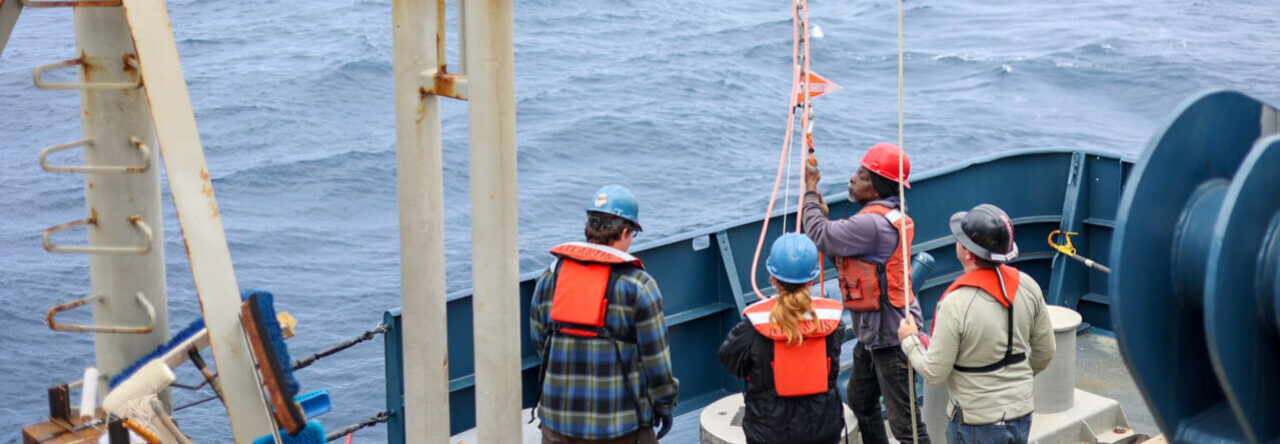
We recovered the mooring!!!! It’s fascinating how long it is (over a mile in length) and it’s hard to imagine just how deep the water beneath us really is, but this recovery definitely helps put things into perspective. Interestingly, the way that the mooring is recovered here is to pick it up from the bottom and wind the wire in up to the top, stopping for wire replacements and instrument removal. Here you can see the final buoy and ADCP being recovered on deck.

In the morning (before daylight) the ship turns off all transmitting acoustics so that the scientists can turn on their own acoustic transmitter (this is what I helped set up in the straza tower a week ago). This is because they need to “communicate” with the bottom mooring release in order to tell the mooring to drop the weights and resurface. Having multiple acoustic transmissions going at the same time is similar to trying to hear one person when many are talking all at once. essentially messages consisting of:
“Are you awake?”
“Yes I’m awake”
“Please drop the weights”
“Ok”
Once the weights have been released, it takes approximately 5-7 minutes for the top of the mooring to surface and about 40-50 minutes for the rest of it to surface. Now everyone working right now needs to go up to the bridge and look for the mooring. One of the crew mates, Henderson, was exceptionally good at spotting it. Once it is spotted, the person that sees it will hold their arm with hand open, gesturing towards where they saw it and try and get as many eyes on it as possible. Each of the instruments attached to the mooring have their own set of buoyancy spheres that will raise and so it is important to see each of these segments (with different colors and numbered spheres) in order to know where to pick the mooring up. After we located it, the whole mooring surfaced, and we picked it on a grappling hook, then is where the winches and lines come into play.
It took us a total of 7 hours (a little on the long side) but this was because we had to replace FOUR 400 meter long lines. We also had 2 tangles which impeded progress significantly. This is where things get more confusing, because you can have a whole mess of wires going in every direction with a bunch of tension on each of them and you need to decypher which ones go where. The scientists have each of the segments of wire labeled so that’s how we would tell where it’s supposed to go on the mooring. It was really cool to see all that tension transfer from one line to another in order to remove and repeat the processes. We had to replace a lot of the segments of wire which was done after a certain number of deployments or after significant damage from a tangle. In order to replace the segments, we had to reel it onto the big squid (large winch we were using), tie off the rest of the mooring with a deck line to hold the tension, unhook the line and wind it onto an empty spindle. Unfortunately, the spindle that holds all the wiring when loading and unloading it onto the mooring, is HAND OPERATED.
It requires a lot of arm strength. Apparently they’ve got a compressed air powered spooler ordered but it won’t arrive for quite some time, and so hand spooling it is in the meantime. I had a critical job on this recovery- taking care of the diapers. Each of the links on the mooring need to be covered with a protective cushioned cloth so that when it’s tension-loaded onto the winch, the shackles won’t bend or pierce the wire around it. I’m so glad I got to see the mooring recovery as I was worried that our last trip cancellation might not allow me this.
Tomorrow we will be re-deploying the mooring which includes dropping a 2,500 lb weight at the end of the line and having it sink down. Apparently this process is much more straight-forward and therefore runs faster. We will see if that rings true tomorrow.
May 7, 2023
Today was mooring deployment day! It took us around 5 hours to get everything in the water. Similar to yesterday it was a lot of taking tension on and putting it somewhere else in order to attach different wires, buoys, and instrumentation.