The first week on board the R/V Hugh R. Sharp has gone well! I was picked up at the tiny Salisbury airport by KG, one of the technicians that will be on the second and third leg of the survey, and his visiting friend. They drove me from Salisbury, Maryland to Lewes, Delaware. Along the way we had lunch at a local diner and bought some heavy-duty foul weather gear, including a pair of rubber steel-toed boots. Sharp was docked next to another vessel and an associated administration building. The building had offices as well as workshop space to maintain the ship. I was given a tour of the Sharp and was introduced the crew. Afterwards I was given time to unpack, grab dinner in downtown Lewes, and have an early night to recover from my 5 am flight. Tina moved in that night as well. She’s an independent contractor technician that is with us for night watch of the first leg. On the second day, we started work at 7 am and I mostly followed Max around, the technician that will be on all three legs of the scallop survey. The ship was already prepped and ready on the tech side of things so I mostly watched the scientists ready the fiber optics cable, learned my way around the ship, and learned the daily duties aboard the ship. We had lunch on the ship and the crew went home about 3 pm to pack and get ready for the upcoming cruise. I had dinner again in Lewes. It’s a nice mile or so walk into downtown from where we were docked.
The next day, everybody was loaded up and we set to sea. During the day we test deployed the Habcam, the CTD, and the dredge. The Habcam is a giant apparatus that has cameras and various other equipment attached to a frame. It is dragged behind the ship just above the sea floor and it takes pictures of the sea floor, including scallops. The dredge on the other hand scrapes the sea floor, collecting everything there, and dumps out the haul on a massive metal table to be sorted through by the scientists. The scientists are transitioning over using the Habcam more than the dredge to lessen their environmental impact. Another vessel is dredging the same area as us so the first leg uses only the Habcam while the second and third legs will alternate between them. However sometime during the test deployment, one of the main power connectors to the ‘brain’ of the Habcam flooded from an imperfect connection. We went back into Lewes that night as it was unclear whether the Habcam’s ‘brain’ would work once dried out. We docked for a couple of hours until it we found out from science that the Habcam is fully functioning. We headed back to sea and continued on track.
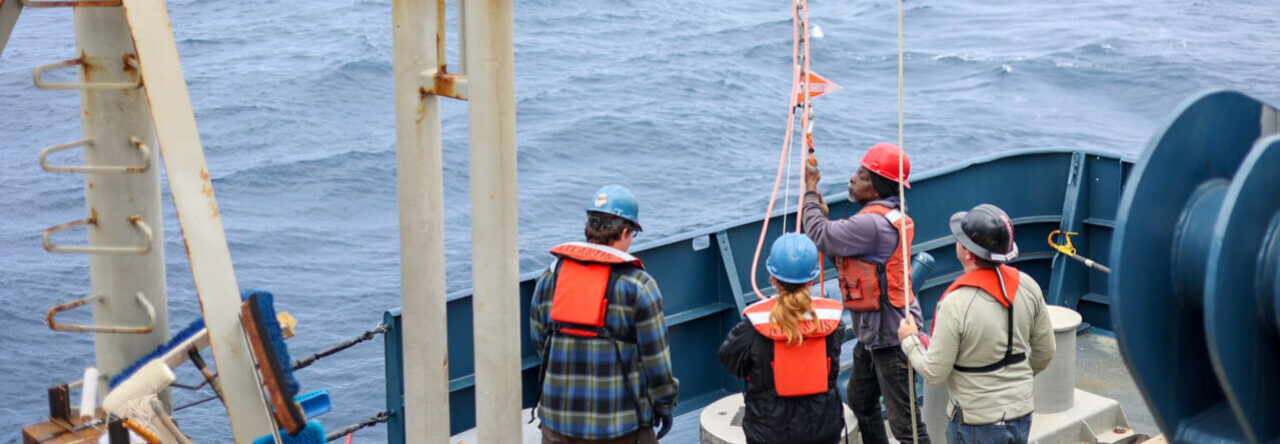
In the following days, I’ve fallen into a routine. Watch is from 6 am to 6 pm with breakfast at 5:30 am, lunch at 11:30, and dinner at 5:30 pm. I spend most of my time in the bridge with the rest of the crew that’s on watch. I have been reading (finished 4 books so far) and chatting with the crew. Everyone is very friendly and science will enthusiastically talk about what they’re currently working on. The Habcam does not require anything from the techs so days can be slow. There have been some equipment issues that keep us on our toes but other than that, we only have to do a daily check on the systems. The daily check includes cleaning a filter, washing down the CTD, and double-checking that the weather readouts are accurate. All in total, it only takes 20 minutes or so. Today, we tested the dredge again and got some sea stars, sand dollars, fish, crabs, and scallops. During a dredge, Max and I are in charge of attaching the dredge to the winch and assisting getting the dredge back on board. We have to shovel the catch into piles so that the scientist can sort it and wash everything down once finished. All in all, I’d say that things have gone well. The weather has been calm and the trip has been fascinating. See you next week!
– Maia