
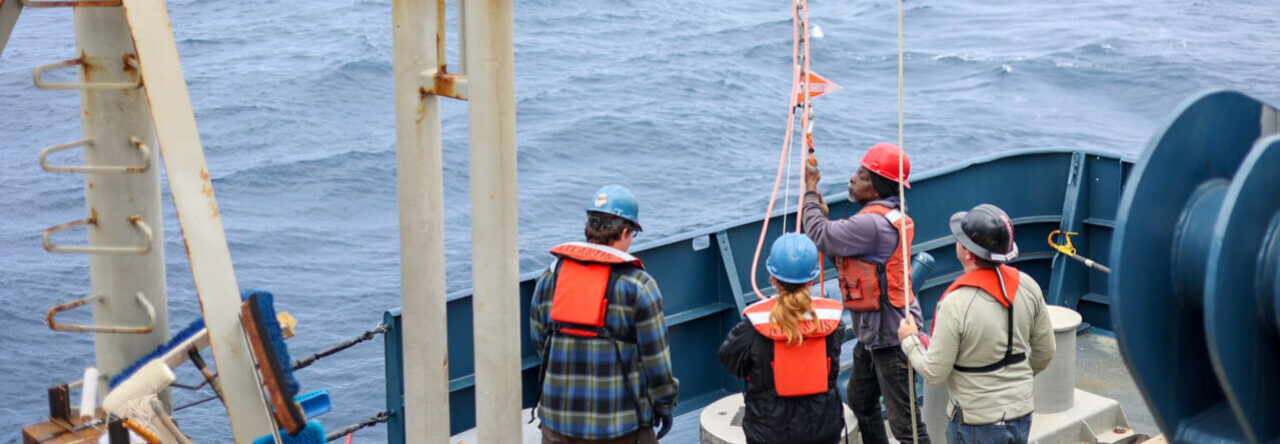
After living aboard the USCG Healy for two + weeks, I am finally becoming accustomed to living on a large ship. Thankfully my greatest fears of being violently seasick have yet to come true and, in fact, the pitch and roll of the boat often rocks me to sleep. My days have blended together becoming a blur, judged not by the time, but rather what part of my shift I am in and when the next time I can sneak away to some corner for a strategic nap. I have learned to appreciate the simplest things, like a Snickers bar handed out after dinner. I have also been very lucky to find myself in the company of a crew and group of scientists, who teach me something new each and every day. They also have the uncanny ability of making fun of themselves, just as easily as they can give me a hard time for doing something as awkward as walking into a stationary container box or falling off a chair. I have also found myself going from some serious conversations about politics or science to laughing hysterically about nothing at all in a five-minute time frame—all of which makes the long days go by so much quicker.
The hours are long and the schedule tight. My “day” usually begins around 0330 and I start my 12-hour shift at 0400; however, these hours are a generalization and they have been shifted many times to better match a CTD line. Although a CTD line may not last my full shift, they often do, so I struggle to find the time to visit the gym, eat a meal and, most importantly, write a blog and maintain my journal. Even the weather and the increasingly dark days have taken on a familiar pattern. Since boarding ship, we have had at most 5 days with sunshine, while the rest have been gloomy, foggy and grey. When the sun does show itself, it stays along the horizon all day long creating an almost permanent pre-dusk glow. Since entering the Arctic Circle, we have also been losing day light at a rate of close to 10 minutes a day.
Mealtime is one of my favorite times of the day. While the food may not be the best and is similar to the cafeteria food I quickly abandoned in college, it is the main social affair of the day. For each meal, the galley is only open for an hour, so almost everyone who is awake on the boat shows up. At first, the crew sat on one side and the scientists sat on the other, much like a high school cafeteria, but that lasted about a week before the science crew (the coastguard members that we work with directly) joined the ranks of the scientists. Beyond mealtime, there is little interaction with the crew unless it is at one of the organized “events” that include science lectures, Saturday morale night (an activity and movie played on the big screen) or Sunday trivia. Working as part of Team CTD, I also spend a significant portion of my day with different crew shifts that come in and out of the lab space. Otherwise, interactions include frequent passing in the narrow hallways and stairs or short conversations at one of the two gyms aboard the boat. Which brings me to one of the few things that I will not actually miss about living on the boat: navigating the myriad of doors. Because of the need to secure everything at all times for transit, all doors are secured from both the inside and outside. There are also watertight doors between every section of the boat. In order to isolate any flooding accidents, these doors are secured by opening and closing a bar handle. When walking anywhere, everyone jockeys to be in the middle of the group so that we can avoid opening and closing the heavy doors.
Communication on the boat takes me back to my youth when all the “cool” parents had pagers. The only way to find someone who is not in the same room with you is to dial their pager number and wait patiently for them to call you back on the phone that is on whatever room you are in. Although it is not always the most efficient method of communication, it seems to be a good match for the ship life.
Since we have been underway, we have passed several significant landmarks and seen some things that few people ever get the chance to see. Breaking ice is absolutely wild and not like anything I have experienced before. The boat relies on brute force to blaze a trail for us to follow. As the boat moves, it crashes up and down while the ice crumbles beneath its weight. There are then long scratching noises along the side of the boat as huge chunks of ice move past us. The thicker the ice the louder and bumpier the ride becomes. While we were on the ice, the crew saw one polar bear; unfortunately, I missed it because I was squeezing in breakfast before the next CTD cast. We have also had the rare opportunity to cruise past the Smoking Hills of Canada, which are deposits of lignite (carbon-rich shale and pyrite rich in sulphur) that can ignite spontaneously as the hill erodes and the mineral veins are exposed to the air. Finally, as we headed west again, we took a detour to watch the sun set over Herschel Islands. We were lucky enough to have the clouds lift just enough to let the sun shine through.