Belated post (ironically) due to technical difficulties! Originally written July 16, 2025.
It’s been a busy few days! This week, I traveled to join the Healy, but evidently, I didn’t even need to hop on a plane to meet my MATE mentor, Tyler! As I lined up to board my flight from Portland, Oregon, to Anchorage, Alaska, Tyler found me and introduced himself. He’s a marine technician at Oregon State University, coincidentally my alma mater! He was a MATE intern a few years ago who was mentored by other previous MATE interns, so I’m stoked to be reaping the benefits of a long line of program successes. I’m in good hands!
Tyler works on the Ship-based Technical Support in the Arctic (STARC) contract, which essentially provides marine techs for the USCGC Healy’s science missions. Although the Healy is first and foremost a Coast Guard vessel, it’s also a research vessel. The cruise I’m on now is in support of the Arctic Mobile Observing System (AMOS), a network of autonomous oceanographic instruments making long-scale autonomous observations of ocean and sea ice physics.

In Anchorage, we met up with Micah, the long-term MATE intern joining for the same leg of this expedition. Soon, we were all on the short flight to Nome, a small town known for being the last stop in the famous Iditarod dogsled race. There, we met a member of the Coast Guard and spent roughly the next couple of blustery days banding together to explore Nome’s historical landmarks, gift shops, and eclectically remote dining options while waiting for the Healy’s arrival. Highlights included seeing wild musk oxen, finding the finish line of the Iditarod, and ordering sushi at a pizza restaurant.


Once the Healy was in position off the coast of Nome, we coordinated with more newly arrived Coast Guard officers for our onboarding. Suddenly a bright and sunny day after a perpetual rainy gray, we made our way to Nome’s port. There, one of the Healy’s small boats (just 26 feet long!) picked us up in small groups while a water taxi transferred our luggage. As an understatement, the small boat ride was awesome. Wearing a Mustang suit, speeding along up and down through waves on an endless sunny sea as the grand profile of the Healy grew closer and closer was definitely a cinematic experience.


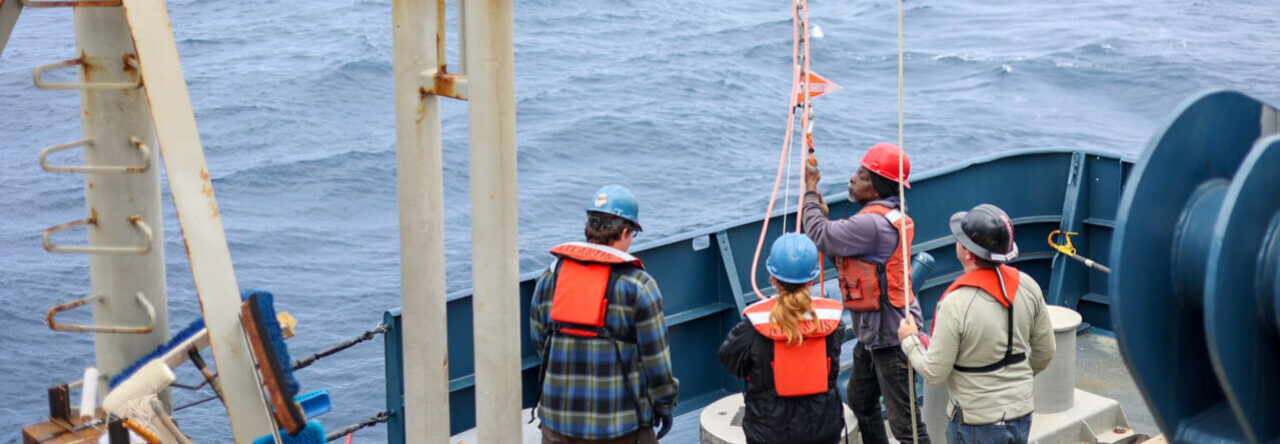
When we reached the Healy (a whopping 420 feet in length), we were faced with our next new and novel experience: climbing a Jacob’s ladder dangling off the Healy’s deck while our small boat bumped through the waves next to it. Once I started climbing the swinging rope, I understood why its name carried the carnival connotation. Despite some nerves, I made it smoothly to the top and was officially on the Healy!

After climbing up, Micah and I were given a tour (lots of muscling through watertight doors) from the STARC lead onboard, Christina, then hauled our bags up and got settled in the computer lab. Then, once Tyler was onboard, the real work began! As we started north, Tyler showed me the “water wall,” the system of seawater that flows through a set of sensors for continuous data collection while underway. It gives us information about the current seawater temperature, salinity, oxygen, and chlorophyll levels. Configuring the water wall involves a “seesaw” of opening and closing valves to allow flow through the full arrangement of all the instruments with the right water pressure. Here, our main goal is to keep it flowing, accurate, and not explode it!


Tyler also gave me a crash course in some key sonar instruments the STARC team monitors on the ship: the multibeam echosounder, singlebeam echosounder, and acoustic Doppler current profiler (ADCP). The multi-beam echosounder is an instrument that emits lots and lots of sound pulses to map out the seafloor like a 3D model by detecting how the frequencies change as they bounce back to it. The single-beam works similarly, but with just one pulse point, which provides us with a cross-sectional line of the seafloor topography. The ADCP uses sound to measure water current speed and direction by emitting sound pulses that bounce off particles suspended in the water. It then calculates the speed and direction of the current by measuring the Doppler shift, which is the change in frequency of the returning sounds.
Finishing up the first of my noon to midnight working days, we ended with a walk on the weather decks, admiring the almost-sunset off the land of the midnight sun. I’m so stoked to finally be onboard and excited for the steep learning curves ahead. Until next week!
Polar bear count: 0*
*Polar bears are not native to the Portland International Airport.
