(dun–dun–dun da-da-da-dun)
No rest for the weary on a Coast Guard ship! My first morning on the Healy started with alarms—man overboard! Don’t worry, it was just the first of several shipboard safety drills that day to welcome us onboard. An abandon-ship drill later in the day brought me to the hangar, where Micah and I tested our ability to speedrun suiting up in immersion suits. As we did, an exciting announcement came over the speakers: we’d officially crossed into the Arctic Circle!


Just one day later brought us something to show for our crossing: sea ice! I’ve found that no matter how much you stare at the glinting white and cyan shapes bobbing by, it never gets old. The Healy is an icebreaker ship capable of continuously breaking 4.5 feet of ice, or 10 feet when backing and ramming. The continuous shudder of icebreaking is definitely a unique feeling compared to the usual sway of open water. The ship’s hull is designed not to pierce through waves like most boats, but rather to slide up onto ice and crush it beneath its weight. Watching the ice break and churn alongside the ship is mesmerizing. I worry ice pictures may be beginning to outnumber dog pictures in my camera roll! Hopefully some polar bear pictures will bridge the gap…


Throughout the week, Tyler taught me systems essential to a marine tech’s job, like the Rolling Deck to Repository (R2R) data system and e-logging requests from the science crew. I also started learning about user datagram protocol (UDP) and virtual machines (VM), which we’ll likely get into more of later. Stay tuned! Tyler additionally gave me a crash course on more instruments, including the ADCP and gravimeter. The gravimeter is an instrument that detects tiny changes in the strength of the gravitational field to give us better insight into the geological topography under the ocean.
Our first big project was updating the CTD. CTD stands for conductivity (salinity), temperature, and depth (pressure), and is considered the “bread and butter” of marine tech. The CTD package is often mounted to a rosette that also holds other sensors and Niskin bottles to collect water at various depths as it is lowered into deep water. To make it a little more confusing, “CTD” often refers to the entire setup, not just the core instrument package.


After a baseline deck test confirmed most of the system was in good shape, we discovered the fluorometer wasn’t working. A fluorometer is an instrument that can measure the fluorescence of the seawater to give an estimate of the volume of chlorophyll present, which indicates the primary production of phytoplankton (the photosynthesizing base of the marine food web). Using a power supply and multimeter, we confirmed it was faulty and tested its replacement along with new oxygen and colored dissolved organic matter (CDOM) sensors, which we would also be adding to the CTD.
While I had worked with a CTD previously, learning about how instruments work using frequency and voltage was a new and exciting lens to explore. Tyler emphasized the importance of matching instruments to their correct pinouts. This involved digging for the correct cables in the endless cable drawer down in the science hold, testing them with the multimeter, labeling them, and then securely routing and connecting the cables on the CTD. Attaching expensive instruments to something going thousands of meters down in the ocean can be a little nerve-wracking, so we made sure everything is neatly wired and secured using hose clamps, velcro, and zip ties. After updating calibration files in Seasave and running another deck test, everything was set.


This week had no shortage of exciting sidequests. I spent lots of time with the multibeam ensuring it was running as best it could with the racket of ice all around and turning it off when the bridge spotted marine mammals. Having the most dramatic flare of the week, the metal pole supporting the wind sensor on the forward jackstaff snapped, leaving the sensor’s cable to be the only thing to hold up both. Deeming it in need of an immediate fix, the ship came to a halt and Tyler climbed the dicey jackstaff ladder off the bow to safely take it down. I was just happy to support from the deck!
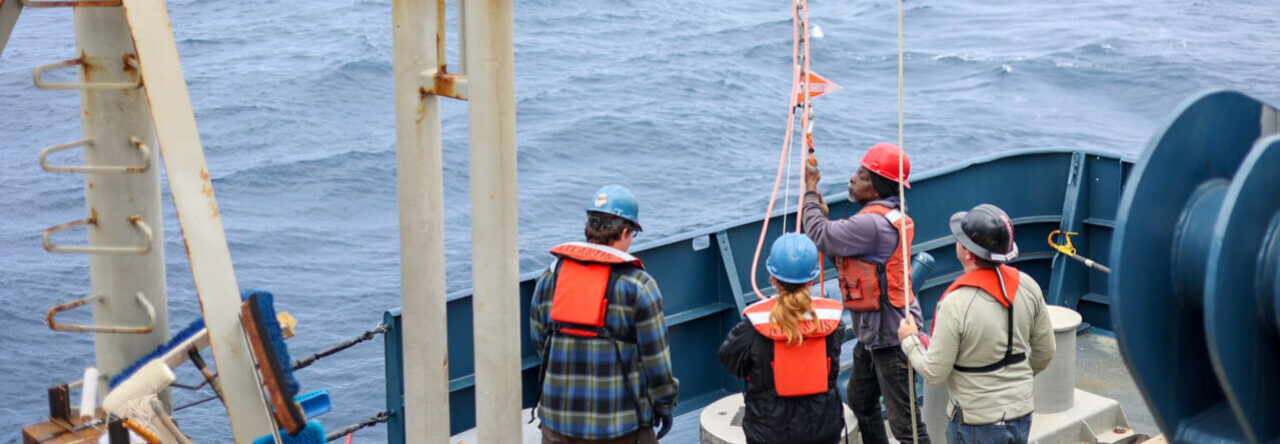
We also began some more standard deck work. As of today, we’ve recovered three moorings that have been collecting data in the Arctic Ocean for a couple of years. Navigating mooring recoveries with the added obstacles of constantly moving and refreezing sea ice has been a really interesting process to learn along the basics of winches, taglines (and also in this case, grappling hooks!). I’m looking forward to observing and potentially participating more in upcoming deck work.


As we tackle tasks big and small, I’m slowly gaining familiarity with the work of a marine tech and learning more each day. It’s hard to believe it’s only been a week! Don’t worry, though, the watertight doors and eating lunch for breakfast keep me humble. Until next week!
Polar bear count: 0.5*
*A Coast Guard public affairs specialist (PA) showed me a picture he took of one from far, far away during the first night onboard, but none have been seen since then. I did, however, spot some walruses swimming in the distance!
