Category: R/V Marcus G. Langseth Page 2 of 10

Week 1 – Preparing the R/V Langseth – Will

Greetings from aboard the R/V Marcus G. Langseth! We have had a very busy, productive first week aboard the Langseth, assisting LDEO’s technical team in preparing to get underway. In regards to getting underway, the Langseth will now be setting sail for Cape Verde, off the coast of Africa, to retrieve OBS equipment as opposed to our initial plans of traveling to Costa Rica to deploy OBS equipment. This change comes in light of concerns with next year’s NSF funding, with fears that there may not be enough funding to retrieve the equipment that was to be deployed off the coast of Costa Rica.

The Langseth is a remarkable ship, and the only one in the UNOLS fleet equipped to carry out multi-channelled seismological research, making it a world-class floating Earth observatory! One of the very first things we did was a vessel famaliarization tour with our supervisor and Cheif Science Officer, Cody Bahlau, allowing us to familiarize ourselves with all of the impressive lab spaces that we would be frequently working in.

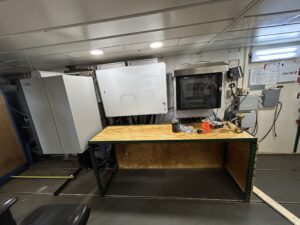
One of the first major projects we had aboard the Langseth was the construction of a set of shelves that would be fitted into the ship’s Dry Lab in order to replace the old filing cabinet and fencing, create more workable area, and improve the overall quality of the lab.
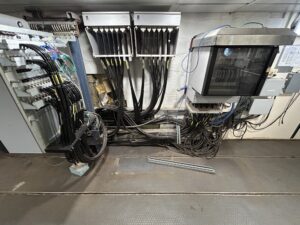
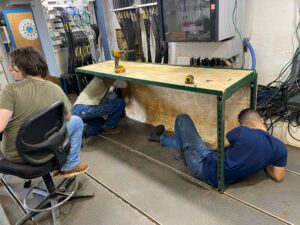
The shelves were contructed in about 3 days, leaving us very proud and fulfilled with our final products! This was the first time I had every built something from scratch using power tools, so I was thrilled to put some hard work and new skills under my belt so shortly into my internship! The three of us even signed our names underneath, which I thought was really cool!

We also began to learn about the instrumentation aboard the Langseth that is used to conduct research, such as the multibeam sonar system, Digibirds, weather station and gravimeter. While still waiting till we are underway to really begin using and maintaining the sonar and Digibirds, this first week exposed us to running the sonar’s instrument testing, ensuring the weather station was transmitting data properly, and performing a Gravity Tie and weekly checks in preparation for transporting the gravimeter off the ship.
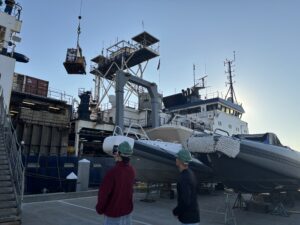
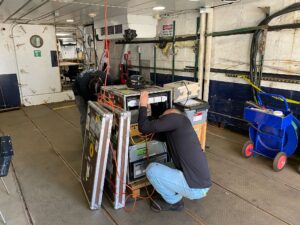
Moving and preparing the gravimeter for transportation was a very precise task, as we had to ensure it recieved uninterupted power at all times, otherwise, we could be risking thousands of dollars in damage and repairs! While our time with the gravimeter was short, we learnt a lot about how it functions and were involved in every step of its offloading.

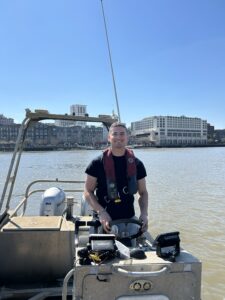
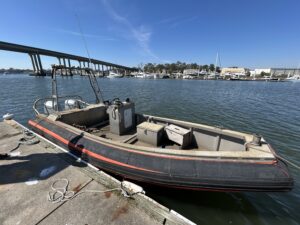
We also had the opportunity to join Cody for a venture along the Savannah River in the Langseth’s science workboat, which provided us a nice break from the ship out on a beautiful day, but wasn’t free of complications! While issues with the port motor were not ideal, it gave us the opportunity to perform some maintenance and troubleshooting, all valuable experience!
Besides these larger activities, we have been hard at work preparing the Langseth to set sail for Cape Verde, which includes less glamarous but essential tasks such as securing items to the ship, cleaning and organizing work spaces & labs, installing computers & monitors, offloading non-essential equipment for transport back to WHOI and Columbia University, labeling equipment, loading provisions, inventorying PPE, and continuing to familarize ourselves with the vessel, daily operations, and emergency procedures. Cody has been a great supervisor, forthcoming with his experience and wealth of knowledge, and always present to assist us as needed but allowing us the autonomy to work and troubleshoot tasks independantly. Unfortunately, we did lose Ethan a few days ago, as he could not do the couple extra days added to the trip by Cape Verde due to other commitments he had.

I am super excited to get underway to Cape Verde soon, and I look forward to continuing to share my experience during this internhship! See you at sea!

– Will
Theo Lafontant Kagan — Introduction

Hello! My name is Theo and I am one of three interns aboard the R/V Langseth this February.

I recently graduated from Bowdoin College, where I majored in Biology (concentrating in Ecology, Evolution, and Marine Biology) and minored in Environmental Studies. I have a strong background in marine science, having previously studied shark populations in South Africa, modeled upwelling dynamics along the Skeleton Coast, and analyzed marine food webs using eDNA.

Down the road, I’m interested in pursuing graduate-level studies in ecology and marine systems, but before applying I wanted to become more familiar with the technology and instrumentation used in field expeditions. I’m looking forward to developing my technical skills with the Langseth’s state-of-the-art scientific equipment and to collaborating with the marine technical team at sea. This will be my first time working aboard a UNOLS vessel, so I am excited to learn from everyone on board.

Check back in next week for an update!

Ethan Wadsworth – Introduction

Hello! My name is Ethan Wadsworth and I will be one of the Interns aboard the R/V Marcus G. Langseth transiting from Savanna, Georgia to Puntarenas, Costa Rica.

I am a recent graduate from Cal Poly Humboldt in northern California. I graduated with a Bachelor of Science in Oceanography and a minor in Geology. At Cal Poly Humboldt, I had the opportunity to go on day cruises aboard the R/V Coral Sea introducing me to marine technology and research cruises. I am super excited to spend time at sea aboard the R/V Marcus G. Langseth developing my technical skills and gaining and growing experience with different instruments and equipment. I am particularly interested in the sea floor so I’m looking forward to getting hands-on experience with sonar.

I can’t wait to meet everyone and sharing more once I’m on board.

William Eltringham – Introduction

Greetings! My name is William Eltringham; I will be interning aboard the R/V Marcus G. Langseth from February 20th to March 9th, starting in Savannah, Georgia, and ending in Puntarenas, Costa Rica!

I am currently a Junior at the Massachusetts Maritime Academy, where I am pursuing a degree in Marine Science, Safety, and Environmental Protection with a minor in Marine Biology! As an undergrad, my goal is to build my work experience to make myself a great candidate moving into my professional career! Having had plenty of previous outstanding internships, I am particularly excited for this unique and remarkable opportunity to join the LDEO team aboard the R/V Langseth as a MATE-Marine Technical Intern! Working aboard the ship during its transit to Puntarenas will provide a great opportunity to develop my technical skills and knowledge as I work and familiarize myself with the onboard equipment and operations.

I look forward to sharing more of my experience and will be sure to touch back soon!

Week 6 Ayse M. On the Langseth

The cruise is nearing its end, having completed six weeks of travel. On July 18, around 8 am, the crew received a radio call from the Icelandic Coast Guard about a distress signal from a vessel with a broken mast and low fuel. The Marcus G. Langseth, being the closest ship, backtracked to assist. After about five hours, the sailboat was spotted. The crew deployed a small boat to deliver multiple cans of fuel to the stranded vessel, successfully enabling it to return home safely. It appears the boat had not been ready for the harsh weather, as their sails were shredded.

Continuing on, we passed Iceland on the west and entered the Arctic Circle, where the sun never sets. However, operations were suspended for several days due to poor weather. Upon resuming, we completed work at Station 6 east of Greenland, where we observed pilot whales and retrieved a core sample containing a piece of sponge. We then headed to Station 7, the final station.

We also experienced power disruptions due to engine issues; I believe the starboard main overheated and shut down, likely due to a procedure missed as we slowed down to deploy our last Argo float. Fortunately, the engineering team resolved the issue within a couple of hours.

Week 5 Ayse M. On the Langseth

Daylight is lasting a lot longer than I’ve ever experienced. Sunrise starts almost the moment I’m on shift (midnight). It’s hard to claim I’m on night shift when most of my work is still being done during the day. Overall, it seems like we’re all falling into a good rhythm. Usually, around 5 am, myself and the other tech on night duty start prepping the deck and the equipment for the day. Eddy, another MATE intern, writes us notes letting us know what work was done and what work we can do.

I finally had time to hang out with the science crew while they processed their samples. Before now, all I really got to see of their work was them taking the shuttles off the multicorer and into the vans (essentially, a shipping container kept at 33-36 degrees Fahrenheit) and then coming out with the mud in small bottles. I am really thankful that they took the time to show me their work. Inside the van, they have quite a bit of dedicated equipment that allows them to remove the mud from the shuttles without the mud being exposed to air.

I also had the joy of seeing an XBT (its Nicholas name is “Expendable Bathythermograph”) deployment. It is shaped a little like a toy rocket and essentially, it is a probe that measures the temperature as it falls through the water. There is a very thin copper wire connecting the probe to the equipment on the ship. When it reports that it has reached depth, we break the wire and leave the XBT in the ocean. It is something I’ve learned about in my studies but had heard they were not used most days as they are a bit wasteful, and there are other ways to get the same data.

Week 6 aboard the Langseth

We are at the end of the 6 week of the this cruise and the end as whole is just around the corner. It has certainly been an eventful week. On our transit to the final station we recieved a distress signal from a vessel with a broken mast and running low on fuel. The Marcus G. Langseth was the closest ship to the distressed party and made the easy decision of changing course in order to provide assistance. After back tracking for several hours we were able to spot the small sailing vessel nested in a thick fog. The ship’s crew wasted no time in preparting to assist. They loaded up one of our small boats with fuel cans and a small party of three to meet the ship approximately a mile away from us. It is quite a process to deploy the boat and all were in attendance at the spectacle. Luckily there were no issues and the distressed vessel was able to make its way home safe.

With our own small boat and its party secured again we made for our heading towards the Arctic Circle. We passed right by Iceland on this transit and quite possibly may have seen it if the continuous fog didn’t follow us. As we passed the Arctic Circle we have truly come into a place of eternal daytime. Unfortunatley we have not been able to utilize this extra light to our advantage as we have suspened operations for several days due to the weather. Once it clears we will finish up our final station and make our way to Reykjavic for a well needed sight of land.

Duva Week 6 R/V Langseth

Station 6 was east of Greenland and we arrived on Saturday the 13th and started coring on Sunday. One of those cores caught a piece of a sponge! We also were visited by a large pod of pilot whales on Sunday. There was a group of roughly 20 whales that were jumping and diving near the boat, and another group closer to the horizon.

Monday was a big day of coring and by Tuesday evening, we had finished the CTD cast and were headed onward towards station 7, our last station!

Usually transit days are more relaxed, but Wednesday and Thursday brought some excitement. First, we released our last Argo float on Wednesday, followed by an XBT probe to get water column temperature data from the location of deployment. XBT stands for Expendable Bathythermograph; “expendable” because the probe is launched into the water and not recovered. The probe is a small, torpedo shaped object that stays connected to the launching device by a delicate thread of copper wire which transmits the data back to the ship. Once we reach its maximum depth, you break the thin wire and are left with a temperature profile of the water column the probe fell through. XBTs are used on the Langseth for seismic, in which sound is used to map the ocean floor, and an XBT helps find the speed of sound through water, which is dependent on the salinity and temperature of the water.

A few hours later, we experienced some disruptions in power as one of the main engines had a kerfuffle. At this time, I was in the bridge and it was interesting to see how the captain and second mate managed the situation. After some troubleshooting, the engineering team were able to get everything back online.

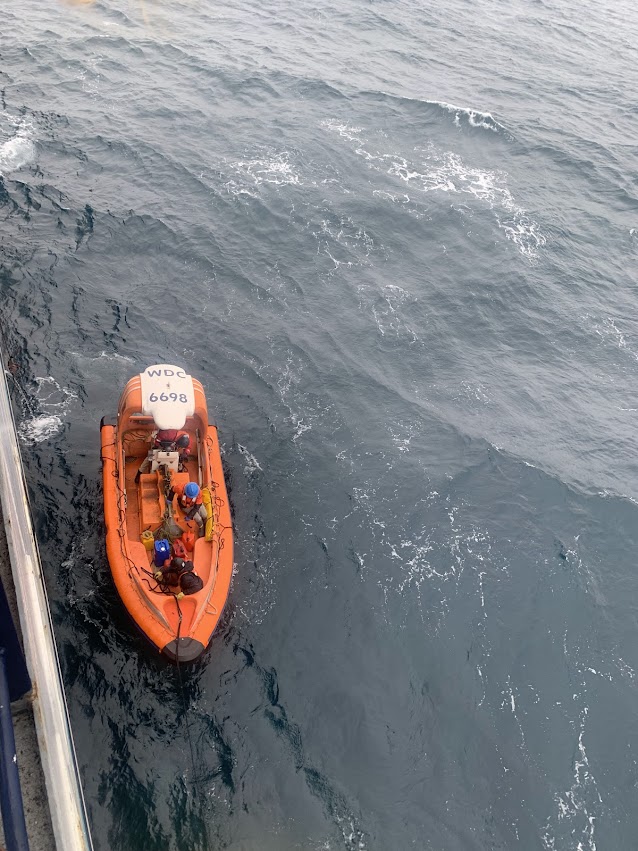
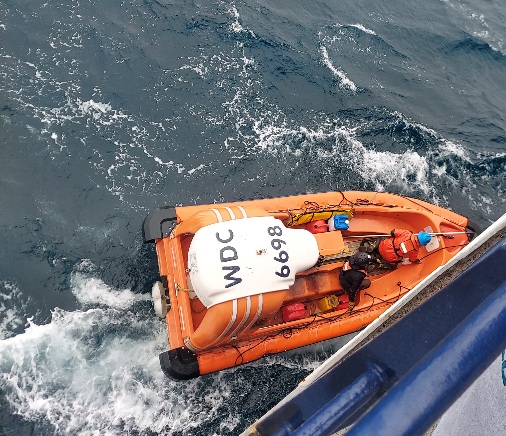
On Thursday morning, we were notified by the Icelandic Coast Guard that we were the closest vessel to a sailing vessel in distress and asked to render aid. The sailboat lost its sails in a storm and was running out of fuel. We backtracked for a few hours until we were in sight of the sailboat. The second mate, third mate, and one AB went in the fast rescue boat to bring them jugs of fuel. It was a little unnerving to watch the little orange boat be rocked around in the cold waves, but they reached the sailboat safely twice to bring them about 50 gallons of fuel. The rest of the deck crew contributed to a successful deployment and recovery of the fast rescue boat.

Our excitement for Friday was crossing the Arctic Circle!! And it was Larkin’s (our awesome videographer/photographer/science communicator on board) birthday! We also had a meeting for planning demobilization once we reach port, which includes arranging for shipping containers, cranes, and forklifts.

We are expecting some big seas in the next few days and hopeful we still be able to find a weather window to get station 7 done before heading to Reykjavik. Home stretch!

Pod of pilot whales, photo by Lexi!

View from the bridge as the orange fast rescue boat crosses our bow.

Fast rescue boat just after it was deployed from its davit on port side.

Duva Week 5 R/V Langseth

We started week 5 by arriving to station 5, located in the central Labrador Sea between Greenland and Labrador. We sent multi-core casts all day on Monday and Tuesday, and finished up station 5 with a CTD cast on Wednesday. Sunset is getting later as we continue northward.

Scores of northern fulmars and gulls kept us company at station 5, floating and flying near the ship. Fulmars spend almost all their days at sea, so they are not typically seen from land. Another lift to ship morale were two incredible nights of having Haagen Dazs ice cream bars for dessert.

During transit on Thursday, a group of us got a tour of the engine room. We saw the massive air compressors for seismic work, as well as the engines, shaft generators, aux generator, and air conditioning systems. In addition to catching up on projects and reading, I spent some time in the bridge while transiting.

By Saturday we were on station at station 6, east of Greenland. We resumed sample collection in about 2600 meters of water.

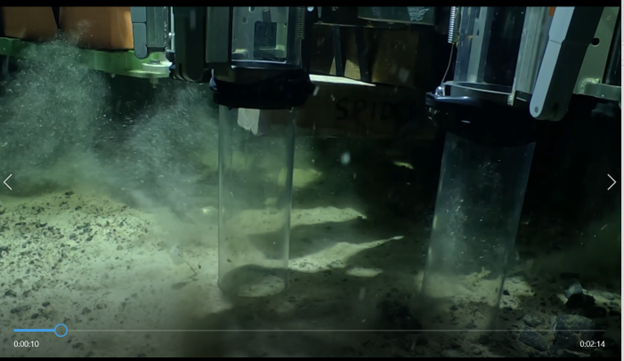
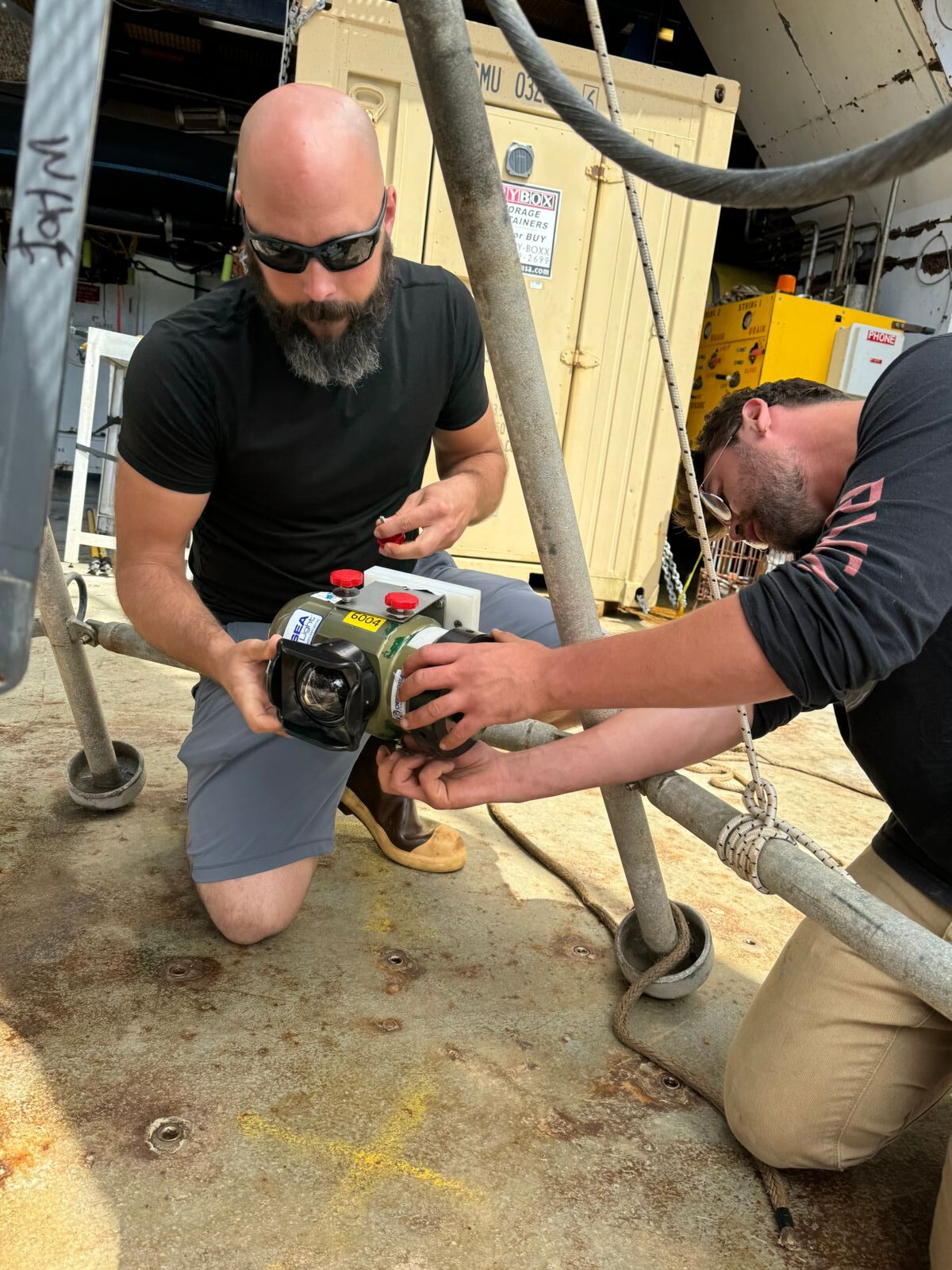
The multicore has two cameras on it, one of which is helpful for landing the corer on the seafloor and the other for troubleshooting sampling. One of the cameras we can view images from during the cast via the winch’s sea cable. Mounted near this camera is a light which we have the ability to turn off and on during the cast. The light is kept off for most of the cast, because it draws the most power and we don’t want to drain the batteries. All of the power for the cameras and light come from two batteries mounted to the frame of the corer, which get charged up overnight with a trickle charger. The second camera records the whole cast (which is mostly darkness) because it is a GoPro in a special metal housing. So we start the video recording then pack the GoPronto the housing and mount it on the multicore frame. The housing also has a highly specialized lens that corrects for distortion from the water.

Screenshot of a video from GoPro of a bottom landing

Techs attaching the GoPro camera inside its housing to multicore frame

Multi-core being recovered. Orange boxes on sides are batteries to power camera and light. Small white birds in background are fulmars


Week 5 aboard the Langseth

This marks the end of 5 weeks aboard the R/V Marcus G. Langseth. It is hard to believe that we have but a few weeks left on our cruise. This week has been quite productive in regards to our primary mission of collecting sediment cores. Most of the days we were able to do 4-6 deployments of the multi core with decent returns on average. I say on average because we have had several deployments with perfect returns and a few with none at all. It certainly is a practice in patience when we spend three or so hours on a deployment to only end up with no mud. The more challenging aspects of deck operations, such as running taglines and operating the winch, have also began to come easier and smoother. I still have much to learn but am worlds better than I was at the beginning of the cruise. Our work hasn’t only been on deck though as we also have been doing work around the shop on small projects as well as organizing all the copious data files from our instrumentation. Excel can at times be just as challenging as operating heavy machinery.

Luckily we have collected all the samples we needed for that station and are now headed towards our last intended station, north of the arctic circle! I am antsy to reach such a northern location especially with these extremely long summer days. By the time I head in for bed the morning light is already beginning to show even at midnight. Looking forward to our transit further north and beginning at our last station.

Page 2 of 10

Powered by WordPress & Theme by Anders Norén