Category: R/V Point Sur Page 2 of 3

Kristine Prado-Casillas Introduction

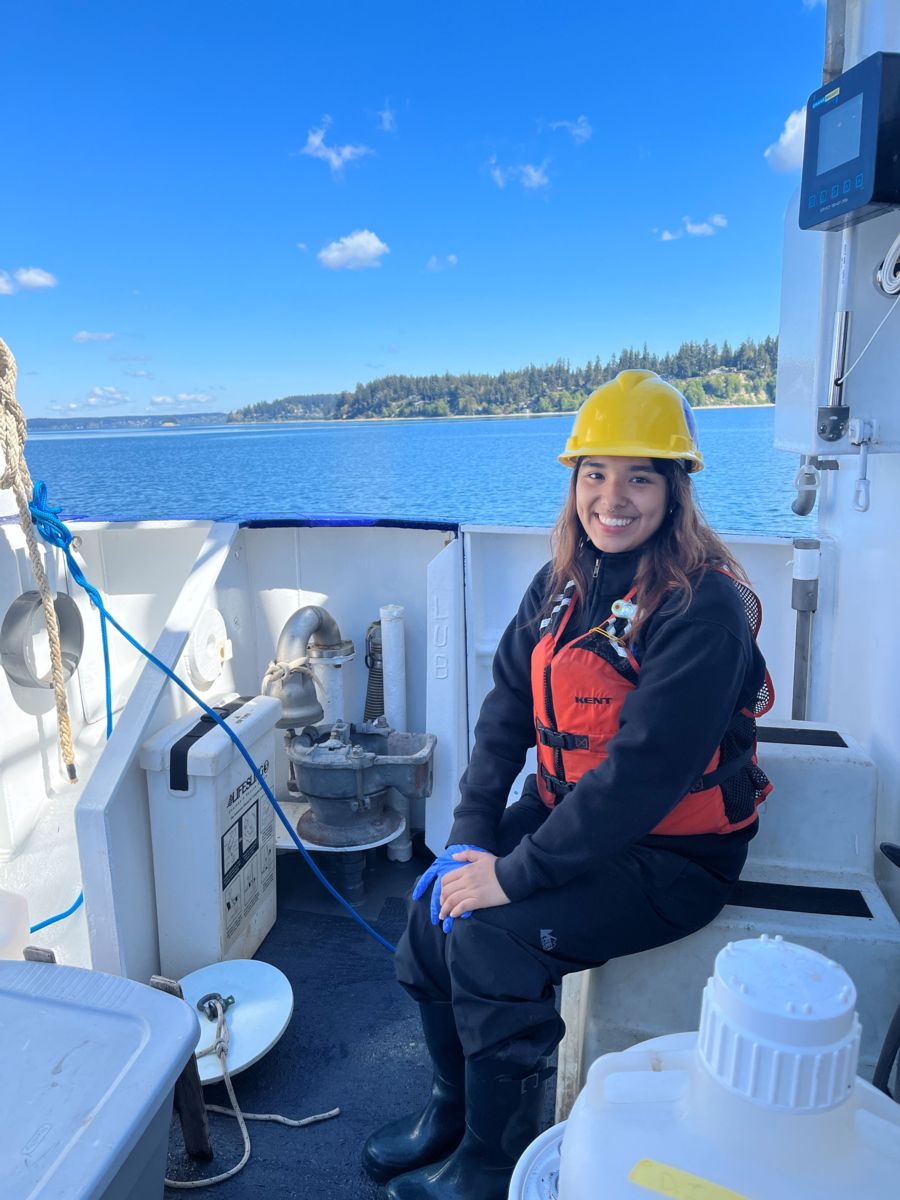
Hello reader! My name is Kristine Prado-Casillas and I will be interning aboard the R/V Pt. Sur!

I recently graduated from the University of Washington with a Bachelor of Science in Oceanography. During my time at UW I participated in a number of research cruises aboard the R/V Rachel Carson and R/V Thomas G. Thompson. My time out at sea during these cruises introduced me to the field of marine technology, something completely different compared to my lab experiences in academia. Coming back from research cruises, I was itching to find more opportunities to go out to sea and help collect the data necessary for the science within oceanography.

What fascinated me the most about the career as a marine technician was seeing them deal with something new every day. They were constantly learning new things and developing new skills to keep up with the science and techniques to gather data. The ability to constantly learn on the job while working on a boat to support science is what drew me to the field and eventually this opportunity. I cannot wait to work with my mentor to learn skills working out on the deck and to see how much I can grow from this internship!

Outside of my love for the sea, I enjoy hiking, camping, crocheting, making friendship bracelets, playing with my pet birds, and dancing!

Goodbye Puget Sound, Gulf of Mexico here I come!

Kristine Prado-Casillas Introduction

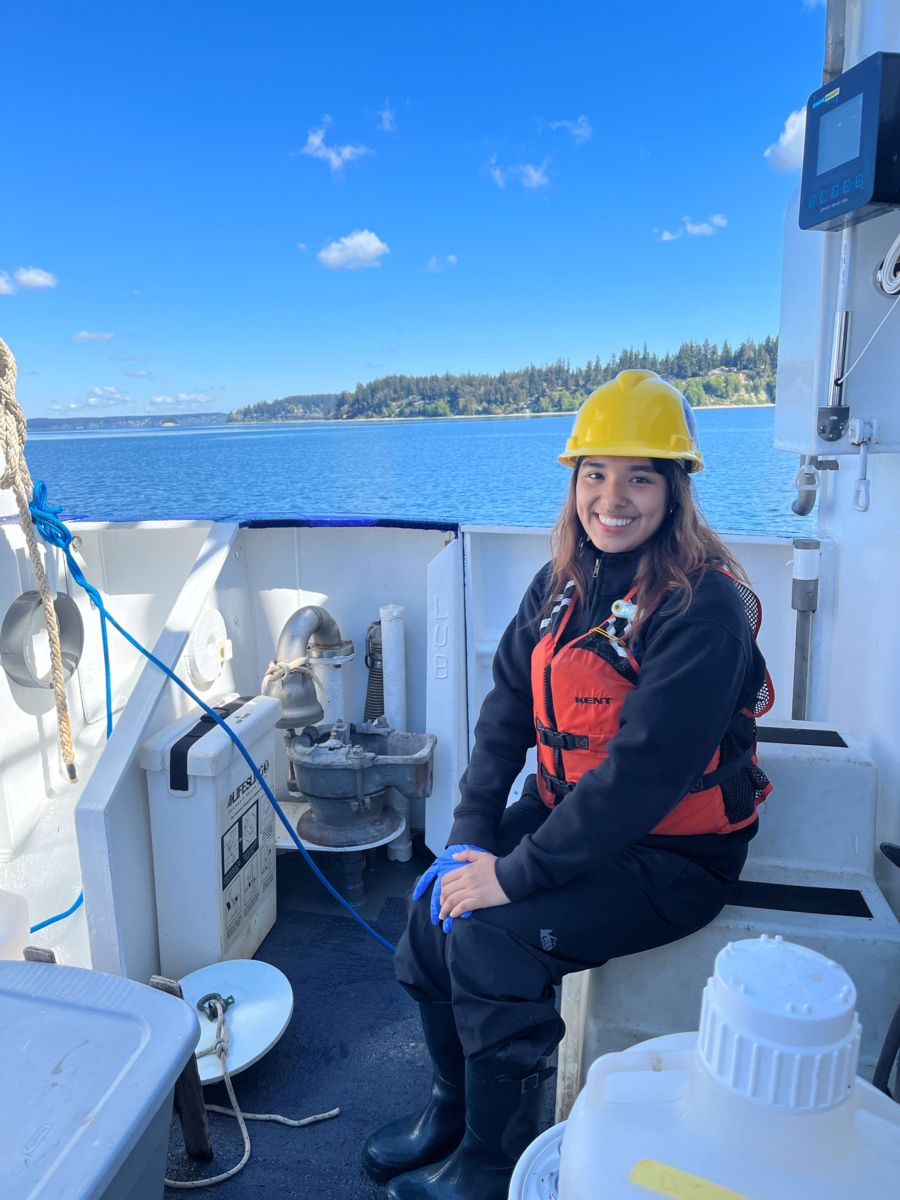
Hello reader! My name is Kristine Prado-Casillas and I will be interning aboard the R/V Pt. Sur!

I recently graduated from the University of Washington with a Bachelor of Science in Oceanography. During my time at UW I participated in a number of research cruises aboard the R/V Rachel Carson and R/V Thomas G. Thompson. My time out at sea during these cruises introduced me to the field of marine technology, something completely different compared to my lab experiences in academia. Coming back from research cruises, I was itching to find more opportunities to go out to sea and help collect the data necessary for the science within oceanography.

What fascinated me the most about the career as a marine technician was seeing them deal with something new every day. They were constantly learning new things and developing new skills to keep up with the science and techniques to gather data. The ability to constantly learn on the job while working on a boat to support science is what drew me to the field and eventually this opportunity. I cannot wait to work with my mentor to learn skills working out on the deck and to see how much I can grow from this internship!

Outside of my love for the sea, I enjoy hiking, camping, crocheting, making friendship bracelets, playing with my pet birds, and dancing!

Goodbye Puget Sound, Gulf of Mexico here I come!

A New Vessel in Mississippi

We made it back to port, after a very long transit from Mississippi Canyon to LUMCON. Due to the sheer size and amount of our equipment, we spent two days demobilizing. A crane and sixteen wheeler was ordered for the removal of the ROV and ROV tech van. The following days consisted of unloading equipment and preparing for our following cruise. Because our CTD was not used on our prior cruise, we had to reload and prepare our CTD with adequate sensors, reterminate our two CTD wires and regrip our hanging cable. In addition to  CTD work, I flushed our MIDAS flow through system using pumps and a 10% bleach bath. I let the pipes sit over night and by the time we were finished demobilizing, the pipes were well-cleaned. The usual office duties and sensor inventory was also completed.

After a long few days, I made my way over to Gulfport Mississippi to board another research vessel- the R/V Point Sur. In between my time on the Pelican and Point Sur, I made a detour to Texas. The trip was very enjoyable and it was nice to stop and smell the roses after a long cruise. Feeling well rested and high in spirits, I docked the Point Sur.

Point Sur Endeavors:

I am admist my first Point Sur cruise: the mission is multi-coring and CTD work.

Our first day came with some variability with the multi-core system. Specifically, we had difficulty getting the MC800 trigger mechnisms to fire at depth. All the parts are functioning as they should- after some refitting, regreasing and some serious TLC- but we continued to perfect our bottom method throughout the week. With the multi-core, it is important to drive the core- with the winch- into the sediment properly, but depending on the sediment, you may not want to linger for too long or too little on the bottom. Attached to our multi-core system is a transducer- so we used HYPACK and the Tracklink software once again- a skill I am now more increasingly familiar with. Throughout the trip I learned a lot about multi-coring, its trigger mechanisms and how it works. The device can be finicy and it is important to test, test, test before deploying down to 2000+m.

In addition to multi-coring, I learned a lot on the mechnical and tech side of things. Mechnically, I began operating the a-frame, j-frame and crane on the boat throughout the entirity of the cruise. The experience was a good confidence builder, and while it requires a great amount of responsibility, I am happy to reach a point where I am capable of taking that responsibility on. In addition to a few wire terminations on the multi-core winch wire, I fixed a few CTD landyard bottles and even got to shrink another cup! I will post photos below.

On the tech side of things, this cruise enabled me to better my CTD software skills- specifically in using its data processing hardware and converting cnv, dat and text files! I also installed several VGA monitors, hooked them up with ethernet jacks, ran several cables throughout the walls and terminated a ADU800 (heading, pitch and roll system) connector. I am very thankful for the extreme welcome I was given on the Point Sur- they made my time away from my home ship more than comforting!
 

Almost on my Way!


My name is Amanda Dostie, a recent UConn BS graduate, and a soon to be MATE Intern. With only a number of days left before my departure, I am overwhelmed by a complex variety of emotions. Beyond all else, I am overcome by a deep sense of honor and excitement in beginning this wonderful opportunity. I will start my journey in New Orleans, LA, aboard the R/V Pelican and R/V Point Sur, at the LUMCON facilities. For approximately three months I will learn the ropes of a new world, become accustomed to the life of a marine technician, and in doing so, grow tremendously. Following my time in New Orleans, I will make my way to Bermuda, working alongside BIOS and other institutes.

My journey to where I am now began with my love for the ocean. From a young age, my childhood was enriched with vivid memories along the coastline- swimming, exploring and boating along the waters. Later, my passions lead me to pursue a career within marine science. During my undergraduate career, I immersed myself in a number of academic and personal endeavors surrounding the environment and natural sciences. I took advantage of the research opportunities within my institute, and worked as a research technician for over four years. I worked under several water quality projects studying nutrient pollution, eutrophication, algae blooms, hypoxia, TNT/RDX and other related biochemical interactions. My experience as a research technician exposed me to work aboard large and small vessels. My passion for working in the field, lead me to instruct marine science and other naturalist subjects within outdoor-education. During this time I earned my USGS 6-pak Captains License, and other useful certifications. I finished college deck handing for my institute’s vessels and pursuing personal research endeavors. My personal research endeavors involved algae bloom quantification, remediation, as well as NGO and municipal work, in the hopes of pursuing a business in algae remediation. Upon graduation I was intrigued by the MATE Internship- an exciting opportunity that will utilize and blend my research and mechanical interests. Although I will be extremely out of my element, I am excited to learn as much as I can, especially in fixing instruments!

I am spending my remaining days with friends and family, enjoying the simple moments we too often put on hold, and scrounging up any last-minute travel necessities. Oh, and of course, there are the copious amounts of reading I will be doing. To my surprise, a bulk of my packing was completed early- though I am still gathering together my smallest creature comforts, like books and personal items, which I will be especially grateful for on long cruises. As I wait through my last few days, I am overwhelmed with both nerves and excitement. In a short amount of time, my routine and perspective will completely change, and in lieu of my trepidation- I could not be anymore excited to take this step. My process will last a little over half a year; easy by no means, but perhaps one of the most rewarding adventures of my life.


My third and longest trip

Well I am back from my longest trip of this internship. We were out to sea for 11 days. This trip was very interesting to me, mostly because we were using a ROV on it. After an 18 hour trip to our first deployment location we deployed wave gliders and other gear that we would eventually pick up on our return. The instruments we deployed were set in water that was over 2000 meters deep. We then moved to an area that was about 600 meters deep and deployed more gear. That is where we used the ROV. The ROV was recently reconfigured to operate at those depths but was never tested until we deployed it. During our first dive with it we had some video issues, the thrusters were causing noise in the line. After descending all the way to the bottom to view a package to make sure everything was going good with it we were bringing it back up. At about 150 feet the GFI on the deck box kept tripping.

Eventually we were able to retrieve it and bring it back on board. In between dives we were working on fixing the video. It never really got any better. The next day we made a second dive with it. We made it down to 575 meters, completed that mission and brought it back to the surface. At about 150 feet we started blowing the GFI again but was able to bring it back on board. The third dive was also to 575 meters. Once again we were able to complete the mission but on the way back up we had the same problems. The next morning I woke up to find out that at least one of the vertical thrusters was full of water. We spent the next day and a half tearing apart the ROV to check the rest of the thrusters. Come to find out that both of our vertical thrusters had water in them. After drying them out and cleaning them we hooked them back up to test to see if they worked. We were only able to get one back to working order. We had to reconfigure the ROV to accommodate only one vertical thruster before our fourth and final dive. The decent on the fourth dive was slower and the seas were the roughest that it has been the whole trip. It made for a huge challenge but eventually we made it to the bottom, viewed the package, and made the scientist happy and brought the ROV back to the surface safely. Over the next couple days we assisted the scientist deploy and recover their gear. It was an amazing learning experience for me. I will be taking back a great deal of knowledge back to my classmates to share with them. As for me, I am getting ready to head over the R/V Pelican for my final trip of this internship. We will be conducting a study of hypoxia zones from the flow of the Mississippi River into the Gulf of Mexico using a CTD sensor array.

First 12 days on the Point Sur

Well it has been twelve days since I arrived in Gulfport Mississippi and boarded the R/V Point Sur. Over these past days I have had many great experiences and have learned a lot. The first trip that we went on involved working with the United States Environmental Protection Agency (USEPA). After leaving port we had a 40 hour transit to Galveston Texas where we picked up more scientists then an 18 hour trip down the coast to the Corpus Christi area. During the transit I was able to learn about the CTD, help change out the control bottle on it, troubleshoot why it wouldn’t talk to the computer and fixed the issue.  I also had time to do some networking of computers on the boat. When we finally arrived at the testing site we took sediment samples, dredged for worms and clams, and photographed cross sectional views of the bottom.

We arrived back in port and the next day we took out a group of students from the University of Southern Mississippi out to do some research.

The crew on the Point Sur are wonderful to work with. The food is amazing.

This was my first time on a boat in the ocean. It is not much different than being on the Great Lakes. I did not realize how many oil rigs were really out in the Gulf of Mexico. At night it looks like a city on the water.

Right now we are getting ready to head back out for 11 days. The boat is being loaded with a bunch of gear. There is a rov and two big wave gliders and a few smaller ones. This trip is going to be exciting, it is geared toward what I want to do when I get out of school. When I get back from this next trip I will give another update.

Dreams do come true

Hello everyone, my name is Ken McQuarrie. I am a student at Alpena Community College which is located in Northeast Michigan on the shore of Lake Huron. I am enrolled in the Marine Technology program specializing in ROVs.

So let me tell you about myself more. I am 38 years old. When I was young I always wanted to work on the ocean. I wanted to be a marine biologist. When I was 17 I ended up having a child. At that point I gave up on my dream of working on the ocean. I left the small town of Alpena at the age of 19 and moved to Lansing, Mi. While there I worked many jobs but mostly I worked at a photo lab and I painted houses. When I was 22 I had another child. I raised him his whole life by myself. Almost two years ago I came to Alpena to visit for the holidays. When I was there I was helping cut down a huge maple tree at my grandma’s house. I climbed a ladder to tie a cable around the limb that was hanging over her house. When I reached the top of the ladder it broke. I fell 18 feet and broke my leg. It changed the direction of my life. I was no longer a painter.

While I was recovering, I was trying to figure out what to do next in my life. That is when I found the Marine Tech program at ACC. After finding this program, a flood of memories and dreams came back to the forefront of my mind. I decided to give school a try again. Going back to school after 18 years was a little scary. Fortunately the second time around was much easier. It is amazing what that time away from school has taught me. All those life experiences really helped me excel in my classes. Over the past year I have had so many amazing experiences. I have learned how to scuba dive, piloted rovs on over a dozen shipwrecks, met and worked with many amazing people in the industry and now this internship through MATE.

Growing up in Michigan, I have been out on the Great Lakes numerous times. I absolutely love being out on the water. I have never been on the ocean though. This will be another dream of mine that will be marked off my checklist. I am excited and nervous at the same time. I am sure I will make the best of this opportunity as I have all the others over the past year. So my message to everyone reading this is: No matter what life throws at you and how far gone your dreams seem to be, everything happens for a reason. Don’t be afraid to chase your dream, even if you are older like me.

I look forward to this opportunity and will keep everyone posted on my travels when possible. Thank you MATE, ACC, friends and family for your support. I will make you all proud.


Ken McQuarrie

Reflections after the internship

It all started with great excitement and enthusiasm. Arriving to Dutch Harbor and meeting the crew was amazing. I exchanged words with young scientists, the marine tech and the captain. Being at sea has its challenges due to the inestabilty of the vessel and the particular metereological conditions of the day. You don’t know what to expect. However, over time you learn from previous experiences and master working at sea. The food was terrific and always on time. One could relax from time to time as the conditions were calm. I feel I gained much control over myself during those hours aboard a Research Vessel and was able to connect with the crew as the day went by. Now this internship is over and I am about to head home soon but I will remember those days I spent during the transit and the beautiful images of the Pacific Ocean.

CTDs

As  I continue on this transit,  I have engaged into more conversations with Alex and Holly who are the scientists who collaborate with Professor Collins in taking CTDs measurements from the Ocean. Stian has repeatedly shown me how to act as a console operator and how to take information from the CTDs. Most of my work has consisted on assisting Alex and Holly with bottles fillings and labeling. Cocking up the bottles in the CTD and deploying and returning the CTD back on the Ship.

Every once in a while Professor Collins asks me to help with removing some hardware from the CTD or wiring.


As far as getting along with my cruise mates, I have become more used to them. We share lunch and dinner and have interesting conversations about language, school, work. During times I exit the galley and stare at the ocean.  There are times when the ocean calms down and one can relax while at the same time appreciate being on board the R/V Point Sur.

Sea sickness under control

Today, I experienced sea sickness. After a long rest I woke up around 10 AM with the motions of the vessel. The sea was now agitating and kept rocking the vessel side to side. It was difficult to take a shower and after a while it got me to the head. I had some lunch prepared by Tara and resumed to meet Stian, Alex, and Tori for another day of CTD. We found out that our logs were not properly marked and made the goal of the day to make sure we were more consistent and through in our data logging. Around 12 pm I could not stand the nausea and had to step out from the wet lab and sit by the deck to get some fresh air. It helped me recover but I was yet not cured. After half an hour I went back to my bed and laid down for two hours. I think I was exhausted and the effort I did on taking a shower in the morning definitely affected my balance today. Later in the afternoon, I grabbed some dinner and took another nap and resumed work .

CTDs are now easier to deploy, and data logging and bridge communication can get done quicker. Practice has definitely help in managing our team work more efficiently.


Today I met sea sickness and learned to overcome its first effects. Sitting still and taking naps were the best solutions and I am relieved for the conditions may get worse in the next coming days but for now I feel relaxed.

Page 2 of 3

Powered by WordPress & Theme by Anders Norén