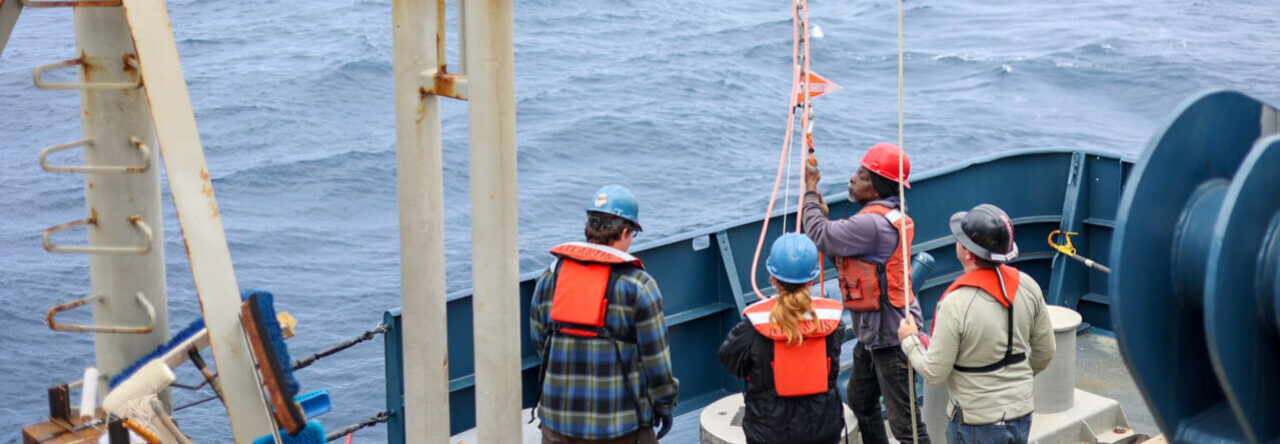
Well I am back from my longest trip of this internship. We were out to sea for 11 days. This trip was very interesting to me, mostly because we were using a ROV on it. After an 18 hour trip to our first deployment location we deployed wave gliders and other gear that we would eventually pick up on our return. The instruments we deployed were set in water that was over 2000 meters deep. We then moved to an area that was about 600 meters deep and deployed more gear. That is where we used the ROV. The ROV was recently reconfigured to operate at those depths but was never tested until we deployed it. During our first dive with it we had some video issues, the thrusters were causing noise in the line. After descending all the way to the bottom to view a package to make sure everything was going good with it we were bringing it back up. At about 150 feet the GFI on the deck box kept tripping.
Eventually we were able to retrieve it and bring it back on board. In between dives we were working on fixing the video. It never really got any better. The next day we made a second dive with it. We made it down to 575 meters, completed that mission and brought it back to the surface. At about 150 feet we started blowing the GFI again but was able to bring it back on board. The third dive was also to 575 meters. Once again we were able to complete the mission but on the way back up we had the same problems. The next morning I woke up to find out that at least one of the vertical thrusters was full of water. We spent the next day and a half tearing apart the ROV to check the rest of the thrusters. Come to find out that both of our vertical thrusters had water in them. After drying them out and cleaning them we hooked them back up to test to see if they worked. We were only able to get one back to working order. We had to reconfigure the ROV to accommodate only one vertical thruster before our fourth and final dive. The decent on the fourth dive was slower and the seas were the roughest that it has been the whole trip. It made for a huge challenge but eventually we made it to the bottom, viewed the package, and made the scientist happy and brought the ROV back to the surface safely. Over the next couple days we assisted the scientist deploy and recover their gear. It was an amazing learning experience for me. I will be taking back a great deal of knowledge back to my classmates to share with them. As for me, I am getting ready to head over the R/V Pelican for my final trip of this internship. We will be conducting a study of hypoxia zones from the flow of the Mississippi River into the Gulf of Mexico using a CTD sensor array.