Category: University of Washington, School of Oceanography Page 4 of 7

Last week on the Escanaba Cruise

Week 4 – End of Escanaba Cruise and back to Port (6/10-6/17)

The last week of the Gartman Cruise finished off strong!

Thursday afternoon last week the team was unable to launch JASON due to weather conditions, but by Friday (6/10), it cleared up and we were able to launch at 2pm for a 12hr dive.

Friday – Monday (6/10-6/13)

Each day JASON was successfully launched, completed dive missions, and recovered. The samples obtained during this cruise met the scientific party’s objectives and the last dive was spent exploring a new area that had not yet been mapped.

During this time, no vehicle issues or malfunctions occurred so turn-over time from recovery to relaunch was minimal.

Monday (6/13), after recovering JASON at 9am, the ship began its voyage back to port and JASON crew member’s shifts adjusted back to 8am-5pm.

The afternoon was spent demobilizing JASON and prepping it for the next cruise.

Some tasks included:

  • Draining the vehicle’s oils and prepping it for the next cruise.
  • The front “basket” or “porch” area that held the sampling equipment was dismantled and cleaned.
  • Washed down the vehicle to clean the saltwater off
  • Tested hydraulic swingarm lines and found blockage issues, so then removed faulty lines.
  • Secured vehicle for transit

Tuesday (6/14)

Today the demobilization/preparation continued with:

  • Removing and cleaning all bio-boxes, side-arm boxes, and crates.
  • Began cleaning the winch area (de-greasing everything) to prepare for land crew members to replace the wind-level motor
  • Tested primary and secondary auxiliary lines, light cables and drained the boxes.
  • Replaced cable fluids and bled air from lines.

At 3pm, the ship arrived in Newport and the crew were able to have the rest of the afternoon off to pick up rental cars, clean their bunks, and do laundry.

At 7pm, all the crew members (JASON, SENTRY, Science Party, Thompson Crew) met in town to celebrate together. We found an outdoor venue (covid protocols) and spent the evening reflecting on the trip.

Wednesday (6/15)

Demobilization/Prep continued with tasks such as:

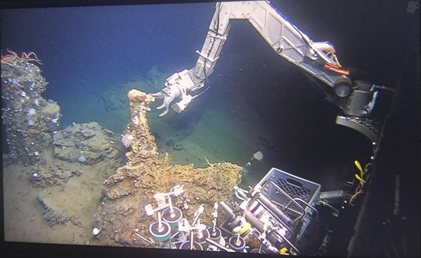
  • Removing and replacing the swingarm motors. (The swingarms are located on the starboard and port side of JASON) They house the bio-boxes (sampling boxes) and when triggered, the swing the boxes from underneath JASON to the front section, where the arm manipulators can open them, insert samples, and close them back up to preserve whatever was obtained. Then you trigger the swingarm to rotate back into its “home” position in JASON’s belly.
  • Since the oil lines leading to the swingarms were found to have slight blockage, we replaced the lines and had to reroute, label, and secure them.
  • Removed the grated fencing from the back of the winch system so the wind-level motor replacement could begin.
  • Terminated JASON’s tether cable
  • Began cleaning, organizing, and preparing specific parts/equipment for shipping back to WHOI’s office in Massachusetts.

This evening the JASON crew met at the top of Tsunami Hill and had an end-of-cruise barbeque. The team leads picked up a small grill and loads of food! For the last time this trip, the team worked together, and each person took a role in either preparing, cooking, organizing, overseeing, or taste-testing the buffet-style dinner. It was bittersweet to share stories and a lot of laughs with each other!

 Thursday (6/16)

This morning the crew members who are departing spent the morning packing their belongings, cleaning their berths and workspaces, and wrapping up loose ends.

The people who continue onto the next mission (myself included) prepare the hydro lab (JASON’s main work area) for the new crew members. The previous crew is scheduled to depart at noon while the new team arrives shortly after.

The boat’s crane system is being used to transport equipment on/off the ship and the winch wind-level motor is also being replaced, so crew are remaining inside to keep the deck clear unless instructed otherwise.

This first cruise I was able to accumulate:

  • 20 days at sea
  • Mobilization Days: 3
  • Demobilization Days: 3
  • Co-Piloting JASON (engineering chair): 57hrs
  • Piloting JASON: 1hr

Tip of the week: Cutters/snips and a knife

  • Seems like we are always applying and removing zip ties, cables, or ropes so I have found to always have a decent pair of cutters on you! As soon as you think you are done and put them away, you will find something else that needs to be removed. Specifically on this cruise, there was a brand-new pair of diagonal cutters, and everyone wanted them. It is quite satisfying to be the one who obtained them for the day, and the ease of snipping away zip ties without struggle was coveted by all.
  • Having a good knife is especially handy for this line of work! When you have to secure and remove lines non-stop, having one that clips to your side is more convenient and saves a lot of time!

Introduction – Syenna Graham

Hey guys!

My name is Syenna and I am a junior in ocean engineering and computer science at Virginia Tech.

Ocean exploration is my dream job after reading 20,000 Leagues and then proceeding to obsess over deep sea fish and submarines since. 

Something rememberable about me for you all:

  • I drag race submarines 
  • I have a tortoise named thortoise

Looking forward to having you guys read along on my ocean robotics journey this summer.

3rd Week with JASON

Week 3 (6/4-6/10)

Saturday (6/4)

Today the R/V Thompson went back to shore to drop off a member of the scientific party. The trip back was approximately 14 hours, and as soon as the “drop off” was concluded, we were on our way back to the mission site.  

During this time, the JASON crew had extra time to work on miscellaneous tasks such as:

  • Rewiring the Brow pan/tilt Camera. It spontaneously will refuse to pan for one shift, but then be completely operational for the next. This camera is perched at the central top of JASON’s “face”.
  • We also replaced the connections from the motor-control pods to the thrusters. The previous dive ended when three thrusters had to be disabled due to grounding issues. JASON was able to still operate with two thrusters down, but when the third became problematic, the dive was aborted, and JASON was recovered.

Sunday – Thursday (6/5-6/9)

Each day JASON was launched and recovered within 20 hours. The launch and recovery procedure takes approximately 30 minutes to have JASON deck-to-water and vice versa. It is the ascent and decent of 3200 meters that usually takes around two hours. While the rise or dive is being initiated, the pilot and navigator stay in the motor-control van, while the engineering member is on Winch Watch.

This week’s dives have all been successful with no issues and all desired samples were obtained.

Thursday evening the weather was too severe for another launch, so it was postponed until

Friday(6/10) afternoon at 2pm.

This week was especially exciting not just because of the success of the dives, but I was able to pilot JASON for a portion of the dive on Tuesday (6/7). I was surprised how stable JASON was when maneuvering around the area. A big difference from the smaller observation ROVs that I have flown in the past. Though it was a shorter dive, it was one of the most exciting moments I have ever experienced!

What extra time I had this week was spent learning different hydraulic fittings. I was even quizzed on them later in the week.

We only have a few days left on this cruise, so the team will try and get in as many dives as possible before we head back to port. I am lucky enough to remain on the vessel and accompany the next cruise, which will go until July 2nd.

This week’s tip: Napping & Rain Gear

On a cruise such as this with the different shift times, you will most definitely want to become accustomed to napping. Some days that may be the only sleep you get. If recovery and launch times fall in between your shift, then a few naps are what you will get. But after a couple days of this reoccurring, your shift leader will work it out to where you can take a whole 6–7-hour sleep time.

Also, if you are to venture out on a project like this, make sure you bring rain gear. Even if it is not raining, it comes in handy! When recovering JASON, you complete post-launch checks which require you to climb up into the vehicle. And you WILL get soaked! I brought a pair of water-proof bibs, so those have been quite beneficial for this endeavor.

2nd week with WHOI

The second week of work has been quite the challenge.

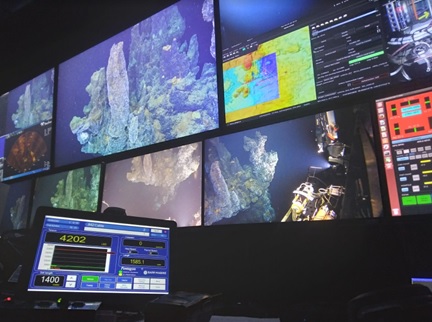
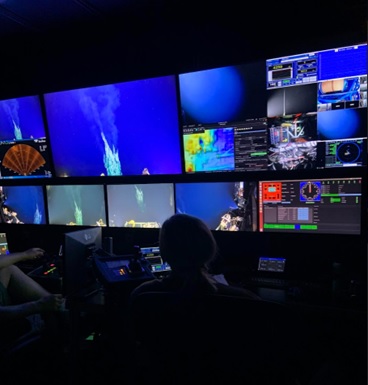
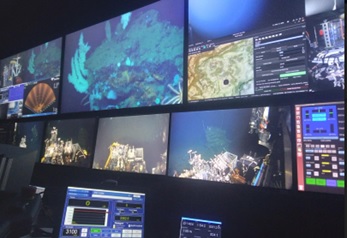
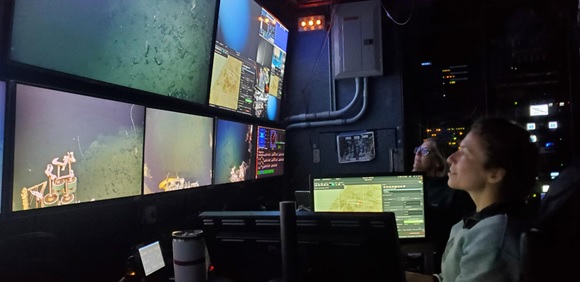
Due to weather conditions, JASON was unable to safely deploy on Saturday (5/28). This hiatus gave extra time to train in the Control Van. That is where the magic happens! There are twelve screens that allow us to see and operate all of the camera angles on the ROV, JASON’s hydraulic pressures and sensors, wench diagnostics, navigation settings, sonar displays, and so much more! To monitor and operate JASON while diving, it takes three people.

The pilot sits in the center, where they have the best views of all the screens. The Navigator sits on the left and is responsible not just for the navigation of JASON, but also the R/V Thompson. They also document the target points and locations as well. Lastly, the Engineer Tech sits in the right chair (this is where I will be). I will be responsible for maintaining, operating, and overseeing all of JASON’s hydraulic equipment such as:

  • Thruster Comp Pressures                            
  • Main Comp Pressures
  • Manipulator sensors
  • Camera settings and positioning
  • Ground Fault alarms
  • Basket (front retractable porch), slurp (suction system for retrieving samples), side sample bio-boxes, niskin sampler triggers, etc.
  • I also am able to help operate the manipulator arms as needed by the pilot
  • Completing hourly checks of all temperature and pressure levels, alarm systems, and reacting to every alarm that may go off.
  • Tether management

I would be lying if I said I was not nervous, but the WHOI team training me are so helpful and insightful and I have no doubts they will support me the whole time.

The rest of today was spent rebuilding the sampler MAJORS from last week. These devices, when triggered, retract, and suck up whatever water or sediment they are inserted into. I ended up replacing the inner seals because they were worn and had a build up of gritty residue on them.

I also lead the Pre-dive check for the vehicle, which consists of over forty-five checks ranging from:

  • Upper Vehicle & LARS checks
  • J-Boxes & Comps
  • Powering Up the vehicle/devices
  • Laser & Light testing
  • Thruster checks
  • Hydraulics
  • Manipulators
  • Misc. checks like vehicle safety vests, securing inner cables/wires, etc.

Sunday (5/29)

First JASON dive is a go!  

– Completed Pre-Dive checks.                                                  

– Secured and arranged sampling tools inside JASON’s front porch/basket.

– Added front weighted plates and rear weighted bricks that can be removed during the dive.

JASON was successfully launched at 11 am.

For my 4-8pm shift, I sat in the Engineering Tech seat in the Control Van and was witness to the amazing capabilities of JASON. This vehicle is capable of unbelievable things, but it is the crew that makes it possible. The dive was successful with its decent and sample collection at over 3200 meters, but towards the end of our shift, it was noted that JASON’s Thruster Comp levels plummeted from 9 to 0.5, and the decision was made to recover the vehicle.

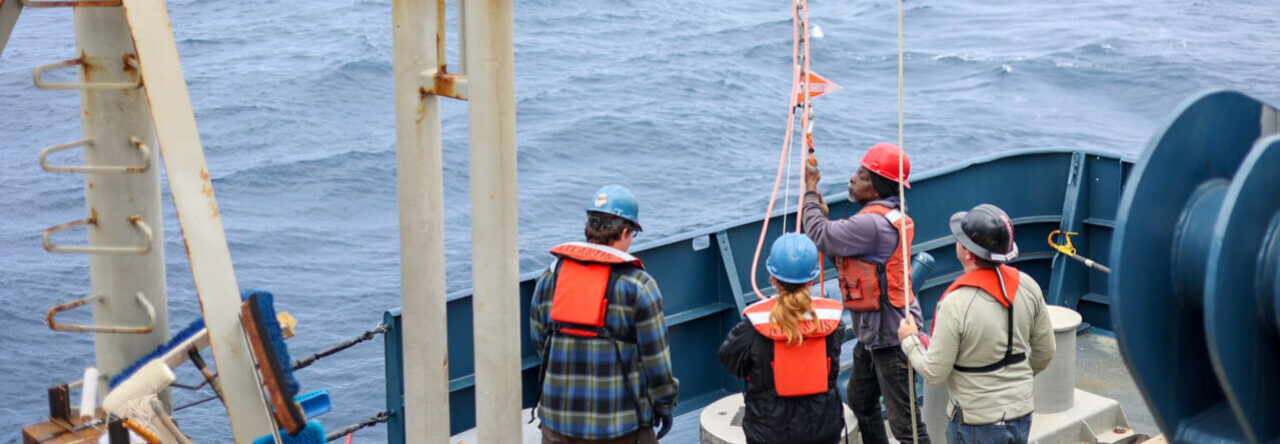
It takes almost two hours for JASON to get to the surface, but only 40 minutes to get him safely back and secured on the vessel. The team removes all 38 tether floats (which are quite large and heavy). One person ropes off the cable to bring it closer to the side of the vessel, another holds the float ropes to secure it and one last person unlatches the lock. With the crane operator timing the retracting carefully, it only takes minutes to clear the cable and finish the recovery.

It would be too long to list off everything that happens with each of these tasks, but I can tell you that everyone has several responsibilities, and each one is vital to mission success.

Monday (5/30)

4-8am shift:

  • JASON investigation revealed possible water seepage into one of the thruster lines. Cleared and bled thruster lines.
  • Pre-Dive checks at 6am
  • JASON launch at 8am
  • Unfortunately after securing all of the tether floats onto JASON’s cable, a thruster alarm triggered and JASON was brought back onto the vessel.
  • The day was spent replacing the vertical thrusters and trouble shooting cable issues.
  • Though my shift is scheduled 4-8, when JASON is down, everyone is working. We spent the whole day triple checking all of the adjustments and hope tomorrow’s dive is successful.

Tuesday (5/31)

  • 12 – 1am – JASON was deployed.
  • Both 4-8 shifts were completed in the Engineering Tech position.
  • Sample collection was successful and JASON operated without issues.
  • Some of the sampling tools did not perform as expected, so it was noted and will be addressed upon recovery/ post-dive.
  • 8pm – JASON was recovered and secured on deck.

Wednesday (6/1) – Friday (6/3)

  • JASON was launched each day and successfully completed sample collection objectives.
  • The normal dive time was approximately 20 hours each dive.
  • Trouble shooting and repairs were completed during post and pre-dive times.
  • The brow pan/tilt camera suffered ground fault issues and was replaced.
  • The thruster control pods for the vertical thrusters were disassembled, cleaned, repaired, and reattached.
  • All lines were continuously bled for air and the junction boxes \checked for water leakage.

This week’s lessons:

  • Oil pads are lifesavers! (We call them diapers) While replacing thruster lines, camera lines, whatever lines…they are all filled with either royal purple (an oil) or mineral oil. Even with clamps, sometimes the amount of oil lost can be substantial. So plan ahead, layout a “diaper” to collect whatever oil may spill. Clean everything!
  • I was able to diagnose a thruster connector leak by making sure to clean the area after replacing the vertical thruster.
  • Be meticulous. Ask questions. Double and triple check everything. Have someone else check your work. Good practice!

First week with the JASON team

Talk about hitting the ground running!

Monday (5/23) the JASON team boarded the R/V Thompson at 8am, dropped our duffels/suitcases in the main lab area and went to work!

First order of business was unwrapping the vehicle and rinsing it down, while checking to ensure everything was undamaged.

The primary goal of my first day was to disassemble, clean, and reassemble six Majors (water sampling systems). Once finished, we attached the handles but later detached them for the testing and training phase.

 (Pic of Major) without handle or nozzle  

We then trained a member of the research team how to:

  • Operate, test, and empty the Majors
  • Attach the Major handles and nozzles

Vehicle checks were then completed. Half of the team was up in the control van while the other half was outside with the vehicle.

The second day (5/24) was spent creating a layout of Jason’s basket (extendable/retractable front porch) to include collection boxes, empty crates, and sampling equipment mounts.

All had to be securely fastened down but we also needed to create a system was so the milk crates containing equipment and samples could be removed by the research team members and easily reattached as needed.

Vehicle checks were then initiated and completed.

At the end of the day, a line test was completed to test the JASON tether and backup cable system.

Day three (5/25) started off with attaching the slurp collector (sediment/soil sampling nozzle) to its collector hose. This attachment was completed using hose clamps and heat sinks.

Team members then began filling JASONS’s oil chambers, checking all hoses and primary/auxiliary boxes for air bubbles. The goal was to bleed out any air in JASON’s systems (which there are many!).

Towards the end of the day, the thrusters, manipulators, and hydraulic oils were also topped off.

Day four (5/26) was departure day!

The first three hours was dedicated to strapping down and securing all JASON systems, equipment, and supplies to prepare for vessel launch. Anything that could potentially move needed to be secured.

All of JASON’s cables, wires, and connections were zip-tied to ensure total security.

The thrusters were again bled for air bubbles and will be bled multiple times over the next couple days. The ship’s movements will help shift any air bubbles to the top of the lines so by deployment day, the air will be completely expelled.

The afternoon was spent rigging a base for the Fluke Temperature Probe to sit at the front port side of JASON’s porch in front of the collection crates. This will be used by JAONS’s manipulator arms to measure temps inside hydrothermal vents. The maximum temp this probe is rated to is 500 degrees Celsius.

Vehicle checks were initiated and completed. (This time I was able to be inside the control van)

Throughout today, fire and safety drills were executed, and all crew members met in designated parts of the vessel with their life vests and float suits to discuss steps in case there was a fire or if the ship was sinking.

The end of day was spent securing a location for a “Mapper” tool that a research team member requested be attached to the vehicle. It was positioned on the top front, starboard side of JASON, above the starboard manipulator. Once finished, team members bled out the starboard manipulator arm. (This arm was attached the day before. It is a rental arm, used for this mission while the previous one is being repaired)

Day five (5/27) is zip-tie fiesta day! You can not have enough zip ties. That is the number one rule.

Especially with JASON, if any cord or cable is not sufficiently secure, it can loosen and possibly end up in a thruster, which means disaster! So most of this morning is double checking everything.

The port side manipulator was then bled and checks were completed to ensure all air has been evacuated.

At lunch time, the team goes on break and after lunch, shift times begin.

The shifts for this mission are 4 hours on and 8 hours off. But if something breaks, everyone is working.

For example, my shift is 4-8 every morning and night. A major rule: Start your shift 15 minutes early. This gives time for the previous shift to update you on what has happened and what needs to be done.

I begin my 1st shift in approximately 2 hours.

So far this experience has been absolutely thrilling.

Hands-on, always busy, and always working. Everyone works together efficiently and as soon as someone if finished with a task, they jump right into another or ask how they can help. If you have questions, a team member is there to graciously help explain, train and teach you how to get something done. I cannot wait to see what tomorrow brings!

* I will try to upload more pics next post, the data is limited on this trip so this is all the time I have today!

Preparing to venture out!

Well hello and good evening from Traverse City, Michigan!

I actually just completed my PCR Covid test and now am organizing all of my clothing and supplies into my large, dusty blue duffel bag. The last two weeks I have been diligent in maintaining safeguards to remain as healthy as I can before departure. 

I am filled with gratitude and excitement to be partaking in this amazing opportunity. Maria (MATE Internship Coordinator) and Kevin Kavanagh (from WHOI) have been wonderful in sending me lists of suggested items to pack, reminders, and tid-bits of valuable information to better my preparedness. This is my first internship in the Marine Technology field and I could not be more thrilled to watch, learn, and work alongside the WHOI team members. I was also invited to join the ROV JASON team’s weekly zoom meeting and that has been helpful to begin engaging with these individuals who will be mentoring me throughout the next 6 weeks. 

Tomorrow I fly out to Portland, Oregon, then Sunday will travel to Newport, and finally get to board the R/V Thomas G. Thompson on Monday (pending negative covid tests). That will be my new “home” for the following 6 weeks.

 **** Here is my dog, Emma!

I cannot imagine what different things await me and am looking forward to each and every one of them. 


Week 16

The heat and humidity rise as we approach the equator. The water is unbelievably warm, pushing 30 C (thirty is hot, twenty is nice, ten is cold, zero is ice) some days. Its color is a deep, clear blue: indicating oligotrophic waters, which lack the nutrients for much life to thrive. Still, flying fish scatter in all directions as the ship plows forward and kicks their flight response into full gear. Amber fronds of sargassum float by, patches growing larger and becoming more frequent with each passing day. 


For the past decade or so, sargassum has bloomed in unprecedented amounts. It coagulates in massive mats (large enough to spot with satellites) that float along the warm, equatorial current and land on some unlucky beach in their path. Mounds build up and begin to rot, releasing sulfuric gas as they decompose, thus uprooting beachgoers and disrupting entire intertidal ecosystems. It is an expensive and difficult mess to clean up. For a bit, it was thought that the seagreen had potential as cattle feed or fertilizer, but when trace amounts of arsenic were found in sargassum tissues, those ideas were ditched. 

As a favor to a previous chief scientist, the techs have agreed to conduct some opportunistic sampling as we transit south. As we pass through the sargassum belt, we pause to collect water and snag a few handfuls of tissue samples (using a custom-made sargassum grappling hook). I get the chance to put my undergraduate research experience to good use, since with every station there is a good 5-6 hours of filtration to process the samples. Fortunately, I actually enjoy the tedium and repetition of filtration, for with practice comes efficiency, which is so so so satisfying. It feels good to have the chance to participate in a research project in this way, especially one with such an interesting story.

Week 10

Back on shore, we hit the ground running. Our major NSF and Navy inspections are in a week, and there are a lot of loose ends to tie up before we are ready. 

Earlier in the month, we unspooled and respooled nearly 40,000 metres of wire. Some had become too damaged and rusty and needed to be replaced. The rest that was in decent shape still needed maintenance, which meant that all wires came off the boat, foot by foot, and were lubed on their way back on board. From each spool, we cut a ten meter sample, which usually gets shipped out to the wire pool headquarters for a break test. Coincidentally, we happen to be on the same dock. So we deliver our wire samples by hand. 

Barbara greets us, I recognize her name from our wire records. The wire pool lab houses two machines that are able to inflict up to 100,000 lbs of tension on a section of wire. Which is pretty amazing, but in the history of break tests, no wire has been able to withstand more than 50,000 lbs. She shows us the termination casts, which takes her hours to attach to either end of the wire. They were designed in-house, specifically for withstanding extreme tension. For a long time, the terminations were the first to break during the wire test, but with the new design, higher tensions can be reached and the true strength of the wire can be measured. 

A few days later, Barbara invites us over to view a break test of our .680 cable, which is supposedly one of the more spectacular breaks. Our cable is all hooked up when we arrive, pulled tight across the break machine. A cage closes over the wire and the stretching begins. We can watch the tension increase on the monitor, and Barbara warns us once we reach 30,000 lbs to prepare for a break. I can hear the wire snap, even though im wearing earplugs, and a huge cloud of dust and rust rises from the cage. The wire has broken close to the termination, causing it to snap towards the other end of the cage, bending and warping the wire into a beautiful twist. We made it to 36,000 lbs. We pass the test. 


Week 9

After my brief stint on the R/V Rachel Carson, I catch a flight to the East coast and arrive in Woodshole to meet UW’s larger ship, the R/V Thomas G Thompson. The boat is docked all the way at the end of town, but I can see the mast towering high above the buildings as I walk down the street. This small, coastal town is a major hub for Oceanography, and essentially is built around and consists of the Woodshole Oceanographic Institution. I can overhear people discussing their research while walking down the street. There are flyers for a plankton exhibit taped on store fronts. Everyone sports shades of blue. 

The Thompson is enormous. It can house about thirty crew and thirty scientists. There are four different science labs, a library, a lounge, a gym. It is much larger and more stable than any other ship I have ever sailed on. When we leave the dock, there are no sudden movements or strange noises. So, it’s only when I look up and out the porthole and see the masts of other ships going by that I realize we are underway. Out we go, to the continental shelf!

About one hundred miles off the coast of New England, the oceanic plate dives under the continental plate, resulting in a sudden drop from relatively shallow coastal shelf to deep ocean. The Gulf Stream runs northward along this boundary, and every so often, the inner edge of the stream catches and peels off in massive eddies. In the main lab across the passageway, a satellite image is displayed on the projector screen. Shades of the rainbow illustrate where the warm water from the Gulf brushes against the cold, nutrient-rich shelf water. To the south of Woodshole is a massive swirl of red that is unmatched in size by any other feature on the screen. A warm core eddy. By its side is a bright blue ribbon that snakes out into the open ocean. The scientists point and call it the streamer.

Although this whole region has been widely sampled and studied, scientists have yet to thoroughly examine and quantify the streamer itself. The science party on board is an interdisciplinary group, made up of labs all over the country. They have come together to seek out this streamer and learn everything they can about it. To do this, they have brought an arsenal of instruments on board with them. As one of the technicians, one of the largest aspects of the job is to assist in the safe deployment and recovery of these instruments. My first deployment on board is with the Video Plankton Recorder (VPR) which looks like a small black fixed-wing plane. In its nose is a strobe light and in the starboard wing is a camera, so as the instrument is towed behind the ship, it takes images of an area the size of a cubic centimeter. It essentially acts as an underwater microscope, which can communicate a live feed of images to us up in the lab as it “flies” through the water. On board is also one of the Remote Environment Monitoring UnitS (REMUS) from the Woodshole Institution of Oceanography. This robot comes with its own team of technicians that are responsible for programming, communicating, and troubleshooting REMUS. Although it looks like a glider, REMUS has a propeller on its tail, which gives it greater control over its movement and a greater range of travel throughout its mission. The deployment is a bit more complicated, since the robot will be free floating, we lift the 700 lb REMUS up into the air with our crane, then slowly lead it overboard and out into the water. As it hit the surface of the water, we pull a line that releases a pin mechanism on the bridle of the instrument, and the robot is free. 

During our cruise, REMUS unexpectedly aborted one of its missions. Communication with the instrument while it is underwater is limited to echo sounding, which only works when the instrument is within range. To “talk” to REMUS while it is close by, but underwater, the team has a hand-held transducer that can be lowered just over the rail and into the water. There are a variety of commands that can be communicated through a series of clicks. Judson holds the transducer up to my ear and sets the dial to “Abort”. I hear it crisp and clear; click, click, click-click-click. He sets the dial to the next setting “Run”. Click, click, click-click-click. I can’t tell the difference at all. Judson is all smiles. Clearly excited, he explains that the commands may all sound the same to the human ear, but REMUS can differentiate between them and respond accordingly. However, when the robot aborted its mission, the transducer wasn’t even in the water. By some sort of miracle, that exact series of clicks was generated by something somewhere out in the ocean, and REMUS heard. 

When the data from all of the instruments and sensors are combined, we are able to see the ocean in a rare and beautiful light. Instead of just a satellite surface layer image, the screen now flashes through 3D graphics of the streamer with red and blue and green swirls indicating temperature fronts, high and low salinity, blooms of phytoplankton, areas with oxygen, areas without. To the average person, this swath of sea would appear desolate and lifeless. Perhaps a few would notice amber fronds of sargassum floating by; maybe others would spot a storm petrel riding the high pressure wind under the crest of a wave. But for the most part, the North Atlantic, to the naked eye, is an endless blue desert. So if you are lucky enough to tag along with group of thirty oceanographers at sea, do not hesitate, for they will reveal to you a world that is teeming with diversity and incredible forms of life.


Week 7

We have reached the final station of the cruise. Our plan is to sit tight and sample here for the next day or so, then make our way back to Seattle. With only a few days to go, the chief scientist loses his balance during a roll and tumbles headfirst into the steel doorway of the ship. Todd sees him take the fall and is by his side in an instant. We head for shore.

We all sit around the galley, John in the corner with a towel pressed on his wound, and trade head injury stories to pass the time. Turns out, every decade or so, John hits his head. It’s been fifteen years since the last one, so he laughs and says he was overdue. The guy has had dozens of staples in his head, and by the end of the day, he will have nine more.

After an injury occurs, there is a twelve hour window for stitches. We are due in Neah Bay at 0200, leaving just four hours to get John to the nearest hospital. It takes the whole team, both on shore and at sea, to make arrangements to dock in Neah Bay, get a shoreside crew member to drive from Seattle to the peninsula to pick John up at the dock, make the bumpy back road drive to Port Angeles, find a hospital, seek treatment, get breakfast, and get John back on board at 0900. By some miracle, it all comes together, and we are off again.

Our last day on board is spent navigating among the San Juan Islands. The water is clear and green as sea glass. We glide past cliff sides covered in evergreens above and mussels below. With the underway pumping system chugging away on its own, the entire crew and science party are out on deck, taking in the smooth seas and sunlight. At slack tide we make it to Deception Pass, Todd tells me of the insane currents he has encountered here, and of the time he once flooded a fishing boat trying to make it through at the wrong tide. But the water is calm enough right now, and as we coast along we wave to the onlookers standing on the bridge above, who eagerly wave back. Sunset hits as we head south on a run behind Whidbey Island. The Cascades and clouds turn pink as our cruise comes to an end. 

Page 4 of 7

Powered by WordPress & Theme by Anders Norén