Category: University of Alaska Fairbanks Page 4 of 5

Week 3: Drydock part one

I realize that its been a while since I last posted a blog, which I’m going to blame on the fact that this is the busiest we’ve been since we finally got into drydock last week. When we got to Vigor, we spent a couple days tied up to the pier. Unfortunately, our biggest and most pressing projects needed to wait for when the ship was high and dry, so while the rest of the crew were running around all weekend, the other marine techs and I had to make do with small projects for the time being. The first thing we did was to remove the ships gravimeter for recalibration. A gravimeter is an extremely sensitive instrument that uses a temperature controlled mass held by an electromagnetic field to detect gravity anomalies. Because they’re temperature controlled, the sensor has to be constantly connected to power, which is a little tricky when you have to take it off the ship and send it across the country and back. It’s such a tricky process that we had to have a gravimeter expert come out and help us do it properly. I had never heard of a gravimeter before, let alone worked with one, so it was really cool to talk to him about the sensor and all the things it can do. Luckily, we didn’t mess anything up, and the ship should have a newly calibrated gravimeter once we get to Newport next month. 

On Monday the 17th, we were finally able to move into the drydock. Drydocking is an extremely complicated process, and it took a massive coordination between everyone involved to make it happen. However, as with all things, the yard made it look easy. As much fun as it would have been to spend all day watching them dock the ship, it just so happened to be the perfect time to get a head start on one of our big projects; specifically, the installation of a 38-kHz Acoustic Doppler Current Profiler (ADCP). An ADCP is a sensor that uses sound to measure how fast water is moving throughout the water column. One of the other marine techs, Carmen Greto, and I started installing the cable that would connect the sensor, which is at the bottom of the hull, to the computer lab, which is where all the onboard sensors are controlled from. ADCP cable is really big and stiff, and it was a pain to get installed, but we got it done. 

After the ship was high and dry, we had to put our ADCP dreams on hold and focus on our other major project: cable spooling. The ship has three different winches, as I detailed in an earlier blog. We needed to take the cable off of each one. We needed to completely replace one cable, and lube all three of them. I thought it was going to be an easy process of rolling out the cable and then put it back, but as I’ve come to learn, everything on a ship is more complicated than it seems. Spooling and unspooling cable needs to be closely monitored so the cable is under perfect conditions the whole time. One small error and it can get tangled and wrapped in itself, which no one wants to deal with. To help us, a team from Scripps came to the yard with some really cool toys. They had a shoreside cable spooler, similar to the winches onboard. Between our winch and the dock spooler, we could control the speed and tension of the cable, which let us keep the cable from turning in to a giant mess. For the entire week, we were running the cables off and on the ship. It was messy and tiring, but I learned so much about the process, and it was really cool to be able to control some of the deck machinery on the ship.

After we wrapped up (pun intended) the cable project, we focused our attention on finishing the ADCP installation. The sensor needs to be mounted a flat against the hull is possible, so I took some time making sure the housing was clean enough for it. From there, it was easy enough to hoist the sensor and bolt it in place. We had to be really careful about torquing the bolts correctly. I’ve never used a torque wrench before, so I was a little worried when I heard how important it was that the bolts were torqued, but it ended up being easier than I thought. After that, we wrangled some of the crew to help us put a protective ice window over the sensor, and it was finally installed. After it was in place, I installed a layer of foam inside the casing to prevent the sound waves coming from the sensor to reverberate and mess with the data. Despite all our hopes, it wasn’t as simple a process as we had hoped. For as easy as the physical installation was, we had to pay a price somewhere. Recall the cable that Carmen and I installed? Unfortunately, the connector that plugs into the sensor doesn’t fit in the watertight housing that lets the ship not flood. It isn’t very obvious, but this is kind of a problem. We’re still trying to figure it out, but it’s a tricky situation. 

That’s been everything keeping me busy during this first week out of the water, so I’ll wrap up this post. Hopefully by next week we’ll have found a way to keep the ship from flooding. 

Week 2: Stormy Seas

Last night, at around 10 pm, the moment the entire crew was waiting for finally happened. We finally made it to Portland and tied up to the pier at Vigor. We were so excited about this momentous occasion that the crew took bets on when we would finally tie up (our third mate proved that his skills of prediction were the best on board). Before I talk anymore about Portland, let me go back to the beginning. 

Our long journey began over a week ago on Thursday the 6th, back in Seward. All morning, the crew was buzzing around trying to make sure everything was strapped down and that all the stores were loaded. Finally, we were able to push off from the dock and get underway. It was really clear and sunny coming out of the port, and I was able to get a few good shots of Seward from the water. The conditions were so good, in fact, that me and Ethan were able to get some projects done sooner than we thought. We spent a few hours starting to install a new LAN rack in the science office and cleaning out the uncontaminated seawater system. We also had to mount some monitors in the computer lab, which isn’t a big thing on its own, but it was the first time I’ve gotten to work with a 3D printer. It was a really cool opportunity to be able to dive deeper into 3D design and manufacturing. Some of my friends have done 3D printing before, but I’ve never had the opportunity. It was really fun, and I’ve gotten to do some more printing work since, which has been very eye-opening. 

Unfortunatly, eye-opening experiences can go both ways. Two days out of Seward, we hit a big storm. We had been expecting it since we left, but it still hit us pretty hard. We were riding through 35-foot seas and 40-knot winds for three days straight. I’ve never been this far out to sea before, so even though I tried to ask around and prepare, I was not ready for just how violent the ocean was. I got thrown against bulkheads and doors a lot, and I did get a little seasick, despite how hard I tried to avoid it. Fortunately, the more experienced crew members taught us a trick to not get thrown out of your bed at night: you can stuff a safety suit or a few pillows under one side of your mattress and fold it like a taco so it will hold you. It doesnt stop the rest of the stuff in your room from getting thrown around, but at least you stay put(most of the time). 

Luckily, the weather calmed down significantly, and the last few days weren’t too bad. However, yesterday, it picked up again, and it got to the point where we couldn’t take a pilot onboard. Fortunately, we were able to navigate the bar just by following them, and we finally crossed into the Columbia river. Even though we were still on the water, there was a marked difference the moment we crossed into the river. After a week of the ship rocking and rolling harder than Gene Simmons(hi pubs), it felt strange not having to constantly stuggle to walk through the ship.

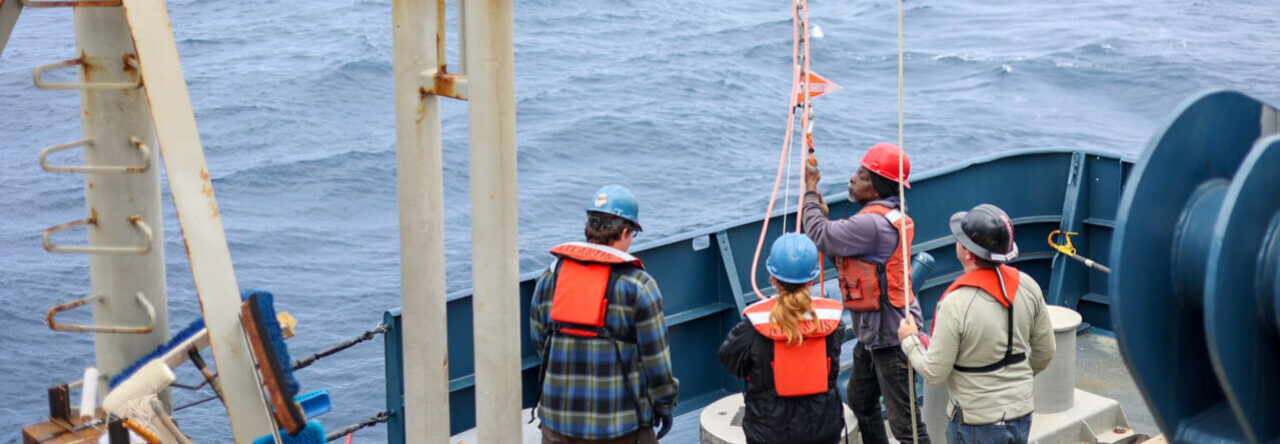
The trip down the river to Portland takes around 10 hours, so me and Ethan were able to get some more stuff ready for the shipyard. One of the ship’s main winches is getting a new cable, so we had to rotate one of the other winches into a new position so that there is enough room for the respooling job. The winches have a cool design feature that allows them to rotate so they can be used by different cranes/booms as needed, and all it takes is some elbow grease and Dawn dish soap. It wasn’t easy, but for a multi-ton hunk of steel, it moved way more smoothly than I anticipated. While doing that, I got to learn a lot about the winches, how they work, and how the ship operates them, which was really cool. It’s a side of engineering that I’ve never explored much before, and I’m excited to continue it when we replace the cable on the other winch. 

Late last night is when we finally reached the pier, and I think I’ve already covered how that went. We’ll be on the pier until Monday, which is when the ship goes into the drydock. We get to stay onboard for the drydocking, which I didn’t expect. Everyone says it’ll be pretty uneventful but I’m still excited for it. 

First Week(kind of): Alaska

So just to start, I say that this blog is only kind of about my first week because it only started yesterday. However, that being said, I’ve already learned so much that I never knew before that I feel like I’ve been here for much longer than I have. Also, the ship is setting sail tomorrow for Portland, so I think this is a good time to post an update. 

I spent Tuesday travelling to Seward. In total, it took me around 15 hours, which isnt bad considering how many flights are getting canceled or delayed around now. When we finally got to Seward, and it was pitch dark and freezing cold, I thought I had mentally prepared myself to a sufficient degree – I was wrong, but at least the ship is warm inside. 

Today was the first day that I was working on the ship. For the first half of the day, I was just getting acquainted with all the spaces onboard, what all the safety plans were, and what life on the ship usually looks like. The second half of the day is where it really picked up. I’m working with the marine technicians for my internship, and its our responsibility to look after all of the ships science equipment, like the winches, the sensors, and all the labs. My supervisor, Ethan, walked me all around the ship and went over everything that was important to us as marine techs. It was a little overwhelming, but I learned so much that I never knew before. Research vessels have so much more going on under the surface than I ever imagined, and it was incredible to pick Ethan’s brain about every little system that we talked about. For example, we spent a while looking at a seawater collection system for the vessel. It constantly collects seawater to analyze its temperature, chemistry, gas content, etc. as the vessel travels. Looking back, it’s clear why a ship with scientific missions would do that, but I never thought about something like it. Another important thing we did was to lower the centerboard in preparation for leaving port tommorrow. It sounds easier than it was; the centerboard on the Sikuliaq is a 15-ton movable keel that holds a number of different acoustic sensors. It exists so the ship can collect data from water not disturbed by the turbulence along the ship’s hull while in transit. Before we put in the water, Ethan showed me what it looked like from the underside, and explained what all the different instruments were for. It was a really cool thing to see, and also something I never would have thought about if I weren’t on the ship this winter. Once the ship is out of the water, we’ll also have a rare opportunity to look at the sensors mounted to the outside of the hull. I cant wait to start working on those.

Tomorrow, the ship is heading to Vigor shipyard in Portland to go into drydock. The ships azipod thrusters were damaged by ice recently, so the ship needs to come out of the water for the repairs to take place, in addition to the annual maintenace period the ship usually undergoes. While in drydock, the marine techs have a number of important things to get done. The first big task we’re going to do is to replace an old cable with a new fiber-optic cable on one of the deck winches. I’m going to have to learn a lot about fiber-optics and electronics really fast, but I’m excited about the opportunity to do something new like this. 

I’ll post again after we make it to Portland. Everyone says the transit shouldn’t be super busy, but I’m sure I’ll have a lot of stories to share. 

Pre-Internship Intro Blog

Hi Everyone!

My Name is Miguel Sanchez, and I am very excited to start my internship aboard the R/V Sikuliaq. For my internship, I will be assisting the marine technicians as the ship undergoes maintenance this winter. I am flying up to Alaska next week, where we will spend several weeks overhauling the ship. Eventually, we will sail to Oregon, where my internship will end.

A bit about me: I am an undergraduate student at Webb Institute in Glen Cove, New York. I, like everyone else at my school, am double majoring in Naval Architecture and Marine Engineering. As part of the curriculum, my school has every student do an internship somewhere in the marine world every winter. After four years, these opportunities will have given us valuable experience and knowledge about the practical application of what we learn in the classroom. For example, last winter, I worked at General Dynamic’s NASSCO San Diego shipyard as a pipefitter. After I graduate, I am interested in designing research vessels, which is what made me interested in the MATE internship. I wanted to experience what it was like work on and operate an active research vessel, and MATE’s program seemed perfect for that. My experience working with the marine technicians will be invaluable going forward as a ship designer. 

I am really looking forward to this internship, and I am excited to be able to share my stories with you all. 

See you soon!

Conclusions on the R/V Sikuliaq

And so, my time on the Sikuliaq comes to a close. Many CTD lines and supersucker attempts later, we’re done collecting data.Since we got done early, we were able to set up an ice station off of the Wainwright line. After a day of searching, we found a piece of sea ice that was large enough to be stable. Paul, our boson, drove the landing craft to get to it. We drilled and sawed into the ice to take samples and see if there was any ice algae. Afterwards, we shuttled groups of crew and science back and forth to let everyone get out on the ice. I got in a snowball fight, made snow angels with some crew friends and generally had a good time out on the ice. Afterwards, we got a speedy boat ride back through the sea ice. Nothing as  exhilarating as zooming through and around sea ice in a small boat in the Arctic!

We also were able to visit Point Hope, a small Alaskan Native village, for a day. We got to see the ceremonial whale burial grounds, and stopped in the town hall and grocery store. Afterwards, I walked around the north side of town for some alone time and a great view of the Brooks range. Those were some really gorgeous mountains. We took the landing craft back to the ship and set off again!

The ship navigated some choppy waters back through the Bering Strait. We anchored off shore near Teller to weather the storm. The next day, we finally docked in Nome and went to go celebrate a good cruise. It’s been a good time; I’ve learned a lot about CTDs, coring, nitrogen fixation and primary productivity, the Arctic, maritime life, how rigorous science is, and what it means to be a marine technician. I learned a lot about this cruise’s experiments, the ship’s seawater system, sonars, pco2 monitoring system and other underways. I also got to see the glider and super sucker and learn about both of them. I learned about deck ops and the AON morning. I got to help with sampling and even learned some about engineering. Interning has also taught me how to be more proactive, communicate professionally and work in a team. I mostly like the biological aspects and the technical aspects, and could be interested in specializing in one or both. I could be really interested in deep sea work, which would be very biological and technical. I’m also interested in doing work that’s more people oriented, working with local communities or front-line communities, perhaps implementing traditional knowledge or working with them on climate justice issues. All in all, this was a great internship to take right after school. It taught me about professionalism and oceanography, exposed me to marine careers, and gave me a better idea of what I want to do. But for now, I’m off to venture around Alaska!

P.S. I’ll put up one more photo blog. Stay tuned for pics! 🙂

Sheets and Ice Sheets: Taking the Plunge

Hey there!

This week, we’ve gone through lots of sea ice as we sail through the Arctic, to the north of Barrow and Wainwright. The Arctic Ocean views have been really gorgeous and tranquil, with the water’s surface as still and smooth as glass, reflecting the oh-so-blue sky. We’ve also gotten to see polar bears, a whole walrus colony, and a few auroras! 

With all this sea ice, the ship has been going a maximum of 2-3 knots, meaning there is more time between CTD stations.This week, I’ve learned to plot points in the Olex system, which helps us know our time to station. I’ve also relearned how to tie a bowline and a sheet bend. Sheets are ropes, or lines on a boat.

After getting through the ice, we’ve finally been able to start coring and using the supersucker. I really enjoy using the multi-corer because our camera system allows us to see what’s on the bottom. The multi-corer is also more hands-on than our CTD. It’s been fun to hop on the buddy lines, and use poles and hooks to safely deploy and recover the multi-corer.

I’ve also gotten to cut cores and sample water with Miguel Goni, a professor at Oregon State University, and his students. It’s been nice to be involved in science as well as science tech, particularly as someone interested in pursuing oceanography in graduate school. I’ve also gotten more involved this week overall. I finally got to operate the CTD, meaning that I got to direct the winch operator and tell them how deep to send the CTD, where to wait, etc. I think I was too laidback the first week, so other people got to operate the CTD and handle lines. I’ve realized that I just need to jump in more and ask to do things, rather than being shy and letting other people take the lead. Gotta take that plunge!

We’ve been sampling lots of lines: the Wainwright, Barrow, DB06 and DB04 lines, which means lots and lots of CTDs and a good bit of coring. The marine techs keep pulling intense hours, then resting when we tow the super sucker. The super sucker has to be towed continuously for 24 hours, so we can’t stop do CTDs or multi-core. This gives science a nice break, as there’s no water to process, and no cores to cut.

We’ve mostly been doing shallow water casts – 40 to 50 meters, but we also got to do some deep casts. These casts ranged from 1000-3900 meters, taking about 1 to 4 hours, respectively. We got to make souvenir cups on the deepest of the casts. We all decorated Styrofoam cups, packed them with paper towels, put them in mesh bags, then tied them onto the CTD rosette frame. We cast the CTD to 3930 meters, then pulled it back up. The cups came back bigger than a thimble, about the size of shot glasses. We all got to keep them for cruise souvenirs.

We also did test runs of the UAF carbon glider. My roommate, Brita, is the lab technician working on the glider project. Gliders are nice because you can launch them and they’ll continuously gather data for up to 4 months. One of the microcomputers on Brita’s glider went down though. We’re going to try launching it again tomorrow. We’ll do small boat ops to launch it. If we’re in the right area, we might also pick up another glider that is currently gliding around the Chukchi Sea to the North of us.

We’re at the midpoint of the cruise. I want to check in with the two marine techs for mid-internship feedback. I’ve also continued to appreciate the company of both science and crew. We’ve all gotten into a nice rhythm, and ops and data are flowing nicely. I’ve definitely made some great friends on the ship so far. Time on the R/V Sikuliaq is going far too quickly, if anything.

CTDs, Sea Ice and Polar Bears

Hey there all!

After being in port in Nome, seeing some Northern Lights, swimming in the Bering Sea, moving lots of equipment onboard and singing karaoke with science and new crew, we’re finally underway! It’s been really nice to be cruising this week and getting into the flow of things.

The first couple days were mostly transiting, with some CTD (Conductivity Temperature Depth) casts and preparing an AON (Arctic Observation Network) mooring. We went through the Bering Strait, past the Chukchi Sea and into the Beaufort. At our max, we hit about 72.5 degrees North. We lost internet right as we went into the Arctic Circle. Due to our heading, our mainstay blocks our satellite dish at a very specific angle. You’re reading this because it’s gone back up though, intermittently at least. It’s actually been nice getting away from the internet though.

In the past week, I’ve learned to prepare, check, operate and clean a CTD. I’ve learned how we process CTD data and utilize that to reset our sound velocity profile. Knowing the speed of sound at a particular site is important because it helps us recalibrate our multi-beam sonar. Our TOPAS system and multi-beam sonar are used to map both the bathymetry of the sea floor, and the substrate beneath it. These both operate whenever we’re underway, helping add to worldwide knowledge of the seafloor, one cruise at a time.

I also got to help recover and deploy this Arctic Observation Network mooring. Moorings like this are used to monitor temperature, salinity and other environmental conditions in a location over a long period of time. This helps scientists track climate change or other continued patterns in an area over time. In the Arctic and off the Alaskan coasts for example, scientists are doing research into what role increased glacial melt plays in the ecosystem. In recent years, there has been a coccolithophore bloom off the Alaskan coast, turning the normally dark blue Bering Sea a pale shade of turquoise with their calcium carbonate shells. As we passed through the Bering Sea, we were actually able to observe this, registering an increased amount of carbon at that micron size and seeing the clear blue turquoise of this bloom. Our research ties into this, monitoring nitrogen fixation and primary productivity of the Arctic. This helps us to gauge the Arctic’s importance in fixing carbon and nitrogen, and what the Arctic ecosystem’s role is globally.

In other cool things, the AON mooring also had an ADCP (Acoustic Doppler Current Profiler) and an Aural whale recorder. Although tricky at times, it was really cool to work with the deck crew to both recover and deploy the AON mooring. We worked together in the stormy Arctic weather to get everything in and out safely. After that, science, science tech and ABs (able-bodied sailors) have come together to make CTD casts happen 24 hours a day for the next 3 days. I really enjoy how the boat pulls together for these operations, it makes the boat community that much more tight. All in all, it’s been really great learning a lot this week, finding my niche and becoming a part of the R/V Sikuliaq family.

Transiting on the R/V Sikuliaq!

Hey there!
This is Kristie Okimoto, the final MATE Summer Intern! I’m on the R/V Sikuliaq, also headed up to the Arctic. We are somewhere in the Bering Sea at the moment! Tomorrow, we’re docking in Nome, and will be loading equipment, food and fuel for the upcoming cruise.

The transit from Seward to Nome has gone pretty smoothly. This week has mostly been an orientation week of sorts. The science party has gotten safety talks, an engine room tour and done fire and abandon ship drills. Ethan, one of my two mentors on the ship, showed me around some of the ship systems I’ll be helping to maintain. We looked at the ship multibeam sonar, the TOPAS system, the pCO2 system and the seawater inflow system. These systems operate at all times on the ship, gathering data whenever the system is underway.

As the upcoming cruise will be researching nitrogen fixation and primary productivity of waters in the Arctic, the seawater inflow system will be super important. Scientists will continuously measure the nutrients and gasses of this seawater. The researchers will also utilize a CTD (conductivity, temperature, depth) rosette and an ADCP (acoustic doppler current profiler) to help gauge nutrients throughout the water column and to help gauge the related currents. As marine technicians, we will be supporting all of these instruments.

I am excited for the actual research cruise to get underway! All in all, I have really enjoyed being at sea so far. There really is something amazing about being surrounded by a vast expanse of blue, blue water on all sides. Alaska was also really beautiful! Well, onward to Nome, and then onto the Juranek cruise!

Pre-Internship on the R/V Sikuliaq!

Hi there!
I’m Kristie Okimoto, a recently graduated senior from University of California Berkeley. At Berkeley, I studied Conservation and Resource Studies with concentrations in Anti-Oppression, Decolonial Thought and Oceanography.

I applied to MATE Summer because I’m possibly interested in pursuing oceanography in graduate school. I’m also interested in doing culturally appropriate marine conservation, that is community based and better implements traditional knowledge, rather than using the western colonial conservation model. I’m also very interested in climate justice work, as low income communities and communities of color will be among those most affected by climate change.

When applying, I thought we’d probably be doing a cruise off of California, or possibly the South Pacific if I was lucky. When I was offered a cruise position to the Arctic, it was an unexpected surprise! The Arctic was not somewhere I’d think to visit, or do research in by myself, so I am very glad for the opportunity to go do work there.

At the moment, I am wrapping up my time at home, and trying to pack for the Bay Area, the Arctic and South America all in one. I’ll be visiting friends in the Bay Area and wrapping up ends there before my internship, and traveling with a friend around South America for a bit after the internship. Needless to say, the clothing in my bag is super varied, haha!

Well, off to go pack more. Tchau for now!

R/V Sikuliaq Cruise Report

Due to intermittent and limited bandwidth Internet connection, I have saved my entire two week cruise report for this single post. This post will be broken up into various dated sections where I will describe what I did during that time period. Although this was quite a short cruise, I was still able to experience quite a lot and this has been one of the best times of my life.


June 27-28
These first two days the ship is still in port at Victoria. I have spent these two days getting a feel for the ship and meeting the crew and scientists. This is by far the largest ship I have ever sailed on, this boat has everything you could ever need for weeks at sea. On this cruise we will be using the Jason ROV so I got a chance to check out the hardware and meet with the support staff. The goal of this cruise is to insert a seismic sensor into a pre-drilled borehole. This sensor will allow scientists to detect the small movements between tectonic plates which could be used to predict earthquakes. All of the scientists and crew have arrived by the 28th and we are ready to set sail early the morning of the 29th.

The Jason ROV


June 29-July 1
We have arrived on our first station. In order for the borehole sensor to get power and transmit data it must be connected to an underwater junction box via a pre-laid cable. Unfortunately during testing on a previous cruise it was discovered that the cable between the borehole and junction box is not functioning correctly. In an attempt to fix this we are lowering a cable spool near the junction box and will later use Jason to unspool and connect the cable. We deployed this spool at night and heavy winds made the process quite difficult. Finally, after the third attempt the spool was lowered to the bottom. This concludes our operations at this station for now, we will return after installing the sensor in the borehole to begin unspolling cable.

After laying the spool we have moved to the borehole location. In order for Jason to be able to move the borehole sensor into position it must be made to be close to neutrally buoyant. In order to accomplish this we have attached a metal ring with a bunch of green floats attached by string. Once the sensor is moved into position these strings will be cut and the sensor will fall into place. We have also attached several yellow glass spheres on a quick release for additional buoyancy.

On the eve of June 30th and into the morning of July 1 the borehole sensor was successfully installed into the hole. This operation took several hours but the sensor was finally installed according to plan. Jason had to move up and down the line several times to cutoff floats until the sensor finally descended into the hole. Following this Jason hooked up the the sensor for a 4 hour data monitoring session.

The Cable Spool

The Borehole Sensor With Floats

Inserting The Borehole Sensor

July 2
Today I deployed my first XBT and CTD. Prior to this cruise I had done several CTD’s but I have never used an XBT. An XBT allows for the science techs to measure the speed of sound to be used in sonar calibration. The speed of sound varies slightly based on depth so it is important to keep an accurate number. Both deployments went perfectly. 

Today I also started a project to put two orange lights in the ship hanger. Currently the ship has no running lights when the winches are active which is a safety concern. Thankfully the ship builders left plenty of wire run between the various rooms of the ship that we were able to use so installation wasn’t that big of a deal. This ship uses special thermal expanding blocks on every bulkhead to ensure fires don’t spread between rooms. This makes it slightly harder to run cable between rooms but I worked through it.

One Of The Hanager Lights I Installed

July 3
Today we moved back to the spool and were deploying Jason to begin unspooling. Unfortunately during deployment the weather picked up and Jason got his tether kinked. This kicked off a 12 hour repair that would lead us to eventually abort the unspolling. While Jason was being repaired there really wasn’t much to do around the ship, I finished up a few wiring diagrams for the light project and waited.

July 6
After finally repairing and testing Jason we were forced to wait until the 6th for suitable weather. By this time in order to make it back to port in time we deployed Jason and recovered the spool. Once the spool was recovered we headed back to port to finish the cruise. Even though we were unable to connect the sensor the data we collected during the 4 hour test indicated that everything is working ocrrectly and there is hope that the unit will be fully connected within the year.

Coming Into The Seattle Lock


Overall this was an amazing experience and I loved every minute of it. The hours were long and the work wasn’t easy but I am extremely happy that I did this cruise. This has been one of the best trips of my life and I look forward to continuing my career into ocean sciences.

Page 4 of 5

Powered by WordPress & Theme by Anders Norén